

Why Iron Deficiency Triggers Hair Loss and What Recovery Actually Looks Like
You are watching more hair circle the shower drain each morning, and a quick search leads you to one burning question: does iron deficiency cause hair loss? The short answer is yes. Iron fuels hemoglobin production, which carries oxygen to every cell in your body, including the rapidly dividing cells inside hair follicles. When iron stores drop, your body redirects resources away from non-essential functions like hair growth, pushing follicles prematurely into the resting (telogen) phase. The result is a condition dermatologists call telogen effluvium, characterized by diffuse shedding that can feel alarming.
The Iron-Hair Connection Most People Misunderstand
Does low iron cause hair loss on its own, or is something else going on? Research shows that iron is directly involved in DNA synthesis within the hair follicle bulge region, regulating genes critical to the growth cycle. A cross-sectional study of 193 telogen effluvium patients found their average serum ferritin was just 24.27 ng/mL, significantly lower than the 45.55 ng/mL average in healthy controls. So yes, low iron hair loss is a well-documented phenomenon. Can low iron cause thinning hair even when lab results say you are technically "normal"? Absolutely. Many people fall within standard reference ranges yet remain far below the threshold where hair thrives.
Why This Timeline Question Matters for Your Recovery
Understanding how long iron tablets take to stop hair loss requires separating two very different outcomes. Most articles lump them together, leaving readers confused about what progress actually looks like. Here is the distinction that changes everything:
Stopping active shedding and regrowing lost hair operate on separate timelines. Shedding typically slows months before any new growth becomes visible to the eye.
Could low iron cause hair loss that takes a year to fully reverse? In many cases, yes. Iron tablets and hair loss recovery involve a biological sequence: first, replenishing depleted stores so follicles can exit the telogen phase, and second, waiting for new strands to grow long enough to notice. Conflating these two milestones is the single biggest source of frustration for people mid-recovery.
This article maps both timelines with realistic, evidence-based expectations so you know exactly what to watch for at each stage.
Two Separate Timelines You Need to Track
Most people searching for how long do iron tablets take to work expect a single answer. One number. One finish line. The reality is more nuanced, and understanding it can save you months of unnecessary worry. There are two distinct biological events happening inside your scalp, each on its own clock. Tracking them separately is the difference between feeling hopeful and feeling defeated.
Timeline One — When Shedding Slows Down
The first milestone is the one you will feel before you see it: fewer hairs falling out. How long does it take for iron pills to work at this level? Typically two to four months of consistent supplementation.
Here is why. When iron stores begin rising, your body no longer needs to ration oxygen delivery away from hair follicles. Follicles that were pushed into the telogen (resting) phase receive the signal that resources are available again. They stop releasing their hair shafts prematurely. Clinical data supports this window. A real-life observational study of 200 women with telogen effluvium found that patients supplementing iron for three months were significantly more likely to report satisfaction compared to those who only took it for one month, where 76.5% remained unsatisfied. Research on intermittent iron therapy also shows measurable shedding reduction within four to eight weeks of starting treatment.
During this phase, your ferritin levels are climbing, follicles are transitioning out of telogen, and the daily hair count in your brush gradually drops. You will not look different in the mirror yet, but the internal shift is already underway.
Timeline Two — When New Growth Becomes Visible
Stopping the fall is only half the story. How long do iron supplements take to work before you actually see regrowth? That second timeline stretches to six to twelve months, sometimes longer.
The biology explains the delay. Once a follicle re-enters the anagen (growth) phase, the new hair shaft grows at roughly one centimeter per month. A strand needs to reach two to three centimeters before it is visible against your existing hair. Baby hairs typically appear at the hairline and part line around month three or four, but meaningful density, the kind other people notice, takes six to nine months to fill in. Full texture and thickness recovery can extend past the one-year mark.
This gap between how long for iron tablets to take effect on shedding versus how long does it take iron pills to take effect on visible density is the single biggest source of discouragement. People quit supplementation during the silent middle months, thinking nothing is happening. In reality, their follicles are actively building new strands beneath the scalp surface.
The table below maps both timelines side by side so you can track your progress against realistic milestones:
| Timeframe | Timeline 1: Shedding Reduction | Timeline 2: Visible Regrowth |
|---|---|---|
| Weeks 1-4 | Ferritin levels begin rising; no change in shedding yet | No visible changes; follicles still in telogen |
| Month 2-3 | Fewer hairs in shower drain and brush; shedding rate drops noticeably | Follicles re-entering anagen phase beneath the surface |
| Month 3-4 | Shedding normalizes to under 100 hairs per day | Fine baby hairs may appear at hairline and part line |
| Month 4-6 | Shedding fully stabilized for most people | New growth reaches 2-4 cm; visible as short strands |
| Month 6-9 | Maintained; no excess shedding | Density visibly improving; thinning areas filling in |
| Month 9-12+ | Maintained; hair cycle fully reset | Full density and texture restoration for most cases |
How long will iron tablets take to work overall? The honest answer depends on which outcome you are measuring. If your goal is to stop the alarming daily shedding, you are looking at roughly two to four months. If your goal is to see your hair look and feel the way it used to, plan for six to twelve months of patience. How long do iron pills take to work is not one question but two, and separating them gives you a realistic roadmap instead of vague hope.
Your starting ferritin level, the severity of your deficiency, and how well your body absorbs the supplement all influence where you land within these ranges. Those variables deserve their own closer look.
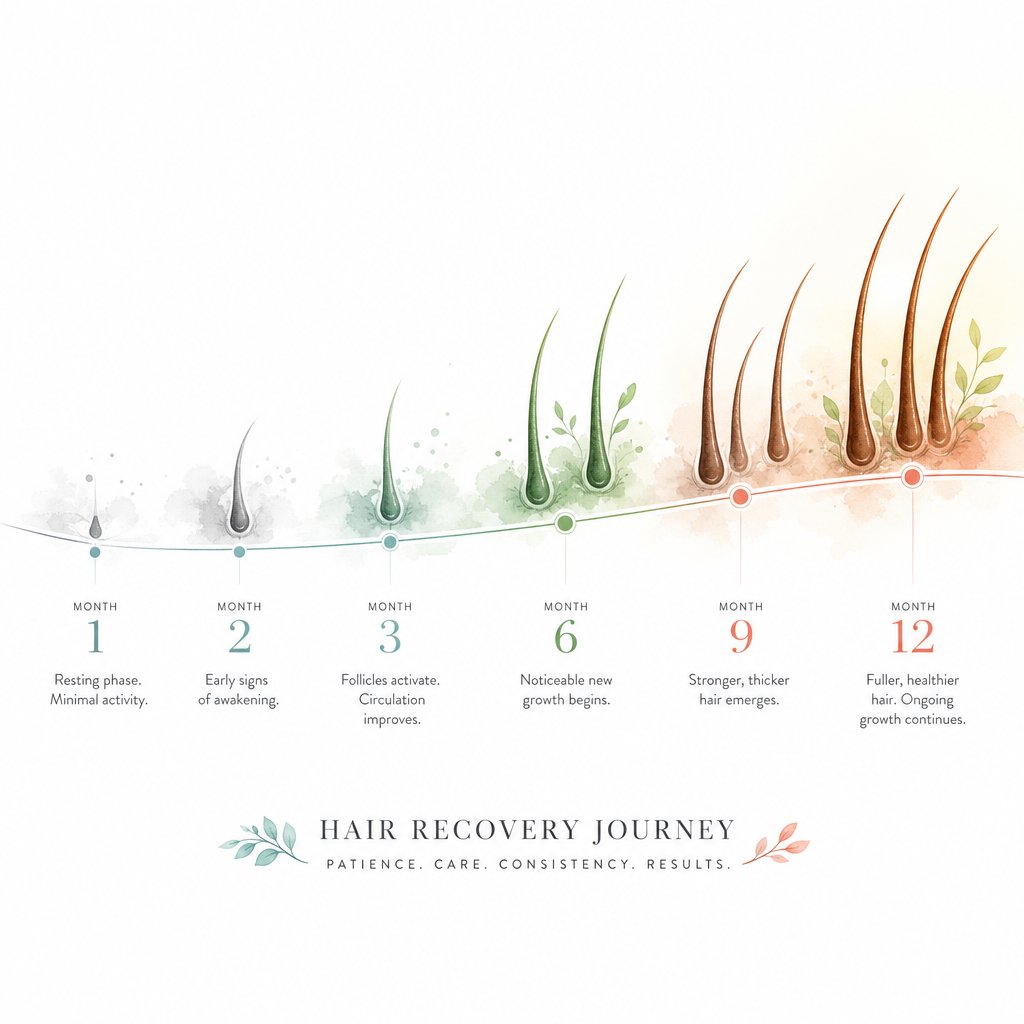
Month-by-Month Recovery Timeline After Starting Iron Tablets
Knowing that two timelines exist is one thing. Living through them week by week is another. The hardest part of iron supplements for hair growth is the silence at the beginning, those early weeks when your blood chemistry is shifting but your mirror shows nothing different. A detailed month-by-month map removes the guesswork and gives you concrete markers to watch for at every stage.
What Happens in the First Month
You have started your iron tablets. Maybe you are feeling hopeful, maybe skeptical. Either way, here is what is actually happening inside your body during weeks one through four:
- Weeks 1-2: Serum iron responds first. Your bloodstream iron levels begin rising within days of starting supplementation. Clinical data shows that even 50 mg of elemental iron daily produces measurable gains within six weeks, but the earliest biochemical shifts start much sooner. Hemoglobin production ramps up, and oxygen delivery to tissues gradually improves.
- Weeks 2-4: Ferritin begins its slow climb. Unlike serum iron, ferritin reflects stored iron, and it moves at a different pace. Most people see a rise of 10-20 ng/mL after about eight weeks of daily 60-100 mg elemental iron. During this first month, the increase is modest but real.
- Hair follicles: still in telogen. This is the frustrating truth. Your follicles do not respond instantly to improved iron availability. Those already in the resting phase need to complete their natural cycle before re-entering growth. Shedding continues at roughly the same rate.
The first month is about internal repair, not external results. Your blood is changing even when your hair is not.
How long does it take for iron supplements to work at a level you can actually feel? Many people notice improved energy, less breathlessness, and stronger nails before any hair changes appear. These early body signals confirm that absorption is happening and iron stores are rebuilding. If you are tracking progress, these non-hair improvements are your first green lights.
The Three-to-Six Month Turning Point
This is where the recovery story gets interesting. Between months two and six, both timelines begin producing tangible evidence that iron tablets and hair growth are connected in your specific case.
- Month 2-3: Shedding rate drops. Follicles that were pushed into telogen by low iron begin receiving the signal that resources are available again. You will notice fewer hairs in the shower drain, less accumulation on your pillow, and a lighter brush after styling. The daily count may drop from 150-200+ hairs to something closer to the normal range of 50-100. This reduction is gradual, not sudden, so tracking over weeks gives a clearer picture than comparing individual days.
- Month 3-4: Shedding normalizes and early regrowth appears. For many people, this is the first moment of genuine relief. The excessive fall has stopped. At the same time, dormant follicles are re-entering the anagen phase beneath the scalp surface. Fine baby hairs, often shorter and slightly different in texture, may appear near the hairline, temples, or along the part line. These new strands are thin and soft initially, sometimes only visible in certain lighting or when you pull your hair back.
- Month 4-6: New growth becomes visible to others. Iron for hair growth reaches its most rewarding phase here. Those baby hairs from month three are now 2-4 centimeters long. They start blending with your existing hair, adding volume and reducing the appearance of thinning. Hair texture often improves as well, with less brittleness and more shine. The new growth may initially feel different, slightly wiry or finer than your usual strands, but this normalizes as the follicle fully recovers its strength.
How long for iron supplements to work at this visible level depends heavily on your starting ferritin. Someone beginning at 25 ng/mL may hit this turning point faster than someone who started at 8 ng/mL. But the biological sequence remains the same regardless of severity: replenish stores, stop shedding, then grow new hair.
Six Months and Beyond — Visible Density Returns
The six-month mark is where iron supplements hair regrowth becomes undeniable for most people who have been consistent with their supplementation.
- Month 6-9: Density noticeably improves. Thinning areas begin filling in. Ponytails feel thicker. The scalp is less visible through the hair. New strands have reached 6-9 centimeters and are contributing meaningfully to overall volume. Before and after iron deficiency anemia hair loss photos taken at this stage typically show the most dramatic contrast with baseline images.
- Month 9-12: Full texture and thickness restoration. For moderate deficiencies, this is the finish line. Hair has completed at least one full growth cycle under adequate iron conditions. The strands are stronger, the growth rate has normalized, and shedding remains within healthy limits. Your hair cycle has essentially reset.
- Month 12+: Maintenance phase. Severe deficiencies or cases complicated by other factors may still be improving past the one-year mark. Continued supplementation, guided by ferritin monitoring every three months, ensures stores remain above the 70 ng/mL threshold that research links to optimal hair follicle function.
A practical note on managing expectations during this journey: the period between weeks one and eight is often called the "silent phase" because nothing visible is changing. This is where most people lose confidence and consider stopping. Knowing that iron supplements for hair growth operate on a biological delay, not a failure of the supplement, helps you stay the course. Track your energy levels, nail strength, and daily hair count rather than staring at the mirror during those early weeks.
One more thing worth noting: this timeline assumes consistent daily supplementation with adequate absorption. If your body is not absorbing iron efficiently, or if your deficiency is more severe than average, these milestones shift later. The depth of your starting deficiency shapes the entire recovery curve.
How Deficiency Severity Changes Your Recovery Timeline
Your starting ferritin number is essentially the distance marker on a recovery map. Someone beginning at 28 ng/mL is running a different race than someone starting at 7 ng/mL, even though both experience iron deficiency hair thinning. The deeper the deficit, the longer your body needs to rebuild stores before follicles can resume normal cycling. Understanding where you fall on this spectrum sets realistic expectations and prevents premature discouragement.
Mild Deficiency — The Fastest Recovery Window
If your ferritin sits between 20-30 ng/mL, you are dealing with a mild depletion. Your iron stores are low enough to disrupt hair follicle function but not so depleted that recovery requires extensive rebuilding. In this scenario, low ferritin and hair loss typically respond within two to three months of consistent supplementation. Shedding often slows by week six to eight, and early regrowth signs appear around month three to four.
Why the faster turnaround? Your body does not need to fill a massive storage gap. A relatively modest increase of 20-30 ng/mL brings ferritin into the range where follicles receive adequate iron for DNA synthesis and oxygen transport. Many people in this category notice improved energy and nail strength within the first few weeks, followed by a gradual decline in daily hair fall.
Moderate to Severe Deficiency — Why Patience Is Essential
Moderate deficiency (ferritin 10-20 ng/mL) and severe deficiency or frank anemia (ferritin below 10 ng/mL) demand significantly more patience. Can anemia cause hair thinning that takes a full year to reverse? Yes, and here is why.
When ferritin drops into single digits, your body has been rationing iron away from hair follicles for months, sometimes years. Anemia hair loss at this level often involves a higher percentage of follicles stuck in telogen, meaning more strands need to cycle back into growth. The storage deficit is also larger, requiring sustained supplementation just to reach the threshold where follicles begin responding. Anemia and hair loss recovery in severe cases typically follows this pattern: shedding reduction at four to six months, visible regrowth at eight to twelve months, and full density restoration potentially extending past twelve months.
The table below maps expected timelines based on your starting severity:
| Severity Level | Ferritin Range | Timeline to Reduced Shedding | Timeline to Visible Regrowth |
|---|---|---|---|
| Mild deficiency | 20-30 ng/mL | 6-10 weeks | 3-5 months |
| Moderate deficiency | 10-20 ng/mL | 3-4 months | 6-9 months |
| Severe deficiency / anemia | Below 10 ng/mL | 4-6 months | 9-12+ months |
| Lab-normal but suboptimal | 12-30 ng/mL (reported as "normal") | 6-12 weeks | 3-6 months |
When Lab-Normal Ferritin Still Causes Hair Loss
This is the scenario that generates the most frustration. You get blood work done, your doctor says everything looks fine, yet your hair keeps falling. Does low ferritin cause hair loss even when results fall within the standard reference range? The evidence strongly suggests it does.
Most laboratories flag ferritin as "low" only when it drops below 12-15 ng/mL. But dermatologists specializing in hair loss generally consider ferritin below 40-70 ng/mL insufficient for healthy hair growth. A ferritin of 18 ng/mL will not trigger an alert on your lab report, yet it may be the primary driver of your shedding. Hair loss specialist Dr. Jeff Donovan notes that while many people function fine with ferritin in the low 30s, as levels dip below 26 ng/mL it becomes increasingly likely that iron supplementation will help hair recovery.
Low ferritin hair loss in the "normal but suboptimal" range often responds well to supplementation, with timelines similar to mild deficiency. The challenge is getting the diagnosis in the first place. If your ferritin is between 12-30 ng/mL and you are experiencing diffuse thinning, it is worth discussing iron deficiency for hair loss with a dermatologist rather than accepting a blanket "your levels are fine" from a general practitioner who may not be using hair-specific thresholds.
The takeaway: severity dictates pace, but it does not dictate outcome. Whether your recovery takes three months or twelve, the biological process remains the same. What changes is how efficiently your body absorbs and utilizes the iron you are giving it, and that efficiency depends on several factors beyond the tablet itself.

Factors That Speed Up or Slow Down Your Results
Two people can start the same iron tablet on the same day and see completely different outcomes three months later. How long does iron supplements take to work is not just a question of dosage or starting ferritin. It is a question of what your body actually does with the iron once it hits your digestive tract. Several variables determine whether that tablet translates into rising ferritin and recovering follicles, or passes through with minimal impact.
Absorption Boosters and Blockers That Change Everything
Iron absorption happens primarily in the duodenum and upper jejunum, and the environment you create around your supplement dramatically affects how much iron actually enters your bloodstream. Vitamin C is the single most powerful absorption enhancer for non-heme iron. It acts as a reducing agent, converting ferric iron into the ferrous form your intestinal cells can absorb. Taking your iron tablet with a glass of orange juice or a vitamin C supplement can increase uptake by two to three times.
On the other side, several common substances actively block absorption. Tannins in tea and coffee, calcium in dairy products, and phytates found in whole grains and legumes all bind to iron and reduce bioavailability. Timing matters enormously here. Taking iron on an empty stomach, ideally 30-60 minutes before a meal, maximizes absorption. Taking it alongside your morning coffee or calcium supplement can cut effectiveness in half.
Here is a quick breakdown of what accelerates or delays your progress:
Factors that speed up results:
- Taking iron with vitamin C (citrus juice, bell peppers, strawberries)
- Supplementing on an empty stomach or between meals
- Choosing highly bioavailable forms (ferrous sulfate, heme iron polypeptide)
- Spacing iron away from tea, coffee, and dairy by at least two hours
- Addressing concurrent deficiencies (vitamin D, B12, zinc) simultaneously
- Consistent daily supplementation without skipping doses
Factors that slow down results:
- Taking iron with calcium supplements or dairy products
- Drinking tea or coffee within one hour of your dose
- Ongoing blood loss from heavy menstrual periods or GI bleeding
- Poor gut health or conditions that impair absorption (celiac disease, IBD, gastric bypass)
- Untreated concurrent deficiencies that independently cause hair loss
- Inconsistent supplementation or frequent missed doses
Concurrent Deficiencies That Slow Your Progress
Iron rarely works alone when it comes to hair health. Vitamin D, zinc, vitamin B12, and vitamin C all play independent roles in the hair growth cycle. Zinc is involved in keratin synthesis, the protein that gives hair its structure and resistance. Vitamin B12 supports the normal functioning of hair follicle cells. Vitamin D deficiency can aggravate telogen effluvium, particularly in autumn and winter months. If any of these are simultaneously low, iron supplementation alone may produce slower or incomplete results. How long before iron pills work depends partly on whether iron is the only missing piece or one of several.
This is why comprehensive blood work matters. Testing ferritin alongside vitamin D, B12, zinc, and thyroid markers gives you the full picture. Addressing all deficiencies together shortens the overall recovery timeline compared to tackling them one at a time.
Why Gut Health Determines How Fast Iron Works
How quickly do iron pills work if your gut cannot absorb them properly? Much more slowly than expected. Research shows that gut microbiota directly influence iron regulation, affecting how intestinal cells store and transport iron into the bloodstream. Conditions like celiac disease, inflammatory bowel disease, or even chronic low-grade gut inflammation can reduce absorption by 25% or more. Germ-free animal studies demonstrate that without healthy gut bacteria, intestinal cells display very low iron stocks and reduced transport capacity.
How long does it take iron supplements to work when gut health is compromised? Potentially twice as long. If you have been supplementing for months without ferritin improvement, gut absorption issues deserve investigation. Your doctor may recommend testing for celiac antibodies, checking for H. pylori infection, or considering whether an alternative delivery method like liquid iron or even IV iron is warranted.
How long to take iron supplements also depends on ongoing losses. Women with heavy menstrual periods lose significantly more iron each month than they can replace through standard oral doses. Undiagnosed GI bleeding from ulcers or polyps creates the same problem. In these cases, how long does an iron supplement take to work stretches indefinitely until the underlying loss is addressed. You are essentially trying to fill a bucket with a hole in it.
The practical takeaway: iron supplements for hair health work best when absorption is optimized, competing deficiencies are corrected, gut function is intact, and ongoing losses are controlled. Addressing these variables can mean the difference between seeing results at month three versus still waiting at month eight. The type of iron supplement you choose also plays a significant role in this equation.

Comparing Iron Supplement Types for Hair Recovery
Not all iron pills for hair are created equal. The type of iron you choose directly affects how quickly your ferritin rises, how well you tolerate the supplement, and ultimately how fast your follicles respond. Picking the wrong formulation can mean months of stomach discomfort with minimal absorption, while the right one can shave weeks off your recovery timeline.
Ferrous Sulfate vs Fumarate vs Gluconate — Key Differences
Ferrous sulfate is the most widely prescribed iron supplement for hair growth and the one most clinical research is built around. It delivers approximately 65 mg of elemental iron per 325 mg tablet, making it the highest-potency option among standard ferrous salts. Ferrous sulfate how long does it take to work? Clinical trials show hemoglobin increases of 1-2 g/dL within three to four weeks, with ferritin stores rebuilding over three to six months. The tradeoff is tolerability. A systematic review of 43 randomized controlled trials found that ferrous sulfate significantly increases gastrointestinal side effects compared to placebo, with an odds ratio of 2.32. Roughly 50% of patients report symptoms like nausea, constipation, or stomach cramps.
Ferrous fumarate offers similar potency at about 106 mg elemental iron per 325 mg tablet. A retrospective study of 260 anemic patients found that ferrous fumarate raised hemoglobin from 9.87 to 11.72 g/dL over 90 days, comparable to other conventional salts. However, it carried the highest rate of GI side effects in that study, with 30.77% of patients reporting issues like gastric irritation, bloating, and nausea.
Ferrous gluconate contains less elemental iron per dose, around 36 mg per 325 mg tablet. This lower concentration often translates to fewer digestive complaints, making it a reasonable choice for people who cannot tolerate stronger formulations. The downside is that you may need higher or more frequent dosing to achieve the same ferritin gains, potentially extending your timeline.
Newer formulations like ferrous bisglycinate (chelated iron) and Sucrosomial iron offer improved absorption with lower elemental iron content. A clinical study showed Sucrosomial iron at just 30 mg elemental iron produced significantly higher hemoglobin and ferritin improvements than ferrous fumarate at 50 mg, with only 9.23% of patients reporting side effects compared to 30.77% in the fumarate group. Heme iron polypeptide, derived from bovine hemoglobin, uses a separate absorption pathway that bypasses many of the inhibitors affecting standard iron salts. It is better absorbed and gentler on the stomach, though considerably more expensive.
So what qualifies as the best iron tablets for hair loss? It depends on your tolerance and budget. Here is how the main options compare:
| Supplement Type | Elemental Iron per Dose | Relative Absorption | Common Side Effects | Suitability for Hair Recovery |
|---|---|---|---|---|
| Ferrous sulfate | ~65 mg (325 mg tablet) | High (10-15%) | Nausea, constipation, stomach cramps | Excellent potency; best for moderate-severe deficiency if tolerated |
| Ferrous fumarate | ~106 mg (325 mg tablet) | High (10-15%) | Gastric irritation, bloating, nausea | High potency; similar efficacy to sulfate with slightly different side effect profile |
| Ferrous gluconate | ~36 mg (325 mg tablet) | Moderate (10-12%) | Milder GI symptoms | Good for sensitive stomachs; may require longer supplementation |
| Ferrous bisglycinate | ~24-30 mg (typical dose) | High (chelated form) | Minimal GI effects | Strong option; therapeutic equivalence to higher-dose sulfate reported |
| Sucrosomial iron | ~30 mg (typical dose) | Very high (DMT-1 independent) | Very low incidence | Excellent; highest ferritin gains per mg with fewest side effects |
| Heme iron polypeptide | ~12 mg (typical dose) | High (heme pathway) | Minimal | Good absorption; limited data specific to hair outcomes |
How Supplement Format Affects Absorption and Compliance
Beyond the iron salt itself, the delivery format matters more than most people realize. Standard tablets are the most common and least expensive, but they dissolve in the stomach where iron can irritate the gastric lining. Capsules, particularly enteric-coated versions, aim to release iron further down the digestive tract. However, research raises concerns about enteric-coated formulations because iron absorption is optimal in the duodenum and upper jejunum. Delayed release past these zones may actually reduce bioavailability.
Liquid iron supplements offer easier dose adjustment and faster initial absorption, making them useful for people who struggle with tablets or need gentler dosing. Gummy formats have gained popularity for their palatability, but they typically contain ferric pyrophosphate at lower doses, making them better suited for maintenance than aggressive repletion. Oral liquid sprays deliver iron directly to the buccal mucosa, bypassing the GI tract entirely, though at lower doses.
Compliance is the hidden variable in all of this. The best iron supplement for hair loss is ultimately the one you will take consistently for six to twelve months. A highly potent tablet that causes daily nausea and gets abandoned after three weeks delivers zero results. A gentler formulation taken reliably every morning for nine months will rebuild your ferritin and restore your hair. When choosing iron tablets for hair growth, weigh potency against your personal tolerance threshold.
What Brands Should Know About Iron Formulation
For nutrition brands and private label sellers developing iron tablets for hair, the formulation decisions above are not just consumer concerns. They are product development challenges. Choosing between ferrous sulfate, bisglycinate, or Sucrosomial iron as your active ingredient, then pairing it with the right delivery format, determines whether your product actually moves the needle on ferritin levels and customer satisfaction.
The hair health supplement market increasingly demands products that combine iron with synergistic nutrients like vitamin C, biotin, and zinc in formats that minimize side effects. OEM/ODM manufacturing partners like ZhuFeng enable brands to develop customized iron formulations across multiple delivery formats, including hard capsules, tablets, gummies, oral liquids, and powder sachets, with scalable production and flexible minimum orders. This kind of manufacturing flexibility allows brands to optimize bioavailability for specific outcomes like hair regrowth while offering the format variety that modern consumers expect.
Whether you are a consumer choosing the best iron tablets for hair growth or a brand developing the next iron supplement for hair growth, the principle is the same: formulation science determines real-world results. The gap between a product that raises ferritin efficiently and one that sits in a medicine cabinet unused often comes down to how thoughtfully the iron type, dose, and delivery system were matched to the end user's needs.
Choosing the right supplement is a critical first step. But how do you know it is actually working before visible hair changes appear? The early signals are subtler than you might expect.
Signs Your Iron Tablets Are Working Before You See Hair Growth
You have been taking your iron supplement consistently for weeks, maybe months, and your reflection looks the same. Does iron help with hair growth if nothing seems different yet? Here is the thing: your body sends signals that iron stores are rebuilding long before a single new strand becomes visible. Learning to read those signals keeps you motivated during the waiting period and confirms you are on the right track.
Early Body Signs Before Hair Changes Appear
Hair follicles are not the first tissue to benefit from rising iron levels. Your body prioritizes essential functions first, directing newly available iron toward hemoglobin production, oxygen transport, and cellular energy metabolism. That means the earliest signs iron pills are working hair growth show up as general health improvements, not scalp changes.
Within the first two to four weeks, many people notice:
- Improved energy and reduced fatigue. Iron fuels hemoglobin, which carries oxygen to every cell. As levels rise, that persistent exhaustion begins lifting. You may find yourself less winded climbing stairs or more alert in the afternoon.
- Less breathlessness during exercise. If you were getting winded from activities that used to feel easy, improved oxygen delivery is often the first tangible payoff of supplementation.
- Stronger, less brittle nails. Nails and hair share similar keratin-based growth mechanisms. Brittle nails are a recognized symptom of iron deficiency, and they often improve before hair does because nail plates are thinner and respond faster to nutrient changes.
- Warmer hands and feet. Cold extremities result from reduced peripheral circulation when hemoglobin is low. As iron stores rebuild, circulation normalizes.
- Improved concentration and mood. Iron deficiency impairs cognitive function. A subtle mental clarity returning is a legitimate early marker.
These improvements typically appear within two to six weeks of consistent supplementation. Results from iron supplements may occur as early as 14 days, though full replenishment takes a minimum of three months. If you are noticing better energy and stronger nails but no hair changes yet, that is exactly the expected sequence. Your body is confirming absorption is happening.
Hair-Specific Progress Markers to Watch For
Do iron pills make your hair grow overnight? No. But between months two and four, hair-specific signals start emerging. These are the markers worth tracking:
- Fewer hairs in the shower drain. This is usually the first hair-related sign. Instead of a clump, you notice a smaller amount. The change is gradual, so comparing week over week gives a clearer picture than day to day.
- Less hair on your pillow each morning. Nighttime friction pulls out telogen hairs easily. As fewer follicles remain in the resting phase, pillow accumulation drops.
- A lighter brush after styling. If you used to pull a dense tangle of shed hair from your brush daily, a noticeable reduction signals that the telogen-to-anagen shift is underway.
- Short baby hairs at the hairline and part line. These fine, wispy strands are new anagen growth. They often appear around month three to four, standing upright near your temples or along your part. They may look unruly at first, but they are evidence that follicles have re-entered the growth phase.
- Improved hair texture and shine. Iron benefits for hair extend beyond growth rate. Adequate iron supports the structural integrity of the hair shaft itself. You may notice less dryness, reduced breakage, and a healthier sheen before density visibly improves.
The psychological challenge during this period is real. You are watching for subtle changes while your brain wants dramatic transformation. A practical approach: take a photo of your hairline and part line under consistent lighting every two weeks. Side-by-side comparisons over eight to twelve weeks reveal progress that daily mirror checks miss entirely.
Blood Test Monitoring — When and What to Recheck
Your mirror is one tracking tool. Blood work is the other, and it is far more objective. How long until iron supplements work at a measurable level? Most clinicians recommend retesting three months after starting supplementation. This interval allows enough time for ferritin to reflect genuine storage gains rather than short-term fluctuations.
Here is what to monitor and what the numbers mean for hair recovery:
- Ferritin: The primary marker of iron stores. You want to see a steady upward trend. A rise of 20-40 ng/mL over three months indicates good absorption. For hair-specific recovery, aim for ferritin above 50-70 ng/mL rather than simply clearing the lab's "normal" threshold of 12-15 ng/mL.
- Hemoglobin: Should increase by approximately 2 g/dL within four to eight weeks of adequate iron replacement. If hemoglobin is not responding within this timeframe, absorption issues or ongoing blood loss may need investigation.
- Transferrin saturation: Reflects how much iron is currently available for use. A level below 20% suggests iron-restricted erythropoiesis is still occurring. Rising transferrin saturation alongside rising ferritin confirms your supplement is being absorbed and utilized.
How long until iron pills work well enough to show on blood tests? Many people see serum iron improvements within two weeks, but ferritin, the number that matters most for hair, moves more slowly. Do not panic if your first retest at three months shows modest gains. The trajectory matters more than any single number. If ferritin is climbing steadily, even if it has not yet reached 50 ng/mL, your follicles are receiving progressively better iron supply.
Iron pills and hair growth operate on a trust-the-process timeline. The body signs come first, the shedding reduction comes second, and the visible regrowth comes last. Tracking all three layers, general health markers, hair-specific changes, and blood values, gives you a complete picture of recovery rather than relying on the mirror alone.
But what happens when three, four, even six months pass and none of these signs appear? When the expected progress markers stay stubbornly absent, the issue may not be patience. It may be that something else is interfering with your recovery.

What to Do When Iron Tablets Alone Aren't Stopping Hair Loss
You have been taking iron tablets for hair loss for three months, maybe six, and the progress markers from the previous section simply are not showing up. Your brush still fills with hair. Your ferritin barely budges. The baby hairs never arrived. Before you conclude that iron supplements for hair loss do not work for you, consider that the problem may not be the iron itself but something standing between the tablet and your follicles.
Common Reasons Iron Tablets Aren't Producing Results
Can iron help with hair loss if your body is not actually absorbing it? Not effectively. The most common reason iron pills for hair loss fail is an absorption problem hiding in plain sight. Run through this troubleshooting checklist before changing course:
- Timing and pairing: Are you taking iron with vitamin C on an empty stomach, or swallowing it alongside your morning coffee or calcium supplement? Even small timing errors can cut absorption by half.
- Ongoing blood loss: Heavy menstrual periods, undiagnosed GI bleeding from ulcers or polyps, or frequent blood donation can drain iron faster than oral supplements replace it. A study of iron-deficient women with alopecia found that obstetric/gynecologic conditions (hypermenorrhea, irregular menstruation) and GI diseases (GERD, lower GI bleeding, peptic ulcers) accounted for 44.1% of underlying causes.
- Gut absorption barriers: Celiac disease, inflammatory bowel disease, H. pylori infection, chronic antacid use, or prior bariatric surgery all impair duodenal iron uptake.
- Insufficient dosage or poor formulation: Some over-the-counter hair loss iron tablets contain low elemental iron or use poorly absorbed forms. Verify that your supplement delivers at least 30-65 mg of elemental iron per dose.
- Zinc deficiency blocking iron utilization: Research shows zinc deficiency can downregulate iron transporters like ferroportin-1, inhibiting mobilization of iron from storage into circulation. Testing zinc alongside iron is essential.
- Inconsistent supplementation: Skipping doses regularly or stopping for weeks at a time resets your progress. Iron stores build cumulatively and require sustained daily intake.
One counterintuitive question also deserves attention: can too much iron cause hair loss? Excess iron creates oxidative stress that can damage follicle cells. Iron overload is rare from oral supplements alone, but it is possible in people with hereditary hemochromatosis or those supplementing without confirmed deficiency. Always supplement based on blood work, not guesswork. Similarly, can iron tablets cause hair loss if they trigger severe GI distress that leads to nutritional malabsorption? Indirectly, yes. Chronic nausea and appetite suppression from poorly tolerated formulations can worsen overall nutritional status.
When Iron Deficiency Overlaps With Other Hair Loss Causes
Iron deficiency rarely exists in isolation. The same research from a tertiary medical center found that 62.4% of women with iron deficiency-related alopecia had comorbidities contributing to their hair loss, including zinc deficiency (36.7%), psychological stress (11.9%), autoimmune diseases (8.3%), thyroid disorders (6.4%), and metabolic syndrome (4.6%). When multiple causes overlap, iron tablets for hair fall address only one piece of the puzzle.
The most common overlapping conditions include:
- Thyroid disorders: Both hypothyroidism and hyperthyroidism independently disrupt the hair cycle. If your TSH, free T3, or free T4 are abnormal, iron supplementation alone will not resolve your shedding.
- Androgenetic alopecia (pattern hair loss): This genetic condition causes follicle miniaturization through a completely different mechanism involving dihydrotestosterone. Iron deficiency can worsen it, but correcting iron will not reverse the androgenetic component.
- Hormonal imbalances: PCOS, postpartum shifts, perimenopause, and elevated androgens all affect hair independently of iron status.
- Autoimmune conditions: Alopecia areata, lupus, and other autoimmune diseases cause hair loss through immune-mediated follicle destruction that iron cannot address.
- Chronic psychological stress: Sustained cortisol elevation inhibits hair growth and promotes perifollicular inflammation regardless of iron levels.
The critical insight from this research: if you have been taking iron supplements for hair loss for six months with adequate ferritin improvement but no hair response, the cause of your shedding may not be iron deficiency alone. A comprehensive evaluation is warranted.
Escalation Steps and Seeking Specialized Help
When oral iron is not producing results, the next steps depend on what your blood work reveals. If ferritin remains stubbornly low despite months of supplementation, the issue is absorption or ongoing loss. If ferritin has risen adequately (above 50-70 ng/mL) but hair loss persists, the issue is likely a concurrent or alternative diagnosis.
Here is when to escalate and to whom:
- See a hematologist if ferritin will not rise despite consistent oral supplementation. They can investigate absorption disorders and determine whether intravenous (IV) iron is appropriate. IV iron bypasses intestinal absorption entirely, delivering iron directly to the bloodstream. Reticulocytosis typically begins within five to seven days of IV infusion, and hemoglobin rises approximately 1 g/dL every two to three weeks, making it dramatically faster than oral therapy for refractory cases.
- See a dermatologist if ferritin has normalized but shedding continues. They can perform scalp biopsies, trichoscopy, and pull tests to differentiate between telogen effluvium, androgenetic alopecia, alopecia areata, and scarring alopecias.
- See an endocrinologist if thyroid markers, androgens, or other hormonal values are abnormal. Hormonal hair loss requires targeted treatment beyond nutritional correction.
- See a gastroenterologist if you suspect malabsorption or have symptoms of GI disease. Identifying and treating celiac disease, IBD, or chronic bleeding resolves the root cause of iron depletion.
Regarding dosage adjustments before escalating: research supports that initiating iron supplementation within six months of hair loss onset produces significantly better outcomes than waiting longer. The same study found that chronic alopecia lasting more than six months was a poor prognostic factor for ferritin improvement after supplementation. This does not mean late starters cannot recover, but it underscores why prompt, aggressive treatment matters.
Supplement quality also plays a role in treatment failures. Poorly formulated products with low bioavailability, inadequate elemental iron content, or missing synergistic cofactors like vitamin C and zinc deliver subpar results regardless of compliance. For brands and importers developing more effective iron-for-hair products, this is where formulation science becomes critical. Manufacturing partners like ZhuFeng offer customized OEM/ODM formulation capabilities that allow combining iron with synergistic nutrients in optimized delivery formats, whether hard capsules, tablets, gummies, or oral liquids, engineered for maximum bioavailability rather than minimum cost. The difference between a supplement that meaningfully raises ferritin and one that passes through largely unabsorbed often comes down to how the formulation was designed at the manufacturing level.
The bottom line: iron tablets for hair loss work when iron deficiency is the primary cause, absorption is adequate, and no competing conditions are undermining your progress. When they do not work, the answer is not to give up but to investigate deeper. Whether that means switching formulations, addressing concurrent deficiencies, treating an overlapping condition, or escalating to IV iron therapy, there is almost always a next step available. The key is refusing to accept a stalled recovery without understanding why.
Frequently Asked Questions About Iron Tablets and Hair Loss Recovery
1. How long do iron tablets take to stop hair from falling out?
Most people notice a measurable reduction in daily hair shedding within 2 to 4 months of consistent iron supplementation. However, this timeline varies based on your starting ferritin level. Mild deficiency (ferritin 20-30 ng/mL) may respond in 6-10 weeks, while severe deficiency (ferritin below 10 ng/mL) can take 4-6 months before shedding normalizes. The key is distinguishing between reduced shedding and visible regrowth, which are two separate biological events operating on different schedules.
2. What ferritin level is needed for hair regrowth?
While most labs flag ferritin as low only below 12-15 ng/mL, dermatologists specializing in hair loss recommend ferritin levels above 40-70 ng/mL for optimal hair follicle function. Many patients with ferritin between 12-30 ng/mL experience ongoing shedding despite being told their levels are 'normal.' Aiming for ferritin above 50 ng/mL gives follicles adequate iron for DNA synthesis and oxygen transport, supporting both reduced shedding and new growth.
3. What are the first signs that iron supplements are working for hair loss?
Before any hair changes appear, your body signals iron replenishment through improved energy levels, reduced breathlessness, stronger nails, and warmer extremities, typically within 2-4 weeks. Hair-specific signs follow at months 2-4: fewer hairs in the shower drain, less accumulation on your pillow, and eventually fine baby hairs appearing at the hairline and part line. Tracking these layered signals confirms absorption is happening even during the 'silent' early phase.
4. Can iron tablets cause hair loss or make shedding worse?
Iron tablets themselves do not cause hair loss when taken for a confirmed deficiency. However, supplementing without confirmed low iron can lead to iron overload, which creates oxidative stress that may damage follicle cells. Additionally, severe GI side effects from poorly tolerated formulations can suppress appetite and worsen overall nutritional status indirectly. Always supplement based on blood work rather than self-diagnosis, and choose formulations with good bioavailability and tolerability to maintain consistent intake.
5. Why are my iron tablets not helping my hair loss after several months?
Several factors can explain stalled progress: poor absorption due to taking iron with coffee, calcium, or on a full stomach; ongoing blood loss from heavy periods or GI bleeding; gut conditions like celiac disease impairing uptake; concurrent deficiencies in vitamin D, B12, or zinc; or overlapping hair loss conditions such as thyroid disorders or androgenetic alopecia. If ferritin has risen above 50-70 ng/mL but shedding persists, the cause may not be iron deficiency alone, and evaluation by a dermatologist or endocrinologist is warranted.