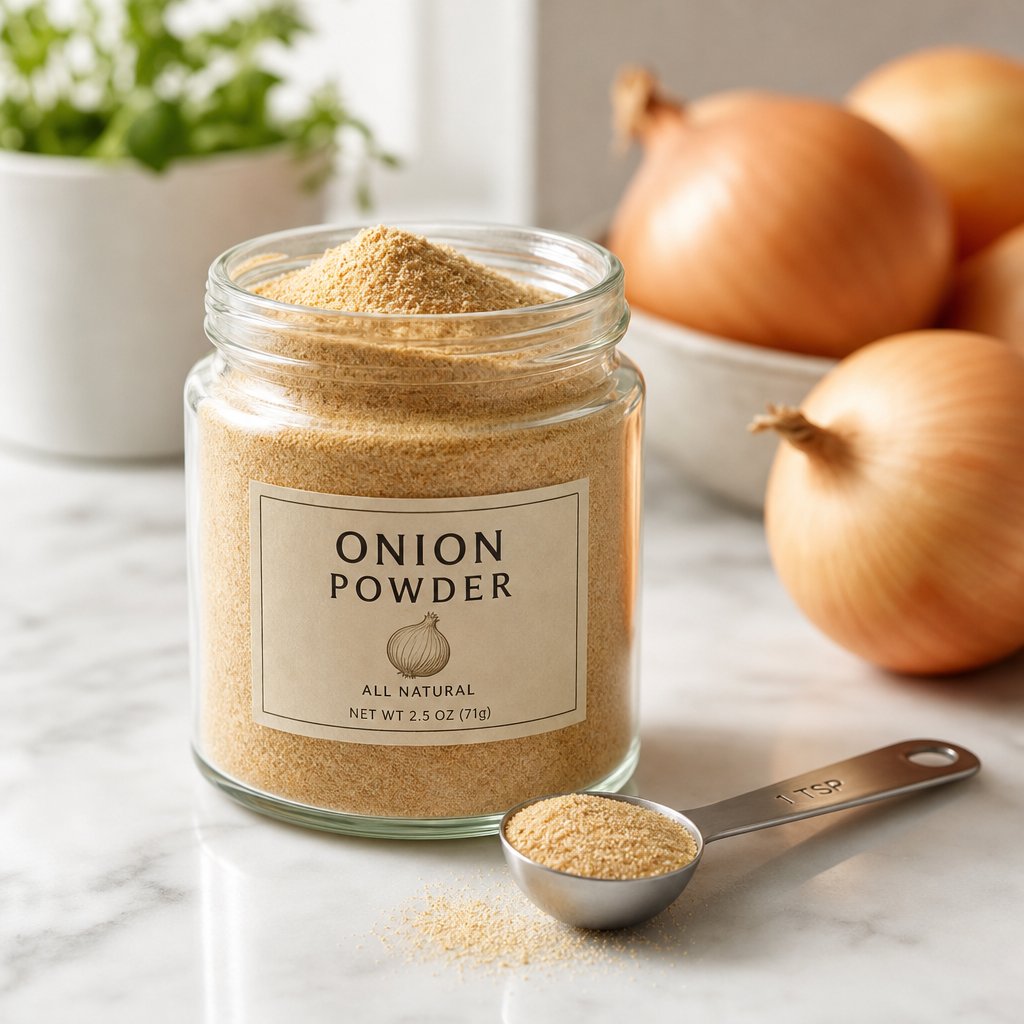
Does Onion Powder Have Sodium and How Much Per Serving
If you're watching your sodium intake, every ingredient gets a second look. So does onion powder have sodium? Yes, but the amount is so small it barely registers on a nutritional scale.
The Short Answer About Sodium in Onion Powder
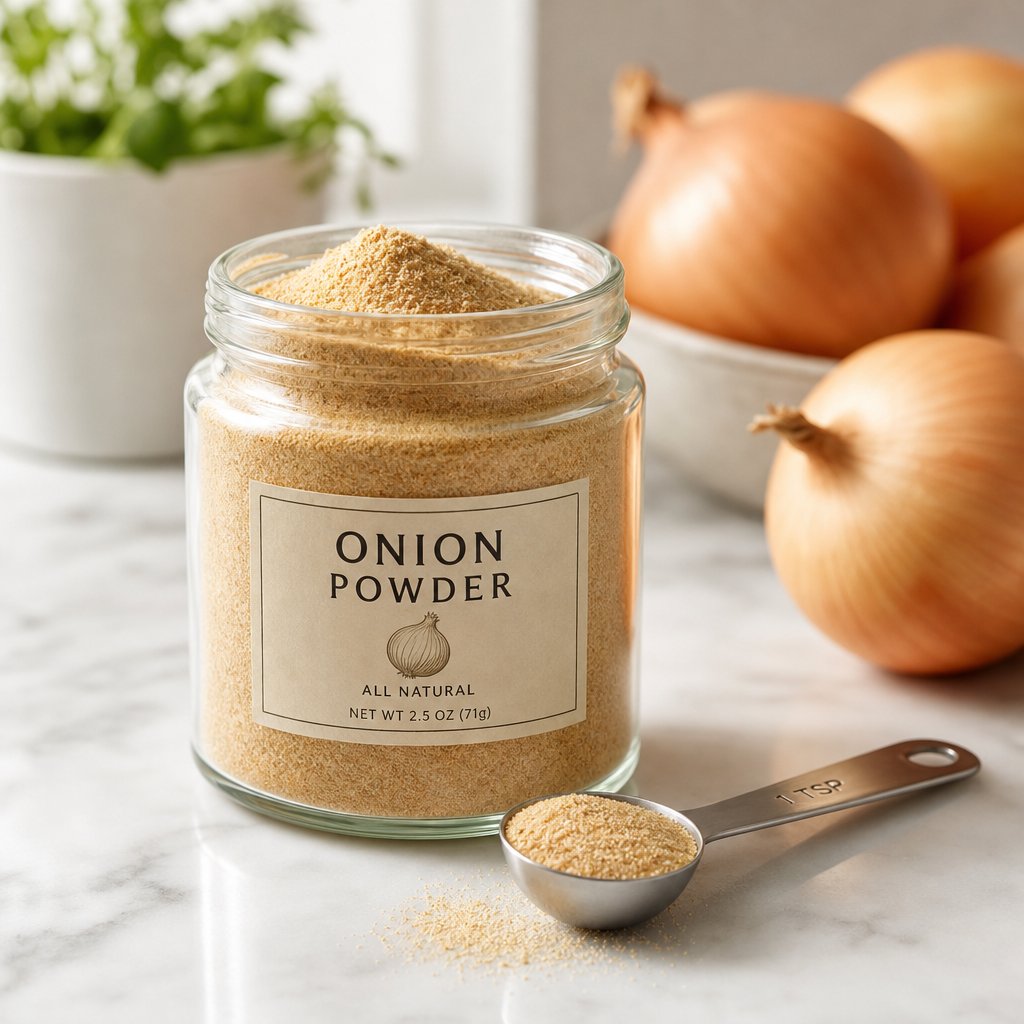
Pure onion powder contains roughly 2 mg of naturally occurring sodium per teaspoon. That's not added salt. It's simply the trace sodium present in onions themselves, concentrated through dehydration. McCormick confirms their onion powder has no added sodium and lists just 2 mg per serving. The ingredient list on a quality product should read one thing: dehydrated onion. Nothing more.
This means that when you're asking whether there is sodium in onion powder, the honest answer is technically yes, but practically no. The sodium exists because onions are a natural food, and all natural foods contain some mineral content, including trace sodium.
How This Compares to Your Daily Sodium Limit
The FDA sets the Daily Value for sodium at 2,300 mg. A single teaspoon of onion powder contributes about 2 mg to that total. To put that in perspective:
One teaspoon of onion powder provides less than 0.1% of your recommended daily sodium limit.
You'd need to consume over 1,000 teaspoons of onion powder in a single day to reach your sodium ceiling from this ingredient alone. That's not a realistic concern for anyone.
The confusion often starts because people mix up onion powder with onion salt, a completely different product that blends salt directly into the seasoning. Pure onion powder is simply dehydrated ground onion with zero added salt, and that distinction matters more than most labels make clear.
Onion Powder Nutrition Facts at a Glance
Sodium is only one piece of the puzzle. When you reach for that jar of onion powder, you're adding more than just flavor to your dish. You're also adding a small but interesting mix of calories, carbohydrates, and micronutrients. Understanding the full nutritional value of onion powder helps you make smarter decisions, whether you're counting macros, managing a health condition, or simply curious about what goes into your food.
Calories and Macronutrients in One Teaspoon
Does onion powder have calories? Yes, though the number is almost negligible. One teaspoon (approximately 2 grams) delivers just 8 calories. Most of that energy comes from carbohydrates, which makes sense when you consider that onion powder is essentially concentrated, dehydrated onion with its water content removed.
Here's what the full onion powder nutrition profile looks like per standard serving, based on USDA FoodData Central:
| Nutrient | Amount Per 1 tsp (2g) | % Daily Value |
|---|---|---|
| Calories | 8 kcal | 0% |
| Total Fat | 0.02g | 0% |
| Total Carbohydrate | 1.9g | 1% |
| Dietary Fiber | 0.14 - 0.36g | 1% |
| Total Sugars | 0.16 - 0.85g | 0% |
| Protein | 0.24 - 0.25g | 0% |
| Sodium | 1.3 - 1.8mg | 0% |
| Cholesterol | 0mg | 0% |
You'll notice the carbs in onion powder sit around 1.9 grams per teaspoon, with net carbs closer to 1.5 grams after subtracting fiber. For anyone following a keto or low-carb approach, this is well within safe territory at typical seasoning quantities. You'd have to use tablespoons upon tablespoons before carbohydrate content became a factor worth tracking.
Fat and protein are both essentially zero. Onion powder is not a meaningful source of either macronutrient, which is exactly what you'd expect from a dehydrated vegetable used in pinch-sized amounts.
Vitamins and Minerals Beyond Sodium
The micronutrient story is where onion powder gets a bit more interesting. While no single teaspoon delivers a significant percentage of any vitamin or mineral, the profile reveals a surprisingly diverse mineral presence:
| Nutrient | Amount Per 1 tsp (2g) | % Daily Value |
|---|---|---|
| Potassium | 22.6 - 23.6mg | 1% |
| Calcium | 8.7 - 9.2mg | 1% |
| Phosphorus | 7.7 - 8.2mg | 1% |
| Magnesium | 2.7 - 2.9mg | 1% |
| Iron | 0.06 - 0.09mg | 1% |
| Vitamin C | 0.35 - 0.56mg | 1% |
| Folate | 1.5 - 4.0mcg | 0 - 1% |
| Vitamin B6 | 0.02 - 0.03mg | 1% |
| Vitamin K | 0.1mcg | 0% |
Potassium stands out as the most abundant mineral in onion powder, with nearly 23 mg per teaspoon. That potassium-to-sodium ratio of roughly 13:1 is actually favorable from a cardiovascular health perspective. Calcium, phosphorus, and magnesium round out the mineral content in small but consistent amounts.
Imagine seasoning a full recipe with two or three teaspoons. Those trace minerals accumulate modestly, contributing a small nutritional bonus on top of the flavor you're already getting. It's not a supplement replacement by any stretch, but it's a reminder that whole-food-derived seasonings carry more than just taste.
The bottom line on onion powder nutrition: it's calorie-light, virtually fat-free, and carb-moderate in a way that fits comfortably into nearly any dietary framework. The real question most cooks face isn't whether onion powder fits their nutrition plan. It's how much they're actually using per serving, and whether the product in their pantry is truly pure onion powder or something blended with salt.
Sodium Content Per Realistic Serving Size
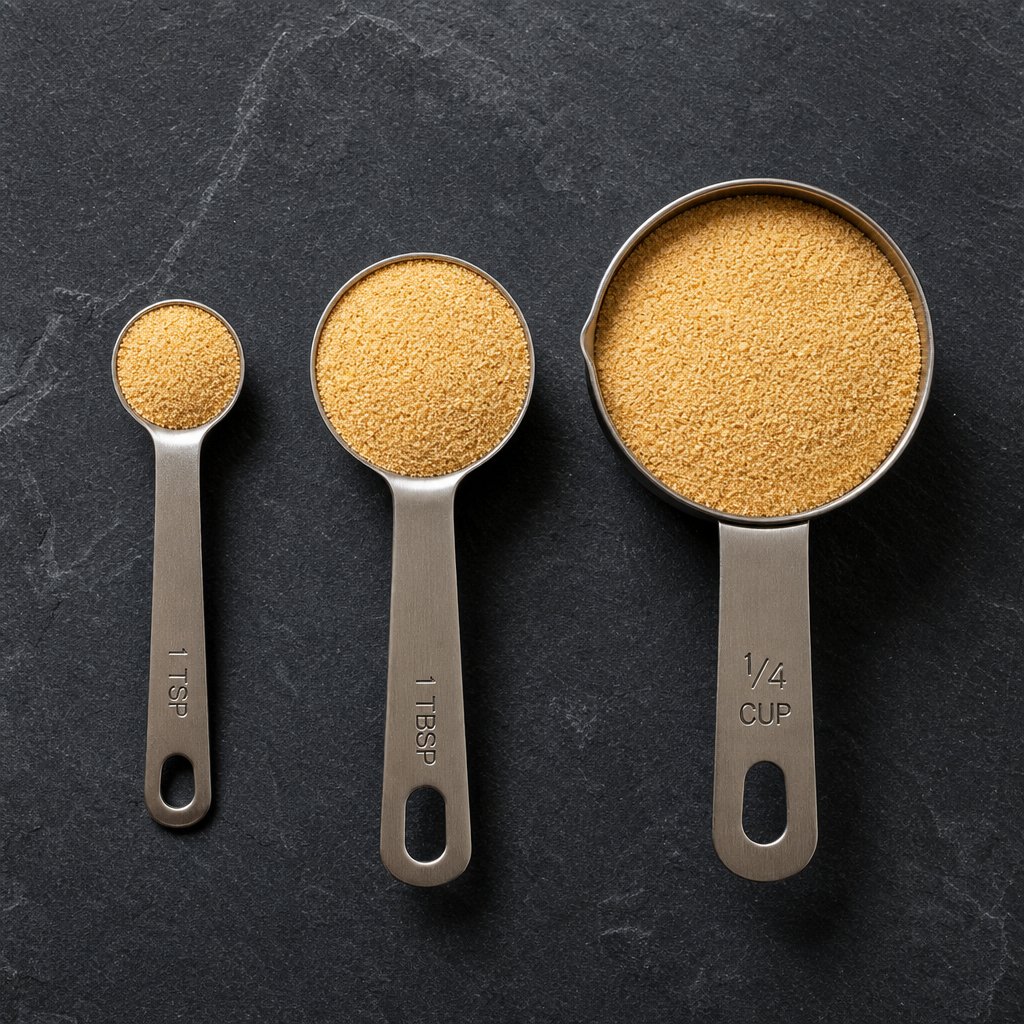
Knowing the sodium in a single teaspoon is helpful, but it doesn't reflect how people actually cook. A dry rub for ribs might call for a full tablespoon. A big batch of chili or soup could use even more. So how much sodium is in onion powder when you scale up to real-world recipe quantities?
Sodium in One Teaspoon vs One Tablespoon
The onion powder sodium content scales linearly. If one teaspoon contains approximately 2 mg, then a tablespoon (three teaspoons) delivers about 6 mg. A quarter cup, which would be an unusually large amount for a single recipe, brings the total to roughly 24 mg. Here's how that breaks down against the FDA's 2,300 mg daily limit:
| Serving Size | Approximate Weight | Sodium (mg) | % Daily Value (2,300 mg) |
|---|---|---|---|
| 1 teaspoon | 2g | 2 mg | 0.09% |
| 1 tablespoon | 6g | 6 mg | 0.26% |
| 1/4 cup (4 tbsp) | 24g | 24 mg | 1.04% |
Even at a quarter cup, you're looking at barely 1% of your daily sodium allowance. Compare that to a single quarter-teaspoon of table salt, which packs approximately 575 mg of sodium. The difference is staggering. You could use an entire quarter cup of onion powder and still consume less sodium than what a tiny pinch of salt delivers.
For context on what these measurements replace in the kitchen: one tablespoon of onion powder equals roughly one medium-sized onion. That means a recipe calling for two medium onions needs only about two tablespoons of powder, contributing around 12 mg of sodium total. Do onions have sodium in their fresh form? Yes, a medium raw onion contains about 4 mg. The dehydration process concentrates everything, including that trace sodium, but the amounts remain nutritionally trivial either way.
Does Sodium Add Up in Full Recipes
Imagine you're making a large pot of soup that serves eight people. The recipe uses two tablespoons of onion powder for the entire batch. That's 12 mg of sodium spread across eight servings, meaning each bowl gets about 1.5 mg from the onion powder. For someone on a strict sodium-restricted diet of 1,500 mg per day (the level often recommended for people with hypertension), that 1.5 mg per serving represents 0.1% of their daily budget.
Even in recipes where onion powder is used generously, like a homemade seasoning blend or a dry rub where you might combine a tablespoon of onion powder with garlic powder, paprika, and cumin, the total sodium from all those pure spices combined stays remarkably low. The real sodium culprits in any recipe are always the same: table salt, soy sauce, broth, canned goods, and processed ingredients.
Here's a practical way to think about it:
- A tablespoon of soy sauce contains roughly 900 mg of sodium
- A single slice of deli meat can have 300-500 mg
- One cup of canned chicken broth averages 860 mg
- One tablespoon of onion powder contributes just 6 mg
The math is clear. Even if you doubled or tripled the onion powder in a recipe, the sodium contribution remains a rounding error compared to virtually any other savory ingredient in your pantry. For anyone managing blood pressure or following a heart-healthy eating plan, onion powder is one of the last ingredients that needs monitoring.
What does deserve scrutiny is the label on the jar itself. Not all products sold as "onion powder" contain only dehydrated onion, and the difference between a pure product and a seasoning blend can mean hundreds of milligrams of hidden sodium per serving.
Onion Powder vs Onion Salt and Why People Confuse Them
That label confusion is exactly where the problem starts. Many people searching for whether onion powder has salt in it are actually thinking of onion salt, a completely different product that shares shelf space and similar packaging. The two names sound interchangeable, but their sodium profiles couldn't be more different.
What Is Actually in Onion Salt vs Pure Onion Powder
Pure onion powder contains one ingredient: dehydrated onion, ground into a fine powder. No salt. No preservatives. No anti-caking agents in its purest form. The FDA classifies it as a spice, a single-ingredient product that delivers concentrated onion flavor without any sodium additions.
Onion salt is a seasoning blend. Its primary ingredient is table salt, typically making up 60-80% of the product by weight. The remaining 20-40% consists of onion solids. By volume, the ratio works out to roughly 75% salt and 25% onion powder. Many commercial versions also include anti-caking agents like calcium silicate or sodium aluminosilicate to prevent clumping.
Think of it this way: when you buy onion salt, you're mostly buying salt with a hint of onion flavor mixed in. When you buy onion powder, you're buying pure concentrated onion. The distinction matters enormously for anyone tracking sodium intake.
So does onion powder have salt in it? No. Pure onion powder contains zero added salt. The only sodium present is the naturally occurring trace amount found in onions themselves, roughly 2 mg per teaspoon. Onion salt, on the other hand, is engineered to be salty first and onion-flavored second.
Sodium Numbers Side by Side
The gap between these products becomes obvious when you compare the actual numbers. Here's how onion powder stacks up against common salt-based seasoning blends per teaspoon:
| Seasoning | Sodium Per 1 tsp | % Daily Value (2,300 mg) | Primary Ingredient |
|---|---|---|---|
| Pure Onion Powder | 2 mg | 0.09% | Dehydrated onion |
| Onion Salt | 480-1,140 mg | 21-50% | Salt |
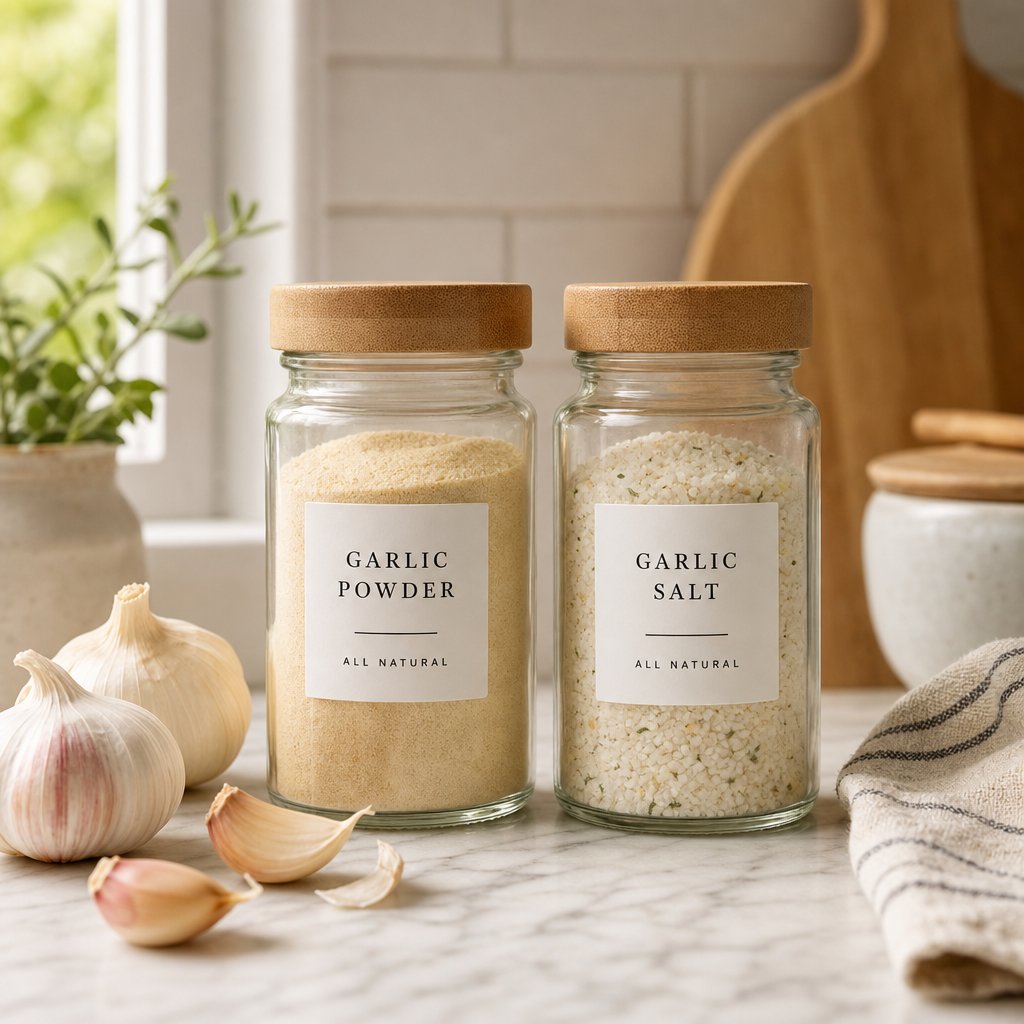
| Garlic Salt | 190-400+ mg | 8-17% | Salt |
Look at that range for onion salt: a single teaspoon can deliver anywhere from 480 mg to over 1,100 mg of sodium. That's potentially half your entire daily allowance in one small spoonful. Tufts Health & Nutrition Letter notes that garlic salt ranges from 190 to over 400 mg per quarter teaspoon alone, confirming that all salt-based blends carry significant sodium loads.
Meanwhile, pure onion powder sits at 2 mg. The difference isn't marginal. It's a factor of 240 to 570 times more sodium in onion salt compared to onion powder.
This disparity explains why so many people ask whether onion powder is high in sodium. They've likely used onion salt at some point, noticed the sodium content on the label, and assumed onion powder carries the same burden. It doesn't. The confusion is a naming problem, not a nutrition problem.
Here's how to protect yourself from accidentally grabbing the wrong product:
- Read the ingredient list, not just the product name. If salt appears anywhere on the list, it's a blend.
- Check the sodium line on the Nutrition Facts panel. Pure onion powder should show 0-5 mg per serving.
- Look for products labeled "pure onion powder" or "100% dehydrated onion" rather than "onion seasoning" or "onion blend."
- Be cautious with store-brand or bulk-bin products that may not clearly distinguish between powder and salt varieties.
Do onion powder have salt in it when you buy generic or budget brands? Not necessarily, but some lower-quality products may include salt or sodium-containing anti-caking agents without making it obvious on the front label. The ingredient list is always your most reliable guide.
The takeaway is straightforward: if your jar says "onion powder" and the only ingredient listed is dehydrated onion, you're holding a product with virtually no sodium. If salt appears in the name or the ingredient list, you're dealing with an entirely different nutritional profile. Keeping these two products straight is the single most important step for anyone concerned about hidden sodium in their spice rack.
Of course, onion powder and onion salt aren't the only seasonings that create this kind of confusion. Many common spice rack staples range from sodium-free to sodium-heavy, and knowing which category each one falls into can reshape how you approach seasoning altogether.
Sodium Comparison Across Common Seasonings
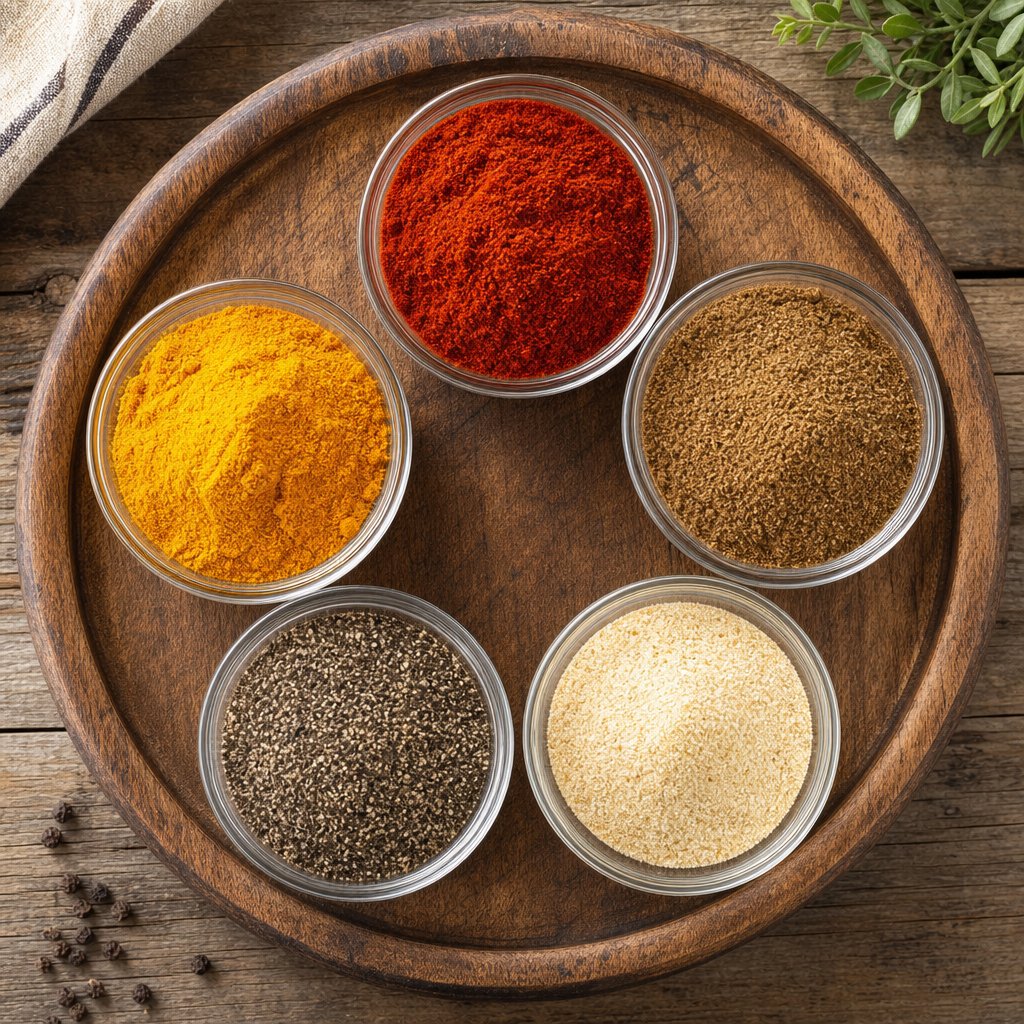
Your spice rack likely holds a dozen or more jars, and each one carries a different sodium story. Some are virtually sodium-free. Others pack hundreds of milligrams into a single teaspoon. Knowing which is which saves you from guessing every time you season a dish.
How Onion Powder Ranks Among Common Spices
When you line up the most popular seasonings side by side, a clear pattern emerges. Pure ground spices and herb powders, those made from a single dehydrated ingredient, contain only trace amounts of naturally occurring sodium. The moment "salt" enters the product name or ingredient list, sodium levels jump dramatically. Here's how the numbers compare per one teaspoon, based on USDA FoodData Central values:
| Seasoning | Sodium Per 1 tsp | Low-Sodium Friendly |
|---|---|---|
| Onion Powder | 2 mg | Yes |
| Garlic Powder | 1 mg | Yes |
| Paprika | 2 mg | Yes |
| Cumin (ground) | 4 mg | Yes |
| Black Pepper (ground) | 1 mg | Yes |
| Turmeric (ground) | 1 mg | Yes |
| Onion Salt | 480-1,140 mg | No |
| Garlic Salt | 760-1,600 mg | No |
| Seasoned Salt | 380-480 mg | No |
Notice the divide. Every pure spice on this list stays under 5 mg of sodium per teaspoon. That's less than 0.2% of the FDA's 2,300 mg daily limit. The sodium in onion powder, garlic powder, paprika, and cumin is simply the mineral content that exists naturally in the plant itself. No processing step adds to it.
Salt-based blends, on the other hand, deliver 100 to 800 times more sodium per identical serving. Tufts Health & Nutrition Letter confirms that garlic salt can contain 190 to over 400 mg in just a quarter teaspoon, while garlic powder itself contains negligible amounts. The same principle applies across the board: the spice is safe, the salt blend is not.
Which Seasonings to Watch on a Low-Sodium Diet
If you're managing blood pressure or following a heart-healthy eating plan, the rule is simple. Any seasoning with "salt" in its name belongs on your watch list. Mississippi State University puts it plainly: seasonings that contain the word "salt" also contain high levels of sodium, especially in larger quantities.
Here's a quick mental framework for navigating the spice aisle:
- Pure single-ingredient spices (onion powder, garlic powder, paprika, cumin, black pepper, turmeric, oregano, thyme) are universally low-sodium friendly.
- Products with "salt" in the name (onion salt, garlic salt, celery salt, seasoned salt) are high-sodium by design.
- Mixed seasoning blends (chili powder, curry powder, taco seasoning) vary widely. My Food Data reports that chili powder contains about 77 mg per teaspoon, while pumpkin pie spice and saffron stay under 1% of the daily value. Always check the label.
The practical takeaway? Sodium in onion and other pure ground spices is universally negligible. You can season generously with any single-ingredient powder and stay well within safe limits. The real sodium culprits aren't hiding in your spice jars. They're hiding in the blends that mix a little flavor with a lot of salt.
Pure spices add flavor without sodium. Salt-based blends add sodium with a hint of flavor. The label tells you which one you're holding.
This distinction becomes even more important when you realize that FDA labeling rules allow certain products to display "0 mg sodium" on their Nutrition Facts panel, even when trace amounts exist. Understanding how those rules work, and what ingredients to scan for on the back of the jar, gives you a sharper edge when shopping for truly low-sodium seasonings.
Reading Spice Labels and FDA Sodium Rules
You've probably noticed something odd while comparing onion powder brands at the store. One label shows 0 mg sodium. Another lists 2 mg. A third says "sodium free" in bold letters on the front. Are these different products, or is something else going on? The answer lies in how the FDA allows manufacturers to round and label sodium content, and understanding these rules gives you a real advantage when shopping for low-sodium seasonings.
Why Some Labels Show Zero Sodium
Here's the key regulation: under 21 CFR 101.61, the FDA permits any food containing less than 5 mg of sodium per reference amount customarily consumed (and per labeled serving) to use the terms "sodium free," "zero sodium," or "no sodium" on its packaging. Since pure onion powder contains roughly 1.3 to 2 mg of sodium per teaspoon serving, it falls well below that 5 mg threshold.
This means a manufacturer can legally print "0 mg" on the nutrition facts onion powder panel, even though trace sodium exists in the product. It's not deception. It's a rounding rule designed to prevent consumers from worrying about amounts the FDA considers nutritionally insignificant. The regulation also requires that the product contain no ingredient "generally understood by consumers to contain sodium," which pure dehydrated onion satisfies easily.
So when you see two brands of onion powder, one listing 0 mg and another listing 2 mg, both can be telling the truth. The first brand rounds down per FDA guidelines. The second reports the actual measured trace amount. Neither product has added salt. The difference is purely a labeling choice within legal boundaries.
This also explains why some products carry a front-of-package "sodium free" claim while others don't bother. Both may contain identical onion powder nutritional value, but only one manufacturer chose to highlight the claim. The absence of a "sodium free" label doesn't mean the product contains meaningful sodium. It may simply mean the brand didn't apply for or prioritize that marketing language.
Ingredients That Sneak Sodium Into Spice Blends
The labeling picture changes entirely when manufacturers add ingredients beyond dehydrated onion. Some commercial products sold under names like "onion powder seasoning" or "onion flavoring" include additives that introduce sodium without making it obvious on the front label. This is where reading the ingredient list becomes essential.
Watch for these red-flag ingredients that add sodium to what might look like a simple spice product:
- Salt (sodium chloride) - The most obvious addition, sometimes listed further down the ingredient list where it's easy to miss.
- Monosodium glutamate (MSG) - A flavor enhancer that contains about 12% sodium by weight. One gram of MSG adds roughly 120 mg of sodium.
- Sodium aluminosilicate - An anti-caking agent used to prevent clumping in powdered products.
- Sodium bicarbonate (baking soda) - Occasionally added to adjust pH or texture in processed seasoning blends.
- Sodium citrate - Used as a preservative or flavor modifier in some commercial spice mixes.
- Silicon dioxide with sodium compounds - Another anti-caking agent that may contribute trace sodium.
- Hydrolyzed protein - Often contains added sodium as part of the hydrolysis process.
A product listing any of these ingredients will have a higher sodium profile than pure onion powder, even if the front label doesn't scream "contains salt." The FDA requires all ingredients to appear on the label, but it doesn't require them to be highlighted or explained. You have to look for them yourself.
What is in onion powder when it's truly pure? One ingredient: dehydrated onion. Some brands add a small amount of silicon dioxide as an anti-caking agent, which is sodium-free and doesn't affect the nutritional profile. If the ingredient list contains more than two items, you're likely holding a blend rather than a pure spice.
Do Different Forms of Onion Powder Vary in Sodium?
You'll find onion powder sold in several forms: standard fine powder, granulated (coarser texture), organic, roasted, and toasted varieties. Does the form matter for sodium content?
For pure products without additives, the sodium content remains essentially the same regardless of grind size or organic certification. Granulated onion powder and fine onion powder both come from dehydrated onion. The only difference is particle size, which affects how quickly the flavor disperses in cooking but doesn't change the mineral composition. Organic onion powder follows the same principle. The organic label refers to farming practices, not nutritional differences.
Roasted or toasted varieties are where you need to pay closer attention. The roasting process itself doesn't add sodium, but manufacturers sometimes add salt or seasoning during roasting to enhance flavor. A "roasted onion powder" with salt listed in its ingredients could contain 100+ mg of sodium per teaspoon, a dramatic jump from the 2 mg in a pure product. The roasting isn't the problem. The added ingredients are.
Here's a practical approach when evaluating any onion powder product:
- Flip the jar and read the ingredient list first, before checking the Nutrition Facts panel.
- If the only ingredient is "dehydrated onion" or "onion," the sodium content will be negligible regardless of brand, form, or price point.
- If additional ingredients appear, check the Nutrition Facts panel for the actual sodium number per serving.
- Compare serving sizes between brands. Some list a serving as 1/4 teaspoon while others use 1 teaspoon, making direct comparison tricky without doing the math.
The FDA's rounding rules and labeling flexibility mean you can't always trust the front of the package. But the ingredient list and Nutrition Facts panel together give you everything you need to make a confident choice. A product with one ingredient and 0-2 mg sodium per serving is exactly what it claims to be: pure, low-sodium onion flavor ready to enhance your cooking without any hidden salt burden.
Armed with that label literacy, the natural next question becomes practical: how can you actually use onion powder as a tool to reduce sodium in your everyday meals?
Using Onion Powder to Reduce Sodium in Cooking
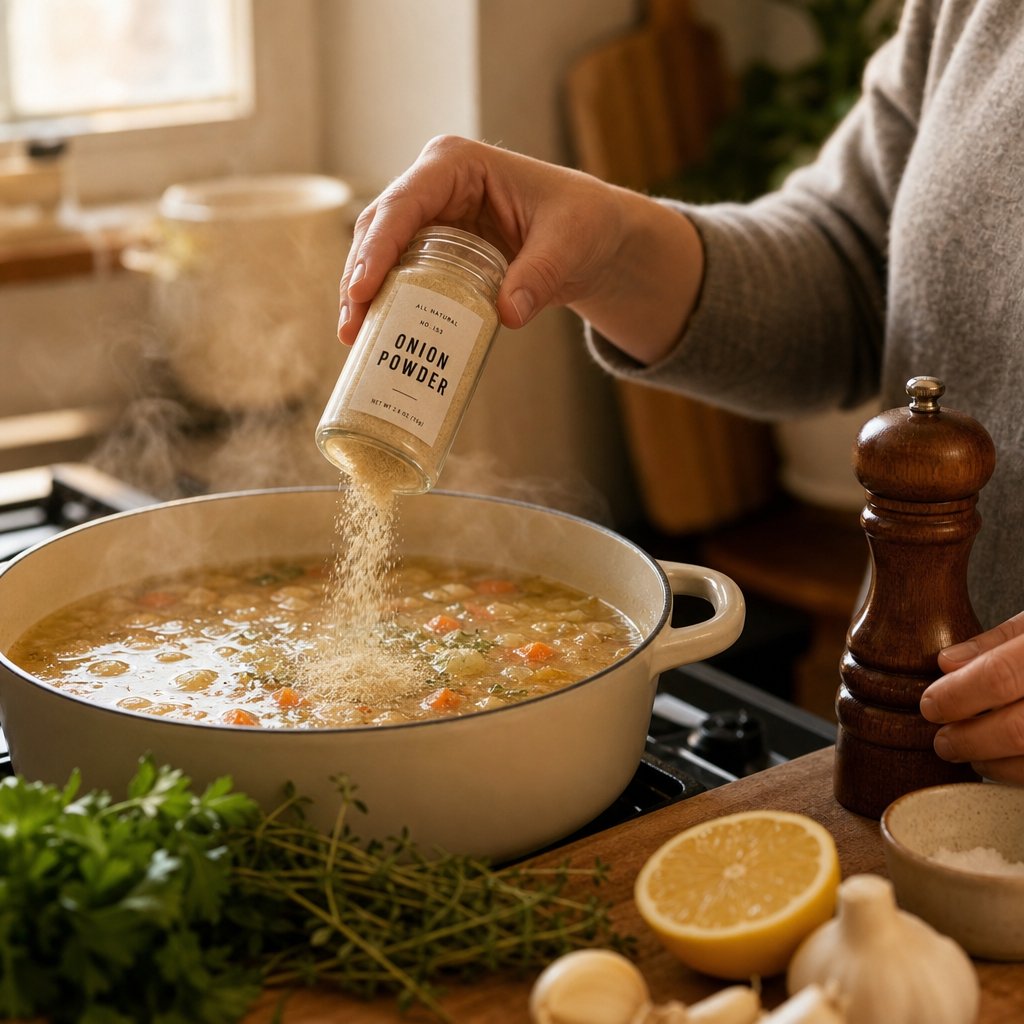
Cutting salt from recipes sounds simple until you taste the result. Food goes flat. Soups feel hollow. Roasted vegetables lose their savory depth. The challenge isn't removing salt. It's replacing the flavor satisfaction that salt provided. Onion powder solves this problem because it delivers concentrated, savory complexity with virtually zero sodium cost.
A single teaspoon of table salt contains 2,300 mg of sodium. A single teaspoon of onion powder contains 2 mg. Yet onion powder brings a rich, sweet-savory depth that tricks your palate into perceiving fullness and seasoning completeness. It won't replicate saltiness directly, but when layered with other flavor-dense ingredients, it fills the gap that missing salt leaves behind.
Replacing Salt With Flavor-Dense Seasonings
The strategy isn't to swap onion powder for salt one-to-one. It's to build a flavor foundation using multiple low-sodium ingredients so your taste buds never notice what's missing. The Cleveland Clinic recommends using natural substitutes like lemon, ginger, dried herbs, onion, garlic, and dry mustard to replace salt in cooking. The National Kidney Foundation echoes this approach, specifically noting that replacing garlic salt and onion salt with garlic powder and onion powder is one of the easiest first steps toward a low-sodium kitchen.
Here's a practical list of low-sodium seasoning strategies that pair well with onion powder:
- Layer aromatics together. Combine onion powder with garlic powder, smoked paprika, and black pepper for a savory base that covers multiple flavor notes simultaneously.
- Add acid for brightness. A squeeze of fresh lemon or lime juice lifts dishes the same way salt does by enhancing other flavors already present. Citrus plus onion powder creates a surprisingly complete seasoning profile.
- Use herbs for complexity. Dried thyme, rosemary, basil, and oregano each bring distinct aromatic layers. Mixed with onion powder, they create depth that salt alone never could.
- Incorporate heat. A pinch of cayenne, crushed red pepper, or fresh chili adds a flavor dimension that distracts from reduced salt. The warmth pairs naturally with onion powder's sweetness.
- Try umami boosters. Nutritional yeast, tomato paste, and mushroom powder all deliver savory richness without sodium. Combined with onion powder, they create a deeply satisfying flavor profile.
You'll notice that none of these strategies require specialty ingredients. Everything listed is available at any grocery store, and each one contributes less than 5 mg of sodium per teaspoon.
Fresh Onion to Powder Conversion for Recipes
When you're adapting recipes to reduce sodium, knowing how much onion powder equals 1 medium onion helps you substitute confidently. McCormick's conversion guide provides a straightforward rule: one tablespoon of onion powder is equal to one medium-sized onion.
From there, you can scale up or down based on what your recipe calls for:
| Fresh Onion Amount | Onion Powder Equivalent | Sodium Added |
|---|---|---|
| 1 small onion | 1 teaspoon | ~2 mg |
| 1 medium onion | 1 tablespoon | ~6 mg |
| 1 large onion | 1.5 tablespoons | ~9 mg |
| 1/2 cup chopped onion | 1 tablespoon | ~6 mg |
So how much onion powder equals one small onion? About one teaspoon. And 1 medium onion equals how much onion powder? One tablespoon. These ratios work for most savory applications, though you can always adjust to taste. Some cooks prefer slightly less powder since the dehydration process concentrates flavor, making the powder taste more intense per equivalent volume than fresh onion.
The beauty of this substitution is that you're not sacrificing flavor to reduce sodium. You're gaining convenience (no chopping, no tears) while keeping sodium contribution under 10 mg for even the largest conversions. Compare that to the common habit of adding a teaspoon of onion salt instead, which would dump 480-1,140 mg of sodium into the same dish.
Onion Powder and the DASH Diet
The DASH diet (Dietary Approaches to Stop Hypertension) is one of the most well-researched eating plans for managing blood pressure. It emphasizes fruits, vegetables, whole grains, lean proteins, and low-fat dairy while limiting sodium to 2,300 mg per day, with an ideal target of 1,500 mg for most adults.
Onion powder fits comfortably within DASH guidelines. Its negligible sodium content means you can use it freely without tracking or measuring against your daily budget. More importantly, it makes DASH-compliant meals taste better, which addresses one of the biggest reasons people abandon sodium-restricted diets: bland food.
Studies consistently show that long-term dietary adherence improves when food tastes satisfying. If a low-sodium meal feels like a punishment, people don't stick with it. Onion powder, alongside garlic powder, herbs, and citrus, transforms a restrictive-feeling meal into something genuinely enjoyable. That shift from deprivation to satisfaction is what keeps people on track week after week.
For anyone following DASH or a similar heart-healthy plan, here's a simple daily approach: keep onion powder, garlic powder, black pepper, and dried Italian herbs within arm's reach while cooking. Season generously. Taste before reaching for the salt shaker. You'll often find the dish doesn't need salt at all.
Custom Low-Sodium Seasoning Formulation for Brands
Consumer demand for low-sodium products isn't a niche trend anymore. It's reshaping how seasoning brands formulate, label, and market their products. For food entrepreneurs and private label sellers, onion powder's flavor-boosting properties at virtually zero sodium cost create a compelling foundation for new product lines.
Market Demand for Low-Sodium Seasoning Products
The numbers tell a clear story. The global seasoning market is projected to reach USD 49.3 billion in 2026 and scale to USD 81.3 billion by 2036, growing at a 5.1% CAGR. A significant driver behind that growth? Regulatory pressure on sodium reduction and consumer health awareness. Average sodium intake for Americans still exceeds 3,300 mg per day, well above the recommended 2,300 mg limit, and governments worldwide are pushing manufacturers to reformulate.
Research from Kerry found that 85% of consumers say sodium levels influence their purchasing decisions. ADM's data shows 49% of North American consumers actively look to minimize sodium intake. These aren't fringe shoppers. They represent a mainstream buying force looking for seasoning products that deliver bold flavor without the salt burden.
Is onion powder healthy enough to anchor a product line? For brands targeting heart-health-conscious consumers, keto dieters, or clean-label shoppers, the answer is yes. With only 2 mg sodium and 1.9 g of onion powder carbs per teaspoon, it checks the boxes for low-sodium claims, keto compatibility, and single-ingredient transparency. An onion powder keto seasoning blend, for example, can combine pure spices into a product that satisfies multiple dietary tribes simultaneously.
Developing Custom Powder Blends With Controlled Sodium Levels
Building a seasoning brand around low-sodium positioning requires more than a good recipe. You need manufacturing partners who can control formulation at scale, maintain consistent sodium levels across production runs, and deliver flexible product formats that fit retail, foodservice, or e-commerce channels.
This is where OEM/ODM manufacturing partnerships become practical. Rather than investing in production infrastructure from scratch, brand owners can work with contract manufacturers who specialize in powder and granule formulations. The right partner offers customized formulation capabilities, letting you specify exact sodium targets, ingredient ratios, and packaging formats while handling the production complexity behind the scenes.
For nutrition brands and supplement importers exploring this space, ZhuFeng's OEM/ODM health food manufacturing services offer flexible product formats including powders, granules, tablets, and capsules with customized formulation and scalable production. Their approach allows precise control over sodium content in finished products, which matters when you're building a brand around a specific nutritional claim. Whether you're developing a salt-free seasoning blend anchored by onion powder or a functional supplement powder with controlled mineral profiles, having a manufacturing partner that understands formulation precision makes the difference between a label claim you can defend and one you can't.
The opportunity is straightforward: consumers want flavor without sodium, clean labels without mystery ingredients, and products that fit their dietary frameworks. Brands that combine onion powder's natural flavor density with disciplined formulation and transparent labeling are positioned to capture a growing share of that USD 81.3 billion market.
The Bottom Line on Onion Powder and Sodium
Whether you landed here managing blood pressure, following the DASH diet, or simply curious about what's in your spice rack, the answer is reassuringly simple. Pure onion powder is one of the safest seasonings you can reach for on a sodium-restricted diet, and it actively helps you eat less salt by making low-sodium meals taste better.
Key Takeaways for Sodium-Conscious Cooks
Here's what the data confirms after examining USDA nutrition profiles, FDA labeling rules, and real-world recipe math:
- Pure onion powder contains approximately 2 mg of naturally occurring sodium per teaspoon, less than 0.1% of the 2,300 mg daily limit.
- There is no added salt in onion powder. The trace sodium comes from the onion itself.
- Even generous recipe use (a full tablespoon) contributes only about 6 mg of sodium, a nutritionally insignificant amount.
- Onion salt is a completely different product, containing 480-1,140 mg of sodium per teaspoon. The name similarity causes most of the confusion.
- FDA rules allow products with less than 5 mg sodium per serving to display "0 mg" on the label, which is why some brands show zero while others show 2 mg. Both are accurate.
- Does onion powder have calories? Yes, about 8 per teaspoon. Does onion powder have carbs? About 1.9 g per teaspoon, with net carbs around 1.5 g. Neither amount is meaningful at typical seasoning quantities.
Pure onion powder delivers concentrated flavor at 2 mg sodium per teaspoon. Onion salt delivers mostly salt at 480-1,140 mg per teaspoon. Reading the ingredient list is the only reliable way to know which one you're buying.
When to Choose Onion Powder Over Salt-Based Seasonings
Every time you reach for a seasoning, you're making a sodium decision. Here's a practical framework for making that choice confidently:
- Always choose pure onion powder over onion salt. You get the same onion flavor without hundreds of milligrams of sodium per serving.
- Check the ingredient list before trusting the front label. If "dehydrated onion" is the only ingredient, you're safe. If salt, MSG, or sodium-containing anti-caking agents appear, put it back.
- Layer flavor instead of adding salt. Combine onion powder with garlic powder, black pepper, herbs, and citrus to build savory depth that makes salt unnecessary.
- Use conversion ratios with confidence. One tablespoon of onion powder replaces one medium onion at roughly 6 mg sodium, far less than the salt most recipes call for alongside fresh onion.
- Season generously. Unlike salt-based products, pure spices give you freedom to use as much as your taste buds want without blowing your sodium budget.
Is there salt in onion powder? No. Not in the pure form. That single fact should give you complete confidence every time you unscrew the cap. Onion powder belongs in the category of seasonings you never need to worry about, alongside garlic powder, paprika, cumin, and black pepper. Use them freely, taste your food before adding salt, and let flavor do the work that sodium used to.
Frequently Asked Questions About Sodium in Onion Powder
1. Is onion powder high in sodium?
No, pure onion powder is extremely low in sodium. One teaspoon contains approximately 2 mg of naturally occurring sodium, which represents less than 0.1% of the FDA's recommended daily limit of 2,300 mg. The trace sodium comes from the onion plant itself, not from any added salt. This makes onion powder one of the safest seasonings for people on sodium-restricted diets, including those following the DASH eating plan for blood pressure management.
2. What is the difference between onion powder and onion salt?
Onion powder is made from a single ingredient: dehydrated ground onion, containing about 2 mg sodium per teaspoon. Onion salt is a blend of roughly 75% table salt and 25% onion powder, delivering 480 to 1,140 mg of sodium per teaspoon. The key distinction is that onion salt is primarily a salt product with onion flavoring, while onion powder is a pure spice with no added salt. Always check the ingredient list to confirm which product you are purchasing.
3. Can I use onion powder on a low-sodium diet?
Absolutely. Onion powder is recommended by organizations like the National Kidney Foundation and Cleveland Clinic as a flavor-boosting alternative to salt and salt-based seasonings. Even using a full tablespoon in a recipe adds only about 6 mg of sodium. Pairing onion powder with garlic powder, herbs, citrus, and black pepper creates satisfying flavor depth that helps reduce reliance on table salt while keeping total sodium intake well within healthy limits.
4. Why do some onion powder labels show 0 mg sodium while others show 2 mg?
FDA regulations under 21 CFR 101.61 allow manufacturers to round down and display 0 mg sodium on the Nutrition Facts panel when a product contains less than 5 mg per serving. Since pure onion powder has only 1.3 to 2 mg per teaspoon, some brands round to zero while others report the actual trace amount. Both are accurate and legal. Neither product contains added salt, and the nutritional difference between them is nonexistent for practical purposes.
5. How much onion powder equals one medium onion?
One tablespoon of onion powder is equivalent to one medium-sized fresh onion in terms of flavor contribution. For a small onion, use about one teaspoon. For a large onion, approximately 1.5 tablespoons works well. These conversions add only 2 to 9 mg of sodium respectively, making onion powder a convenient and sodium-friendly substitute when you want concentrated onion flavor without the prep work of chopping fresh onions.