What Custard Powder Really Is and Why You Should Know
You spot it in a recipe, see it on a shelf, or hear someone mention it in a baking video. But what is custard powder, exactly? And more importantly, what is in custard powder that lets it transform plain milk into a silky, golden dessert in under five minutes?
Custard Powder Defined in Simple Terms
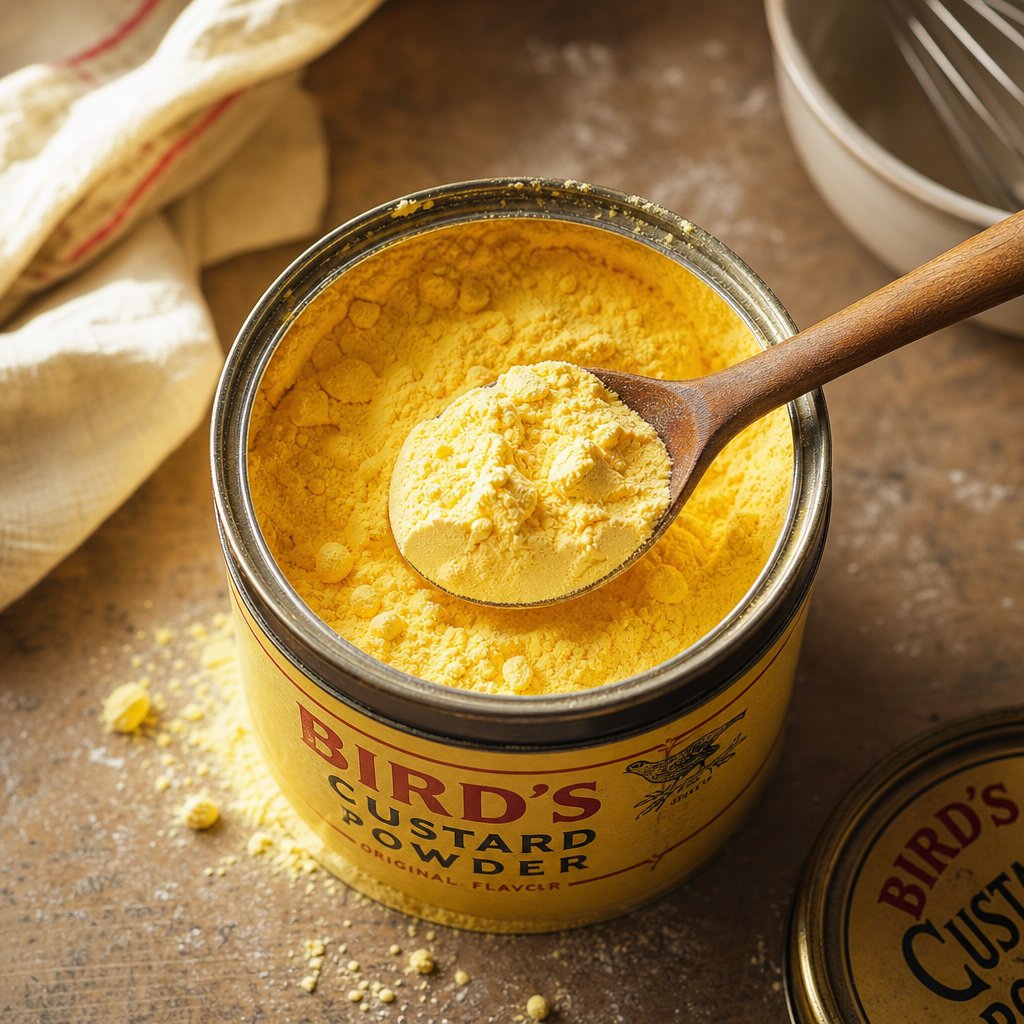
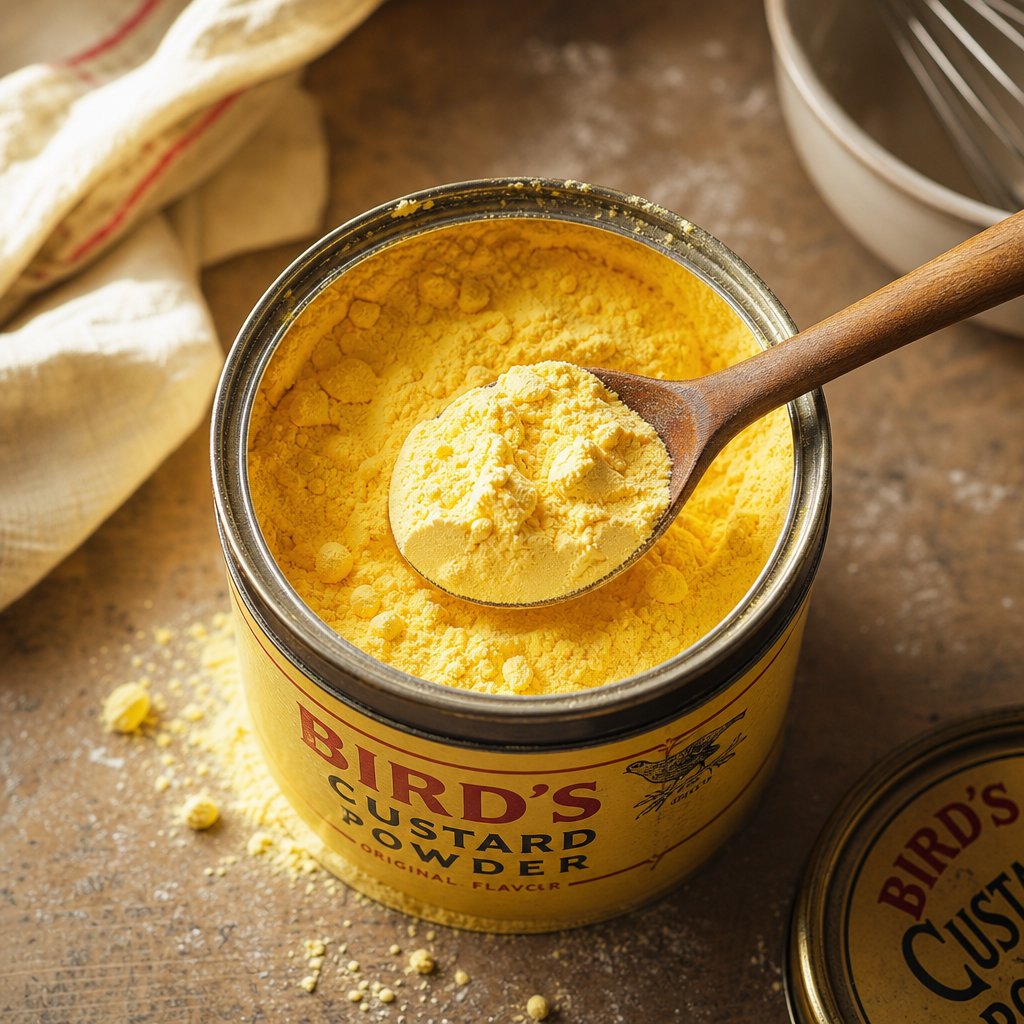
Custard powder is a pre-mixed dry blend of cornflour (cornstarch), vanilla flavoring, and yellow coloring designed to replicate the taste, texture, and appearance of traditional egg-based custard without using any eggs.
That custard powder definition surprises a lot of people. There are no eggs in it. There is no dairy in it either. The powder itself is entirely plant-based in most formulations. You add milk and sugar during preparation, but the dry mix sitting in the tin or packet contains none of those things.
So what is a custard powder doing differently from, say, instant pudding mix or pastry cream? The distinction matters. Instant custard mix often includes milk solids or sugar pre-blended for a simpler one-step preparation, sometimes requiring only water. Custard cream, on the other hand, refers to a finished product or a biscuit filling in British English. Standard custard powder is the most stripped-back version: a base that needs hot milk and stirring to become custard.
Why Understanding the Ingredients Matters
Knowing what goes into this pantry staple helps you make smarter choices about allergens, dietary compatibility, and recipe substitutions. It also explains why ingredient lists look different depending on whether you pick up a tin in London, Mumbai, or Melbourne. Formulations vary by brand and region, sometimes significantly.
This article breaks down every component you will find on a custard powder label, explains why each one is there, and shows you how brands differ across global markets. Whether you are managing food allergies, baking for someone with dietary restrictions, or simply curious about what you have been spooning into your desserts, the answers start with the ingredient list.
The Egg-Free Origin Story Behind Custard Powder
The reason custard powder contains no eggs is not a cost-cutting shortcut or a modern dietary trend. It is the entire reason the product exists. To understand what is the custard powder at its core, you need to go back to 1837 Birmingham, England, and a chemist who loved his wife more than convention.
Alfred Bird and the Egg Allergy That Changed Desserts
Alfred Bird's wife, Elizabeth, adored custard but suffered from a severe egg allergy. Traditional custard relied entirely on egg yolks for thickening, color, and richness, which meant Elizabeth could never enjoy it. Alfred, a skilled chemist, refused to accept that limitation. He developed a powder made from colored and flavored cornflour combined with sugar that, when mixed with hot milk, produced a creamy sauce nearly identical to classic creme anglaise. The original egg free custard powder was born not in a factory, but in a kitchen, out of love.
The story goes that Alfred's invention was "accidentally" served to dinner guests, who could not tell the difference. Realizing the broader appeal, he founded Alfred Bird and Sons Ltd. in Birmingham and by 1844 began marketing his vanilla custard powder across the United Kingdom.
How a Kitchen Experiment Became a Global Pantry Staple
Bird's formula of cornflour, flavoring, and coloring became the template every modern custard powder still follows. His competitors tried to replicate the success, but Bird was such an astute businessman that he made his name synonymous with the product itself. Over 180 years later, the basic architecture remains unchanged: a starch base, yellow color to mimic egg yolks, and vanilla-forward flavoring to deliver that familiar warmth.
What started as one woman's dietary restriction became one of the most accessible egg-free dessert solutions on the planet. And that original motivation, removing eggs entirely, is exactly why the ingredient list looks the way it does today.
Every Ingredient in Commercial Custard Powder Explained
Flip over any tin or packet of custard powder and you will find a surprisingly short ingredient list. Most people expect something complex, but the custard powder contents are remarkably straightforward. The challenge is not the number of ingredients. It is understanding what each one actually does and why it is there.
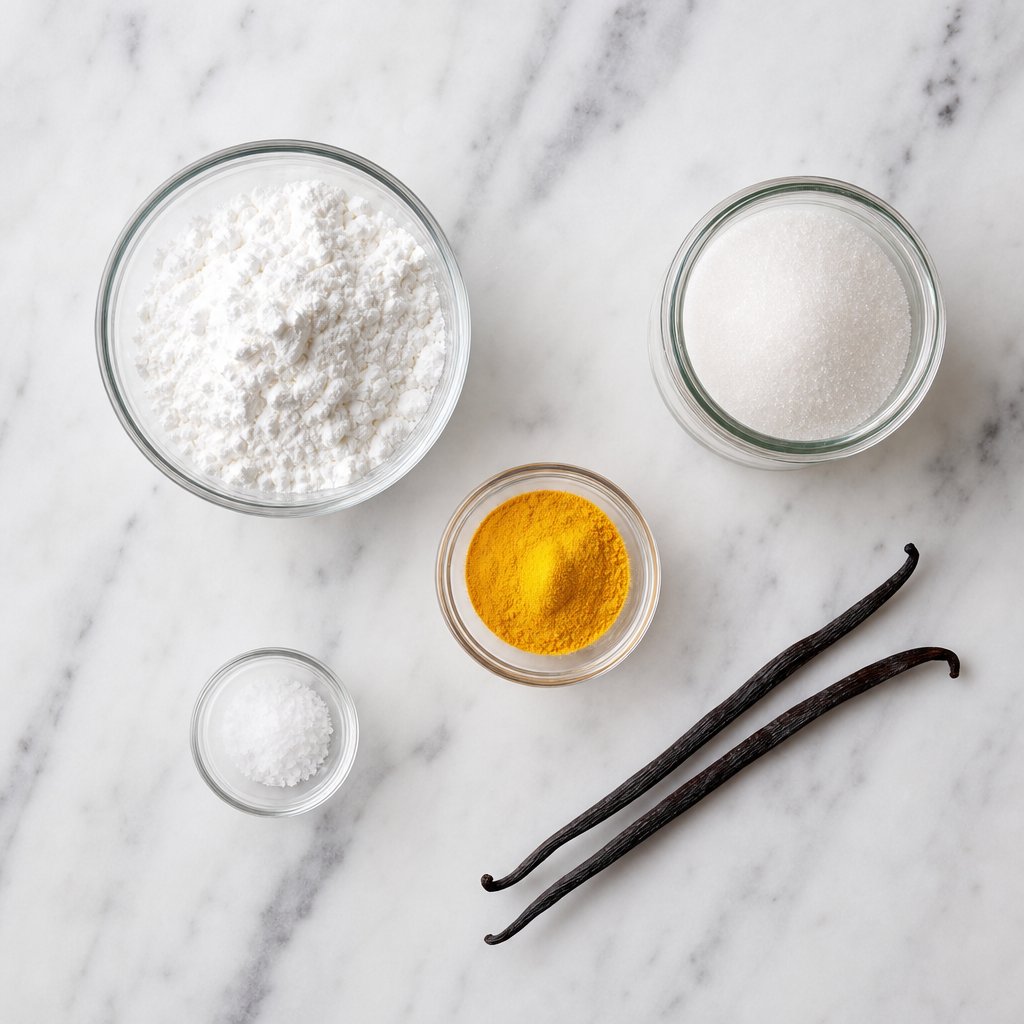
Here is what is custard powder made of, broken down by category:
- Cornflour/Cornstarch - The primary thickener, making up roughly 70-80% of the blend. This is the structural backbone of the entire product.
- Sugar or Sweetener - Some brands include sugar in the powder itself; others leave sweetening entirely to the consumer during preparation.
- Salt - A small amount to enhance and balance flavor.
- Coloring Agents - Annatto (E160b), tartrazine (E102), or sunset yellow (E110), depending on brand and region.
- Flavoring - Natural or artificial vanilla, ethyl vanillin, or a proprietary blend designed to mimic the richness of egg custard.
That is it. Five categories. No eggs, no dairy, no wheat in most formulations. The simplicity is part of the genius, but each component deserves a closer look.
The Base Thickener and Starch Component
Cornstarch dominates the ingredients for custard powder because it does the heavy lifting. When you whisk the powder into hot milk, cornstarch granules absorb liquid, swell, and create that thick, spoonable consistency you associate with custard. Without it, you would just have flavored yellow milk.
Some brands use modified maize starch instead of plain cornflour. The modification is not genetic. It refers to physical or enzymatic treatment that makes the starch more stable under heat and more resistant to breaking down when reheated. You will see this listed as "modified starch" or "modified cornflour" on certain labels, particularly in brands formulated for commercial food service where the custard needs to hold its texture longer.
Coloring Agents and What They Mean on Labels
Imagine custard without its golden yellow color. It would look like white paste. Nobody wants that. Coloring agents exist solely to replicate the warm, inviting hue that egg yolks naturally provide in traditional custard.
You will encounter three main coloring agents across different brands:
- Annatto (E160b) - A natural color extracted from the seeds of the achiote tree, which grows in the American tropics. It produces an orange-yellow shade and is the coloring of choice for brands marketing a "natural" image. As the Food Additives and Ingredients Association notes, annatto is used as an orange food coloring in products such as cheese, butter, and custard powder. It is worth knowing that annatto, despite being natural, has been associated with asthma-type side effects in rare cases.
- Tartrazine (E102) - A synthetic yellow dye that produces a bright, consistent color. It is inexpensive and highly stable, which is why some manufacturers prefer it. However, tartrazine has gained a controversial reputation due to suspected links to hyperactivity in children, and several UK brands have voluntarily phased it out.
- Sunset Yellow (E110) - Another synthetic azo dye, sometimes used alone or blended with tartrazine to achieve the exact shade a brand wants. Like tartrazine, it falls under the "Southampton Six" colors that carry voluntary warnings in the EU.
When you see "E" followed by a number on your custard powder label, that is simply the European food additive classification system. E160b means annatto. E102 means tartrazine. These codes are not inherently alarming. They are standardized identifiers that let you look up exactly what you are consuming.
Flavoring Compounds That Mimic Vanilla and Egg
The flavoring in custard powder has a dual job: deliver vanilla warmth and create the impression of egg richness that is not actually there. Most brands use one or more of the following:
- Vanillin - The primary flavor compound in vanilla beans, produced synthetically at a fraction of the cost. It provides that familiar, comforting vanilla note.
- Ethyl vanillin - A synthetic compound roughly three times stronger than vanillin. Brands use it when they want a more intense vanilla punch without increasing volume.
- Natural vanilla extract or powder - Found in premium formulations. More complex flavor profile, but significantly more expensive.
Some brands list flavoring simply as "flavoring" or "natural and artificial flavors" without specifying the exact compounds. This is legal in most markets but makes it harder for consumers to know precisely what they are getting.
To see how the ingredients of custard powder vary in practice, compare these three widely available brands side by side:
| Component | Bird's Custard Powder (UK) | Weikfield (India) | Foster Clark's (Middle East/Africa) |
|---|---|---|---|
| Primary Starch | Cornflour | Cornflour | Modified cornstarch |
| Sugar Included | No | Yes | Yes |
| Coloring Agent | Annatto (E160b) | Tartrazine (E102), Sunset Yellow (E110) | Tartrazine (E102) |
| Flavoring Type | Flavoring (unspecified) | Vanilla, artificial flavoring | Vanillin |
| Salt | Yes | Yes | Yes |
| Additional Additives | None listed | Permitted emulsifier | Dicalcium phosphate (anti-caking) |
Notice the pattern. Bird's keeps its formulation minimal and uses a natural colorant, reflecting UK consumer preferences and regulatory pressure around synthetic dyes. Weikfield and Foster Clark's include sugar in the powder and rely on synthetic colors that are still widely accepted in their respective markets. The ingredients of custard powder are not universal. They shift based on local regulations, consumer expectations, and price positioning.
This brand-level variation is exactly why reading your specific label matters. Two products called "custard powder" can have meaningfully different custard powder ingredients depending on where they were manufactured and who they were made for. The core architecture, starch plus color plus flavor, stays constant. Everything else is a variable.
The Functional Science Behind Each Component
Knowing the ingredient list is one thing. Understanding why those specific ingredients were chosen over thousands of alternatives is where things get interesting. Every component in a custard powder mix serves a precise functional role, engineered to replicate a dessert that traditionally depends on egg proteins and dairy fat.
Why Cornstarch Is the Perfect Thickening Agent
Corn starch custard powder works because of a process called starch gelatinization. When you heat cornstarch in liquid, the granules absorb water and swell dramatically, typically between 140°F and 190°F (60°C to 88°C). As they swell, they burst open and release starch molecules into the surrounding liquid, forming a gel-like structure that thickens the mixture into a smooth, creamy consistency.
This is fundamentally different from how traditional custard thickens. Egg proteins coagulate when heated, bonding together to set the liquid into a gel. That process is delicate and temperature-sensitive. Heat it two degrees too high and you get scrambled eggs in sweet milk. Cornstarch, by contrast, is forgiving. It thickens predictably, holds its texture when cooled, and does not curdle. That reliability is exactly why it replaced eggs in Alfred Bird's original formula and why it remains the backbone of every custard mix powder on the market.
Cornstarch also contributes a neutral flavor profile. It thickens without adding taste, leaving the flavoring agents to do their work uninterrupted.
How Coloring and Flavoring Create the Custard Illusion
Here is the thing about custard: we eat with our eyes first. A bowl of white, starchy sauce does not register as custard no matter how good it tastes. Yellow coloring exists in the formula for one reason: it mimics the golden hue that egg yolks naturally provide. Without it, the brain rejects the product before the spoon reaches your mouth.
Flavoring compounds carry an equally critical job. Vanilla does not just add sweetness. It creates warmth, depth, and a perception of richness that tricks the palate into sensing the fatty, rounded mouthfeel that egg yolks would normally deliver. As flavor science research confirms, aroma determines the specific item we are tasting, often more than the taste buds themselves. The vanilla aroma in custard powder triggers the brain's association with traditional custard before the texture even registers.
Together, color and flavor form a sensory shortcut. They tell your brain "this is custard" through visual and olfactory cues, while cornstarch handles the physical texture.
The Role of Salt in Flavor Balance
Salt appears in tiny quantities on every custard powder label, and most people overlook it entirely. But remove it and the result tastes flat, one-dimensional, and overly sweet. Salt functions as a universal flavor enhancer in dessert applications. It suppresses bitterness, amplifies sweetness perception, and causes salivation that moves flavor across the entire palate. A pinch of salt in a custard powder mix is the difference between a dessert that tastes complete and one that tastes like sugary starch water.
Custard powder is an engineered sensory system: cornstarch replicates the texture of egg-set custard through gelatinization, yellow coloring mimics the visual appearance of egg yolks, vanilla flavoring triggers aroma-based associations with richness, and salt ties the entire flavor profile together.
Every ingredient earns its place not by accident, but by solving a specific problem that removing eggs created. The result is a product where chemistry does the work that biology used to handle, delivering a remarkably convincing imitation from a handful of plant-based components.
How Ingredients Differ Across Brands and Regions
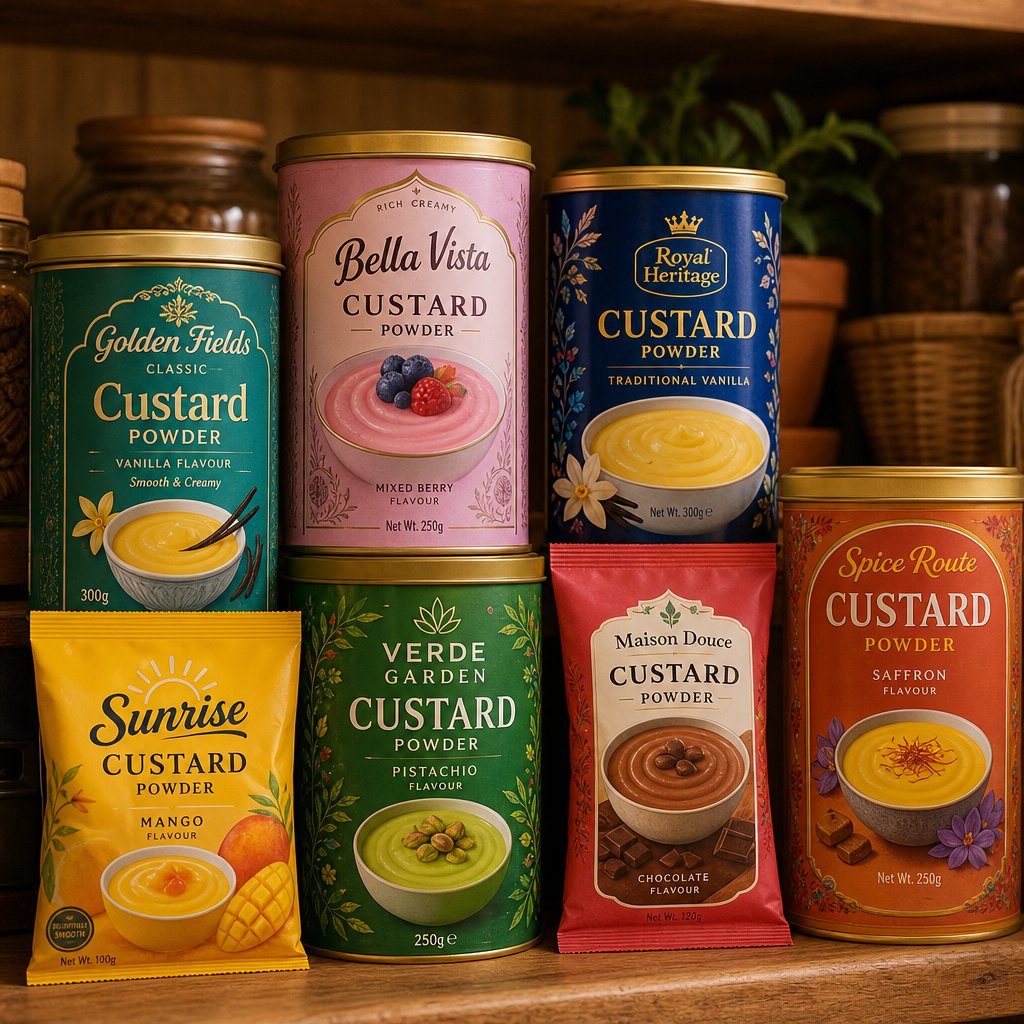
Pick up a tin of custard powder in London and compare it to a packet bought in Mumbai or a box from a supermarket in Dubai. Same product category, same basic purpose, but the ingredient lists tell noticeably different stories. Geography, regulation, and consumer preference shape what ends up in each formulation, and those differences matter if you are managing allergies, following dietary restrictions, or simply trying to replicate a recipe from another country.
How Bird's Custard Powder Compares to Other Brands
Bird's remains the benchmark. It is the original, and the birds custard powder ingredients reflect a deliberately minimalist philosophy: cornflour, salt, coloring (annatto and beta-carotene), and flavoring. No sugar. No emulsifiers. No anti-caking agents. The brand leans into its heritage and the UK market's growing preference for shorter, cleaner ingredient lists.
Weikfield, the dominant custard mix in India, takes a different approach. Sugar is pre-blended into the powder, synthetic colors like tartrazine and sunset yellow provide the golden hue, and a permitted emulsifier helps the powder dissolve more smoothly in hot milk. The formulation reflects Indian consumer expectations: convenience, sweetness built in, and a vibrant color that reads as rich and indulgent.
Foster Clark's, widely available across the Middle East and Africa, sits somewhere between the two. It includes sugar and uses tartrazine for coloring, but also adds dicalcium phosphate as an anti-caking agent to maintain powder flow in humid climates. That last ingredient is a practical concession to geography. Powder products in tropical and subtropical markets face moisture challenges that UK-based formulations simply do not encounter.
Store-brand and generic instant custard powder products add another layer of variation. Some budget formulations swap cornflour for cheaper modified starches, use blended synthetic colorings to hit a target shade at lower cost, or include milk solids to create a product that works with water instead of milk. These are technically custard powders, but they blur the line between a traditional custard mix and a fully instant dessert product.
Regional Variations in Custard Powder Formulation
The differences are not random. They follow clear regional patterns driven by food regulation, ingredient availability, and local taste preferences:
| Region | Typical Coloring | Sugar Included | Starch Type | Regulatory Influence |
|---|---|---|---|---|
| United Kingdom | Annatto (E160b), beta-carotene | No | Plain cornflour | Voluntary removal of Southampton Six synthetic dyes |
| India | Tartrazine (E102), Sunset Yellow (E110) | Yes | Cornflour | FSSAI permits synthetic colors within specified limits |
| Middle East/Africa | Tartrazine (E102) | Yes | Modified cornstarch | Codex Alimentarius standards widely adopted |
| Australia/New Zealand | Annatto (E160b) | Varies | Cornflour or wheaten cornflour | FSANZ preference for natural colorants; wheat starch common |
| Continental Europe | Beta-carotene or tartrazine (with warning label) | Varies | Cornflour or potato starch | EU requires activity warning on products with Southampton Six dyes |
A few patterns stand out. UK and Australian formulations trend toward natural colorants, driven by regulatory pressure and consumer demand. Indian and Middle Eastern products favor synthetic dyes that deliver brighter, more consistent color at lower cost. The sugar question splits along a similar line: markets where custard is typically served as a quick dessert tend to include sugar for convenience, while markets where custard powder is used as a baking ingredient leave sweetening to the cook.
The Australian case is particularly interesting. Many Australian custard powders use wheaten cornflour rather than pure maize cornflour, which means they contain gluten. If you are buying custard powder in Australia and need it to be gluten-free, you cannot assume. You have to check.
These regional differences explain why a recipe that works perfectly with one brand might taste or behave slightly differently with another. A custard mix from India will be sweeter out of the packet than Bird's. An instant custard powder from the Middle East may set slightly differently due to modified starch. Knowing where your powder was formulated, and for which market, gives you the context to adjust accordingly.
Allergen and Dietary Compatibility Guide
Regional formulations and brand-level ingredient differences are not just a matter of taste. They directly affect whether a specific custard powder is safe for you or the people you are feeding. Allergen and dietary questions around this product come up constantly, and the answers are less straightforward than most people assume.
Is Custard Powder Vegan and Egg-Free
Every standard custard powder is egg-free. That is not a bonus feature. It is the founding principle of the product, dating back to Alfred Bird's original 1837 formula. If you need an eggless custard powder, you are looking at the right product category entirely.
But egg-free does not automatically mean vegan. The powder itself typically contains no animal-derived ingredients, yet some brands include milk solids, whey powder, or casein derivatives in their formulations, particularly instant versions designed to be mixed with water rather than milk. You need to check the specific product, not just the category.
The good news for anyone searching "is Birds custard powder vegan": yes, it is. The powder contains maize starch, salt, flavoring, and annatto norbixin (E160b) as its coloring agent. No dairy, no eggs, no gelatin. Bird's custard is certified vegetarian and confirmed dairy-free. To make the prepared custard vegan as well, simply swap cow's milk for a plant-based alternative like soy, oat, or almond milk at a 1:1 ratio. Soy milk tends to produce the closest texture to dairy-based custard due to its protein content.
Gluten-Free and Allergen Status by Brand
Gluten-free status is where things get tricky. Pure cornstarch is naturally gluten-free, so any custard powder built on a maize starch base should be safe in theory. In practice, cross-contamination during manufacturing and the use of wheaten cornflour in some Australian formulations mean you cannot take gluten-free status for granted.
Bird's, for example, states that its custard powder is made with gluten-free ingredients but cannot be officially certified gluten-free due to potential cross-contamination risk. That distinction matters. If you have a preference for avoiding gluten, Bird's works. If you have celiac disease or a diagnosed gluten allergy, the lack of certification is a red flag worth taking seriously.
Here is a quick-reference table covering the most common brands:
| Brand | Egg-Free | Dairy-Free | Vegan | Gluten-Free | Nut-Free |
|---|---|---|---|---|---|
| Bird's Custard Powder (UK) | Yes | Yes | Yes | Made with GF ingredients (not certified) | Yes |
| Weikfield (India) | Yes | Yes | Yes | Yes (cornflour-based) | Yes |
| Foster Clark's (Middle East/Africa) | Yes | Yes | Check label | Check label | Yes |
| Store-brand instant custard | Varies | Varies (may contain milk solids) | Varies | Varies | Varies |
A few practical takeaways from this table. Standard vegan custard powder options are widely available, with Bird's being the most accessible and well-documented choice. Nut allergies are generally not a concern since no major brand includes nut-derived ingredients. The biggest variable is the instant and store-brand category, where manufacturers sometimes add milk derivatives for convenience or use shared production lines that handle wheat, dairy, and soy.
The bottom line: if you are buying a named brand of traditional custard powder (not instant), you are almost certainly getting an egg-free, dairy-free product. Vegan and gluten-free status requires one extra step: reading the allergen declaration on your specific packet. That ten-second label check is the difference between confidence and guesswork.
Custard Powder vs Traditional Egg Custard
Custard from powder and custard from eggs end up in the same bowl, often served alongside the same desserts. But the two are built on entirely different foundations. One relies on protein chemistry. The other relies on starch chemistry. Understanding that distinction helps you choose the right approach for any given recipe and explains why the two versions taste similar but never quite identical.
What Traditional Custard Contains That Powder Does Not
Traditional egg custard is a short ingredient list: egg yolks, milk or cream, sugar, and vanilla. That is it. The egg yolks do triple duty. They thicken the liquid through protein coagulation, contribute fat for richness and mouthfeel, and provide natural golden color. Dairy adds moisture, creaminess, and additional fat. Sugar sweetens and tenderizes by slowing protein bonding.
Custard powder custard replaces all of that egg functionality with engineered substitutes. Cornstarch handles thickening. Yellow coloring handles appearance. Vanilla flavoring handles aroma. Milk is still added during preparation, but the powder itself brings no protein, no fat, and no cholesterol to the equation. How do you make custard with custard powder? You whisk the powder into cold milk, heat the mixture while stirring, and the starch gelatinizes into a thick sauce. No tempering, no double boiler, no anxious thermometer watching.
Texture and Flavor Differences You Can Taste
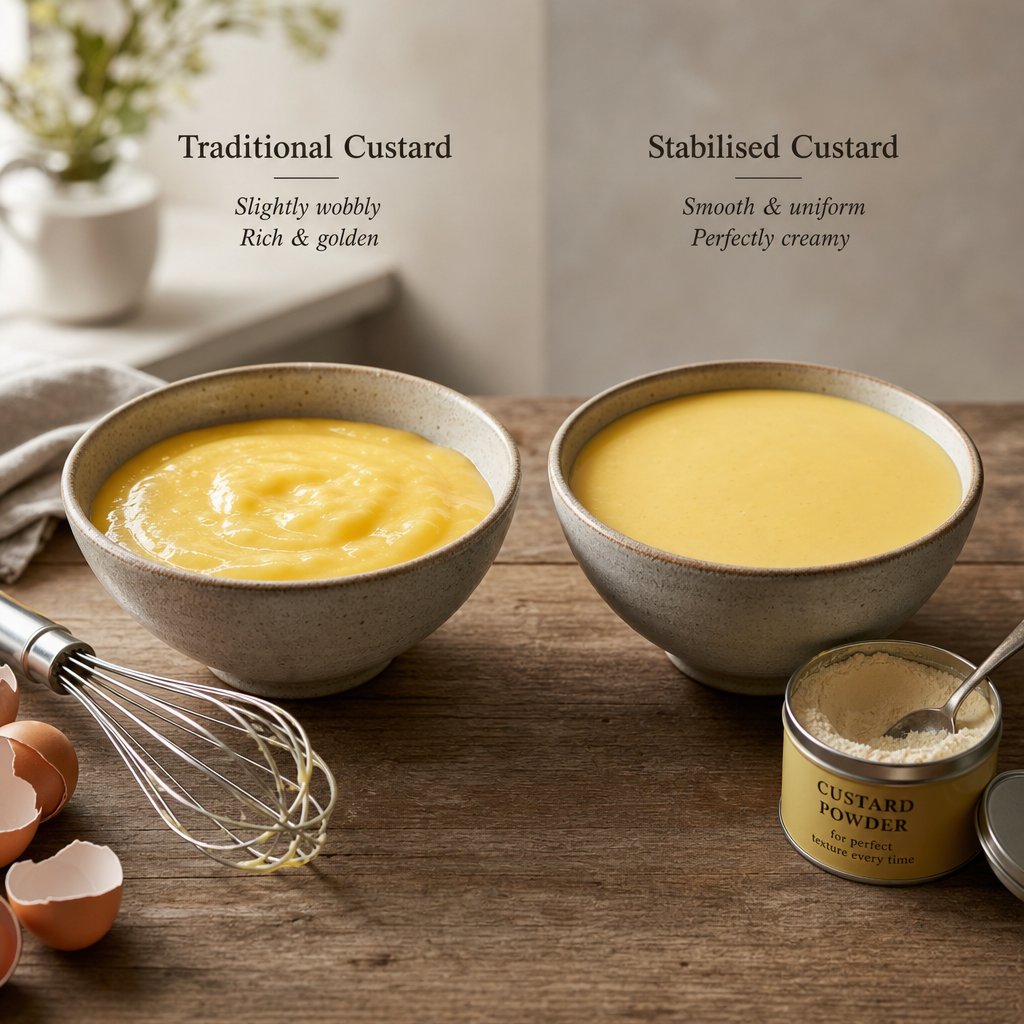
The mechanisms behind each version produce noticeably different results. Egg proteins coagulate when heated, meaning individual protein strands unfold and bond together into a mesh that traps liquid. This creates a custard that is delicate, slightly wobbly, and has a silky mouthfeel from the emulsified fats in the yolks. The texture is fragile by design. Push the temperature too high and those proteins tighten, squeeze out water, and curdle into grainy lumps.
Cornstarch gelatinization works differently. Starch granules absorb liquid, swell, and burst, releasing starch molecules that physically obstruct flow and create thickness. The result is a custard that is smoother, more uniform, and noticeably firmer when set. It holds a spoon track cleanly. It does not curdle. It reheats without breaking. But it also lacks the subtle wobble and the layered richness that egg fat provides.
Here is how the two compare across the dimensions that matter most in the kitchen:
| Dimension | Traditional Egg Custard | Custard From Powder |
|---|---|---|
| Thickening mechanism | Egg protein coagulation | Starch gelatinization |
| Protein content | High (from eggs and dairy) | Low (only from added milk) |
| Fat content | High (egg yolks + cream) | Low to moderate (from added milk only) |
| Texture profile | Delicate, wobbly, silky | Smooth, firm, uniform |
| Flavor complexity | Rich, layered, eggy depth | Clean vanilla, less nuanced |
| Preparation time | 15-30 minutes (requires tempering and careful heating) | 5-10 minutes (whisk and heat) |
| Consistency of results | Variable (risk of curdling or scrambling) | Highly consistent batch to batch |
| Shelf stability (dry form) | N/A (fresh ingredients required) | 12-24 months unopened |
| Curdling risk | High (proteins overcook above 180°F/82°C) | Virtually none |
That consistency column is the reason professional bakers and food service operations lean heavily on powder. A recipe for custard with custard powder delivers the same thickness, color, and flavor whether it is batch number one or batch number five hundred. Egg custard, by contrast, demands precise temperature control. The coagulation window sits between roughly 160°F and 180°F (71°C to 82°C), and overshooting by even a few degrees produces curdled results. In a busy kitchen, that margin of error costs time and money.
Does that mean powder is better? Not necessarily. Egg custard wins on flavor depth and textural elegance. The fats and proteins in yolks create a richness that starch and flavoring cannot fully replicate. For a standalone creme brulee or a classic tart filling where custard is the star, eggs remain the superior choice. For trifles, quick sauces, baking applications, and any situation where speed and reliability outweigh nuance, how to make custard with custard powder becomes the more practical question.
The two approaches are not competitors so much as tools for different jobs. Knowing what each one brings to the table, and what it leaves out, lets you pick the right tool every time. And for anyone who cannot eat eggs at all, custard powder is not a compromise. It is the only option that was specifically invented to solve that exact problem.
Substitutes and Homemade Custard Powder Recipes
Sometimes the tin is empty, the store is closed, or you simply prefer to know exactly what goes into your food. Whatever the reason, finding a reliable custard powder substitute is easier than you might think. The product itself is only a handful of ingredients, which means replicating it from pantry staples is entirely doable.
Common Pantry Substitutes That Work
Not every custard powder replacement performs equally. Some deliver a near-identical result. Others get you close enough for baking but fall short as a standalone dessert. Here they are ranked by how closely they mimic the real thing:
- Cornstarch + vanilla extract + yellow food coloring (or a pinch of turmeric) - This is the closest match and the most common Bird's custard powder substitute. For every tablespoon of custard powder a recipe calls for, use one tablespoon of cornstarch, one teaspoon of vanilla extract, and a tiny drop of yellow coloring. You get the same thickening power, the same flavor profile, and the same golden appearance.
- Instant vanilla pudding mix - Swap at a 1:1 ratio. The texture is nearly identical, though pudding mix tends to be sweeter and may contain additional stabilizers. Works well in trifles, cake fillings, and layered desserts where custard is one component among many.
- Pastry cream powder - A professional baking product that functions similarly but produces a slightly richer, denser result. Best for filled pastries and tarts where you want body and structure.
- Tapioca starch + vanilla + coloring - A viable custard powder alternative for anyone avoiding corn-based products. Tapioca thickens at a similar rate, though the final texture can be slightly more glossy and elastic.
When do these substitutions work well? Baking applications, thickening sauces, and recipes where custard plays a supporting role. A substitution for custard powder in a Victoria sponge filling or a fruit trifle layer will be virtually undetectable. Where substitutes fall short is in standalone custard desserts, the kind you pour into a bowl and eat with a spoon, where flavor complexity and that specific custard powder taste profile become more noticeable.
How to Make Custard Powder at Home
If you bake regularly with custard powder recipes, making your own batch in advance saves trips to the store and puts you in full control of what goes in. Homemade custard powder takes about five minutes to prepare and stores for up to three months in an airtight container.
Here is the basic ratio:
- 1 cup cornstarch - the thickening base
- 1/3 cup powdered sugar - for subtle sweetness
- 2 tablespoons vanilla sugar or 1 tablespoon vanilla powder - for flavor (alternatively, mix 1 teaspoon vanilla extract into the cornstarch and let it dry before combining)
- 1/4 teaspoon fine salt - for flavor balance
- 1/8 teaspoon yellow food coloring powder - optional, purely cosmetic
Sift all dry ingredients together through a fine mesh sieve to remove lumps, then whisk until evenly distributed. Store in a sealed jar away from heat and moisture. To use, follow the same method as any custard recipe from custard powder: combine two tablespoons of your homemade mix with two cups of milk in a saucepan, add sugar to taste, and whisk over medium heat until thickened.
The real advantage of homemade custard powder goes beyond convenience. You choose whether to use natural coloring or skip it entirely. You decide between real vanilla powder and synthetic vanillin. You can swap in coconut milk powder for a dairy-free version or use arrowroot starch instead of corn for a different dietary need. Every ingredient is visible, intentional, and under your control, which is exactly what many home bakers want when they see unfamiliar E-numbers on a commercial label.
Of course, DIY versions lack the precise particle-size engineering and moisture control that commercial manufacturers build into their products. That engineering is what gives store-bought powder its consistent dissolving behavior and extended shelf life, a topic worth exploring if you have ever wondered how food companies scale a simple kitchen formula into a product that performs identically across millions of units.

How Powder Food Products Are Formulated at Scale
A homemade custard powder recipe and a commercial one share the same core ingredients. The difference lies in how those ingredients are processed, blended, and stabilized to perform identically across thousands of batches, in varying climates, over months of shelf life. Scaling a kitchen formula into a mass-produced product introduces engineering challenges that most home cooks never consider.
From Recipe to Production Line
When you learn how to make custard powder at home, you sift dry ingredients together and call it done. Commercial manufacturing demands far more precision. The process begins with particle size matching. Cornstarch granules, coloring agents, salt crystals, and flavoring compounds all have different particle sizes and densities. If these are not carefully matched or controlled, the blend separates during transport and storage, a phenomenon called particle segregation. Heavier particles settle to the bottom while finer ones migrate upward, meaning the first scoop from a container could taste and perform differently from the last.
Manufacturers solve this through controlled blending using ribbon blenders or V-blenders calibrated for specific speeds and durations. Over-blending generates heat and can degrade volatile flavoring compounds. Under-blending leaves uneven color distribution. The sweet spot depends on the exact formulation.
Moisture content is another critical variable. Powder products must stay below specific humidity thresholds to prevent clumping, microbial growth, and premature starch activation. If moisture creeps in during production, the cornstarch begins to gelatinize inside the package rather than when you actually prepare it. That is why how to prepare custard powder from a commercial tin feels effortless: the moisture engineering ensures the starch activates only when you add hot liquid, not before.
Custom Powder Formulation for Specialty Markets
The same manufacturing principles that produce custard powder apply across the broader powder food and supplement industry. Modern OEM/ODM manufacturers use these techniques to develop custom formulations for specific dietary markets: vegan blends, allergen-free products, reduced-sugar versions, and functional food powders fortified with vitamins or probiotics.
How do you make custard powder that meets a specific regional standard or dietary certification? You partner with a manufacturer equipped to handle ingredient compatibility testing, precise particle engineering, and scalable production. Companies like ZhuFeng, which specializes in OEM/ODM health food manufacturing with powder and granule capabilities, help brands develop custom powder formulations with flexible ingredient customization and production volumes that scale from pilot batches to full commercial runs. Their service model covers everything from formulation design through finished product, supporting formats that include powders, granules, capsules, tablets, and gummy products.
This matters beyond custard. The same blending precision, moisture control, and shelf-stability testing that keeps your custard powder performing consistently also governs how protein powders, superfood blends, and functional beverage mixes reach the market. Every powder product you scoop, stir, or shake benefits from the same core engineering: matched particle sizes, controlled environments, and validated blending parameters that guarantee uniformity from the first unit off the line to the last.
Understanding how to prepare custard powder properly, whisking it into cold milk before heating, actually reflects the product engineering built into it. The granule size is calibrated so the powder disperses without lumping at room temperature, then activates cleanly when heat is applied. That behavior is not accidental. It is the result of manufacturing decisions made long before the product reaches your kitchen shelf.
Frequently Asked Questions About Custard Powder Ingredients
1. Is custard powder made from eggs or dairy?
No. Custard powder was specifically invented in 1837 to replicate egg custard without using eggs. The dry powder contains no eggs and no dairy in most standard formulations. It relies on cornstarch for thickening, yellow coloring to mimic egg yolks, and vanilla flavoring for richness. Dairy only enters the equation when you add milk during preparation, and even that can be swapped for plant-based alternatives to keep the final custard entirely vegan.
2. What are the main ingredients in Bird's custard powder?
Bird's custard powder contains four core components: cornflour (maize starch) as the primary thickener, salt for flavor balance, annatto norbixin (E160b) as a natural yellow coloring agent, and flavoring. It does not include sugar, emulsifiers, or anti-caking agents, making it one of the most minimalist formulations on the market. This simplicity also means Bird's is confirmed vegan, egg-free, and dairy-free, though it is not officially certified gluten-free due to potential cross-contamination during manufacturing.
3. Can I use custard powder if I have a gluten allergy?
It depends on the brand and region. Most custard powders use pure maize cornstarch, which is naturally gluten-free. However, some Australian formulations use wheaten cornflour that contains gluten. Even brands like Bird's that use gluten-free ingredients cannot guarantee zero cross-contamination in their facilities. If you have celiac disease, look for products with certified gluten-free labeling rather than assuming all custard powders are safe.
4. What can I use as a substitute for custard powder?
The closest substitute is cornstarch mixed with vanilla extract and a drop of yellow food coloring, using a 1:1 ratio for the cornstarch. Instant vanilla pudding mix also works at equal measurements, though it tends to be sweeter. For a homemade version you can store for months, combine one cup cornstarch, one-third cup powdered sugar, two tablespoons vanilla sugar, a pinch of salt, and optional yellow coloring powder. This DIY approach lets you control every ingredient and avoid artificial additives.
5. Why do custard powder ingredients differ between countries?
Regional food regulations, consumer taste preferences, and climate conditions drive formulation differences. UK brands favor natural colorants like annatto due to voluntary bans on certain synthetic dyes, while Indian and Middle Eastern brands use tartrazine for brighter color at lower cost. Tropical markets often add anti-caking agents to prevent clumping in humid conditions. Sugar inclusion also varies: markets where custard is served as a quick dessert tend to pre-blend sugar, while baking-focused markets leave sweetening to the cook. OEM/ODM manufacturers like ZhuFeng (https://en.ahzfsw.com/service.html) help brands customize powder formulations for specific regional standards and dietary certifications through scalable production.