What Sublingual Means and Why Your Doctor Chose This Method
You just picked up a prescription, and the label says "place under the tongue." Sounds simple enough, right? Yet a surprising number of patients lose a significant portion of their dose by doing it wrong. Before you can master the technique, you need to understand what sublingual actually means and why your medication was designed for this specific route.
What Does Sublingual Actually Mean
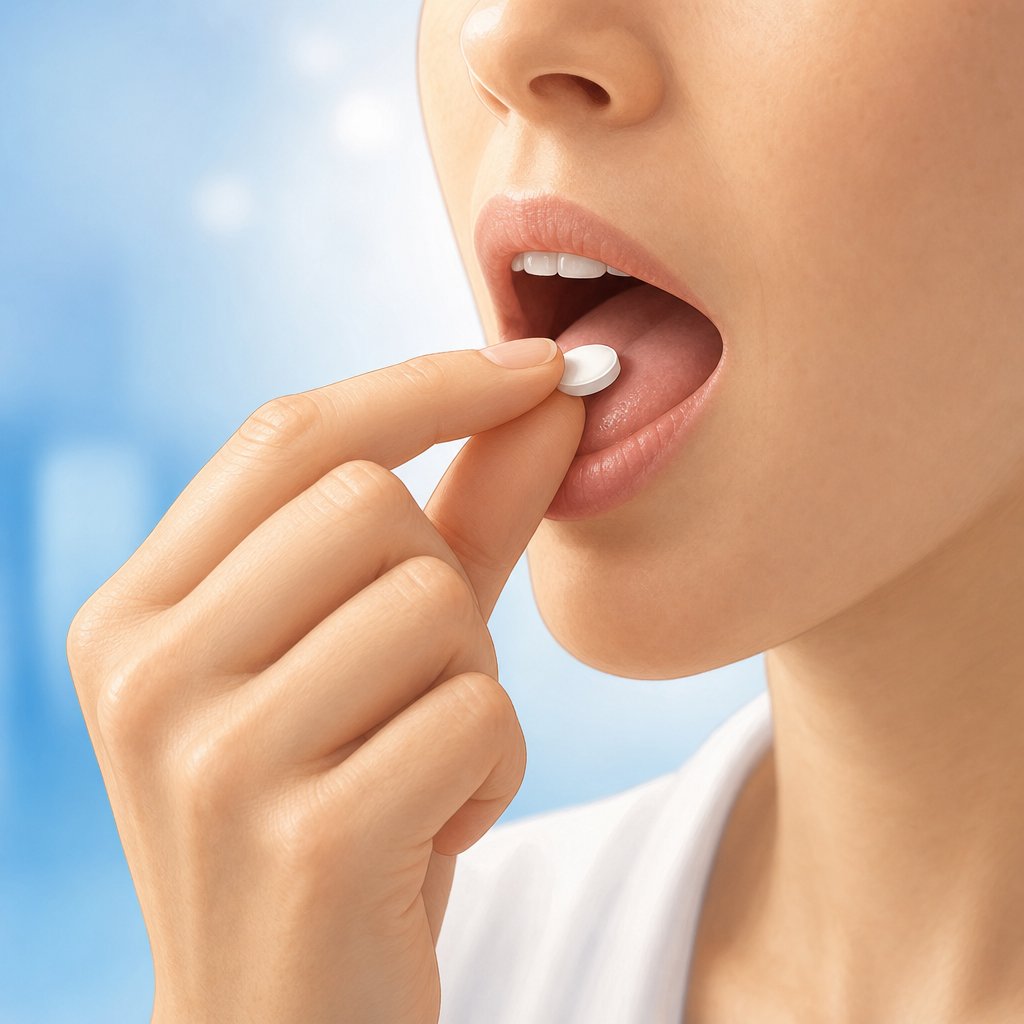
Sublingual definition: A pharmacological route of administration in which a tablet, film, or spray is placed under the tongue, where it dissolves and absorbs directly into the bloodstream through the mucous membrane, bypassing the digestive system entirely.
The word itself comes from Latin. "Sub" means under, and "lingual" refers to the tongue. So when you see the term on a prescription label, it literally tells you where the medication goes. What does sublingual mean in medical terms? It describes any drug delivery method that uses the thin, blood-vessel-rich tissue beneath your tongue as a direct gateway into circulation.
This definition for sublingual applies to a range of product formats, from fast-dissolving tablets like nitroglycerin (Nitrostat) to films like buprenorphine/naloxone (Suboxone) and even concentrated drops. The common thread is the same: the medication never travels through your stomach.
Why Doctors Prescribe Sublingual Instead of Oral
When you swallow a standard pill, it passes through your gastrointestinal tract and liver before reaching your bloodstream. Along the way, stomach acid, bile, and liver enzymes break down a significant portion of the active ingredient. Pharmacologists call this first-pass metabolism, and for certain drugs it can destroy more than half the dose before it ever does its job.
Sublingual delivery sidesteps that entire process. The tissue under your tongue is thin, non-keratinized, and packed with capillaries. Medication placed there diffuses directly into venous circulation within minutes. That translates to three practical advantages:
- Faster onset of action, often comparable to an injection
- Higher bioavailability because the drug avoids degradation in the gut and liver
- A reliable option for patients who have trouble swallowing or suffer from GI conditions
Doctors prescribe this route for medications where speed and potency matter most, including cardiovascular drugs, opioid analgesics, certain hormones, and vitamins like B12. Understanding what is sublingual and why it was chosen for your specific medication is the first step toward using it correctly.
The real challenge, though, is technique. A small error in placement, timing, or mouth preparation can redirect the drug straight into your stomach, turning a sublingual tablet into a poorly performing oral one. The mechanics of how that absorption actually works reveal exactly why precision matters.
How Sublingual Absorption Gets Medication Into Your Blood Faster
Imagine placing a tablet under your tongue and feeling its effects within minutes. That speed is not a coincidence. It is the direct result of anatomy and chemistry working together in a very specific way. Understanding the sublingual route at a basic level helps you appreciate why even small technique errors can sabotage your dose.
How the Under-Tongue Tissue Absorbs Medication
So how are sublingual medications absorbed into the body? The floor of your mouth and the underside of your tongue are lined with a thin, non-keratinized mucous membrane. Unlike the tough, layered skin on the outside of your body, this tissue is only a few cell layers thick. Directly beneath it sits a dense network of capillaries, including the deep lingual vein, which feeds into systemic circulation.
When a tablet dissolves in this space, the active drug molecules pass through the thin membrane via simple diffusion and enter those blood vessels almost immediately. From there, the medication travels through the venous system and reaches target tissues throughout the body. This transmucosal route essentially turns the underside of your tongue into a direct on-ramp to your bloodstream, no detours required.
A few anatomical details make this area especially efficient for drug delivery:
- The sublingual mucosa is highly permeable due to its thin epithelial layer
- Blood flow in the region is abundant and continuous
- Saliva production in the sublingual space is relatively low compared to other oral areas, reducing premature drug dilution
First-Pass Metabolism Explained Simply
When you swallow a standard oral medication, it takes a long journey. The tablet breaks down in your stomach, the active ingredient gets absorbed in the small intestine, and then the drug travels through the portal vein to your liver. Here is where the problem starts. Your liver treats many drugs as foreign substances and breaks them down using enzymes before they ever reach general circulation. Pharmacologists call this first-pass metabolism, and for some medications it can destroy 50% or more of the active dose.
Sublingual absorption bypasses this entire gastrointestinal pathway. Because the drug enters the bloodstream directly through the oral mucosa, it never passes through the stomach, intestines, or liver on its first trip through the body. The result is significantly higher bioavailability, meaning more of the drug you take actually reaches the tissues where it needs to work. For medications like nitroglycerin, which treats acute chest pain, this difference between sublingual vs oral delivery is not just convenient. It can be life-saving.
Sublingual vs Oral Absorption Speed
Timing is where the transmucosal route really separates itself from traditional pills. Sublingual absorption typically delivers medication into the bloodstream within 2 to 5 minutes. Compare that to a swallowed tablet, which generally takes 30 to 60 minutes to produce noticeable effects because it must survive stomach acid, travel to the small intestine, get absorbed, and then pass through the liver.
Here is a quick comparison of the key advantages sublingual delivery holds over standard oral medication:
- Speed of onset: 2-5 minutes (sublingual) vs. 30-60 minutes (oral)
- Bioavailability: Higher, because the drug avoids degradation by stomach acid and liver enzymes
- Dose efficiency: Lower doses can achieve the same therapeutic effect since less drug is wasted
- Independence from GI conditions: Absorption is not affected by food in the stomach, nausea, or vomiting
- No swallowing required: Beneficial for patients with dysphagia or those who are nauseated
That said, sublingual how long does it take to work depends on the specific formulation. Fast-dissolving nitroglycerin tablets may produce relief in under two minutes, while a sublingual B12 supplement might take closer to five minutes to fully dissolve. The medication's molecular size, solubility, and tablet composition all influence the exact timeline.
Speed and bioavailability only matter, though, if the tablet stays in the right place long enough for absorption to happen. The difference between a properly placed tablet and one that slides around your mouth is the difference between a full dose and a partial one. Getting the physical technique right is where most patients either succeed or silently fail.
Step-by-Step Technique for Proper Sublingual Tablet Placement
Knowing the science is one thing. Executing the technique correctly every single time is another. So how do you take a sublingual tablet the right way? The process involves three distinct phases: preparing your mouth, placing the tablet precisely, and staying still while it dissolves. Miss any one of these, and you risk sending your medication down the wrong path.
Preparing Your Mouth Before Placement
Preparation takes less than a minute but makes a real difference in how well your sublingual tablet absorbs. A dry mouth slows dissolution, while an overly wet mouth can wash the drug away before it has time to cross the membrane.
Here is how to take sublingual tablet doses with proper preparation:
- Wash your hands before handling the tablet. Residue from food, lotion, or other substances can contaminate the medication.
- Avoid eating, drinking, or smoking for at least 10 to 15 minutes before your dose. Food particles and beverages alter the oral environment and can interfere with absorption.
- Hydrate lightly if your mouth feels dry. Take a small sip of water a few minutes beforehand to ensure adequate moisture. You want the tissue under your tongue to be moist, not flooded.
- Inspect the tablet before removing it from the blister pack. If it is cracked, crumbled, or discolored, consult your pharmacist before using it.
- Sit upright. Do not lie down while the medication dissolves. An upright position helps keep the tablet in place and reduces the risk of accidentally swallowing it.
Exact Placement Under the Tongue
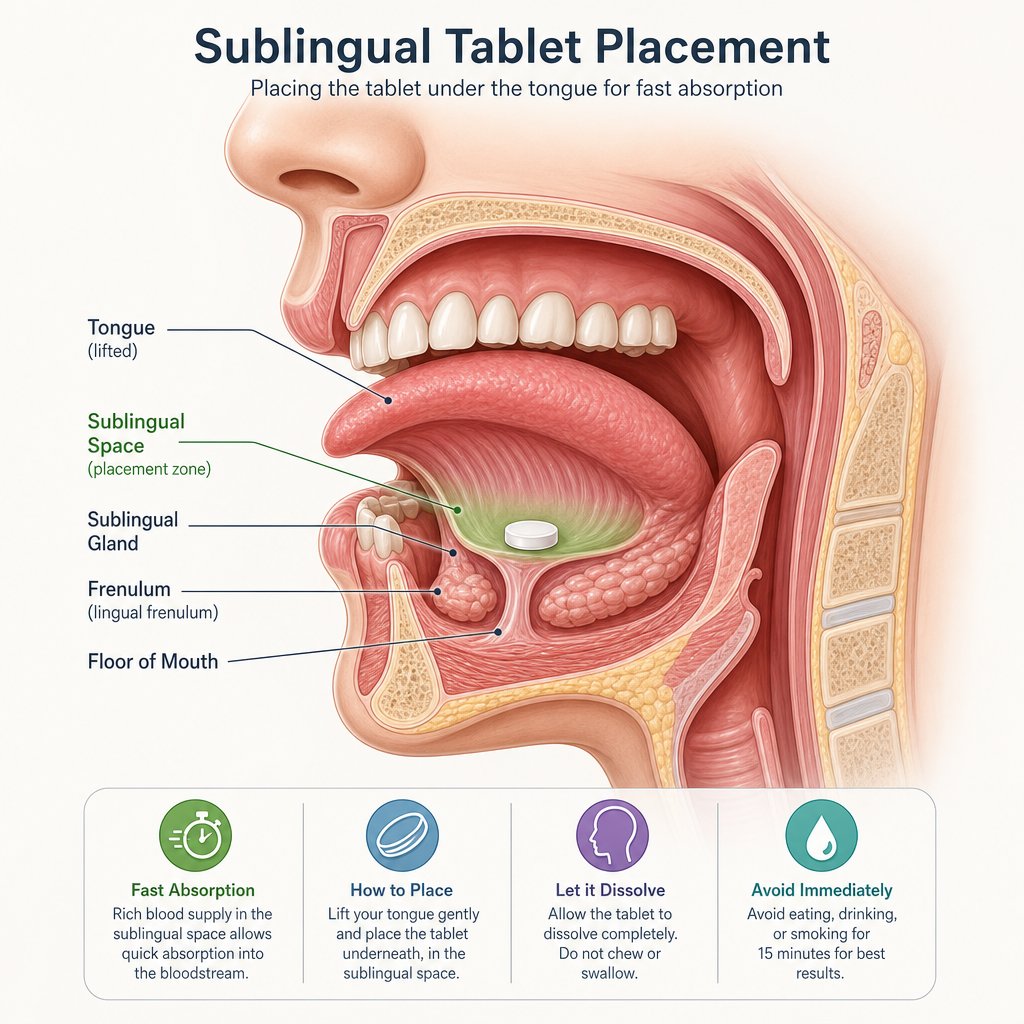
This is where precision matters most. Sublingual medications are placed in a specific pocket of tissue, not just anywhere in the mouth. When you hear the question "how should a sublingual medication be administered to a patient," the answer always centers on this exact location: the sublingual space between the base of the tongue and the floor of the mouth.
- Lift your tongue toward the roof of your mouth.
- Place the tablet directly on the floor of your mouth, in the soft pocket beneath the tongue. Avoid placing it on top of the tongue or too far back toward the throat.
- Lower your tongue gently over the tablet. Do not press down hard. Light contact keeps the tablet in position without crushing it.
- Close your mouth and breathe normally through your nose.
You will notice the tablet sitting comfortably in that small depression. If it feels like it is sliding toward the back of your throat, reposition it slightly forward with the tip of your tongue.
What to Do While the Tablet Dissolves
The dissolution phase is where most people unknowingly sabotage their dose. Once the sublingual tablet is in position, your only job is to leave it alone. Here is how to use sublingual tablets during this critical window:
- Do not chew or crush the tablet. Let it dissolve on its own.
- Do not swallow your saliva until the tablet has completely dissolved. Let saliva pool naturally under your tongue.
- Do not talk. Moving your tongue and jaw displaces the tablet and increases saliva production, both of which reduce absorption.
- Do not eat or drink anything during dissolution.
How long should you hold still? Most sublingual tablets dissolve within 2 to 10 minutes depending on the formulation. Nitroglycerin tablets typically dissolve in under 2 minutes, while buprenorphine products may take closer to 5 to 10 minutes. Your pharmacist can give you a specific timeframe for your medication. Once the tablet is fully gone and no gritty residue remains, you can swallow normally.
Quick rule: Place it, forget it, and do not swallow until it is completely dissolved. If you can still feel any solid material under your tongue, the tablet is not done working.
Learning how to take a sublingual tablet correctly is straightforward once you practice it a few times. The real confusion tends to arise when patients mix up sublingual placement with a closely related technique that uses a completely different area of the mouth.
Sublingual vs Buccal Administration and When Each Applies
Your pharmacist says "place it in your cheek." Your other prescription says "under the tongue." Both involve dissolving medication inside your mouth, and both bypass the digestive system. So what is the actual difference? Confusing sublingual vs buccal placement is one of the most common medication errors patients make, and it can meaningfully change how much drug reaches your bloodstream.
Where Exactly Buccal Medications Go
A buccal medication is placed between the gum and the inner lining of your cheek. You press the tablet or film against the cheek tissue and hold it there while it dissolves. The drug absorbs through the buccal mucosa, a tissue layer that lines the inside of your cheeks and has its own rich blood supply.
Both routes use the transmucosal route to deliver drugs directly into systemic circulation, skipping the stomach and liver entirely. The critical distinction lies in the tissue itself. The sublingual region is lined with thin, non-keratinized epithelium that is only 100 to 200 micrometers thick and 8 to 12 cells deep. The buccal region, by contrast, is 500 to 800 micrometers thick and 40 to 50 cells deep. That difference in thickness directly affects how quickly a drug can cross the membrane and enter the blood.
When a medication is administered buccally, it encounters more cellular layers before reaching the capillaries underneath. This slower permeation is not a flaw. It is a deliberate design choice. The buccal route of administration works well for drugs that benefit from a more gradual, sustained absorption profile rather than an immediate spike in blood concentration.
When Sublingual Is Preferred Over Buccal
Doctors choose between these two routes based on how fast the drug needs to act and how long it needs to release. Sublingual delivery is the go-to when rapid onset matters. Think nitroglycerin for acute angina, where every second counts, or fentanyl sublingual tablets for breakthrough cancer pain. The thinner tissue means faster absorption, often within 2 to 5 minutes.
Buccal administration vs sublingual delivery makes more sense when a medication needs to absorb steadily over a longer period. Buccal fentanyl (Fentora), for example, is formulated as an effervescent tablet that adheres to the cheek and releases the drug over 15 to 25 minutes. Midazolam oral solution (Buccolam) is given buccally for seizure emergencies in children because the cheek placement is easier to manage in a patient who may be convulsing.
The buccal route also offers a larger surface area for adhesive formulations. The buccal mucosa has an estimated surface area of about 50 cm², compared to roughly 26.5 cm² for the sublingual region. This extra space accommodates mucoadhesive patches and films that need to stay in place for extended periods without being dislodged by tongue movement.
| Feature | Sublingual | Buccal |
|---|---|---|
| Placement location | Under the tongue, on the floor of the mouth | Between the cheek and gum |
| Tissue thickness | 100-200 micrometers (8-12 cells) | 500-800 micrometers (40-50 cells) |
| Absorption speed | Rapid (2-5 minutes typical onset) | Slower, more gradual (5-30 minutes) |
| Best suited for | Fast-acting medications needing immediate effect | Sustained-release or longer-acting formulations |
| Common medications | Nitroglycerin, buprenorphine/naloxone (Suboxone), sublingual B12 | Fentanyl (Fentora), midazolam (Buccolam), nicotine lozenges |
| Patient experience | Tablet dissolves quickly; must avoid swallowing for a short window | Tablet or film adheres to cheek; longer hold time but less tongue interference |
The bottom line: if your prescription says sublingual, it goes under the tongue. If it says buccal, it goes in the cheek. Placing a sublingual tablet buccally slows its absorption and may reduce its effectiveness. Placing a buccal medication sublingually can cause it to dissolve too quickly or irritate the thinner tissue. Always follow the specific instructions for your medication, and ask your pharmacist if you are unsure which route applies.
Knowing where to place the tablet is only half the equation. Even with perfect positioning, a handful of common behavioral mistakes during the dissolution process can quietly undermine your dose without you ever realizing it.
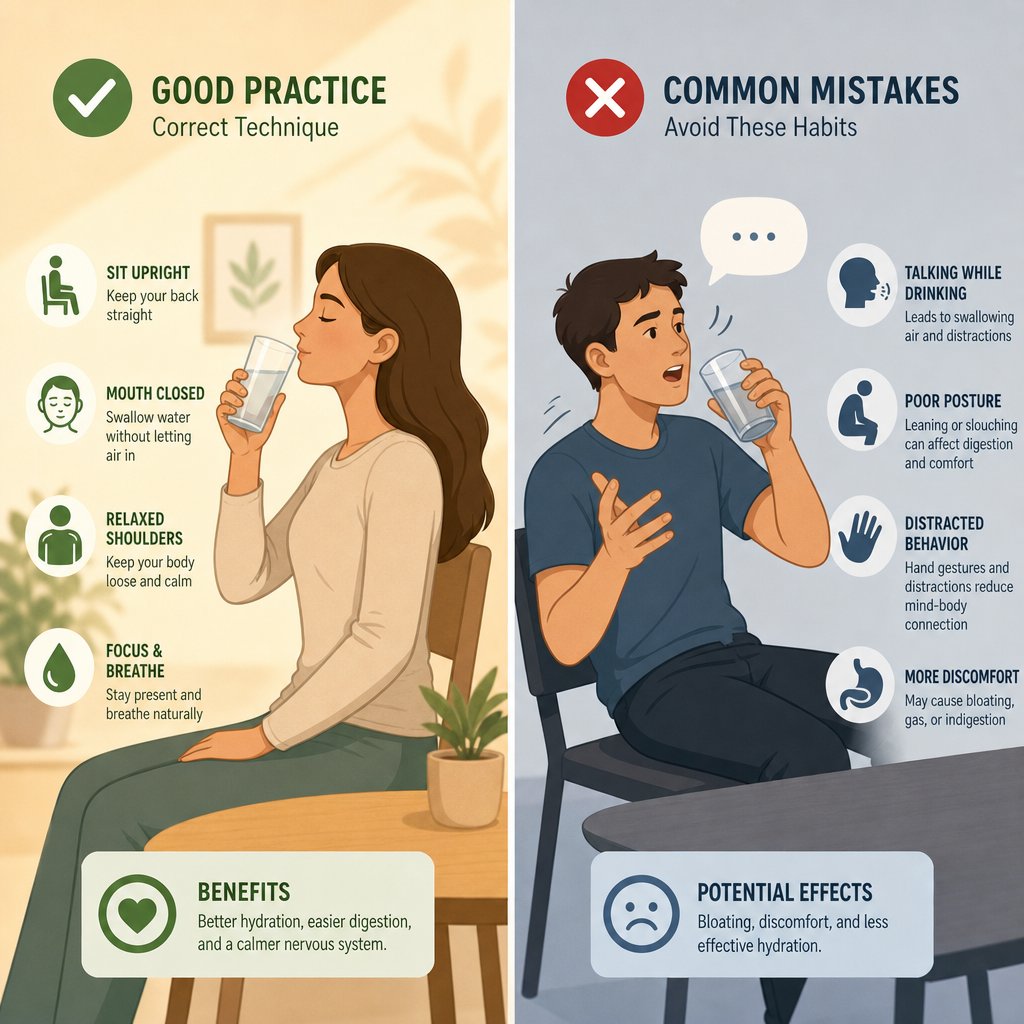
Common Mistakes That Reduce Sublingual Medication Effectiveness
You placed the tablet correctly. You know the science. Yet your medication still does not seem to work as well as it should. The problem is rarely the drug itself. In most cases, subtle behavioral habits during the dissolution window are quietly routing your medicine under tongue straight into your stomach, where it loses potency to first-pass metabolism. Here are the most common errors patients make during sublingual drug administration and what to do instead.
Swallowing Too Early and Why It Matters
The single most damaging mistake is swallowing saliva before the tablet fully dissolves. When you swallow, you carry dissolved medication down into your gastrointestinal tract. Once there, the drug faces stomach acid and liver enzymes, the exact pathway sublingual delivery is designed to avoid. For medications like buprenorphine, swallowing can reduce bioavailability to nearly zero.
- Mistake: Swallowing saliva as it pools under the tongue during dissolution.
- Why it hurts: Dissolved drug gets redirected to the stomach, triggering first-pass metabolism and dramatically lowering the effective dose.
- Correction: Let saliva accumulate naturally under your tongue. Resist the urge to swallow until the sublingual pill has completely dissolved and no gritty residue remains. Only then should you swallow.
This feels unnatural at first, especially if dissolution takes 5 to 10 minutes. Tilting your head slightly forward can help prevent saliva from trickling toward the back of your throat.
Physical Mistakes That Displace the Tablet
Dissolving pills under the tongue requires the tablet to stay in contact with the sublingual mucosa for the entire dissolution period. Anything that moves the tablet away from that tissue reduces absorption time and wastes medication.
- Mistake: Chewing or crushing the tablet to speed things up.
- Why it hurts: Crushing fragments the tablet into pieces that scatter throughout the mouth, reducing contact with the sublingual membrane. It can also irritate the delicate tissue and alter the intended dissolution rate.
- Correction: Never chew sublingual pills. Let the tablet dissolve at its own pace. The formulation is engineered to release the drug at a controlled rate.
- Mistake: Talking while the tablet is dissolving.
- Why it hurts: Tongue and jaw movement physically displaces the tablet from the sublingual space. Talking also stimulates saliva production, which dilutes the drug concentration and increases the likelihood of swallowing prematurely.
- Correction: Stay quiet during dissolution. If someone needs your attention, use a gesture or wait until the tablet is fully absorbed.
- Mistake: Placing the tablet on top of the tongue instead of underneath it.
- Why it hurts: The dorsal surface of the tongue is covered in thicker, keratinized tissue that absorbs medication poorly. The sublingual administration of medication specifically requires the thin, highly vascular tissue on the floor of the mouth.
- Correction: Lift your tongue, place the tablet in the pocket between the tongue base and the mouth floor, then lower your tongue gently over it.
Food and Liquid Errors During Dissolution
What you eat or drink around your dose matters more than most patients realize. Under the tongue medication depends on a stable oral environment to absorb properly.
- Mistake: Drinking water while the tablet is dissolving.
- Why it hurts: Water dilutes the drug concentration at the absorption site and triggers the swallowing reflex, washing partially dissolved medication into the stomach.
- Correction: Do not drink anything until the tablet has fully dissolved. If your mouth is too dry for the tablet to dissolve, take a small sip of water before placement, not during.
- Mistake: Removing or spitting out the tablet before full dissolution because of taste or impatience.
- Why it hurts: You receive only a fraction of the intended dose. Many sublingual medications have a bitter or metallic flavor that tempts patients to cut the process short.
- Correction: Commit to the full dissolution time. If taste is a persistent problem, discuss flavored formulations or alternative delivery formats with your pharmacist.
Each of these errors shares a common thread: they redirect the drug away from the sublingual membrane and into the digestive system, converting a fast-acting sublingual pill into a slow, partially effective oral dose. The fix is always the same. Place it correctly, keep still, and wait.
Avoiding these mistakes during the dose itself is critical, but what you do in the minutes before and after also shapes how well your body absorbs the medication. Timing around food, beverages, and even smoking creates another layer of variables most patients never consider.
Timing Guidelines Around Food, Drink, and Smoking
Proper placement and patience during dissolution only get you halfway there. The oral environment you create in the minutes before and after your dose determines whether the sublingual membrane is primed for absorption or working against you. Food residue coats the tissue. Beverages alter saliva composition. Smoking constricts the very blood vessels your medication needs to reach. These timing details rarely appear on prescription labels, yet they can make or break the effectiveness of your sublingual medications.
Food and Drink Timing Windows
When you eat, food particles cling to the mucous membrane under your tongue. Oils, sugars, and acidic residues create a physical barrier between the tablet and the tissue, slowing or blocking diffusion. Beverages pose a different problem: they flood the sublingual space with liquid, dilute the dissolving drug, and trigger the swallowing reflex that sends medication straight to your stomach.
The general rule for medication under the tongue is straightforward:
Avoid eating, drinking, or chewing gum for at least 15 minutes before and 15 to 30 minutes after sublingual administration. This window keeps the oral environment clean, stable, and optimized for transmucosal absorption.
Some prescribers recommend a longer buffer, particularly for sublingual meds like buprenorphine that require 5 to 10 minutes of dissolution time. If you have just finished a meal, rinse your mouth gently with plain water and wait at least 15 minutes before placing your tablet. The goal is a mouth free of food debris but not so wet that the drug gets washed away.
Coffee and acidic drinks deserve special attention. They can temporarily alter the pH of your oral mucosa, which may affect how certain drug molecules cross the membrane. If your morning routine involves coffee followed by a sublingual dose, build in that 15-minute gap between your last sip and your tablet placement.
Smoking adds another complication entirely. Research on tobacco's effects on oral tissue shows that smoking causes arteriolar vasoconstriction, meaning it narrows the small blood vessels in your oral mucosa. Fewer open capillaries means less surface area for drug absorption. Nicotine also reduces blood flow to the sublingual region, slowing the rate at which dissolved medication enters systemic circulation. This method of administration depends on robust blood flow beneath the tongue, and smoking directly undermines that.
CareFirst Specialty Pharmacy recommends avoiding cigarettes for at least one hour before taking sublingual medication. If quitting is not an option, spacing your dose as far from your last cigarette as possible gives the blood vessels time to relax and dilate back toward their normal state.
Fitting Sublingual Doses Into Your Daily Routine
Knowing the rules is one thing. Living with them is another. Under tongue medicine often requires 2 to 10 minutes of silence, no swallowing, and a clean mouth. That is not always easy to manage during a busy morning, a work lunch, or a social dinner.
Here are practical strategies for making the oral route of medication administration work in real life:
- Morning doses: Take your sublingual tablet first thing after waking, before breakfast and coffee. Your mouth is naturally clean (aside from overnight bacteria), and you have a quiet window before the day starts. Brush your teeth after the dose, not before, since toothpaste residue can coat the sublingual tissue.
- Midday doses: If you need a dose during work hours, step away for a few minutes. A bathroom break or a quiet moment at your desk works. The dissolution window is short enough that most people will not notice your brief silence.
- Social situations: Feeling awkward about not talking for several minutes at dinner? Take your dose before you arrive or excuse yourself briefly. There is no need to explain the details to everyone at the table.
- Multiple daily doses: If your prescription calls for more than one sublingual dose per day, set consistent times that fall naturally between meals. This builds the food-free buffer into your schedule without requiring you to think about it each time.
The lived experience of taking under tongue medications can feel inconvenient at first. Holding still, resisting the urge to swallow, and planning around meals all require conscious effort. Most patients find that after a week or two, the routine becomes automatic. The key is consistency: same time, same preparation, same technique.
Even with perfect timing and flawless technique, things occasionally go sideways. The tablet slips, you swallow by reflex, or the medication does not seem to dissolve at all. Knowing how to handle these situations prevents a minor hiccup from becoming a missed or wasted dose.

Troubleshooting When Something Goes Wrong
You followed every step. Mouth prepped, tablet placed, tongue lowered. Then your body does what it does best: you swallow on reflex, the tablet cracks in half as you remove it from the blister, or it just sits there refusing to dissolve. These situations happen to nearly everyone at some point, and the wrong reaction can cost you an entire dose or, worse, lead to an accidental double dose. Here is what to do when the process does not go according to plan.
Accidentally Swallowed Your Sublingual Tablet
This is the most common mishap. You get distracted, your swallowing reflex kicks in, and the tablet is gone before you realize what happened. The natural question: did you just waste your dose?
The short answer is that the medication will still enter your system, but far less effectively. How long does it take for a pill to digest once swallowed? A standard oral tablet typically breaks down in the stomach within 15 to 30 minutes, but the drug then faces first-pass metabolism in the liver. For sublingual formulations, this digestive route was never the intended pathway, and bioavailability drops significantly.
- Sublingual B12: If you accidentally swallow sublingual B12, the situation is relatively forgiving. Vitamin B12 can still absorb through the gastrointestinal tract, though less efficiently. You will likely get some benefit from the dose, just not the rapid, high-absorption delivery the sublingual route provides. There is no safety concern with swallowing it.
- Buprenorphine (Subutex/Suboxone): If you swallowed Suboxone by accident, the impact is more significant. Drugs.com reports that swallowing buprenorphine reduces absorption dramatically because first-pass metabolism destroys most of the active ingredient before it reaches circulation. The medication becomes much less effective at managing cravings and withdrawal symptoms.
- Nitroglycerin: Swallowing a nitroglycerin tablet during a chest pain episode means the rapid relief you need will be delayed or absent. Seek immediate medical attention if symptoms persist.
Regardless of the medication, the rule is the same: do not take a second dose to compensate without contacting your prescriber first. Doubling up without guidance can lead to overdose or adverse effects. Call your doctor or pharmacist, explain what happened, and follow their specific instructions for your situation.
Tablet Broke, Dissolved Too Fast, or Will Not Dissolve
Not every tablet comes out of the blister pack in perfect condition. And not every dissolution experience matches what you expected. Here is how to handle the most common physical issues:
- The tablet broke before placement. If it cracked into two or three large pieces, place all the pieces under your tongue at the same time. You are still getting the full dose as long as nothing was lost. If the tablet crumbled into powder or tiny fragments that scattered, consult your pharmacist. Powder may dissolve unevenly or be difficult to keep positioned on the sublingual membrane.
- The tablet dissolved almost instantly. Some patients worry when a tablet disappears in under a minute. For most fast-dissolving formulations, this is completely normal. Nitroglycerin tablets, for example, are designed to dissolve in seconds. If your medication consistently dissolves faster than your pharmacist indicated, mention it at your next visit, but rapid dissolution alone is not a sign of a problem.
- The tablet will not dissolve. If the tablet just sits there like a pebble, your mouth is likely too dry. Saliva is essential for dissolution. Next time, take a small sip of water a few minutes before placement to moisten the sublingual tissue. Do not add water while the tablet is already in position, as this can wash it toward the back of your throat. If dryness is a chronic issue due to medication side effects or a condition like Sjogren's syndrome, talk to your doctor about alternative sublingual formats like films or drops that require less moisture.
- The tablet tastes different or looks discolored. Check the expiration date. Degraded tablets may not dissolve properly and can have an altered taste or appearance. If the medication is within date but still seems off, do not use it. Contact your pharmacy for a replacement.
A common concern with dissolution problems is how long do pills take to digest if they end up partially swallowed. If you felt gritty residue slide down your throat before the tablet fully dissolved, you received a partial sublingual dose and a partial (less effective) oral dose. You likely got some therapeutic benefit, but not the full amount. Note what happened and adjust your technique next time: less saliva swallowing, better head positioning, or a slightly moister mouth at the start.
Missed or Doubled Doses
Life gets busy. You forget a dose, remember two hours later, and wonder whether to take it now or skip it entirely. Or you cannot recall whether you already took your morning tablet and consider taking another just in case.
- Missed dose: Take it as soon as you remember, unless you are close to your next scheduled dose. "Close" generally means within half the interval between doses. If you take your medication every 12 hours and you remember 10 hours late, skip the missed dose and resume your normal schedule. Never double up to make up for a missed one.
- Uncertain whether you took it: If you genuinely cannot remember, err on the side of skipping rather than doubling. For most sublingual medications, one missed dose is far less risky than an accidental double dose. Consider using a pill organizer or a phone alarm to prevent this uncertainty in the future.
- Accidentally took two doses: Contact your prescriber or pharmacist immediately. For some medications, a double dose causes only mild side effects. For others, particularly cardiovascular drugs like nitroglycerin or opioid-related medications like buprenorphine, a double dose can cause dangerous drops in blood pressure, excessive sedation, or respiratory depression. Do not wait for symptoms to appear before calling.
People often ask how long does it take to digest a pill when trying to gauge whether a swallowed sublingual tablet "counts" toward their daily dose. The answer depends on the specific drug, but most oral medications reach peak blood levels within 1 to 2 hours after swallowing. For sublingual formulations taken orally by accident, peak levels will be lower and delayed compared to proper sublingual use. This does not mean you should supplement with another dose. Let your prescriber make that call.
Troubleshooting covers the moments when technique fails. But how do you know whether your technique is working on the days everything seems to go smoothly? Recognizing the physical signs of successful absorption, and the subtle warnings that something is off, gives you a reliable way to self-assess between pharmacy visits.
How to Tell If Your Sublingual Tablet Was Absorbed Properly
Your technique looks right. The tablet went under the tongue, you stayed quiet, and you waited. But did it actually work? Unlike a swallowed pill that either settles your stomach or does not, sublinguals give you real-time physical feedback during the process. Learning to read those signals turns you into your own quality-control checkpoint between pharmacy visits.
Physical Sensations That Indicate Proper Absorption
When a sublingual medication is administered correctly, your body gives you several clues that absorption sublingual delivery is happening as intended:
- Tingling or mild numbness under the tongue. Many sublingual formulations, particularly nitroglycerin, produce a slight burning or tingling sensation as the drug crosses the mucous membrane. This is a normal pharmacological response, not a sign of irritation.
- A distinct taste. Most sublingual tablets have a characteristic flavor, often bitter, metallic, or slightly sweet depending on the active ingredient and excipients. Tasting the medication means it is dissolving in direct contact with your sublingual tissue.
- Complete dissolution within the expected timeframe. Depending on the formulation, the tablet should fully disappear within 2 to 10 minutes. No gritty residue, no solid fragments left behind.
- Onset of therapeutic effects within the drug's known window. How long does it take for a pill to absorb sublingually? For nitroglycerin, chest pain relief typically begins within 1 to 3 minutes. For buprenorphine, withdrawal symptom improvement may take 15 to 30 minutes. If your medication produces its expected effect within the timeframe your pharmacist described, your technique is working.
One important note from MedlinePlus: the tingling sensation is normal but is not a reliable indicator that the tablet is working. Some patients never feel it, and that alone does not mean absorption failed. Focus on the full picture rather than any single signal.
Warning Signs Your Technique Needs Adjustment
Equally important is recognizing when things are going wrong. If you notice any of the following patterns consistently, your technique likely needs correction or your formulation may need a change:
- The tablet slides toward the back of your throat. This usually means placement was too far back or your head was tilted, causing gravity to pull the tablet away from the sublingual membrane.
- You swallow gritty residue before the tablet fully dissolves. Partially dissolved medication that ends up in your stomach delivers a reduced, delayed dose instead of the rapid absorption sublingual delivery is designed for.
- No taste whatsoever. If you cannot taste anything during dissolution, the tablet may not be making proper contact with the tissue. Recheck your placement technique.
- Delayed or absent therapeutic effects. If your medication consistently takes much longer to work than expected, or does not seem to work at all, the drug may be getting swallowed rather than absorbed transmucosally.
- The tablet remains intact for an unusually long time. If dissolving tablets under tongue takes significantly longer than your pharmacist indicated, dry mouth may be preventing proper dissolution. Discuss moisture strategies or alternative formats with your provider.
| Indicator | Successful Absorption | Failed or Partial Absorption |
|---|---|---|
| Physical sensation | Mild tingling or numbness under the tongue | No sensation; tablet feels like it is just sitting there |
| Taste | Distinct flavor (bitter, metallic, or sweet) during dissolution | No taste, or taste only noticed when swallowing |
| Dissolution time | Tablet fully dissolves within 2-10 minutes with no residue | Tablet remains solid too long, or gritty fragments are swallowed |
| Tablet position | Stays in the sublingual pocket throughout dissolution | Slides to back of throat or moves onto top of tongue |
| Therapeutic effect | Expected relief or effect within the medication's known timeframe | Delayed onset, reduced effect, or no noticeable benefit |
| After dissolution | Clean mouth, no solid material remaining | Gritty residue swallowed; feeling of something stuck in throat |
If you want to know how to increase sublingual absorption, the answer is not a special trick. It is consistent execution of the fundamentals: correct placement, adequate moisture, no swallowing during dissolution, and proper timing around food and drink. Patients who master these basics and monitor the feedback signals above rarely have absorption issues.
When warning signs persist despite good technique, bring it up with your pharmacist. The issue may not be your method at all. It could be the tablet itself, its formulation, how it was stored, or whether the product format is the right fit for your physiology. Those manufacturing and quality factors play a larger role in sublingual performance than most patients realize.
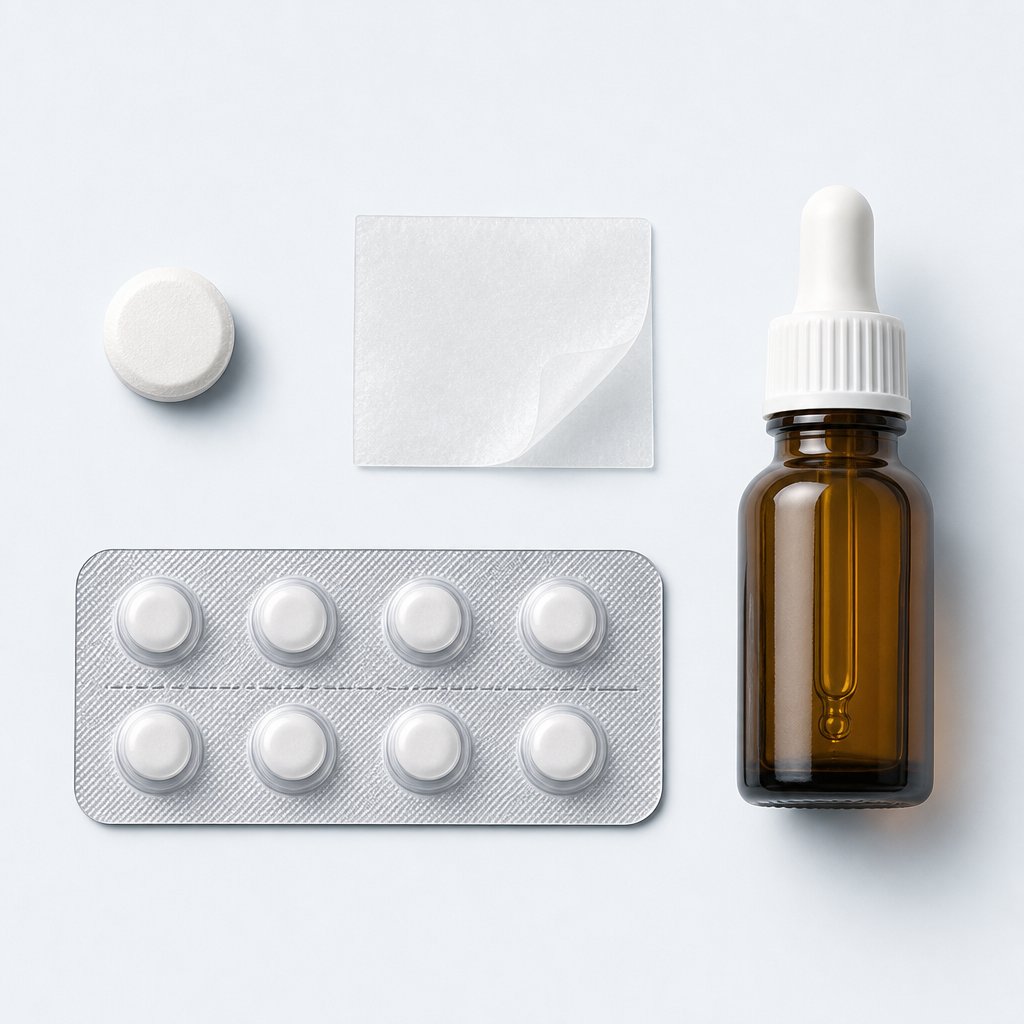
How Tablet Formulation and Quality Affect Sublingual Performance
Your technique can be flawless, but if the tablet itself is poorly formulated or improperly stored, absorption still suffers. What is a sublingual tablet, really? It is not just a smaller version of a swallowed pill. It is a precisely engineered product where dissolution rate, hardness, porosity, excipient selection, and taste masking all work together to deliver medication through a narrow window of time and tissue contact. When any of those variables fall out of range, the drug either dissolves too slowly, crumbles before placement, or fails to cross the membrane efficiently.
Why Tablet Quality and Formulation Matter
Sublingual drugs face a unique engineering challenge. They must dissolve rapidly in a very small volume of saliva, without the aid of water, stomach acid, or mechanical churning. According to research published in Pharmaceutical Technology, the physical and mechanical characteristics of a sublingual tablet, including size, hardness, porosity, and wettability, directly affect its disintegration time. A smaller tablet with lower hardness and higher porosity disintegrates faster, but a tablet that is too porous becomes friable and may crumble during handling or packaging.
Several formulation factors determine whether your sublingual medication performs as intended:
- Dissolution rate: Sublingual tablets are designed to fully dissolve within 2 to 10 minutes. If the formulation uses too much binder or insufficient disintegrant, the tablet may sit under your tongue like a pebble instead of releasing its active ingredient.
- Excipient selection: Sugar-based excipients dissolve quickly in saliva and create a pleasant cooling sensation due to their endothermic heat of dissolution. They also aid taste masking, which is critical for patient compliance with bitter sublingual drugs.
- Taste masking: Because the drug dissolves directly in your mouth, any bitterness or unpleasant flavor hits your taste buds immediately. Sweeteners, flavoring agents, and molecular complexes are incorporated during manufacturing to prevent patients from spitting out or swallowing the tablet prematurely.
- Particle size of the active ingredient: Drugs administered sublingually often have low water solubility. Reducing and controlling the particle size of the active pharmaceutical ingredient enhances dissolution within the limited time the tablet spends in the sublingual space.
- Buffering agents: For ionizable drugs, the inclusion of a suitable buffer can control the pH of saliva in the sublingual region, keeping the drug in its unionized form for optimal membrane permeation.
What are sublingual tablets if not a balance of competing demands? They need to be hard enough to survive packaging and handling, yet soft enough to dissolve in seconds. They need to taste acceptable while delivering a potent, often bitter active ingredient. Getting this balance right is a sublingual medical formulation challenge that directly impacts whether patients receive their full dose.
Storage and Handling Tips for Sublingual Products
Even a perfectly formulated tablet degrades if stored improperly. Sublingual medication is particularly sensitive to moisture because the same property that allows rapid dissolution in your mouth, high porosity and water-soluble excipients, also makes these tablets vulnerable to humidity in the environment.
GoodRx pharmacists note that nitroglycerin sublingual tablets (Nitrostat) should never be transferred from their original containers because environmental exposure can compromise their effectiveness. This applies broadly to most medicine sublingual products. Here is how to protect your tablets:
- Keep tablets in original blister packaging until the moment you are ready to take them. Blister packs protect individual doses from air, light, and moisture far better than pill organizers or open bottles.
- Handle with dry hands. Moisture from your fingers can begin dissolving the tablet before it reaches your mouth, reducing the dose and altering the dissolution profile.
- Store in a cool, dry location. Room temperature (68 to 77 degrees Fahrenheit) is ideal. Avoid bathrooms, where shower steam creates humidity spikes, and kitchens near stoves or ovens. A bedside drawer or a closet shelf works well.
- Never freeze sublingual tablets. Extreme cold can alter the crystalline structure of the active ingredient and change how the tablet dissolves.
- Check expiration dates regularly. Degraded tablets may not dissolve properly, may taste different, or may deliver a reduced dose. If a tablet looks discolored, feels unusually soft, or crumbles when you remove it from the packaging, discard it and use a fresh one.
Patients taking sublingual vitamin D or B12 supplements sometimes transfer tablets into weekly pill organizers for convenience. This practice exposes each tablet to air and ambient moisture for days before use. If you must use an organizer, limit it to a one- or two-day supply at most, and keep the remaining tablets sealed in their original packaging.
Different Sublingual Formats and How They Differ
Not all sublingual products come as traditional compressed tablets. The market includes several delivery formats, each with slightly different technique requirements:
| Format | Description | Dissolution Speed | Technique Notes |
|---|---|---|---|
| Compressed tablets | Standard sublingual tablets manufactured by direct compression or molding | 2-10 minutes | Place under tongue; do not chew; let dissolve fully |
| Orally disintegrating tablets (ODTs) | Highly porous tablets designed to dissolve in seconds with minimal saliva | 5-30 seconds | Place on or under tongue; dissolves almost instantly; avoid spitting |
| Sublingual films | Thin polymer strips that adhere to the sublingual mucosa | 2-5 minutes | Place film flat against the floor of the mouth; do not chew or fold |
| Sublingual drops/sprays | Liquid formulations applied directly under the tongue | Near-instant dissolution | Hold liquid under tongue for 30-60 seconds before swallowing |
Each format has trade-offs. Compressed tablets are stable and easy to dose but require adequate saliva. Films adhere to tissue and resist displacement by tongue movement, making them a good option for patients who struggle to keep a tablet in place. Drops and sprays eliminate the dissolution step entirely but can be harder to dose precisely and may have a stronger taste.
If your current sublingual format is not working well, whether due to dry mouth, taste intolerance, or difficulty keeping the product positioned, ask your pharmacist whether an alternative format exists for your medication. Switching from a tablet to a film, for example, can solve placement issues without changing the drug itself.
For supplement brands and formulators looking to develop sublingual tablet products, such as B12 or vitamin D, the formulation challenges described above underscore why working with an experienced manufacturer matters. OEM/ODM partners like ZhuFeng offer customized tablet formulation and scalable production across multiple delivery formats, helping brands achieve the precise dissolution profiles and taste-masking characteristics that sublingual products demand.
Ultimately, the performance of any sublingual product is a chain: good formulation, proper storage, correct technique, and appropriate timing all link together. Break any single link, and the dose you thought you took becomes something less. Paying attention to the tablet itself, not just how you place it, closes the last gap between taking your medication and actually absorbing it.
Frequently Asked Questions About Sublingual Tablets
1. What happens if you accidentally swallow a sublingual tablet?
When you swallow a sublingual tablet, the medication still enters your system but with significantly reduced effectiveness. The drug must now pass through your stomach and liver, where first-pass metabolism breaks down a large portion of the active ingredient before it reaches your bloodstream. For sublingual B12, swallowing is relatively harmless since B12 can still absorb through the GI tract, though less efficiently. For buprenorphine (Suboxone), swallowing dramatically reduces absorption and therapeutic benefit. Never take a second dose to compensate without first contacting your prescriber, as doubling up can cause dangerous side effects.
2. How long should you keep a sublingual tablet under your tongue?
Most sublingual tablets require 2 to 10 minutes to fully dissolve, depending on the specific formulation. Nitroglycerin tablets dissolve in under 2 minutes, while buprenorphine products may take 5 to 10 minutes. The key indicator is that no gritty residue or solid material remains under your tongue. During this entire window, avoid swallowing saliva, talking, eating, or drinking. Only swallow once the tablet has completely disappeared and the sublingual space feels clean. Your pharmacist can provide the exact expected dissolution time for your specific medication.
3. Can you eat or drink after taking a sublingual tablet?
You should wait at least 15 to 30 minutes after sublingual administration before eating or drinking. Food particles and beverages can interfere with any residual absorption still occurring in the oral mucosa. Before your dose, maintain the same 15-minute buffer to ensure the sublingual tissue is free of food debris, oils, and acidic residues that could block drug diffusion. Coffee and acidic drinks deserve extra caution since they can alter the pH of your oral mucosa and affect how drug molecules cross the membrane.
4. What is the difference between sublingual and buccal medication?
Sublingual tablets go under the tongue, while buccal medications are placed between the cheek and gum. The sublingual tissue is thinner (100-200 micrometers) and absorbs drugs faster, typically within 2 to 5 minutes, making it ideal for rapid-onset medications like nitroglycerin. Buccal tissue is thicker (500-800 micrometers) and absorbs more gradually over 5 to 30 minutes, suiting sustained-release formulations like buccal fentanyl. Placing a sublingual tablet in the cheek slows its absorption, while placing a buccal medication under the tongue may cause irritation or overly rapid dissolution.
5. How do you know if a sublingual tablet was absorbed properly?
Several physical signals indicate successful sublingual absorption: a mild tingling or numbness under the tongue during dissolution, a distinct taste (often bitter or metallic), complete tablet dissolution within the expected timeframe with no residue, and onset of therapeutic effects within the medication's known window. Warning signs of poor absorption include the tablet sliding toward your throat, swallowing gritty residue, no taste during dissolution, or delayed therapeutic effects. If you consistently notice these warning signs despite correct technique, consult your pharmacist about adjusting your approach or switching to an alternative sublingual format like a film or spray.