Why Cutting Tablets the Right Way Matters
Imagine your doctor writes a prescription and says, "Take half a tablet daily." Simple enough, right? You get home, try to snap the pill in two, and end up with one large chunk, one crumbled sliver, and powder scattered across the counter. You have no idea which piece is the correct dose, and you just wasted medication you paid good money for.
Learning how to cut tablets properly is a practical skill that millions of people need but few ever learn correctly. Whether you are adjusting a dose, managing costs, or simply trying to swallow a smaller piece, the technique matters more than most people realize.
Why People Need to Cut Tablets
Pill splitting is remarkably common. Research published in the European Journal of Clinical Pharmacology found that almost a quarter of all drugs administered in primary care have their dose altered through splitting. Three scenarios drive most of this activity:
- Dose titration: Physicians frequently prescribe half-doses when starting a new medication, tapering off a drug, or fine-tuning treatment for conditions like hypertension or anxiety. Knowing how to cut a tablet in half accurately ensures you receive exactly what was prescribed.
- Cost savings: Many medications cost nearly the same regardless of strength. Buying a higher-strength tablet and cutting pills in half can reduce treatment costs by up to 45%, since the price per tablet often does not increase proportionally with dose strength.
- Swallowing difficulties: Large tablets can be difficult or uncomfortable to swallow, especially for older adults and those with dysphagia. Cutting tablets in half creates smaller pieces that are easier to take and improves medication compliance.
What Can Go Wrong With Improper Splitting
Cutting pills the wrong way introduces real risks. When a tablet breaks unevenly, one half may contain significantly more active ingredient than the other. That means you could be underdosing one day and overdosing the next. For medications with a narrow therapeutic window, even small variations can trigger side effects or reduce effectiveness.
Beyond dosing accuracy, improper technique causes physical waste. Crumbling and powder loss mean you lose a portion of the medication entirely. And as the FDA notes, splitting tablets in advance and storing them exposes the cut surfaces to heat, humidity, and moisture, which can degrade potency over time. One pharmacist recounted a patient who split an entire three-month supply at once, only to find the exposed tablets had lost their effectiveness due to oxidation.
This guide covers everything you need to know about how to cut a pill in half safely and precisely: which tablets can be split, which tools work best, the physical technique for a clean cut, and how to troubleshoot common problems. The goal is straightforward: every split should give you an accurate dose with no waste.
The first critical step is identifying whether your specific tablet is safe to split at all, because some medications should never be cut under any circumstances.
Step 1 Identify Which Tablets Are Safe to Split
Not every tablet is designed to be divided. Some are engineered with internal structures so precise that a single cut can turn a safe medication into a dangerous one. Before you reach for a pill cutter, you need to know what you are working with.
Tablets That Are Safe to Split
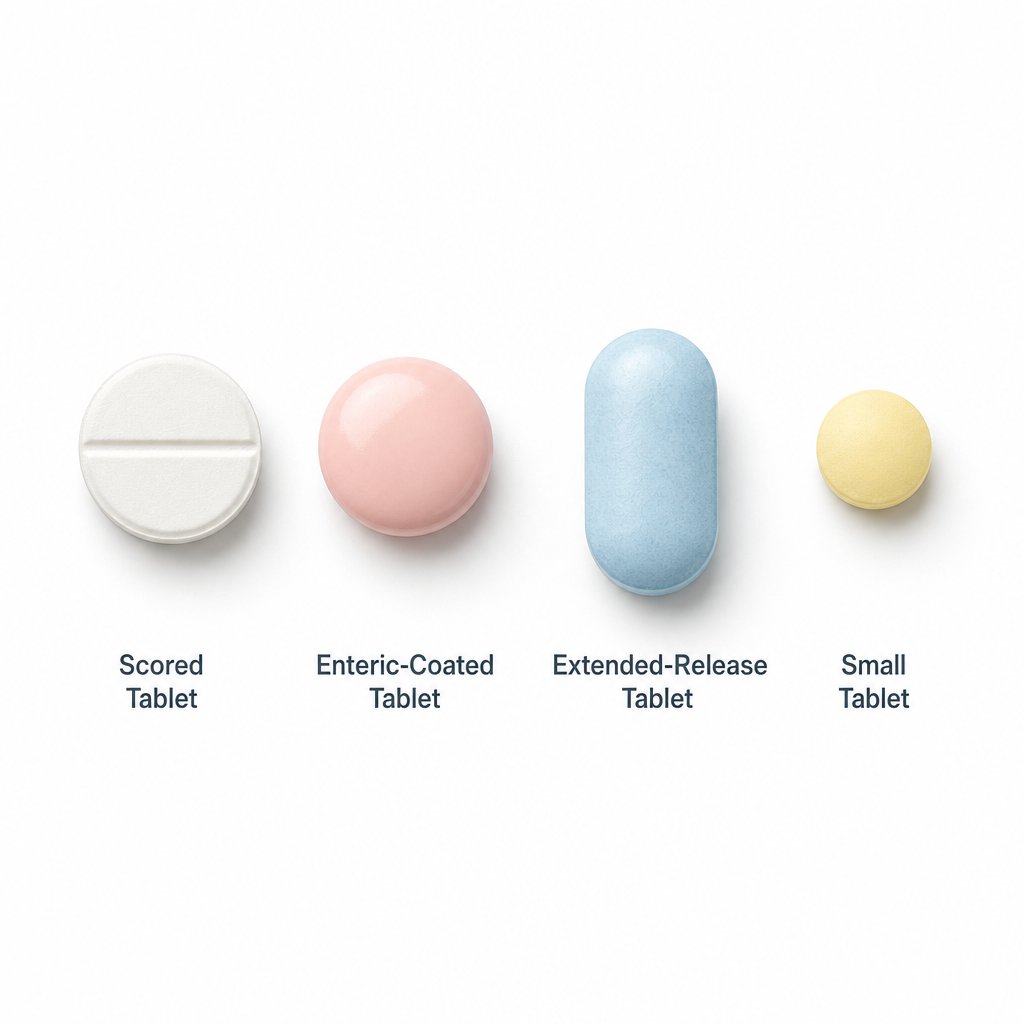
The safest tablets to cut are scored tablets, those with a visible line or indentation running across the surface. That score line is not decorative. It indicates the manufacturer designed the tablet to break along that point, and in many cases the FDA has evaluated the tablet to confirm that both halves deliver equivalent doses.
A scored tablet typically has a uniform distribution of active ingredient throughout its body. When you split along the score, you get two pieces with roughly equal drug content. Research published in Tropical Medicine & International Health confirmed that scored, uncoated tablets produced significantly more accurate splits than unscored or coated alternatives, with medications like ofloxacin and glibenclamide suffering less than 0.62% median weight loss after division.
Unscored immediate-release tablets can sometimes be split too, but only with your pharmacist's confirmation. Without a score line, there is no manufacturer guarantee that the active ingredient is evenly distributed, and the physical cut is harder to center. The FDA recommends checking the "How Supplied" section of the prescribing information to verify whether a specific tablet has been evaluated for splitting.
Medications You Must Never Cut
Certain tablet categories belong on a strict list of medications that cannot be split. Cutting them does not just reduce accuracy; it can cause serious harm. Here are the major categories:
| Tablet Type | Safe to Split? | Risk Level | Key Characteristics |
|---|---|---|---|
| Scored immediate-release | Yes | Low | Visible score line, uniform drug distribution, FDA-evaluated for splitting |
| Unscored immediate-release | Sometimes (ask pharmacist) | Moderate | No score line, drug distribution not guaranteed uniform |
| Extended-release / time-release (ER, XR, XL, SR, LA) | No | High | Internal release mechanism destroyed by cutting; dose dumping risk |
| Enteric-coated (EC) | No | High | Protective coating breached; stomach irritation or drug degradation |
| Narrow therapeutic index drugs | Rarely | High | Small dosing variations cause toxicity or treatment failure (e.g., warfarin, digoxin, levothyroxine) |
| Combination tablets with uneven distribution | No | High | Two or more active ingredients may not be uniformly distributed across the tablet |
People often ask, can you cut potassium pills in half? Many potassium supplements use extended-release or wax-matrix formulations to prevent GI irritation. Splitting them can release the full dose at once, causing nausea or even ulceration. Similarly, can you break Wellbutrin XL in half? Absolutely not. Wellbutrin XL uses a membrane-controlled delivery system, and breaking it destroys the mechanism that meters the drug over 24 hours.
Safety warning: Splitting time release pills in half can cause the entire dose to flood your system at once, a phenomenon called "dose dumping." For potent medications like opioids or certain cardiac drugs, this rapid release can produce life-threatening toxicity. Can splitting time release tablets kill you? In extreme cases with high-potency drugs, yes, it can. Never cut any tablet labeled ER, XR, XL, SR, LA, or CR without explicit approval from your pharmacist.
Understanding Extended-Release and Enteric Coatings
Why does cutting a time-release pill cause such problems? The answer lies in the engineering hidden inside these tablets.
Extended-release formulations use one of three main mechanisms to control how quickly the drug enters your bloodstream:
- Matrix systems: The drug is embedded in a polymer or wax matrix that slowly erodes or allows the drug to diffuse out over hours. Cutting the tablet exposes the interior, creating new surfaces where the drug can escape all at once.
- Osmotic pumps: These tablets contain a drug core surrounded by a semi-permeable membrane with a laser-drilled delivery orifice. Water enters through the membrane, builds osmotic pressure, and pushes the drug out at a constant, zero-order rate. A comprehensive review in Pharmaceuticals explains that the release rate depends on membrane thickness, orifice size, and osmotic pressure gradient. Cutting the tablet destroys the membrane entirely, bypassing the controlled delivery mechanism. Products like Procardia XL (nifedipine) and Glucotrol XL (glipizide) use push-pull osmotic pump designs that become completely non-functional if the outer shell is breached.
- Coating layers: Some tablets use multiple coating layers that dissolve at different rates, releasing drug in stages. A cut exposes the inner layers directly to stomach fluid, collapsing the staged release into a single burst.
Enteric coatings serve a different purpose. These acid-resistant layers protect the drug from stomach acid (allowing it to reach the intestines intact) or protect the stomach lining from an irritating drug. Enteric-coated aspirin, for example, passes through the stomach undissolved and only releases in the higher-pH environment of the small intestine. Cutting through the coating defeats both protective functions: the drug degrades in stomach acid, and the exposed edges can irritate the gastric mucosa.
The practical takeaway is simple. If your tablet has any suffix like ER, XR, XL, SR, LA, or CR in its name, or if it has a glossy, colored coating that feels slick to the touch, do not cut it. Check with your pharmacist first. Many of these medications have immediate-release versions or alternative strengths available that eliminate the need for splitting entirely.
Knowing which tablets are safe to divide is only half the equation. The tool you use to make the cut determines whether you get a clean, even split or a crumbled mess.
Step 2 Choose the Right Tablet Cutting Tool
A clean, even split depends as much on the tool as on the tablet itself. You could have a perfectly scored pill, but if you try to snap it with dull scissors or a butter knife, you will end up with crumbs and frustration. The right tablet cutting device matches the size, shape, and hardness of your specific medication.
Dedicated Pill Cutters and Splitters
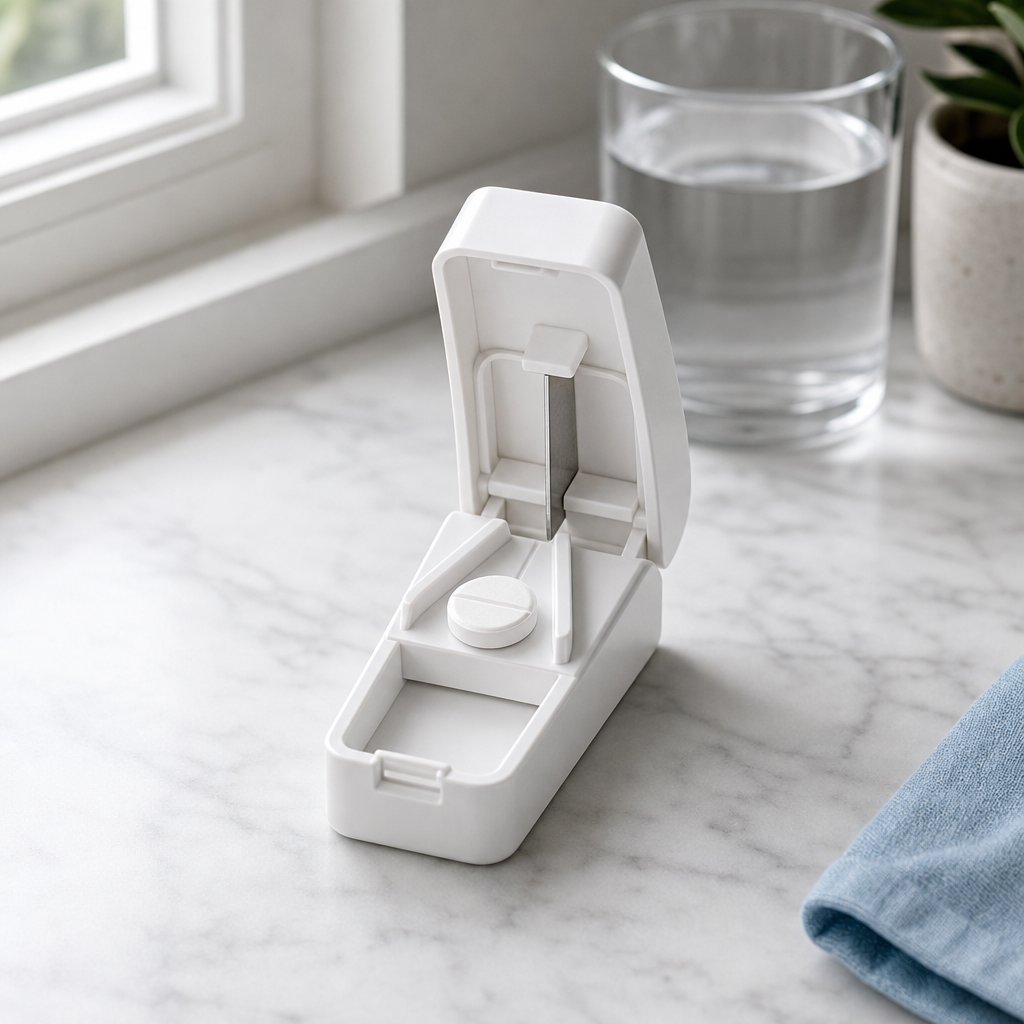
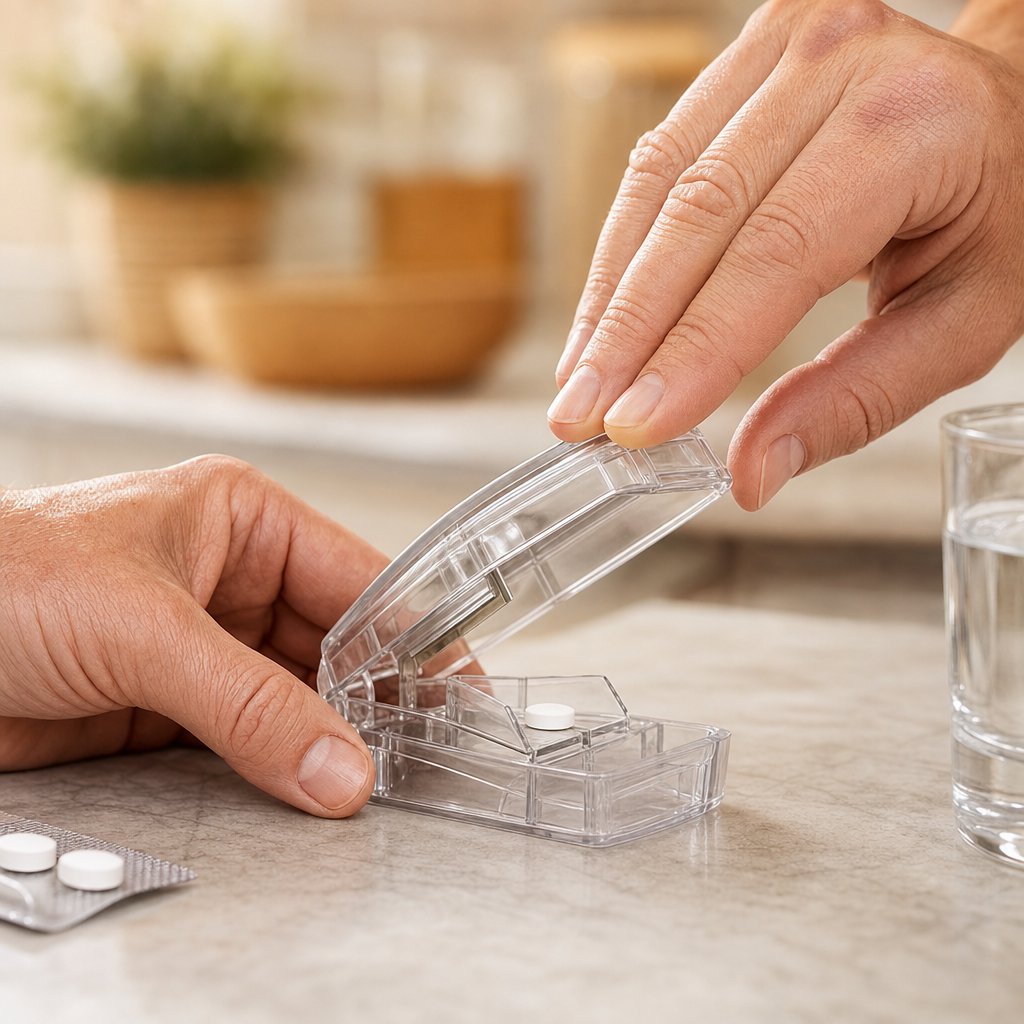
A purpose-built pill cutter is the most reliable option for most people. These inexpensive devices (typically $5 to $10) use a hinged lid with a sharp, embedded blade that presses down onto a V-shaped channel holding the tablet in place. The V-channel centers the pill automatically, and the enclosed design keeps fragments from scattering across the counter.
What separates a good tablet cutter from a bad one? After testing multiple models, a clinical review by a psychiatrist identified three critical features:
- A sharp blade that slices cleanly rather than crushing the tablet
- A firm grip channel that holds the tablet securely so it cannot shift during cutting
- A hinge mechanism that allows quick, repeatable cuts without disassembling the device each time
For tiny medications like 1 mg tablets, standard cutters can leave the pill rattling loosely in an oversized channel. A small pill cutter with a narrower V-groove or adjustable grip solves this problem. Pill splitters for small pills use tighter channels and sometimes include rubber grips that cradle miniature tablets precisely under the blade. If you regularly split medications under 6 mm in diameter, the best pill splitter for small pills will have a shallow, narrow channel and a blade that descends with even pressure across the full cutting surface.
Alternative Cutting Methods Compared
Not everyone has a dedicated splitter on hand. Kitchen knives, razor blades, and the score-and-snap method are common alternatives, but each comes with trade-offs. A study published in the Saudi Pharmaceutical Journal compared hand splitting, a tablet cutter, and a knife for splitting scored nebivolol tablets. The knife actually produced the tightest precision (6.11% CV), while the tablet cutter showed no significant difference between left and right halves (p = 0.222), meaning more balanced splits overall. Hand splitting was the least accurate, with a coefficient of variation of 9.02% and the only method that failed European Pharmacopoeia subdivision standards.
| Tool | Accuracy | Safety | Best Tablet Type | Limitations |
|---|---|---|---|---|
| Pill cutter (standard) | High (balanced halves) | High (enclosed blade) | Round or oval scored tablets | May not grip very small or oddly shaped pills |
| Pill splitter for small pills | High | High | Tablets under 6 mm diameter | Less effective for large or oblong tablets |
| Kitchen knife | Moderate to high (with practice) | Low (exposed blade, slip risk) | Large scored tablets on a flat surface | Requires steady hands; no containment for fragments |
| Razor blade | Moderate | Very low (injury risk) | Flat, uncoated tablets | Dangerous; no grip mechanism; tablet can shoot away |
| Score-and-snap (by hand) | Low | Moderate | Deeply scored, softer tablets only | Fails European Pharmacopoeia standards; inconsistent halves |
The FDA and pharmacist guidance from Drugs.com specifically advises against using a knife or razor to cut tablets, noting these methods can splinter pills and pose injury risks. If you must cut without a dedicated device, a clean, sharp kitchen knife on a stable cutting board is safer than a loose razor blade, but a pill cutter remains the recommended standard.
Choosing the Right Tool for Your Tablet Size
Match your tool to your tablet. Large oval tablets (10 mm or wider) fit comfortably in standard pill cutters and can also be split with a knife if the score line is deep. Small round tablets need a pill splitter for small pills with a snug channel. Oddly shaped tablets, like triangular or D-shaped pills, may not seat properly in any V-channel cutter; for these, a flat-surface knife method or asking your pharmacist about alternative dosage forms is the practical solution.
When shopping for a tablet cutter, also check for a retaining mechanism, a lid or shield that keeps both halves inside the device after the cut. Without it, one half can launch off the counter and onto the floor, which is both unsanitary and wasteful. A transparent lid helps you visually confirm the tablet is centered before you press down.
With the right tool selected, the next factor that determines a clean split is how you actually position the tablet and apply pressure, which is where technique takes over from equipment.
Step 3 Master the Cutting Technique
Even the best pill cutter produces uneven halves if the tablet is misaligned or the pressure is wrong. Technique is the difference between a clean split and a crumbled mess. Here is how to cut pills in half with precision every time, whether you are using a dedicated device or working by hand.
How to Position Your Tablet Correctly
Tablet orientation is the single biggest factor in split accuracy. For scored tablets, always place the pill with the score line facing up so the blade descends directly into the groove. That indentation acts as a guide channel, directing the force along the intended fracture line. If you place the score face-down, the blade has to push through the solid surface first, which often causes the tablet to crack unevenly before the score line engages.
For unscored tablets, centering is everything. Position the pill so its widest point sits squarely in the middle of the V-channel or directly beneath the blade's center. Oval and oblong tablets should be oriented lengthwise in the channel with the blade crossing the short axis. Round tablets are more forgiving, but you still want the blade to pass through the geometric center rather than slightly off to one side.
Before you cut, confirm your hands are clean and dry. The University Hospitals Sussex NHS Foundation Trust lists washing and drying hands as the first step in their official tablet cutter instructions. Moisture on your fingers transfers to the tablet surface, which can cause the pill to slip during cutting or introduce contamination to the exposed interior.
Applying the Right Pressure and Blade Angle
How you apply force matters as much as where you apply it. The goal is one firm, smooth, continuous downward press. Hesitating midway or applying slow, grinding pressure lets the tablet shift under the blade, producing an uneven fracture.
When learning how to split a pill by hand using the score-and-snap method, place both thumbs on the scored side and apply even outward pressure. However, research from the Journal of Pharmacy and Pharmacology found that hand splitting had a coefficient of variation of 9.02%, meaning one in four small scored tablets could not even be split by hand at all. A device is almost always more reliable.
If you are using a knife on a cutting board, hold the blade perpendicular to the tablet surface, not at an angle. An angled blade creates a wedge effect that pushes the tablet sideways before it cuts through, resulting in one thick half and one thin half. Press straight down with steady force.
Using a Pill Cutter Step by Step
Knowing how to use a pill cutter correctly eliminates most splitting errors. Follow these steps for a consistent result:
- Open the lid of the pill cutter fully so the blade is raised and the V-channel is accessible.
- Place the tablet in the V-shaped holder with the score line facing up. If the tablet is unscored, center it so the blade will descend through the midpoint.
- Visually confirm alignment. The blade edge should sit directly above the score line or the tablet's center. The NHS guidance emphasizes checking that the blade is "directly above" the score line before proceeding.
- Close the lid in one firm, quick motion. Press down steadily until the blade passes completely through the tablet. As Express Scripts pharmacists note, pressing too slowly makes the pill more likely to crumble.
- Open the cutter carefully. You should find two equal halves resting in the device. If the halves are very unequal or the tablet has crumbled, discard and start with a fresh tablet.
Understanding how to use a pill splitter also means knowing when to stop. If a tablet crumbles on the first attempt, that is a signal the formulation may be too brittle for splitting, and you should contact your pharmacist about alternatives.
One detail people overlook: keep your cutting surface and device clean. Rinse the pill cutter under running water weekly and let it air dry, as residue from previous medications can cross-contaminate your next split. Store the cutter with your medications in a secure location away from children.
A standard half-split is straightforward with good technique. But what happens when your prescription calls for a quarter tablet or an unusual fraction like three-quarters? That requires an extra level of precision and a slightly different approach.
Step 4 Split Tablets Into Quarters and Unusual Fractions
Splitting a tablet in half is one thing. Cutting it into quarters or three-quarter portions demands significantly more precision, and the margin for error shrinks with every additional cut. Doctors commonly prescribe these smaller fractions during dose titration, when tapering off medications like SSRIs, or when pediatric dosing requires a fraction of an adult tablet. Knowing how to cut a pill into 1/4 reliably can mean the difference between a smooth taper and withdrawal symptoms.
The general pharmacopeial standard allows split fragments to deviate no more than 15% from the target weight. For quarter doses, that tolerance becomes harder to achieve because you are working with a smaller piece that has already been cut once. A systematic review protocol published in Medicine noted that dose inaccuracy from splitting can lead to adverse effects ranging from toxicity to loss of efficacy, especially for drugs with dose-dependent effects. Quarters amplify this risk.
How to Cut a Tablet Into Quarters
The most reliable method for how to cut 1 4 of a pill is a two-step process. You do not try to cut a whole tablet directly into four pieces in one motion. Instead, you split twice:
- Place the whole tablet in your pill cutter with the score line (if present) aligned under the blade. Press down firmly in one smooth motion to create two equal halves.
- Remove one half and set it aside for storage or your next dose.
- Place the remaining half back into the cutter. Rotate it 90 degrees so the blade will cross the original cut line perpendicularly. If the half-tablet has a flat cut face, position that face downward for stability.
- Center the half-tablet carefully. Since there is unlikely to be a score line guiding this second cut, visual centering is critical. The University Hospitals Sussex NHS Trust advises being especially careful when placing a halved tablet beneath the blade because no score line exists to guide you.
- Press down with the same firm, single motion. Open the cutter and check that both quarter pieces are roughly equal in size.
- If the quarters are visibly uneven or the tablet crumbles, discard the fragments and start with a new whole tablet.
A pill cutter quarters function works best with larger tablets (10 mm or wider) because the half-piece still has enough surface area to sit securely in the V-channel. Small tablets under 7 mm become difficult to quarter accurately with any tool, and you may need to discuss liquid formulations with your pharmacist instead.
Cutting Tablets Into Thirds or Three-Quarters
Thirds are the most challenging fraction because no standard pill cutter is designed for three-way division. Standard score lines split a tablet into halves, not thirds. If your prescription requires a third of a tablet, here is a practical marking approach: use a fine-tip marker or a small piece of tape to mark two points that divide the tablet surface into three roughly equal sections. Then use a sharp knife on a flat cutting board to cut along those marks one at a time.
Wondering what a 3 4 tablet pill cut looks like? It is simply three of the four quarter pieces taken together. The most reliable way to achieve a 3/4 dose is to cut the tablet into quarters using the two-step method above, then take three of the four pieces as your dose. This approach is far more accurate than trying to eyeball a three-quarter cut in a single pass, because a 3 4 tablet pill cut made freehand almost always produces unequal portions.
How to cut a pill into 3/4 reliably: split the whole tablet in half, split one half into quarters, then combine the untouched half with one quarter piece. You end up with a precise 75% dose without guesswork. Store the remaining quarter in your original medication container for the next scheduled dose if appropriate.
Accessibility Adaptations for Limited Dexterity
Quarter-cutting requires steady hands and good eyesight, which not everyone has. Conditions like arthritis, essential tremor, Parkinson's disease, or age-related vision loss make precise tablet manipulation difficult and sometimes dangerous. A case report published in Cureus highlighted that individual patients should be assessed for visual acuity, hand-eye coordination, and strength before attempting pill splitting, and that the process should not make the medication regimen excessively complicated.
If you or someone you care for struggles with fine motor tasks, these adaptations help:
- Weighted or ergonomic pill cutters: Models with a heavier base and larger grip surface require less precise hand positioning and reduce the force needed to close the lid.
- Magnifying attachments: Some pill cutters include a built-in magnifying lens over the V-channel, making it easier to confirm tablet alignment before cutting.
- Pre-splitting a week's supply: Ask a caregiver, family member, or pharmacist to split seven days' worth of tablets at once. Store the pre-cut pieces in a labeled pill organizer so daily dosing requires no cutting at all.
- Non-slip mats: Place a rubber jar-opener pad or silicone mat under the pill cutter to prevent it from sliding on the counter during use.
- Pharmacy assistance: Many community pharmacies will split tablets for you at no charge if you explain the difficulty. Some can also recommend alternative dosage forms like oral liquids that eliminate splitting entirely.
The key principle: if splitting makes your medication routine confusing or physically painful, it is time to talk to your healthcare provider about a different approach. The 86-year-old patient in the Cureus case study ended up in the emergency department because pill splitting created confusion between different tablet strengths, a reminder that complexity itself is a risk factor.
Precision cutting is only half the challenge. Once you have your quarter or half doses ready, how you store those exposed tablet surfaces determines whether the medication stays potent until you take it.
Step 5 Store and Label Split Tablets Correctly
You made a perfect cut. Two clean halves, no crumbling, no powder loss. But here is the part most people skip: what happens to that second half sitting on the counter while you swallow the first? Exposed tablet surfaces begin degrading the moment they are cut. Moisture, light, and oxygen attack the freshly revealed interior, and depending on the medication, potency can drop measurably within days if storage is careless.
The FDA requires split tablet stability studies for scored medications precisely because storage conditions matter. These studies evaluate how sensitive a drug product is to light, moisture, and oxidation after splitting, and how long the split portion remains stable before use. For consumers, the takeaway is clear: treat a split tablet like a partially opened product, not like a whole pill.
Proper Containers and Environmental Protection
A common question people ask is, is half a tablet half a dose? In most cases with properly scored immediate-release tablets, yes, the half contains half the active ingredient. But that only remains true if the exposed surface stays protected from environmental degradation. A half-tablet left loose in a bathroom cabinet, where heat and humidity from showers accelerate breakdown, may no longer deliver the intended dose after a few weeks.
Pharmacy experts at Enlyte emphasize that heat, air, light, and moisture can compromise a medication's integrity, and that pills and capsules are particularly sensitive to these elements. Bathrooms are among the worst storage locations because of the humidity generated by showers and baths.
Here is a storage best practices checklist for split tabs:
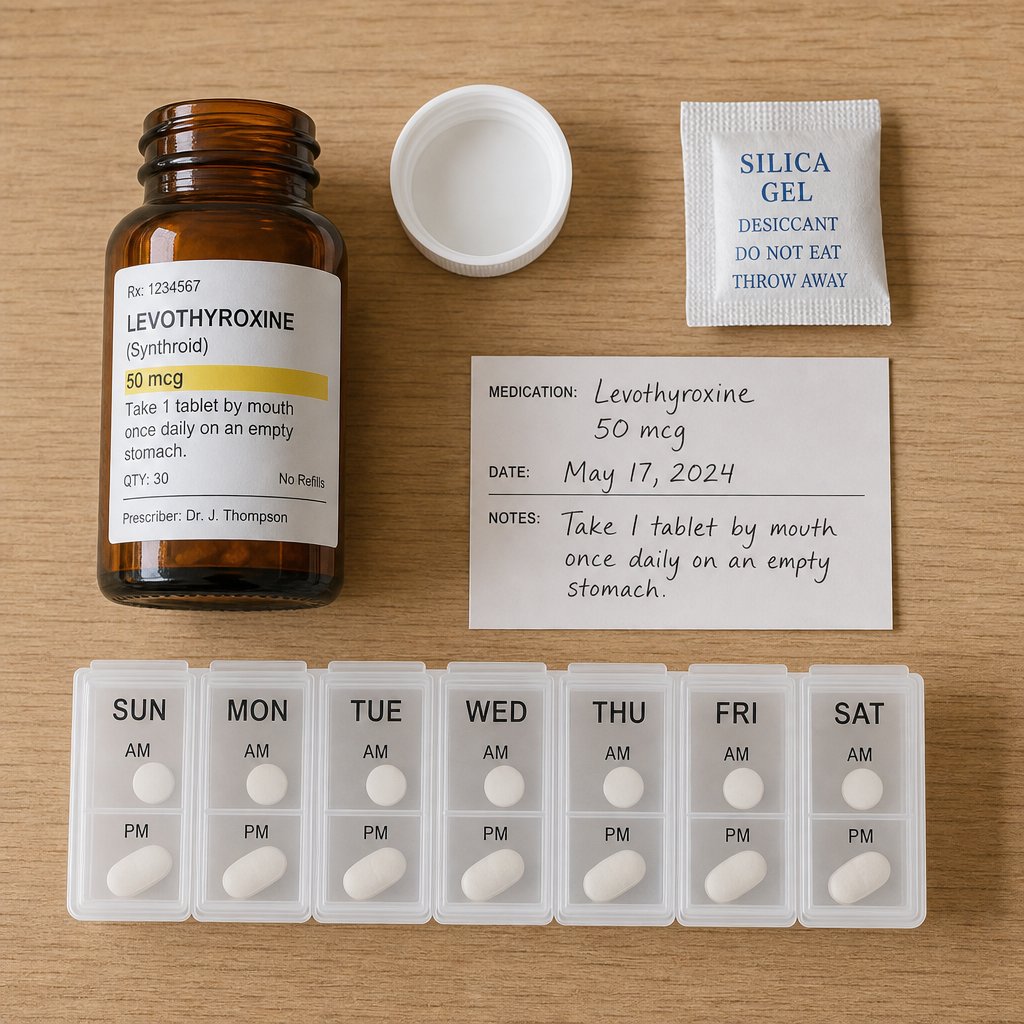
- Use the original prescription bottle: Keep split halves in the same container they came in. The original packaging is designed to protect the medication from environmental factors, and the child-resistant cap provides an additional safety layer.
- Add a desiccant packet: If your bottle did not come with one, place a small silica gel packet inside to absorb ambient moisture. Remove any cotton balls, as pharmacists note these can actually trap moisture inside the container.
- Consider amber glass vials: For medications especially sensitive to light (like certain cardiac drugs or nitroglycerin), amber glass blocks UV wavelengths that accelerate photodegradation. Transfer split halves into a small amber vial with a tight-fitting cap.
- Store in a cool, dry location: A bedroom drawer, a kitchen cabinet away from the stove, or a dedicated medication shelf works well. Avoid windowsills, car glove compartments, and any area exposed to direct sunlight or temperature swings.
- Keep the container tightly closed: Every time you open the bottle, fresh air and moisture enter. Close it immediately after retrieving your dose.
- Separate different medications: Never store split halves of different drugs in the same container. Cross-contamination between medications can alter chemical stability and create confusion about which pill is which.
Labeling and Shelf Life of Split Tablets
Imagine your prescription label reads "take 1 tablet by mouth twice daily," but your doctor verbally instructed you to take half a tablet twice daily during the first week. Without clear labeling on your split supply, it is easy to forget which dose you are on, especially if you manage multiple medications. Proper labeling prevents dosing errors and tracks freshness.
Every container holding split tablets should include:
- Medication name and original strength (e.g., "Lisinopril 20 mg, split to 10 mg halves")
- Date the tablets were split
- Number of pieces remaining
- Any special storage instructions from your pharmacist
How long do split halves stay potent? The FDA's guidance on split tablet stability studies states that the study length should reflect the "anticipated routine storage by the end-user," which may be more or less than 90 days depending on the drug's sensitivity. For most immediate-release tablets stored properly in a closed container at room temperature, pharmacists generally recommend using the second half within a few days to a week. If your prescription label says to discard unused halves, follow that instruction, as it means the manufacturer determined the split portion degrades too quickly for extended storage.
Does cutting a pill in half lower the dosage over time? Not immediately, but degradation from poor storage can reduce the effective dose you actually absorb. A tablet half that has absorbed moisture may dissolve differently in your stomach, or an oxidized surface layer may contain less active ingredient than the protected interior. The practical rule: split only what you need for the next one to two days unless your pharmacist confirms longer storage is safe for your specific medication.
Hygiene also plays a role in shelf life. Always wash and thoroughly dry your hands before handling split tablets. Use a clean pill cutter, and never touch the exposed cut surface directly. If you pre-split a week's supply for convenience, place each day's dose in a separate compartment of a pill organizer rather than piling all the halves together where they can rub against each other and generate powder.
Proper storage keeps your split doses accurate and safe. But even with the right technique and storage, some tablets simply refuse to cooperate. Crumbling, uneven breaks, and fragments flying across the room are problems that require their own set of solutions.
Step 6 Troubleshoot Common Cutting Problems
You followed the steps, used a decent tool, and still ended up with a crumbled mess or two wildly unequal pieces. Sound familiar? Tablet splitting does not always go smoothly, and the frustration is real. The good news is that most failures trace back to a handful of predictable causes, each with a specific fix.
Fixing Crumbling and Powder Loss
Crumbling is the most common complaint when people try to cut pills that crumble easily, and it usually comes down to three root causes:
- Dull blade: Pill cutter blades wear down over time. A dull edge crushes the tablet rather than slicing it, generating powder and irregular fragments. Replace your cutter or blade every six to twelve months if you split tablets regularly.
- Too-slow pressure: Pressing the blade down gradually gives the tablet time to shift and fracture unevenly. Express Scripts pharmacists specifically note that cutting too slowly makes pills more likely to crumble. One firm, quick press is the fix.
- Brittle formulation: Some tablets are simply manufactured with a harder, more friable composition. Older generic formulations and certain supplements use binders that become brittle with age or moisture exposure. If a tablet crumbles consistently regardless of technique, the formulation itself may not be suitable for splitting.
How to cut a pill in half without it crumbling when the tablet is inherently fragile? Try chilling it in the refrigerator for 10 to 15 minutes before cutting. Cold firms up the binder matrix and reduces fracturing. Just make sure to cut immediately after removing it, before condensation forms on the surface.
Solving Uneven Splits
Uneven halves mean uneven doses, which defeats the entire purpose of splitting. The usual culprits:
- Off-center placement: If the tablet is not centered in the V-channel, the blade hits one side before the other, creating a thick piece and a thin piece. Always visually confirm alignment before pressing down.
- Misaligned score line: The score must sit directly beneath the blade. Rotating the tablet even a few degrees off-axis sends the fracture along an unintended path.
- Wrong tool for the shape: Oblong tablets placed sideways in a cutter designed for round pills will not split evenly. Match the tool to the tablet geometry.
If you need to know how to cut a pill without a pill cutter and still get even halves, a sharp kitchen knife on a stable cutting board is the best alternative. Place the tablet on a non-slip surface, position the blade at the score line or center, and press straight down. This method works well for large, flat tablets but poorly for small or round ones that roll under pressure.
For those wondering how to break a pill in half with hands, the score-and-snap technique only works reliably on deeply scored, softer tablets. Place both thumbs on the scored side and push outward evenly. But keep in mind that hand splitting consistently produces the least accurate results, with studies showing a coefficient of variation above 9%, so reserve it for situations where no tool is available and the tablet has a deep, well-defined score.
The best way to cut pills in half depends on matching the tablet's characteristics to the right method. Here is a quick reference:
| Tablet Characteristics | Recommended Cutting Method | Common Failure Mode |
|---|---|---|
| Small round, scored (under 7 mm) | Pill splitter for small pills with narrow channel | Tablet rattles in oversized cutter; off-center cuts |
| Large oval, scored (10 mm+) | Standard pill cutter or kitchen knife on cutting board | Oblong shape shifts during cut if not oriented lengthwise |
| Round, unscored | Pill cutter with visual centering | No guide line leads to off-center splits; unequal halves |
| Coated (film-coated, not enteric) | Pill cutter with sharp blade, single quick press | Coating resists initial blade contact; slow pressure causes crumbling beneath coating |
| Brittle or aged tablets | Chill first, then pill cutter with fresh blade | Crumbling and powder loss regardless of alignment |
| Large flat, deeply scored | Score-and-snap by hand or knife | Excessive force shatters tablet past the score line |
Another common annoyance: the tablet launches across the room the moment the blade makes contact. This happens when the pill is not seated firmly in the channel and the blade's initial pressure flicks it sideways. The fix is simple. Press the tablet gently into the V-groove before closing the lid, ensuring it sits snugly. Some cutters include a rubber grip pad at the base of the channel for exactly this purpose.
When to Stop Splitting and Seek Alternatives
If a tablet crumbles on two consecutive attempts, produces fragments with visible size differences greater than roughly 20%, or generates significant powder loss, stop trying. Repeated failures are not a technique problem at that point. They indicate the tablet is not a good candidate for splitting.
Your pharmacist can help you explore alternatives:
- Liquid formulations: Compounding pharmacies can convert many solid medications into precisely dosed liquid forms, eliminating splitting entirely. Liquid medicine allows exact dose adjustments by volume rather than by breaking a solid in half.
- Lower-strength tablets: The exact dose you need may already exist as a manufactured tablet. A 25 mg tablet is easier to take whole than a 50 mg tablet split in half.
- Alternative dosage forms: Orally disintegrating tablets, chewable formulations, or transdermal patches may deliver the same drug without any cutting required.
How to cut pills in half without a pill cutter and without consistent failure? Sometimes the honest answer is that you cannot, at least not with that particular tablet. The goal is accurate dosing, not stubbornness about method. If splitting introduces more variability than your medication can tolerate, a conversation with your pharmacist about dosage alternatives protects both your health and your wallet.
That pharmacist conversation is worth having even when splitting goes well. Knowing the right questions to ask, and understanding what options exist beyond the pill cutter, gives you a safety net for any medication change down the road.
Step 7 Consult Your Pharmacist and Know Your Options
Your pharmacist knows things about your tablets that the label does not always make obvious. Can you cut a pill in half safely? The answer depends on formulation details, release mechanisms, and drug distribution patterns that only a trained professional can evaluate for your specific medication. A five-minute conversation at the pharmacy counter can prevent weeks of inaccurate dosing or unnecessary risk.
Questions to Ask Your Pharmacist About Splitting
People frequently search for answers to specific questions like can Jardiance be cut in half, can you cut metoprolol succinate in half, or can you cut lisinopril in half. The internet offers conflicting answers because splittability depends on the exact formulation, manufacturer, and tablet design. Your pharmacist can check the prescribing information and give you a definitive answer in seconds.
Bring these questions to your next pharmacy visit:
- Is this specific tablet FDA-approved for splitting? (Not just the drug, but this manufacturer's version.)
- Will splitting affect how the medication is absorbed or released in my body?
- Is there an alternative strength available that matches my prescribed dose without cutting?
- Can I use a standard pill cutter, or does this tablet's shape require a different approach?
- How should I store the unused half, and how long does it remain stable?
- If I switch to a generic or different brand, do I need to reconfirm that splitting is safe?
These questions matter because the same active ingredient can behave very differently across formulations. You cannot cut Wellbutrin XL in half because it uses an osmotic delivery system, but immediate-release bupropion tablets may be scored and splittable. Similarly, can Entresto be cut in half? No, because its film coating and bilayer design are not evaluated for splitting. Can you cut Eliquis in half? Eliquis (apixaban) tablets are not scored and the manufacturer has not submitted split-tablet data to the FDA, making it an unreliable candidate for division.
Alternatives When Splitting Is Not Recommended
When your pharmacist confirms that a tablet should not be split, you still have options. Harvard Health notes that compounding pharmacies can prepare medications in custom strengths or alternative forms, such as liquids, for patients who cannot use commercially available tablets. Other alternatives include:
- Lower-strength tablets: Many medications come in multiple strengths. Your doctor can prescribe the exact dose as a whole tablet.
- Liquid formulations: Oral solutions and suspensions allow precise dose measurement by volume, eliminating splitting entirely.
- Compounding pharmacies: These pharmacies create custom preparations when standard options do not match your needs. They can produce capsules, liquids, or troches in virtually any strength.
- Transdermal or alternative delivery: Some drugs are available as patches, dissolvable tablets, or other forms that bypass the splitting problem altogether.
To verify whether your tablet appears on a list of medications that can be split, follow these steps:
- Locate the medication's prescribing information. You can find it through the FDA's drug labeling database or ask your pharmacist for the package insert.
- Navigate to the "How Supplied" section near the end of the document.
- Look for language indicating the tablet is scored and that the score line is "functional," meaning it has been evaluated for splitting accuracy.
- If no splitting information appears in that section, the FDA has not evaluated the tablet for division. The two halves may not contain equal amounts of active ingredient or perform identically in the body.
- Confirm with your pharmacist, especially if you are switching between brands or generics of the same medication. A scored brand-name tablet does not guarantee the generic version is also safe to split.
The FDA emphasizes that tablet splitting should be done only under the supervision of a healthcare professional. This is not a bureaucratic formality. It reflects the reality that even small dosing errors compound over weeks and months of treatment, particularly for medications managing chronic conditions like hypertension, cholesterol, or mental health.
Ultimately, the cleanest solution to the splitting problem is not a better technique or a sharper blade. It is having the right dose in the right form from the start, which is exactly where modern dosage design and flexible manufacturing come into play.
Better Dosage Design Means No More Cutting
Every technique in this guide exists because someone received a tablet that did not match the dose they actually needed. The sharpest blade and the steadiest hands are workarounds for a design problem: when the right dosage form exists from the start, nobody needs to split anything.
Why Proper Dosage Design Eliminates Splitting
Think about how do you take tablets in an ideal scenario. You open a bottle, take one unit, swallow it, and you are done. No cutting, no crumbling, no guessing whether both halves are equal. That simplicity is what proper dosage design delivers. When a product is manufactured in the exact strength a consumer needs, the entire chain of splitting risks disappears: no dose inaccuracy, no exposed surfaces degrading in storage, no accessibility barriers for people with limited dexterity.
For health brands and supplement companies, this is a product design opportunity. Consumers searching for how to take pills easier or wondering how do you take a capsule without difficulty are signaling unmet needs. Brands that offer multiple strengths, smaller tablet sizes, or alternative formats capture those consumers directly rather than forcing them into workarounds.
Flexible Product Formats for Precise Dosing
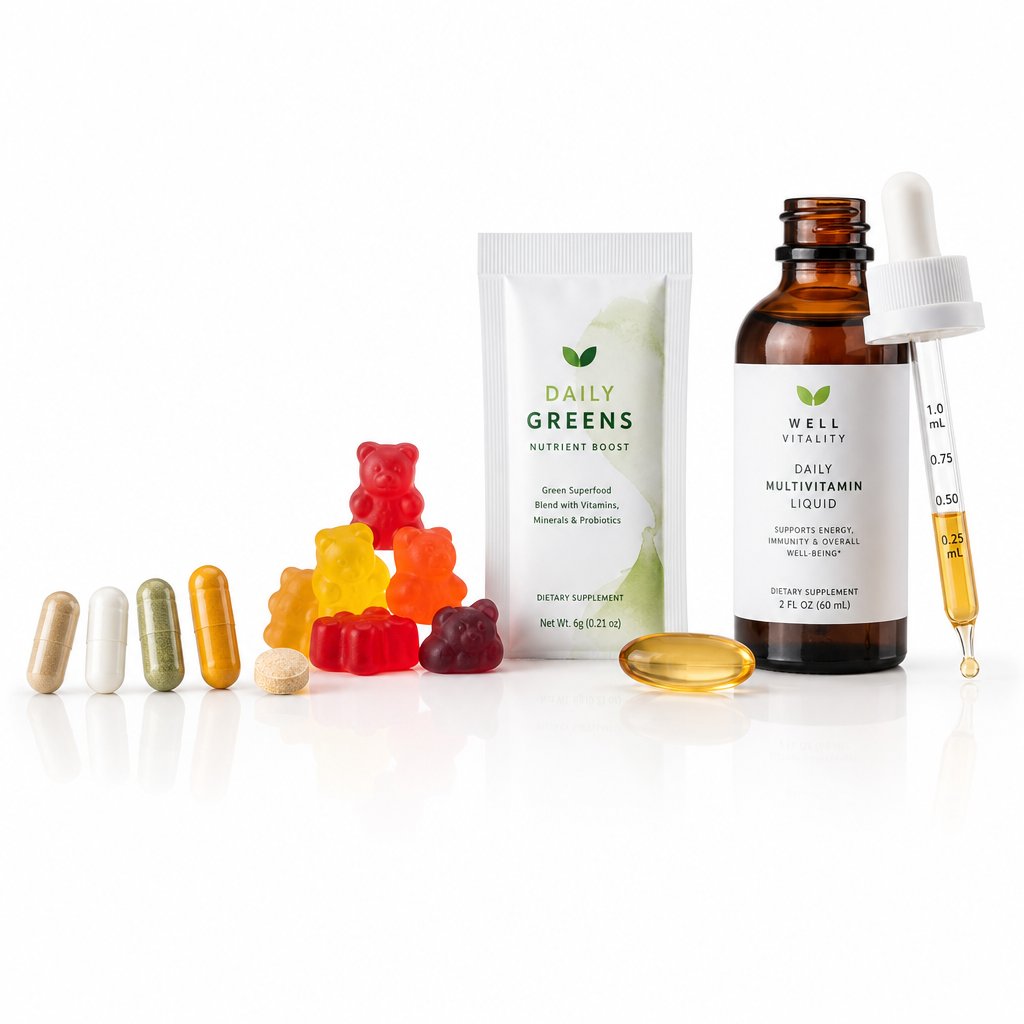
Modern contract manufacturing makes it practical to offer the same formulation across several delivery formats. Each one solves a different consumer pain point, from swallowing difficulty to precise micro-dosing:
- Tablets: Available in custom sizes and strengths, scored or unscored, film-coated for easier swallowing. Ideal when you need exact milligram dosing in a compact form.
- Hard capsules: Easy to swallow and simple to adjust by fill weight. For consumers who check a list of capsules that can be opened, hard capsules also allow the contents to be sprinkled onto food when swallowing whole is difficult.
- Soft capsules: Best for oil-based or lipophilic ingredients like omega-3s and vitamin D. One-piece sealed design ensures uniform dosing with no splitting needed.
- Powder and granules: Mixed into water or smoothies, powders let users measure exact portions by scoop or pre-portioned sachet. A practical answer for anyone asking how to take pills easier when they cannot swallow solids at all.
- Gummy candy: Chewable, flavored, and available in precise per-piece doses. Popular for vitamins, minerals, and functional ingredients where taste compliance matters.
- Oral liquids: Syrups, drops, and liquid shots allow dose adjustment by volume down to fractions of a milliliter, the most flexible option for titration without any cutting.
How do you take capsules, gummies, or liquids compared to splitting a tablet? You simply take the pre-measured unit as designed. No tools, no technique, no troubleshooting.
For nutrition brands, supplement importers, and private label sellers looking to eliminate the splitting problem at the source, working with a manufacturer that supports multiple formats is key. ZhuFeng's OEM/ODM health food manufacturing services offer customized formulation across all six formats listed above, from hard capsules and tablets to gummy candy and oral liquids, with scalable production that lets brands launch market-ready products in the exact strengths their consumers need. Instead of asking customers to buy a higher-dose tablet and split it, brands can offer the precise dosage in a convenient form from day one.
Whether you are a consumer learning how do you take pills more effectively or a brand deciding how to serve that consumer better, the principle is the same: the best split is the one you never have to make. Get the dosage form right, and the pill cutter stays in the drawer.
Frequently Asked Questions About Cutting Tablets
1. Can splitting time-release tablets kill you?
In extreme cases with high-potency drugs, yes. Cutting extended-release tablets destroys the controlled delivery mechanism, causing the entire dose to flood your system at once — a phenomenon called dose dumping. For potent medications like certain opioids or cardiac drugs, this rapid release can produce life-threatening toxicity. Never cut any tablet labeled ER, XR, XL, SR, LA, or CR without explicit pharmacist approval.
2. How do you cut a pill in half without it crumbling?
Use a pill cutter with a sharp blade and press down firmly in one quick, smooth motion — slow pressure is the main cause of crumbling. Make sure the tablet is centered in the V-channel before cutting. If the tablet is inherently brittle, try chilling it in the refrigerator for 10 to 15 minutes before splitting. If it still crumbles after two attempts, the formulation may not be suitable for splitting, and you should ask your pharmacist about liquid alternatives or lower-strength tablets.
3. Is half a tablet always half the dose?
For properly scored immediate-release tablets with uniform drug distribution, yes — each half contains approximately half the active ingredient. However, this only holds true if the split is even and the exposed surface is stored correctly. Unscored tablets, combination drugs with uneven ingredient distribution, or tablets that crumble during splitting may not deliver an accurate half-dose. Always confirm with your pharmacist that your specific tablet is designed for equal splitting.
4. How long can you store a split tablet before it loses potency?
Most pharmacists recommend using the second half within a few days to one week when stored in a tightly closed container at room temperature away from moisture and light. The FDA requires stability studies for scored medications because exposed surfaces are vulnerable to oxidation, humidity, and light degradation. Avoid storing split tablets in bathrooms where shower humidity accelerates breakdown. If your pharmacist provides specific storage instructions, follow those over general guidelines.
5. What is the best way to cut a pill into quarters?
Use a two-step process: first split the whole tablet in half using a pill cutter, then place one half back in the cutter rotated 90 degrees and split again. This works best with larger tablets (10 mm or wider) that still sit securely in the V-channel after the first cut. For a three-quarter dose, split into quarters and combine three pieces. Tablets smaller than 7 mm are difficult to quarter accurately with any tool — discuss liquid formulations with your pharmacist if precise quarter-dosing is needed.