

Why Swallowing Tablets Feels So Difficult
You are not the only person who dreads pill time. Whether you are a parent watching your child gag on a tiny vitamin or an adult who still cannot get a tablet past the back of your tongue, the struggle is real and far more common than most people assume. A study published in the Annals of Family Medicine found that over 55% of participants in a general population sample reported difficulties swallowing solid dosage forms. Among those who struggle, 1 in 3 experience vomiting, gagging, choking, or the sensation of a pill stuck in throat. So if learning how to eat tablets has felt like an impossible task, you are in very large company.
Understanding why your body resists can take a lot of the mystery and fear out of the experience. The reasons fall into two broad categories: things happening in your body and things happening in your mind. Often, both are at play at the same time.
The Anatomy Behind Every Swallow
Swallowing looks simple from the outside, but it is one of the most complex coordinated actions your body performs. According to the National Center for Biotechnology Information, over 30 nerves and muscles work together every time you swallow. Here is the short version of what happens when you try to take a tablet:
Your tongue pushes the tablet backward toward the pharynx. Sensory nerves detect the object and trigger a rapid reflex. The soft palate rises to seal off the nasal passage, and the vocal folds close while the epiglottis tips backward over the airway, preventing anything from entering the lungs. The entire pharyngeal phase takes roughly half a second to one and a half seconds. Once the tablet clears the upper esophageal sphincter, a wave of peristalsis carries it down the esophagus at about 3 to 4 cm per second until it reaches the stomach.
That speed matters when people wonder how long does it take for a pill to digest. The tablet first needs to travel the full length of the esophagus, which typically takes a few seconds with adequate water, before stomach acid and digestive fluids begin breaking it down. Any disruption along this chain, whether physical or neurological, can make swallowing whole tablets feel like a battle.
Physiological Reasons Tablets Feel Impossible
Sometimes the difficulty is rooted in a measurable physical cause. If you have ever felt a tablet lodge halfway down or had to swallow three or four times just to clear one pill, one of the following could be involved:
- Dysphagia - A clinical swallowing disorder that affects the muscles or nerves controlling the oral, pharyngeal, or esophageal phases. Conditions like stroke, Parkinson's disease, and multiple sclerosis are common underlying causes. Around 30% of community-dwelling older adults experience some form of dysphagia.
- Dry mouth (xerostomia) - Saliva acts as a natural lubricant. Medications such as antihistamines, antidepressants, and blood pressure drugs can reduce saliva flow, making it harder for a tablet to glide smoothly.
- GERD (gastroesophageal reflux disease) - Chronic acid reflux can inflame and narrow the esophageal lining, creating a sensation of something stuck even after the tablet has passed.
- Esophageal stricture or narrowing - Scar tissue from reflux, radiation therapy, or other conditions can physically reduce the diameter of the esophagus, making larger tablets especially difficult to pass.
- Age-related changes - Muscle strength and coordination in the throat naturally decline with age. Research on pill dysphagia in older adults shows that pill-specific swallowing difficulty affects roughly 14% of community-dwelling seniors and up to 30% of aged care residents.
The Psychological Side of Pill-Swallowing Difficulty
Here is where it gets tricky. Even when there is nothing physically wrong with your throat, your brain can make how to swallow a pill feel nearly impossible. Psychological barriers are just as real as structural ones, and they often feed off each other in a frustrating loop.
- Anxiety and anticipatory fear - Worrying about gagging or choking before the tablet even touches your tongue tightens the throat muscles, which ironically makes gagging more likely.
- Gag reflex hypersensitivity - Some people have a gag reflex that triggers earlier or more intensely than average. The mere presence of a tablet on the tongue can set it off.
- Choking phobia (phagophobia) - A specific fear of swallowing or choking that can develop after a single bad experience. One participant in a mixed-methods study on pill dysphagia described it plainly: "I have previously choked and this has left me with a fear of dying from a pill caught in my throat."
- Embarrassment and self-judgment - Adults who struggle often feel foolish, which adds stress to every attempt. The same study found participants reporting they "feel stupid" for having difficulty when others seem to manage easily.
These psychological effects are not trivial. The research linked difficulty swallowing pills to lower life satisfaction, reduced positive emotions, and decreased overall wellbeing, even in people with only mild to moderate symptoms. Knowing how to eat pills is not just a convenience skill; it directly affects whether people stick with their prescribed treatments. Nonadherence rates among those who struggle sit around 9.4%, and nearly 59% resort to modifying their dosage forms, sometimes dangerously.
The good news is that both the physical and mental sides of this problem respond well to the right techniques. And the first step toward using those techniques correctly is knowing exactly what type of tablet you are dealing with.
Step 1 – Identify Your Tablet Type Before Taking It
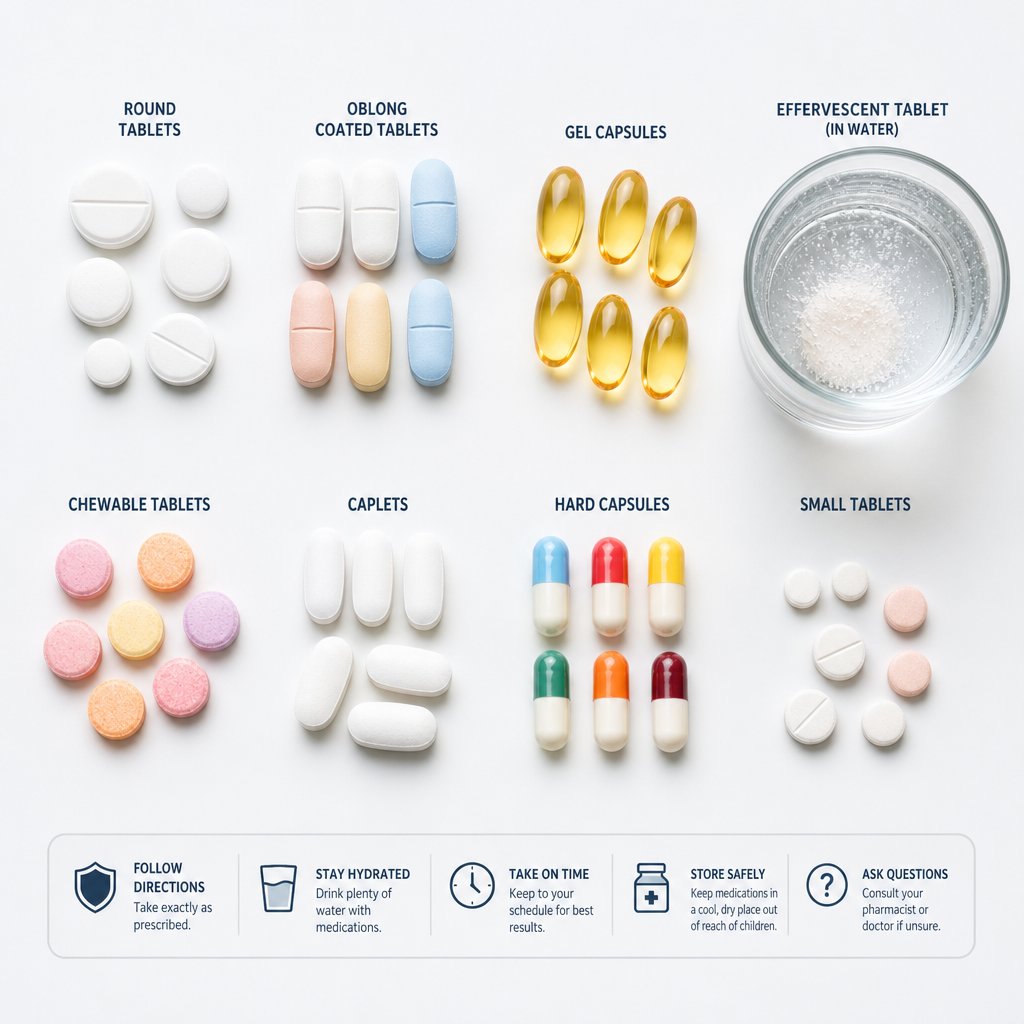
A surprising number of people assume every tablet works the same way: pop it in your mouth, take a gulp of water, and hope for the best. In reality, different tablet types require completely different techniques. Taking a sublingual tablet with a big swig of water, or chewing an enteric-coated tablet because it feels too large, can reduce the medication's effectiveness or irritate your stomach. Knowing what you are holding in your hand is the real first step in learning how to drink pills safely and comfortably.
Standard and Coated Tablets
Standard compressed tablets, sometimes called uncoated tablets, are the most common type. They are made of tightly compressed powder and typically have a dull, chalky surface. You swallow them whole with a full glass of water. Taking them dry or with too little liquid increases the risk of a stuck tablet in throat, because there is not enough moisture to help the tablet glide past the esophageal lining.
Coated tablets come in two main varieties. Film-coated and sugar-coated tablets have a thin, smooth layer that makes them easier to swallow and masks bitter taste, but the coating does not change how the drug is absorbed. These can usually be swallowed the same way as standard tablets. Gastro-resistant or enteric-coated tablets, on the other hand, have a protective shell designed to survive stomach acid and only dissolve once they reach the small intestine. Crushing or chewing them destroys that protection, potentially deactivating the drug or causing stomach irritation.
Chewable, Sublingual, and Orally Disintegrating Tablets
Not every tablet is meant to be swallowed intact, and this is where many people go wrong.
Chewable tablets are formulated to break apart in the mouth. You chew them thoroughly and then swallow. They are common for antacids, certain vitamins, and pediatric medications. Lozenges fall into a similar category: they dissolve slowly in the mouth and are designed to treat the throat directly.
Sublingual tablets go under the tongue, where the thin tissue absorbs the active ingredient straight into the bloodstream. Nitroglycerin for chest pain is a classic example. You do not swallow these with water. You place the tablet under your tongue and let it dissolve completely. Buccal tablets work on the same principle but are placed between the cheek and gum instead. Both routes bypass the digestive system entirely, which is why swallowing them like a regular pill would reduce or delay their effect.
Orally disintegrating tablets, often called ODTs, are placed on the tongue and dissolve within seconds without any water at all. They are a practical option for anyone who panics at the thought of how long can a pill be stuck in your throat, because there is nothing solid left to get stuck.
Effervescent and Enteric-Coated Formulations
Effervescent tablets are never swallowed whole. You drop them into a glass of water, let them fizz and dissolve completely, and then drink the solution. Because the medication is already dissolved before it reaches your stomach, effervescent forms can act faster than standard tablets and are a popular choice for people who struggle with solid pills. Think of it as another way to how to drink pills without the swallowing challenge altogether.
Enteric-coated formulations, whether tablets or capsules containing coated pellets, must be swallowed intact. The coating is engineered to resist gastric acid so the drug releases in the intestine. Crushing, splitting, or chewing these forms can lead to dose dumping, where the entire dose hits your system at once, or to the drug being deactivated by stomach acid before it can work. If a pill swallowing cup or another aid helps you get them down whole, use it. Just never alter the tablet itself without checking with your pharmacist first.
The table below gives you a quick-reference guide to match each tablet type with the correct method.
| Tablet Type | How to Take It | Can It Be Crushed? |
|---|---|---|
| Standard (uncoated) tablet | Swallow whole with a full glass of water | Usually yes |
| Film-coated or sugar-coated tablet | Swallow whole with water | Usually yes, but may taste bitter |
| Enteric-coated (gastro-resistant) tablet | Swallow whole with water; do not chew | No |
| Chewable tablet | Chew thoroughly, then swallow | Yes |
| Orally disintegrating tablet (ODT) | Place on tongue and let dissolve; no water needed | Not applicable |
| Sublingual tablet | Place under the tongue until fully dissolved | No |
| Buccal tablet | Place between cheek and gum until absorbed | No |
| Effervescent tablet | Dissolve in a glass of water, then drink | Not applicable |
| Extended-release / sustained-release tablet | Swallow whole with water; never split or chew | No |
Getting the method right for your specific tablet removes one of the biggest hidden obstacles. But even when you know what to do, the physical setup matters just as much: how much water you use, how you hold your head, and what you eat or drink alongside the dose can all determine whether the tablet goes down smoothly or gets stuck halfway.
Step 2 – Prepare With the Right Water and Body Position
The physical setup you create before the tablet even touches your tongue has a bigger impact on success than most people realize. Water volume, body angle, head tilt, and even the beverage you choose can be the difference between a smooth swallow and that dreaded pill feeling stuck in throat sensation. A few small adjustments here make it dramatically easier to learn how to swallow pills on the very next attempt.
How Much Water You Actually Need
Most people underestimate how much water a tablet needs to travel safely. A pharmacy practice study found that nearly 1 in 6 participants swallowed their medication with 60 ml of water or less, putting them at higher risk for esophageal irritation. The same research referenced data from Gallo et al. showing that successful esophageal passage rates climb steeply with liquid volume: just 9.1% with no liquid, 55.8% with 30 ml, and 81.6% with 100 ml.
The practical takeaway is straightforward. Take a few sips of water before placing the tablet in your mouth. This pre-lubricates the throat and primes the swallowing reflex. Then use a full glass, roughly 200 to 250 ml, to wash the tablet down. If you have ever wondered how long does it take for pills to work, know that adequate water also speeds up dissolution in the stomach, so the active ingredient reaches your system faster.
Stick with room-temperature water. Cold water is fine and can even help relax a tense throat, but hot beverages are a poor choice. Heat can soften or degrade protective coatings on certain tablets, altering how the drug releases. Plain water is the safest default unless your pharmacist says otherwise.
Correct Head and Body Positioning
Imagine trying to send a marble down a kinked garden hose. That is roughly what happens when you swallow a tablet while slouched on a couch or lying in bed. Body angle directly affects esophageal passage. The Gallo et al. data cited in the same study showed that a vertical, upright position achieved a 69.7% passage rate, compared to just 17% in a supine position.
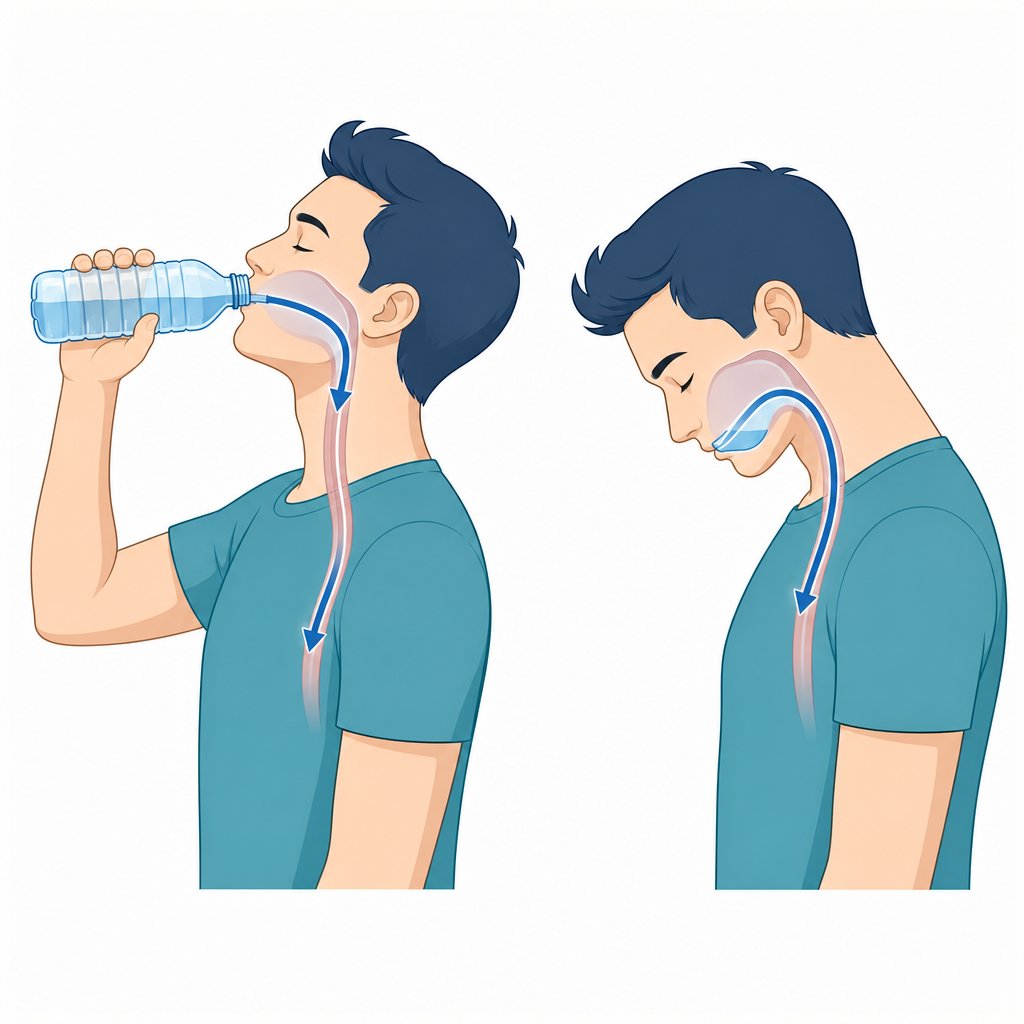
Sit upright in a chair or stand. Keep your chin in a neutral position or tuck it slightly toward your chest. Speech pathologist Leanne Goldberg of Mount Sinai warns that tilting the head back is one of the most common mistakes, because it opens the airway and gives the tablet a direct path toward the trachea instead of the esophagus. A neutral or slightly forward chin guides the tablet toward the correct tube.
Never take a tablet lying down. Remain upright for at least 30 minutes afterward to prevent the tablet from lodging in the esophagus and causing irritation.
Your environment matters too. A calm, unhurried setting lowers the anxiety that tightens throat muscles and triggers the gag reflex. Rushing through the process while distracted or stressed is one of the fastest ways to make how to swallow pills easier said than done.
Food and Drink Interactions to Watch For
What you eat or drink alongside your tablet can change how the medication behaves in your body. The FDA warns that grapefruit juice can block enzymes responsible for breaking down certain drugs, including some statins, blood pressure medications, and anti-anxiety drugs. The result is too much medication entering the bloodstream, which raises the risk of side effects.
Dairy products are another common culprit. Calcium in milk, cheese, and yogurt can bind to certain antibiotics like tetracyclines and fluoroquinolones, reducing their absorption. Some medications also need to be taken on an empty stomach for proper absorption, while others require food to prevent nausea.
A simple habit covers most situations: take your tablets with plain water, check the label or patient information leaflet for food-specific warnings, and ask your pharmacist if you are unsure. These preparation steps may sound basic, but they lay the groundwork for the two clinically proven swallowing techniques that turn tablet time from a struggle into a routine.
Step 3 – Master the Two Clinically Proven Swallowing Techniques
Good preparation sets the stage, but technique is what actually gets the tablet down. Two specific methods have been tested in a controlled clinical setting and shown to make a measurable difference for people who struggle with taking pills. Both come from a cross-sectional study published in the Annals of Family Medicine involving 151 adults, more than half of whom reported difficulty swallowing solid dosage forms. The results were striking enough that researchers recommended both techniques for routine use in the general population.
The Pop-Bottle Method for Tablets
This technique works best for standard compressed tablets, the dense, heavy kind that tend to sit on your tongue like a pebble. The key principle is simple: a suction-and-swallow reflex bypasses the hesitation that usually stalls the process. You do not have to consciously "push" the tablet backward. The water flow does the work for you.
Here is how to do it:
- Fill a flexible plastic water bottle (a standard PET bottle works perfectly) with room-temperature water.
- Place the tablet on the center of your tongue.
- Close your lips tightly around the opening of the bottle, forming a complete seal. No air should get in.
- Take a swift swig by sucking water from the bottle and swallowing in one continuous motion. The suction pulls the water and the tablet backward together, carrying it past the point where most people gag or freeze.
In the study, this method was tested 283 times across large and very large tablet sizes. The pop-bottle technique improved swallowing in 59.7% of all participants, and among those who felt relief, 88.5% considered the improvement meaningful. Lodging of tablets in the throat dropped by 53.7%, and more participants successfully transported the tablet out of the mouth on the first try. These gains held for people with and without pre-existing swallowing difficulties.
Why does it work? The tight seal around the bottle opening forces a rapid, reflexive swallow rather than a slow, deliberate one. That speed matters because it shortens the window in which your brain can trigger a gag response. If you have ever wondered whether can a pill get stuck in your throat using this method, the data is reassuring: the unpleasant "stuck" sensation was significantly reduced compared to the conventional sip-from-a-cup approach.
The Lean-Forward Method for Capsules
Capsules behave differently from tablets. They are lighter and less dense, which means they float in water. Tilting your head back, the instinct most people follow, actually sends the capsule floating toward the front of your mouth and away from the throat. The lean-forward method uses capsule buoyancy to your advantage instead of fighting it.
Follow these steps:
- Place the capsule on the center of your tongue.
- Take a medium sip of water, but do not swallow yet. Hold the water in your mouth.
- Tilt your chin downward toward your chest.
- Swallow the capsule and water together while your head is bent forward.
Because the capsule floats, bending forward causes it to drift toward the back of the throat, right where it needs to be for a clean swallow. The study results were even more impressive here: the lean-forward technique improved capsule swallowing in 88.6% of participants. Every single person who had reported an unpleasant throat sensation during conventional swallowing said it disappeared entirely with this method. Capsule lodging dropped to zero. And 85.6% of all participants in the study said they would adopt these techniques in their daily routines.
This is also a safer posture for anyone concerned about aspiration. Tucking the chin narrows the airway entrance, which reduces the risk of the capsule heading down the wrong pipe. For people learning how to swallow tablets and capsules for the first time, or for anyone who has avoided taking pills out of fear, the lean-forward method is often the easier starting point.
Which Technique Works for Which Pill Shape
Matching the right method to the right dosage form is what makes these techniques so effective. The general rule is straightforward:
- Dense, heavy pills (standard tablets, round or oblong) — use the pop-bottle method. These pills sink in water, so the suction-driven swallow carries them efficiently.
- Lightweight, buoyant pills (gelatin capsules, soft gels) — use the lean-forward method. Gravity and buoyancy work together to position the capsule at the back of the throat.
- Oval or oblong coated tablets — try both and see which feels more natural. Some coated tablets are light enough to benefit from the lean-forward approach.
If you have been searching for how to take pills if you can't swallow them, these two techniques are the strongest evidence-based answer available. They require no special equipment beyond a plastic bottle, no medication changes, and no medical intervention. Still, not everyone finds success on the first try, and some people need a gentler on-ramp. That is where food vehicles, swallowing aids, and graduated practice methods come in.
Step 4 – Try Food Vehicles and Pill-Swallowing Aids
Some people try the pop-bottle method and the lean-forward technique and still feel their throat clamp shut the moment a tablet touches the tongue. That does not mean something is wrong with you. It means your body needs a different entry point, one that sidesteps the direct tablet-on-tongue trigger altogether. Food vehicles, purpose-built swallowing aids, and graduated practice methods each offer a way to take a pill without relying on willpower alone.
The Food-Vehicle Method With Applesauce or Pudding
This approach is exactly what it sounds like: you hide the tablet inside a spoonful of soft food and swallow the whole spoonful in one motion. Your throat treats it like food rather than a foreign object, which often bypasses the gag reflex entirely. Speech pathologist Leanne Goldberg of Mount Sinai recommends placing the tablet in the center of a teaspoon of applesauce, yogurt, or pudding and letting it slide down with the puree consistency.
The key is choosing the right food. You want something smooth, thick enough to carry the tablet, and soft enough to swallow without chewing. Good options include:
- Applesauce — smooth, slightly sweet, and thick enough to hold a tablet in place. This is the most commonly recommended vehicle in clinical settings.
- Yogurt — works well, but avoid varieties with fruit chunks or granola that require chewing. Plain or vanilla yogurt is ideal.
- Pudding or custard — the dense, creamy texture coats the tablet and helps it glide past the throat.
- Mashed banana — a natural alternative that is soft enough to swallow in one motion.
Avoid foods that require any chewing. Bread, peanut butter, or chunky fruit can dislodge the tablet from the food mass mid-chew, leaving it exposed on your tongue and triggering the exact reaction you are trying to avoid. Also keep the portion small. A single teaspoon is enough. Using too much food increases the chance of an unfinished portion, which means an incomplete dose. A review published in Patient Preference and Adherence notes that mixing medications with food can introduce food-drug interactions and that unfinished food portions are a recognized cause of incomplete dosing. Use just enough to carry the tablet and consume the entire spoonful.
One important caveat: the food-vehicle method works for standard uncoated tablets and most film-coated tablets. Never use it with enteric-coated, extended-release, or sublingual formulations unless your pharmacist confirms it is safe. And if you are wondering about how to crush pills and mix them into food instead, that is a separate decision with its own safety rules covered later in this guide.
Pill-Swallowing Cups, Sprays, and Lubricant Gels
When food vehicles are not practical, or when you simply prefer a cleaner method, purpose-built pill-swallowing aids can help. These products are designed specifically for people who can swallow food and liquids without trouble but freeze up when a tablet enters the picture. Here is what is available:
- Pill-swallowing cups — These cups have a built-in shelf or mouthpiece where you place the tablet. When you drink from the cup, the water flow lifts the tablet off the shelf and carries it into your mouth along with the liquid. You swallow both together in a single natural motion, so the tablet never sits on your tongue waiting to trigger a gag. The mechanism is similar to the pop-bottle method but removes the need for a tight lip seal around a bottle opening.
- Pill-swallowing straws — Similar in concept to the cups, these straws suspend the tablet in the liquid stream as you sip. They encourage a chin-neutral or chin-down head position, which is safer than tilting the head back. No published clinical trials have validated their efficacy yet, but the design principle aligns with the postural adjustments that research supports.
- Lubricant sprays — A flavored spray applied inside the mouth before taking the tablet. The spray coats the oral surfaces, reducing friction and making the tablet less likely to stick. A study on adolescents with pill-swallowing difficulties found that 7 out of 11 participants were able to swallow tic-tac-sized candies successfully after using a pill-swallowing spray, suggesting it can serve as both a swallowing aid and a training tool.
- Lubricant gels — These gels are applied directly to the tablet, creating a slippery coating that helps it glide through the throat and esophagus. Preliminary research has found no significant physicochemical interactions between the gel and the medications tested, and they are gaining use in aged care facilities.
- Pill glide coatings — A device that applies a thin, smooth layer around the tablet, masking its taste and texture. In a randomized cross-over study, 40 out of 41 healthy participants with swallowing difficulties reported improved pill swallowing using a coating device, with 54% finding it "much easier" to just swallow whole tablets.
These aids are widely available online and in pharmacies. They are designed for otherwise healthy people with pill-swallowing difficulties, not for individuals with clinical dysphagia, where the risk of aspiration requires professional assessment before using any swallowing device.
The Graduated Practice Approach for Beginners and Children
What if the real barrier is not the tablet itself but the fear of trying? For children learning to swallow pills for the first time, and for adults who have avoided tablets for years, a graduated practice method builds confidence in small, low-pressure steps. The idea is to train the swallowing reflex with tiny, harmless items and slowly increase the size until a real tablet feels routine.
Pediatric psychologist Jennifer Butcher of Michigan Medicine outlines a clear progression that works for children and adults alike:
- Start with a single tiny sprinkle. Place one cake-decorating sprinkle on the center of the tongue and wash it down with a sip of water. If this succeeds, you have proof that your throat can handle a small solid object.
- Move to a slightly larger candy. A Nerds candy or a larger sprinkle is the next step. Practice until you can swallow this size a few times without hesitation.
- Progress to a mini M&M. This is roughly the size of many small tablets. Swallow it with water just as you would a real pill.
- Try a quarter of a Tic Tac or a Good & Plenty candy. These approximate the size and shape of a standard capsule.
- Work up to the full size of the tablet you need to take. By this point, your throat has successfully swallowed dozens of similar-sized objects, and the fear factor drops significantly.
Butcher emphasizes a few rules that make or break this process. Practice for only about five minutes at a time so it never feels like a chore. Always end on a success, even if that means stepping back to a smaller size. If a child panics at a larger candy, do not force it. Return to the last size they handled comfortably and try the bigger one again the next day. Offer small rewards like stickers to keep motivation high, and never practice during high-pressure moments like when the child actually needs to take medication.
For adults, the same logic applies. Start at a size that feels absurdly easy and work up. Remind yourself that you swallow bites of food far larger than most tablets at every meal. The graduated approach retrains your brain to treat a tablet as just another small thing to swallow, not a threat.
Behavioral methods like these have shown success in children and adolescents aged 3 to 21 with conditions including ADHD and HIV/AIDS, where consistent pill-taking is critical. Researchers note that if these interventions work for young patients with significant anxiety, they have strong potential for adults dealing with the same difficulty.
These alternative methods give you a toolkit beyond the two core techniques. Yet for some people, the obstacle is not mechanical at all. It is emotional. The anxiety, the dread, the memory of a tablet stuck in the throat from years ago. Addressing that psychological layer is what turns occasional success into lasting confidence.

Step 5 – Overcome the Fear and Anxiety of Swallowing Pills
Techniques and tools can only take you so far if your body locks up the moment you see a tablet in your palm. For many people, the real barrier is not a weak swallowing reflex or a lack of water. It is fear. The dread of gagging, the memory of a pill stuck in the throat, or the panicky certainty that this time you will choke. That emotional response is not a character flaw. It is a recognized psychological pattern, and it has a name: phagophobia, the fear of swallowing. Understanding how it works is the first step toward dismantling it.
Breaking the Anxiety-Tension-Gag Cycle
Here is what typically happens. You pick up the tablet and immediately start thinking about what could go wrong. Your shoulders tense. Your throat tightens. By the time the tablet touches your tongue, the muscles that are supposed to relax and guide it downward are already clenched. The tablet sits there, your gag reflex fires, and the attempt fails. That failure reinforces the fear, which makes the next attempt even harder.
This anxiety-tension-gag cycle is self-fulfilling. A narrative review in the British Journal of Clinical Pharmacology found that pill aversion frequently co-exists with depression (28.4%) and anxiety (20.6%), and that emotions like fear and negative feelings about medication directly precipitate gagging, nausea, and avoidance. The physical symptoms are real, but the trigger is psychological. Your throat is not too narrow. Your brain is sending a false alarm.
Recognizing this pattern is powerful because it shifts the problem from "my body can't do this" to "my nervous system is overreacting, and I can retrain it." That retraining does not require a therapist for most people, though professional help is available for severe cases. Practical desensitization strategies work well for the majority of pill-swallowing anxiety.
Desensitization Strategies That Build Confidence
The goal is to gradually lower your threat response so that placing a tablet on your tongue feels routine rather than alarming. Think of it as exposure therapy you can do at your kitchen table. If you have been wondering how to swallow a pill when your scared, these steps are designed specifically for you.
- Practice the swallowing motion with water only. Take a sip of water and swallow it deliberately, paying attention to how your throat moves. Do this five or six times. You are reminding your body that swallowing is something it already does thousands of times a day without incident.
- Use slow breathing before and during the attempt. Inhale slowly through your nose for four counts, hold for two, and exhale through your mouth for six. Repeat this three times before picking up the tablet. Controlled breathing activates the parasympathetic nervous system, which directly counteracts the fight-or-flight tension that locks your throat.
- Start with the smallest possible item. A single cake sprinkle or a tiny candy is enough. Place it on your tongue, take a sip of water, and swallow. Success at this size proves to your brain that a small solid object can pass through your throat safely.
- Increase size gradually over days, not minutes. Move from sprinkles to mini M&Ms to Tic Tac-sized candies across multiple sessions. Never jump two sizes in one sitting. Each successful swallow deposits a small amount of confidence that compounds over time.
- Reframe the experience. This is the single most effective cognitive shift you can make. Most standard tablets measure between 8 and 15 mm in diameter. Compare that to the food you eat every day without a second thought.
You swallow bites of food far larger than most tablets at every single meal. A grape, a piece of pasta, a chunk of bread — all bigger, all swallowed without fear.
That reframing is not a trick. It is a fact. And repeating it to yourself before each attempt interrupts the catastrophic thinking that fuels the cycle. Behavioral interventions like counter-conditioning and cognitive restructuring have been used successfully in clinical settings, including with HIV patients who experienced pill aversion severe enough to skip doses. If structured relaxation and reframing can help patients overcome medication avoidance tied to a life-threatening diagnosis, the same principles apply to everyday tablet-taking anxiety.
Age-Specific Guidance for Children, Teens, and Adults
Fear looks different at every age, and so should the approach to overcoming it.
Children (ages 5 and up): Make it a game, not a test. Child Life Specialist Lauryn Shackelford of Children's Health recommends practicing with pill-sized candy when the child is healthy, relaxed, and not under pressure to take actual medication. Use tiny sprinkles first and work up to Skittles-sized candies over several sessions. Offer small rewards like stickers for effort, not just success. If a child gags or refuses, calmly step back to the last size they handled and try again another day. Never force it. Forcing creates exactly the kind of traumatic memory that turns a temporary difficulty into a lasting phobia.
Teens: The biggest enemy here is shame. Teenagers are acutely aware of what their peers can do, and admitting they cannot swallow a pill feels humiliating. Normalize the struggle. Point out that research estimates up to 40% of adults have difficulty swallowing solid oral dosage forms. This is not a kid problem. It is a human problem. Let teens practice privately, choose their own method, and control the pace. Autonomy reduces resistance.
Adults: If you are an adult who still dreads every tablet, know this: you are not childish, and you are not alone. The same narrative review found that how do you take tablets is a question asked across every age group, every continent, and every healthcare setting studied. Adults who struggle often modify their medications by crushing or skipping doses rather than admitting the difficulty to a doctor. That silence makes the problem invisible but does not make it go away. Speak up. Your pharmacist can suggest alternative formats, and the desensitization strategies above work just as well at 45 as they do at 5.
Conquering the psychological side of pill-swallowing difficulty changes the entire experience. But even with confidence rebuilt, there will be moments when a tablet does not go down cleanly. Knowing exactly what to do when that happens, and when to seek help, is the safety net that keeps a minor setback from becoming a serious problem.
Step 6 – What to Do When a Tablet Gets Stuck in Your Throat
Even with the best technique and a calm mindset, there will be a time when a tablet does not go down cleanly. Maybe you rushed, maybe your mouth was dry, or maybe the pill just caught on the wrong spot. That moment of feeling a pill stuck throat-level can trigger instant panic, but your response in the next 30 seconds matters more than the panic itself. Knowing the difference between uncomfortable and dangerous lets you act quickly and correctly.
Esophageal Sticking vs. Airway Obstruction
The first thing to determine is where the tablet actually is. These are two very different situations with very different levels of urgency.
A tablet lodged in the esophagus (the food pipe leading to your stomach) is uncomfortable and sometimes painful, but it is not blocking your airway. You can still breathe, speak, and cough normally. Most people describe it as a pressure or burning sensation behind the breastbone. This is by far the more common scenario.
A tablet blocking the trachea (the windpipe) is a choking emergency. The person may wheeze, gasp, turn blue, or be unable to speak or cough effectively. If this happens, call 911 immediately and perform the Heimlich maneuver or the five-and-five method (five back blows followed by five abdominal thrusts). Do not wait to see if the situation resolves on its own.
For teens learning to swallow pills for the first time, it helps to explain this distinction in advance. Knowing that the stuck feeling almost always means the esophagus, not the airway, can prevent the kind of full-body panic that makes everything worse.
Immediate Steps When a Tablet Gets Stuck
If you can breathe and talk, the tablet is in your esophagus. Here is what to do:
- Drink several large sips of water. This is the simplest and most effective first step. The added liquid helps push the tablet downward through the esophagus. Medical News Today recommends continuing to drink even if the first few sips do not seem to help.
- Try swallowing a bite of soft food. A small piece of bread, a spoonful of applesauce, or a bite of banana can act as a physical pusher, carrying the tablet along with the food bolus into the stomach.
- Stay upright. Remain sitting or standing. Gravity assists the tablet's downward movement, while lying down removes that advantage and increases the risk of esophageal irritation.
Most tablets will dissolve on their own within 20 to 30 minutes, so even if the above steps do not produce an immediate sensation of relief, the tablet is likely already breaking down. How long does it take for a pill to dissolve depends on the formulation: standard uncoated tablets dissolve faster than coated or gel capsules, but none will sit in the esophagus indefinitely.
Here is the part that catches people off guard: the sensation of something stuck can linger long after the tablet has actually passed. This is called globus sensation, a persistent feeling of a lump in the throat that has no physical cause. It is harmless but unsettling, and it can last minutes to hours. If you have successfully swallowed water and food without obstruction, the tablet is almost certainly gone. The feeling is your throat's memory of the event, not the event itself.
When to Seek Emergency Medical Help
Most stuck-tablet episodes resolve at home within minutes. But certain symptoms signal that you need professional help right away. The table below gives you a quick way to assess your situation.
| Symptom | Action to Take |
|---|---|
| Can breathe and speak normally; feels like pressure behind the breastbone | Drink water, try soft food, stay upright. Monitor for 30 minutes. |
| Wheezing, gasping, or inability to speak | Call 911 immediately. Perform the Heimlich maneuver. |
| Chest pain that does not resolve after the tablet passes | Contact your doctor or visit urgent care. Possible esophageal irritation. |
| Unable to swallow saliva or liquids | Go to the emergency room. The tablet may be fully obstructing the esophagus. |
| Sensation of something stuck persists beyond a few hours | See a doctor to rule out esophageal injury or retained fragment. |
| Bloody saliva or vomit after a stuck tablet | Seek emergency care. Possible esophageal ulceration or perforation. |
Certain medications carry a higher risk of causing pill esophagitis if they lodge in the esophagus. Tetracycline antibiotics, especially doxycycline, create acidic solutions as they dissolve and can burn the esophageal lining within minutes. Bisphosphonates used for osteoporosis are another well-known culprit, which is why their labeling instructs patients to remain upright for at least 30 minutes after taking them. Potassium supplements, particularly potassium chloride tablets, have been linked to severe esophageal ulceration. If you take any of these and wonder can you crush potassium pills to avoid the risk, the answer depends entirely on the formulation. Immediate-release potassium tablets can sometimes be crushed, but extended-release versions must be swallowed whole because crushing them releases the full dose at once, which can damage tissue. Always confirm with your pharmacist before altering any of these higher-risk medications.
Iron supplements and NSAIDs round out the list of common offenders. If you regularly take any medication in these categories, the preparation steps from earlier in this guide, especially adequate water volume and upright positioning, are not optional. They are essential safety measures.
Knowing how to handle a stuck tablet removes one of the biggest fears that keeps people from taking their medication consistently. But what about the tablets themselves? Some can be safely crushed or split to make them easier to manage, while others must never be altered. Getting that distinction wrong can be just as dangerous as a stuck pill.
Step 7 – Know Which Tablets Can Be Safely Crushed or Split
Crushing a tablet might seem like the obvious shortcut when swallowing feels impossible. And for some medications, it is a perfectly safe solution that can make how to take pills easier overnight. For others, though, crushing or splitting changes the way the drug enters your body, sometimes dangerously. The difference between a safe crush and a harmful one comes down to how the tablet was designed, and that is not always obvious from looking at it.
Tablets You Can Safely Crush or Split
Two categories of tablets are generally safe to alter:
Immediate-release uncoated tablets. These are the plain, chalky, compressed tablets with no special coating or timed-release mechanism. They are designed to dissolve quickly in the stomach, so crushing them simply speeds up a process that would have happened within minutes anyway. How long does it take for pills to digest in this form? Most immediate-release tablets begin breaking down within 15 to 30 minutes of reaching the stomach, and crushing them before swallowing shortens that window further.
Scored tablets. If your tablet has a line etched down the middle, that score mark is a deliberate design feature. It tells you the manufacturer tested the tablet for even splitting. A GoodRx medication safety guide confirms that a visible score line is one of the clearest indicators that a tablet is safe to cut in half. Use a proper tablet cutter rather than a kitchen knife. Knives create uneven fragments, which means inconsistent dosing and wasted medication.
Tablets You Must Never Alter
This is where a hard pill to swallow becomes a genuinely dangerous one if you try to force a workaround. The following categories must be taken intact, no exceptions:
- Enteric-coated (EC) and gastro-resistant tablets — The coating shields the drug from stomach acid so it only dissolves in the small intestine. Crushing destroys that barrier, which can cause stomach irritation and reduced effectiveness. Common examples include aspirin EC (Ecotrin) and bisacodyl (Dulcolax).
- Extended-release, sustained-release, and controlled-release formulations (ER, XR, SR, CR) — These tablets are engineered to release medication slowly over hours. Crushing them dumps the entire dose into your system at once, a phenomenon called "dose dumping." With medications like morphine sulfate ER (MS Contin) or oxycodone ER (OxyContin), that surge can be life-threatening. Look for abbreviations like ER, XR, SR, CR, LA, or DR on your prescription label.
- Capsules containing coated pellets or beads — Some capsules can be opened and sprinkled on soft food, but only if the pellets inside are swallowed whole. Crushing those pellets destroys the controlled-release mechanism just as surely as crushing a whole tablet would. Your pharmacist can tell you whether a specific capsule's contents are safe to expose.
- Hazardous medications — Certain drugs used in cancer treatment, hormone therapy, and immunosuppression release harmful particles when crushed. Medications like methotrexate, tamoxifen, and finasteride can be absorbed through the skin or inhaled as dust, posing a risk to anyone handling the crushed powder.
Prescription labels will often state "do not crush" or "swallow whole," but not always. Many medications exist in both immediate-release and extended-release versions, and the packaging may not make the distinction obvious. When in doubt, the safest move is a quick phone call.
Always check with your pharmacist before crushing, splitting, or chewing any medication. They can confirm whether your specific product is safe to alter and recommend the best method or an alternative format if it is not.
How to Crush a Tablet Properly
Once you have confirmed your tablet is safe to crush, technique matters. A sloppy crush leaves large fragments that are harder to swallow and can deliver uneven doses.
Use a dedicated pill crusher or place the tablet between two nested spoons and press firmly. The NHS Specialist Pharmacy Service recommends crushing to a fine, uniform powder. Transfer the powder into a small amount of soft food like applesauce, yogurt, or pudding, or mix it with 10 to 20 ml of water using an oral syringe. Consume the entire mixture immediately. Do not prepare crushed tablets in advance, because exposure to air and moisture can degrade the active ingredient before it reaches your stomach.
Rinse the crusher or spoons and swallow the rinse water too. Residue left behind means a portion of your dose never made it into your body, which affects when does the pill start working and whether you get the full therapeutic benefit. Crush only one medication at a time. Mixing multiple crushed drugs together can create chemical interactions that would never occur if each tablet dissolved separately in the stomach.
For some people, even a crushed tablet mixed into food is still a hard pill to swallow, whether because of taste, texture, or the sheer number of daily medications involved. If altering tablets is not solving the problem, the next logical step is to ask whether you need to take a tablet at all. Many medications and supplements now come in formats that bypass swallowing entirely.

Step 8 – Explore Easier Supplement Formats When Tablets Are Not an Option
Sometimes the answer is not a better technique, a calmer mindset, or a spoonful of applesauce. Sometimes the answer is a different format altogether. If you have chronic dysphagia, are recovering from throat or esophageal surgery, care for a young child who cannot manage big pills, or simply experience persistent anxiety that no desensitization strategy has resolved, forcing a tablet down is not the goal. Getting the active ingredient into your body safely is. And there are more ways to do that than most people realize.
How long does it take to digest a pill that never reaches your stomach because it got stuck or spit out? The answer is obvious: it does not work at all. Switching to a format you can actually take consistently is always better than struggling with one you cannot.
Prescription Alternatives to Ask Your Pharmacist About
If your medication currently comes as a tablet or capsule and you cannot swallow it reliably, your pharmacist has several tools to help. Pharmacists can adjust prescriptions by changing the form of a medication, for example from a tablet to a liquid, to ensure you can take it safely and consistently. This is a routine part of pharmaceutical care, not a special favor.
Here are the main alternative formats worth discussing:
- Liquid or syrup formulations — Many common medications already exist in liquid form, including amoxicillin, fluoxetine (Prozac), gabapentin (Neurontin), metformin, and levothyroxine (Tirosint-Sol). Liquids are especially practical for children and older adults. Check the label for added sugars, dyes, or alcohol, particularly in pediatric formulations.
- Orally disintegrating tablets (ODTs) — These dissolve on the tongue in seconds without water. Antihistamines like cetirizine and loratadine, as well as certain migraine triptans, are available in ODT form. Nothing solid ever needs to pass through your throat.
- Transdermal patches — Patches deliver medication through the skin over hours or days. Hormone replacement therapy, nicotine cessation aids, ADHD medications like Daytrana and Xelstrym, and certain pain medications all come in patch form. An added benefit: if a serious side effect occurs, you can simply remove the patch to stop absorption.
- Sublingual and buccal forms — Tablets or films placed under the tongue or between the cheek and gum absorb directly into the bloodstream. These bypass the digestive system entirely, which also means how long does it take to digest a pill becomes irrelevant. The medication enters your circulation within minutes.
- Suppositories — Rectal or vaginal suppositories are useful when oral intake is not possible at all, such as during severe nausea or vomiting. Acetaminophen suppositories are a common backup for fever management in children who refuse oral medication.
- Compounded medications — When no commercial alternative exists, a compounding pharmacy can reformulate your medication into a custom dosage form: a flavored liquid, a lozenge, a topical cream, or a transdermal gel. Compounded medications are not FDA-approved, but they can be a practical solution when standard options fall short. Your prescriber writes the order, and the compounding pharmacist prepares it to your specific needs.
The table below compares these formats side by side so you can identify which ones might work for your situation.
| Format | Best For | Key Advantage |
|---|---|---|
| Liquid / syrup | Children, older adults, anyone with a tablet lodged in throat history | Adjustable dosing; no swallowing of solids required |
| Orally disintegrating tablet (ODT) | People with mild swallowing difficulty or no water access | Dissolves on the tongue in seconds; no water needed |
| Transdermal patch | Patients needing steady, long-duration dosing | Bypasses the digestive system entirely; removable if needed |
| Sublingual / buccal | Fast-acting needs (e.g., chest pain, breakthrough pain) | Rapid absorption; no esophageal transit |
| Suppository | Severe nausea, vomiting, or complete oral intolerance | Works when nothing can be taken by mouth |
| Nasal spray | Migraine, allergy, or flu treatment | Fast onset; avoids the GI tract |
| Compounded medication | Patients whose drug has no commercial non-pill form | Custom format tailored to individual needs |
Supplement Formats That Skip the Swallowing Problem
Prescription medications are not the only area where alternatives have expanded. The supplement industry has moved well beyond the traditional compressed tablet. The FDA notes that dietary supplements now come in tablets, capsules, soft gels, gel caps, powders, bars, gummies, and liquids. For anyone who dreads a tablet stuck in throat every morning with their multivitamin, that variety is genuinely useful.
Here is what is available:
- Gummy supplements — Chewable, flavored gummies are one of the fastest-growing supplement formats. They deliver vitamins, minerals, and even probiotics in a form that feels more like a snack than a medication. Popular for both children and adults.
- Powder and granule sachets — Tear open a sachet, stir the powder into water or a smoothie, and drink. Protein powders, collagen, electrolyte blends, and greens supplements commonly use this format. No solid object ever enters your throat.
- Soft capsules (softgels) — While still swallowed, softgels have a smooth gelatin shell and a slippery surface that makes them significantly easier to get down than a dry compressed tablet. Fish oil, vitamin D, and CoQ10 are widely available as softgels.
- Oral liquid shots — Pre-measured liquid doses in small bottles or vials. You drink the entire shot in one gulp. Common for B-vitamin complexes, collagen, and herbal extracts.
This range of consumer-friendly formats exists because manufacturers have invested in flexible production capabilities. Companies like ZhuFeng, which offers OEM/ODM health food manufacturing across gummies, powders, oral liquids, soft capsules, and traditional tablets, make it possible for nutrition brands to launch products in whichever format their customers actually prefer. That manufacturing flexibility is a big reason why you can now find your favorite supplement in three or four different forms on the same shelf. For nutrition brands, supplement importers, or private label sellers looking to offer easier-to-take options to their own customers, exploring a manufacturing partner with multi-format capability is a practical starting point.
How to Request a Format Change From Your Healthcare Provider
Knowing alternatives exist is one thing. Actually getting switched to one requires a conversation, and many people avoid that conversation out of embarrassment. Do not. Pharmacists and doctors hear this request regularly, and they would far rather adjust your format than have you skip doses, crush a tablet that should not be crushed, or abandon a treatment altogether.
Here is a simple approach:
- Start with your pharmacist, not your doctor. Pharmacists are medication-form experts. They can check whether your specific drug comes in a liquid, ODT, patch, or other non-tablet version and advise on any differences in dosing or cost. In many regions, pharmacists have the authority to make the format switch themselves without requiring a new prescription from your doctor.
- Be specific about the problem. Say "I cannot swallow this tablet" or "This tablet gets stuck every time I take it." Vague complaints like "I don't like pills" are easier to dismiss. A clear, specific statement gives your pharmacist a concrete problem to solve.
- Ask about cost and insurance coverage. Some alternative formats, particularly brand-name liquids and compounded medications, cost more than generic tablets. Your pharmacist can check your insurance formulary and suggest the most affordable option.
- If no alternative format exists, ask about compounding. A compounding pharmacy can create a custom liquid, lozenge, or topical version of many medications. Your prescriber writes the compounding order, and the pharmacy prepares it. This is especially useful for medications that only come in large tablet form.
The goal is not to avoid tablets forever if you do not want to. Many people use an alternative format temporarily while they build confidence with the graduated practice method or desensitization strategies covered earlier. Others switch permanently and never look back. Either path is valid. What matters is that you take your medication consistently, in whatever form makes that possible.
With techniques, tools, psychological strategies, emergency know-how, crushing guidelines, and alternative formats all covered, the final piece is a quick-reference checklist that pulls every critical rule into one scannable list you can return to any time you need a refresher.
Essential Do's and Don'ts for How to Take Pills Safely
Every technique, tool, and strategy from this guide comes down to a set of core rules. Some protect your safety. Others protect the medication's effectiveness. A few do both. This section pulls them into two scannable lists you can bookmark, screenshot, or tape to your medicine cabinet. Whether you are figuring out how to take a tablet for the first time or coaching a child through their first attempt, these are the non-negotiables.
The Complete Do's List
- Sit upright or stand when swallowing any tablet. A vertical position gives gravity a clear path and improves esophageal passage rates dramatically compared to lying down.
- Drink a full glass of water (200 to 250 ml). Take a few sips before placing the tablet in your mouth to lubricate the throat, then use the rest to wash it down. Adequate water is the single easiest way to prevent a tablet from getting stuck.
- Stay upright for at least 30 minutes after taking your dose. This reduces the risk of the tablet lodging in the esophagus and causing irritation, especially with higher-risk medications like doxycycline, bisphosphonates, and potassium supplements.
- Check whether your tablet can be crushed or split before altering it. Look for a score line (safe to split) or ask your pharmacist. Never assume a tablet is safe to crush based on appearance alone.
- Use the pop-bottle method for dense tablets and the lean-forward method for capsules. These are the two clinically studied techniques with the strongest evidence behind them. Match the method to the pill shape for the best results.
- Practice with small candies if you are a beginner. Start with tiny sprinkles and work up to Tic Tac-sized items over several sessions. This graduated approach builds real confidence without any medical risk.
- Read the patient information leaflet. It tells you whether to take the medication with food or on an empty stomach, which beverages to avoid, and whether the tablet can be altered.
- Ask your pharmacist about alternative formats. Liquids, orally disintegrating tablets, patches, and compounded formulations exist for many medications. If you feels like pill stuck in throat every time, a format change may be the simplest fix.
- Use slow, controlled breathing before each attempt. Four counts in through the nose, two counts hold, six counts out through the mouth. This calms the nervous system and relaxes the throat muscles that tighten under stress.
The Complete Don'ts List
- Never take tablets lying down. A supine position slows esophageal transit and increases the risk of pill-induced esophagitis, where the tablet burns or ulcerates the esophageal lining.
- Never crush enteric-coated or extended-release tablets. Crushing destroys the controlled-release mechanism, which can cause dose dumping, stomach damage, or loss of the drug's effectiveness.
- Do not use hot beverages to wash down tablets. Heat can soften or degrade protective coatings, altering how the drug releases and absorbs. Room-temperature water is the safest choice.
- Avoid dry-swallowing. Taking a tablet without any liquid increases the chance of it lodging in the esophagus. Even a small amount of water makes a significant difference, but a full glass is ideal.
- Do not tilt your head back when swallowing capsules. Capsules float. Tilting back sends them toward the front of your mouth, away from the throat. Tuck your chin slightly forward instead.
- Never force a child to swallow a pill. Forcing creates fear, and fear creates the exact anxiety-tension-gag cycle that turns a temporary difficulty into a lasting phobia. Step back, use smaller practice items, and try again another day.
- Do not mix crushed tablets with large portions of food. If you cannot finish the food, you lose part of your dose. Use a single teaspoon of applesauce or pudding and consume the entire spoonful.
- Do not combine multiple crushed medications together. Mixing drugs outside the body can create chemical interactions that would not occur if each dissolved separately in the stomach.
- Do not skip doses because swallowing is difficult. Talk to your pharmacist about alternatives instead. Nonadherence due to swallowing difficulty is common and solvable, but only if you speak up.
When to Talk to Your Doctor
Most pill-swallowing difficulty responds well to the techniques and strategies in this guide. But certain patterns signal that something deeper may be going on, and a medical evaluation is the right next step. How to swallow big pills should not involve pain, and persistent trouble deserves professional attention rather than workarounds.
See your doctor if difficulty swallowing tablets is new or getting worse, if tablets frequently get stuck despite proper technique and adequate water, if you experience pain when swallowing, if you notice unintended weight loss, or if you have trouble swallowing food and liquids in addition to pills.
New-onset swallowing difficulty in an adult can be a sign of conditions like dysphagia, esophageal stricture, GERD-related narrowing, or eosinophilic esophagitis, all of which are treatable but require proper diagnosis. If you can you take a tablet with food and water but not on its own, the issue is more likely anxiety-related. If you struggle with all solids and liquids, not just pills, that points toward a structural or neurological cause that needs clinical evaluation.
Your pharmacist is also a resource worth using more often than most people do. They can review your full medication list, flag tablets that are high-risk for esophageal irritation, suggest safer formats, and walk you through proper technique in person. You do not need an appointment. You just need to ask.
Learning how to take a tablet comfortably is not about willpower. It is about understanding your body, using the right method for the right pill, and giving yourself permission to ask for help when you need it. Every strategy in this guide exists because millions of people share the same struggle, and every one of those strategies works.
Frequently Asked Questions About Swallowing Tablets
1. What is the easiest way to swallow a tablet if you have a strong gag reflex?
The pop-bottle method is one of the most effective approaches for people with a sensitive gag reflex. Place the tablet on your tongue, seal your lips around a flexible plastic water bottle opening, and suck water while swallowing in one quick motion. The rapid suction-driven swallow bypasses the hesitation window that typically triggers gagging. In clinical testing, this technique improved tablet swallowing for nearly 60% of participants and significantly reduced throat lodging. If the gag reflex is anxiety-driven, pairing this method with slow breathing exercises (four counts in, two counts hold, six counts out) helps relax the throat muscles before the attempt.
2. Can you crush any tablet to make it easier to swallow?
No. Only immediate-release uncoated tablets and scored tablets are generally safe to crush. Enteric-coated tablets, extended-release formulations (labeled ER, XR, SR, or CR), and capsules containing coated pellets must never be crushed. Crushing these releases the full dose at once or destroys protective coatings designed to shield your stomach or control absorption timing. Some hazardous medications like methotrexate and tamoxifen can also harm anyone who inhales the crushed powder. Always confirm with your pharmacist before altering any medication, even if it looks like a plain tablet.
3. What should I do if a pill gets stuck in my throat?
If you can still breathe and speak, the tablet is in your esophagus, not your airway. Drink several large sips of water immediately, then try swallowing a small bite of soft food like bread or banana to push it down. Stay upright and give it up to 30 minutes, as most tablets dissolve on their own in that time. The lingering stuck sensation often persists even after the tablet has passed, which is a harmless phenomenon called globus sensation. Seek emergency help only if you cannot breathe, cannot swallow saliva, experience chest pain, or notice blood in your saliva.
4. How can I help my child learn to swallow pills for the first time?
Use the graduated practice approach when your child is healthy and relaxed, never during actual medication time. Start with a single tiny cake sprinkle on the tongue washed down with water. Over multiple sessions, progress to slightly larger candies like Nerds, then mini M&Ms, then Tic Tac-sized items. Keep practice sessions under five minutes, always end on a success, and offer small rewards for effort. Never force a child to swallow, as this creates fear that turns a temporary difficulty into a lasting phobia. Most children aged 5 and up can master pill swallowing within one to two weeks using this method.
5. What alternatives exist if I simply cannot swallow tablets at all?
Multiple non-tablet options are available for both medications and supplements. For prescriptions, ask your pharmacist about liquid formulations, orally disintegrating tablets that dissolve on the tongue, transdermal patches, sublingual films, or compounded medications custom-made in a different form. For supplements, the market now offers gummy vitamins, powder sachets, oral liquid shots, and soft capsules with smooth coatings. Manufacturers like ZhuFeng provide OEM/ODM services across gummies, powders, oral liquids, and soft capsules, which is why consumers increasingly find their preferred supplements in multiple swallow-free formats. Your pharmacist can check whether your specific medication has an alternative form covered by insurance.