
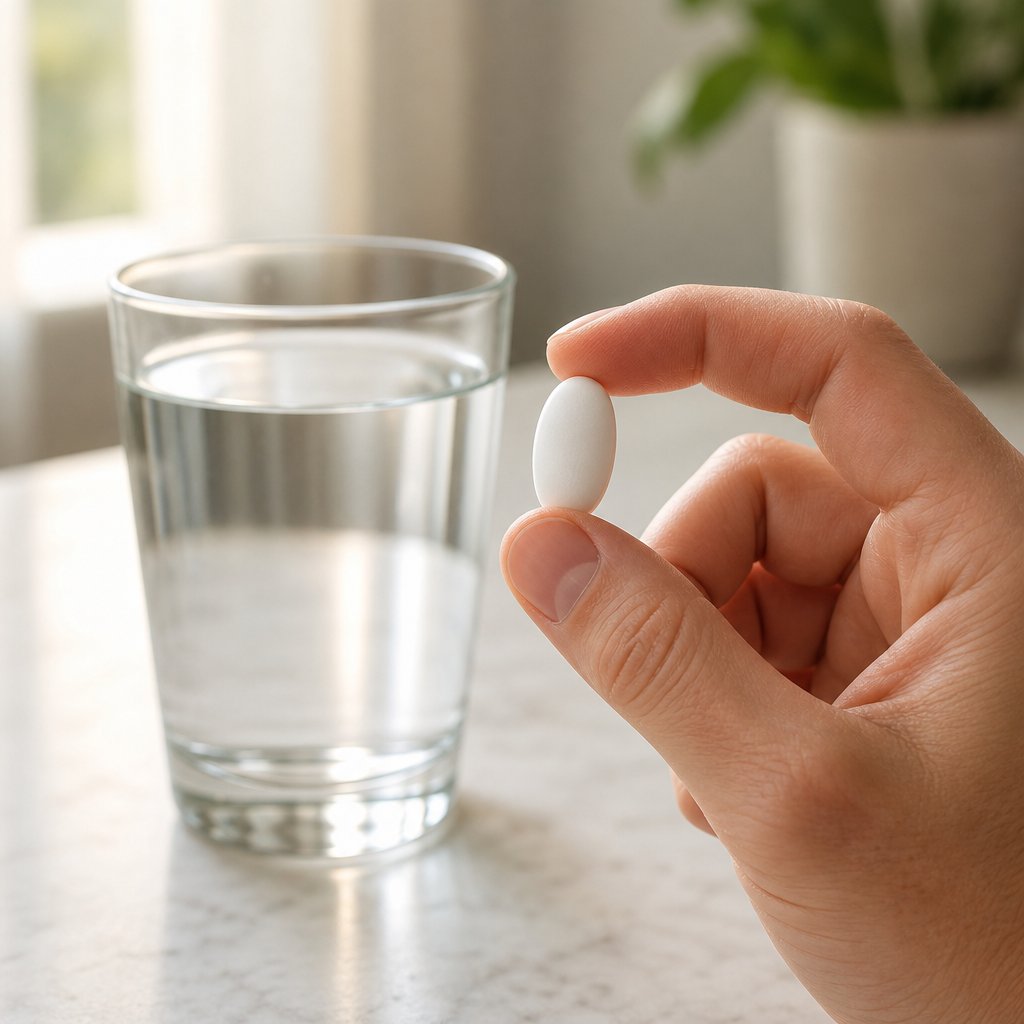
Why Big Tablets Feel So Much Harder to Swallow
If you dread opening that pill bottle because the tablet inside looks more like a small stone than medicine, you're far from alone. A survey conducted at the University of Iowa found that 54% of participants reported encountering pills that were too difficult to swallow, and extra-large tablets were universally loathed. This isn't a matter of willpower or weakness. Learning how to swallow big tablets starts with understanding why your body fights back in the first place.
Why Your Throat Rejects Large Tablets
Your throat handles food just fine all day long, so why cant i swallow pills the size of a vitamin supplement? The answer lies in how your swallowing mechanism responds to a rigid, non-food object. Unlike a chewed bite of dinner that molds itself to your anatomy, a big pill stays the same unforgiving shape from tongue to stomach.
Here's what's working against you when you face hard to swallow tablets:
- Surface area friction: A larger tablet creates more contact with dry throat tissue, increasing drag and the sensation of something "stuck." Without enough saliva or liquid to lubricate the surface, the tablet can cling to mucous membranes instead of gliding past them.
- Weight on the tongue: Heavier tablets press down on the posterior tongue, activating sensory receptors that alert the brain to a potential foreign body. This makes the gag reflex more likely to fire before you even attempt to swallow.
- Gag reflex activation zone: Big pills are harder to position without touching the back third of the tongue, where gag receptors are densest. Even slight contact in this zone can trigger an involuntary rejection response.
- Epiglottis workload: Your epiglottis must seal the airway completely as the tablet passes. A larger object demands more precise timing and a tighter seal, and your body knows it — so it hesitates.
These factors compound each other. Insufficient lubrication plus a heavy, wide tablet equals a literal hard pill to swallow, both physically and psychologically.
Who Struggles Most With Big Pills
While difficulty swallowing pills can affect anyone, certain groups face a steeper challenge. Older adults often produce less saliva, which removes the natural lubrication that helps tablets slide. People living with GERD may have chronic throat inflammation that narrows the passage and heightens sensitivity. Post-surgery patients — especially those recovering from procedures involving the throat, neck, or chest — frequently report that even medium-sized tablets feel impossible.
Research also shows that up to 7% of adults categorically refuse to take hard to swallow pills, and roughly 2-4% have abandoned prescribed treatments entirely because the tablets were too large. These aren't trivial numbers when medication adherence determines health outcomes.
The good news: swallowing big pills is a learnable skill, not a fixed trait. What follows is a step-by-step progression — from calming the mental resistance, through precise physical technique, all the way to lasting confidence — so that the next oversized tablet you face doesn't stand a chance.
Step 1 - Overcome Pill Swallowing Anxiety First
Your throat muscles are perfectly capable of moving a large tablet downward. The real obstacle for most people isn't anatomy — it's anxiety. Before you try a single physical technique, you need to address the fear of swallowing pills that tightens your throat and sabotages every attempt. If you've ever thought "I can't swallow pills no matter what I do," this section is your starting point.
The Anxiety-Tension-Failure Cycle Explained
Here's what typically happens. You look at a big tablet and imagine it lodging in your throat. That fear triggers your sympathetic nervous system, which tenses the muscles around your pharynx and esophagus. A tense throat is a narrow throat — so when you finally try to swallow, the tablet moves slowly or feels stuck. That uncomfortable sensation confirms your original fear, and the cycle locks in tighter the next time.
This pattern is so common it has a clinical name. Phagophobia — the fear of swallowing — is a recognized condition in the Diagnostic and Statistical Manual of Mental Disorders (DSM). It can cause rapid heart rate, sweating, panic attacks, and avoidance of solid medications altogether. If any of that sounds familiar, you're not broken. You're experiencing a well-documented anxiety response that millions of people share.
Many people wonder why can't i swallow pills even with water when the glass is right there and the technique seems simple. The answer is that water alone can't override a throat that's clamped shut by stress. Anxiety disorders, previous choking experiences, or even watching someone else struggle can all plant the seed for this cycle. The key insight is that the difficulty is psychological before it's physical — and that means it responds to psychological solutions.
Relaxation Techniques Before You Even Pick Up the Tablet
Cognitive reframing is your first tool. Consider this fact:
You routinely swallow pieces of food larger than most tablets — chunks of steak, bites of apple, spoonfuls of rice — without any conscious effort or fear. Your esophagus is designed to be flexible and wide enough to handle these objects easily.
That means your throat already knows how to do this job. The tablet isn't the problem. The anticipation is.
Before you even pick up the pill, run through this short relaxation routine:
- Deep breathing: Inhale slowly through your nose for four counts, hold for two, exhale through your mouth for six. Repeat three times. This activates your parasympathetic nervous system and loosens throat tension.
- Shoulder drops: Shrug your shoulders up toward your ears, hold for three seconds, then release. Tension in the neck and shoulders directly transfers to the throat.
- Jaw relaxation: Let your mouth fall slightly open, place the tip of your tongue behind your top front teeth, and allow your jaw to hang loose. A relaxed jaw means a relaxed pharynx.
- Positive self-talk: Replace "this is going to get stuck" with "I swallow things bigger than this every meal." It sounds simple, but redirecting the internal narrative interrupts the anxiety loop before it gains momentum.
If the fear still feels overwhelming, try a desensitization approach. Start by practicing with something tiny and non-threatening — cake sprinkles, mini M&Ms, or small hard candies. Swallow one with water. Then try something slightly larger the next day. This gradual progression builds muscle memory and, more importantly, builds psychological proof that your throat cooperates when your mind isn't fighting it. The University of Calgary's pill swallowing protocol uses exactly this candy-to-pill progression and has helped hundreds of people learn how to take pills if you can't swallow them comfortably yet.
How to swallow a pill when your scared comes down to one principle: calm the mind first, and the throat follows. Spend a few days on relaxation and candy practice before attempting your actual medication. The physical techniques in the next steps will work dramatically better once your throat isn't bracing for impact every time you open the pill bottle.
With your anxiety managed and your confidence building, the next question becomes purely mechanical — where exactly should you place that tablet on your tongue for the smoothest possible swallow?
Step 2 - Position the Tablet Correctly on Your Tongue
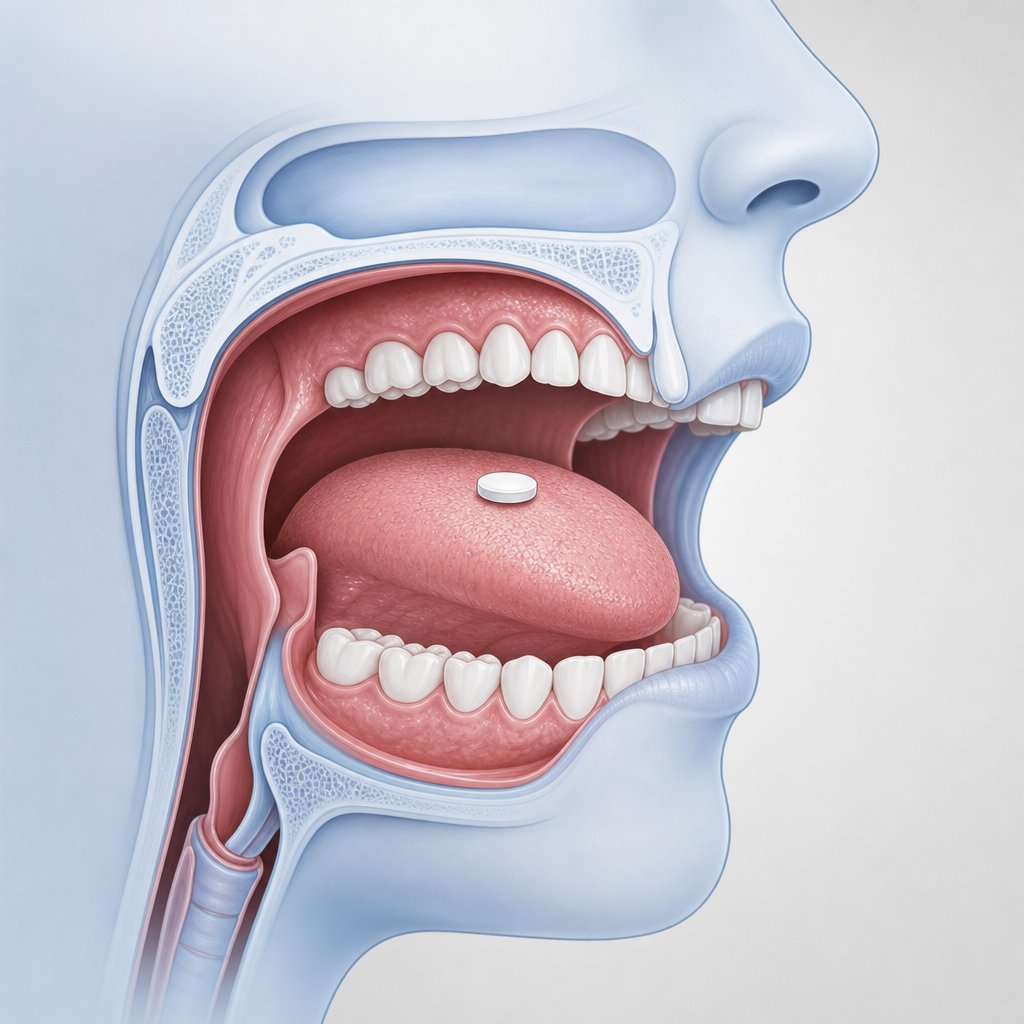
Placement matters more than most people realize. You could have perfect relaxation and zero anxiety, but if the tablet lands in the wrong spot on your tongue, your body will still resist. Understanding how to swallow tablets effectively comes down to a few centimeters of positioning and the angle at which the tablet faces your throat.
Finding the Optimal Tongue Position for Large Tablets
When you think about how do you take tablets, your instinct probably says "drop it on the back of the tongue and gulp." That instinct is wrong. Placing a large tablet too far back immediately contacts the gag reflex zone — the posterior third of the tongue where sensory receptors are most concentrated. The result is retching, spitting the tablet out, or a panicked swallow that sends it sideways.
The opposite mistake is just as common. Placing the tablet on the tip of the tongue means it has to travel the entire length of the oral cavity before reaching the throat. That extra distance gives your brain more time to overthink and your muscles more time to tense up.
The sweet spot is the middle-to-back third of the tongue, just past center. To find it, touch the roof of your mouth with your tongue tip — the area where your tongue naturally rests flat and wide behind that point is your target zone. This position minimizes the distance the tongue must push the tablet while staying safely ahead of the gag trigger area. Mass General's pill swallowing guide recommends placing the pill in the center of the mouth and specifically warns against the back-of-tongue approach because it can trigger gagging.
How Tablet Orientation Affects Your Swallow
Imagine trying to push a dinner plate through a mail slot sideways versus sliding it in edge-first. The same principle applies to how to take a tablet. A flat, round tablet placed broadside presents its widest surface area to your throat opening. Turned lengthwise, that same tablet offers a much smaller cross-section for your pharynx to accommodate.
For oval or oblong tablets — which many large supplements and medications are — align the long axis parallel with your throat. Think of it like swallowing whole a streamlined shape rather than a blunt one. This orientation reduces the sensation of bulk and lets the tablet slip past tissue with less friction.
Moisture is the final piece. A dry tablet on a dry tongue creates immediate friction and that unpleasant "sticking" feeling. The easy way to swallow tablets starts before the tablet even touches your tongue: take a sip of water first to coat your mouth, and if the tablet isn't coated, briefly dip it in water or touch it to your wet tongue before placing it. The Royal National Orthopaedic Hospital emphasizes always having a drink first to ensure the mouth is moistened before attempting any tablet.
Here's the complete positioning sequence — an easy way to swallow tablets that combines everything above:
- Take a sip of cold or room-temperature water to moisten your mouth and throat.
- Place the tablet lengthwise (narrow end facing back) on the mid-tongue, just past center.
- Keep your chin in a neutral position — not tilted back.
- Take a large sip of water and initiate the swallow, letting the water carry the tablet backward and down.
That's it. Four steps, no drama. Proper positioning removes the guesswork and lets your natural swallowing reflex do what it already knows how to do — move objects from mouth to stomach efficiently.
Positioning sets the stage, but the way you deliver water to move that tablet makes an equally dramatic difference. The next technique uses a simple plastic bottle to create physics that do the hard work for you.

Step 3 - Master the Pop-Bottle Technique for Tablets
A flexible plastic water bottle and a bit of suction — that's all it takes to turn a dreaded large tablet into something your throat barely notices. The pop-bottle method is arguably the best way to swallow pills that are dense, heavy, and flat, because it removes the need for conscious effort almost entirely. Instead of willing the tablet down, you let physics handle the job.
A clinical study published in the Annals of Family Medicine tested this technique with 151 adults, including people who already reported difficulty swallowing solid medications. The pop-bottle method improved swallowing ease for 59.7% of all participants — and among those who felt improvement, 88.5% considered the relief significant. Lodging of tablets in the throat dropped by over 50%, and more participants successfully transported the tablet out of the mouth on the first try. These results held for both large and very large tablets.
Pop-Bottle Method Step-by-Step Instructions
Here's how to swallow large pills using this technique. You'll need a standard flexible PET plastic water bottle (the kind that crinkles when you squeeze it) filled with water:
- Fill the flexible plastic bottle with room-temperature water. Make sure it's full enough that you can take a strong drink without running out mid-swallow.
- Place the tablet on the middle of your tongue, oriented lengthwise as described in the previous step.
- Close your lips tightly around the bottle opening, creating a complete seal. No air should be able to sneak in around the edges.
- Tilt your head very slightly forward — not backward — and take a swift, strong sucking drink from the bottle. The bottle should crinkle inward as you drink.
- Swallow the water naturally. The tablet goes with it.
That's the entire process. Most people find it feels like taking a normal drink of water rather than "swallowing a pill." The mental shift alone — from pill-taking to water-drinking — makes this the easiest way to swallow a pill for many people.
Why Suction Makes Large Tablets Easier
Three things happen simultaneously when you suck water from a sealed bottle, and each one works in your favor:
- Negative pressure pulls the tablet backward. The suction you create draws everything in your mouth — water and tablet alike — toward the back of your throat. You don't have to consciously push the tablet with your tongue. The physics do it for you.
- High water volume provides momentum. A strong suck delivers a large bolus of water all at once, creating enough flow to carry even a heavy tablet past the point where it might otherwise stick. Think of it like a river carrying a stone downstream.
- The drinking action distracts your brain. Your focus shifts to sucking water from the bottle rather than monitoring the tablet's position. This bypasses the anxiety-tension cycle because your brain categorizes the action as "drinking" rather than "swallowing a pill." The Harvard Health review of this research noted that the technique helps overcome the volitional phase of swallowing — the part where conscious thought usually interferes.
For extra-large tablets, a few modifications make the technique even more reliable. Use a wider-mouth bottle so your lips can form a better seal without straining. Take a slightly bigger initial sip to build water volume before the main suction pull. And keep that slight forward head tilt — it opens the esophagus and protects the airway simultaneously.
One important note: this method works specifically for tablets, which are dense and sink in water. Capsules float, so suction doesn't pull them backward the same way. If you need to know how to easily take pills in capsule form, a different technique — the lean-forward method — is designed exactly for that challenge.
For anyone searching for an easy way to swallow pills without overthinking every step, the pop-bottle method is worth trying first. It requires no special equipment beyond a water bottle you probably already own, and over 85% of study participants said they'd adopt it as their permanent routine. How to swallow big pills doesn't have to involve willpower or bravery — sometimes the smartest approach is letting water and suction do the work while you simply take a drink.
Step 4 - Try the Lean-Forward Chin-Tuck Method
The pop-bottle technique handles dense tablets beautifully, but capsules play by different rules. They're lighter, they float in water, and suction alone won't pull them backward reliably. So how do you take capsules that bob around in your mouth instead of sinking? The answer is gravity and geometry — specifically, the lean-forward chin-tuck method.
A clinical study involving 151 adults found this technique improved swallowing ease in 88.6% of capsule interventions. Among those who experienced improvement, 96.9% considered the relief significant. The unpleasant throat sensation disappeared entirely, and lodging of capsules dropped to zero in the study group. Those numbers make it one of the most effective approaches for learning how to swallow a capsule without a fight.
Lean-Forward Technique Detailed Instructions
Here's the complete method for how to swallow capsule pills — and it works for large tablets too with a small modification:
- Stand or sit upright. Place the capsule or tablet on the center of your tongue.
- Take a medium sip of water into your mouth, but do not swallow yet. Hold both the pill and the water together.
- Tilt your chin down toward your chest — imagine looking at your belt buckle. Your head bends forward, not backward.
- While in the chin-down position, swallow the water and capsule together in one smooth motion.
Why does looking down help? When you tuck your chin, the capsule floats toward the back of your mouth (because it's buoyant and rises to the highest point of the water pool, which is now the throat-facing side). Simultaneously, the posture changes your internal anatomy in ways that make swallowing safer and easier.
Kinematic research from Seoul National University measured exactly what happens inside the throat during a chin-tuck swallow. The anteroposterior diameter of the laryngeal inlet narrows significantly (from 16.3 mm to 14.0 mm), which means your airway is better protected. The oropharynx also narrows (from 20.5 mm to 18.8 mm), creating a tighter channel that guides the pill downward with less wandering. And the epiglottic base moves upward more forcefully, enhancing the seal over your windpipe.
For how to swallow big capsule pills specifically, modify the standard technique slightly: use a full mouthful of water rather than a small sip, and perform two consecutive swallows. The first swallow moves the capsule past the throat. The second clears it fully into the esophagus. This double-swallow approach ensures large capsules don't linger at the narrowest point of the passage.
Head Position Mistakes That Make Swallowing Harder
The most common mistake? Tilting the head backward. It feels intuitive — you're trying to "pour" the pill down your throat like liquid down a funnel. But the anatomy works against you in that position. Dysphagia specialists at Nutricia note that while many people believe tilting the head back opens the passage to the esophagus, it actually makes swallowing more difficult.
Here's why, broken down by what each position does to your anatomy:
| Factor | Head Tilted Back | Chin Tucked Down |
|---|---|---|
| Esophagus opening | Narrows — the esophageal entrance compresses | Widens — the passage opens for easier transit |
| Airway exposure | Opens wider — increases choking risk | Narrows — better airway protection |
| Epiglottis seal | Less effective — timing must be more precise | Enhanced — epiglottic base moves upward more forcefully |
| Tongue base retraction | Reduced — less pressure to push the pill down | Enhanced — greater and faster retraction generates more propulsive force |
| Swallowing ease | Harder — works against natural anatomy | Easier — works with gravity and muscle geometry |
In short, the head-back position opens the wrong tube and closes the right one. The chin-tuck does the opposite. If you've been throwing your head back every time you take capsules and wondering why it feels terrible, this single correction may solve the problem entirely.
How to take capsules confidently comes down to remembering one rule: chin goes down, not up. Practice the motion a few times with just water — no pill — until the chin-tuck swallow feels natural. Then add the capsule. Most people notice an immediate difference the very first time they try it correctly.
Both the pop-bottle and lean-forward methods work well for most people, but some throats need extra help beyond technique alone — particularly when dryness, coating texture, or medication size pushes past what positioning can fix on its own.

Step 5 - Use Lubricating Aids and Food-Embedding Tricks
Technique alone doesn't always cut it. Some tablets are simply too large, too dry, or too rough-surfaced for positioning and water flow to overcome the friction. If you've tried the pop-bottle method and the chin-tuck and still feel that tablet dragging against your throat tissue, it's time to reduce the physical resistance itself. That means either coating the tablet so it glides, or embedding it in something soft so your throat never contacts the tablet surface directly.
Lubricating Gels and Sprays That Reduce Friction
Pill swallowing gels are medical-grade lubricants designed specifically to coat tablets and capsules before you take them. Unlike water, which slides off a dry tablet almost immediately, these gels cling to the surface and create a slippery barrier between the medication and your throat tissue. The result is dramatically less friction during transit.
The most studied product in this category is Gloup, a medication lubricant gel that has been implemented in approximately half of Australia's aged care facilities. Fluoroscopy studies have demonstrated its superiority over water and food vehicles in terms of tablet transit time, showing minimal post-swallow residue and only a moderate delay compared to water alone. It breaks down in the stomach with minimal or no impact on medication absorption, has no known drug interactions, and doesn't require a prescription.
A quality improvement project at a metropolitan hospital found that patients using a lubricant gel reported less fear of choking on tablets, and nursing staff observed reduced medication administration time. Six out of eight patients surveyed strongly agreed that swallowing medication was easier with the gel than without it.
Here's how to use a pill swallowing aid like a lubricant gel:
- Dispense a small amount (about 5-10 mL) onto a teaspoon or medicine cup.
- Place the tablet on top of the gel, then add another small layer over it — creating a "sandwich" that fully encapsulates the tablet.
- Swallow the entire spoonful in one motion, followed by a sip of water.
Mouth sprays work differently. Instead of coating the tablet, they lubricate the back of your tongue and throat before you take the pill. You spray two or three pumps toward the back of your mouth, then immediately place the tablet and swallow with water. These are best suited for at-home use and are particularly helpful for people with chronic dry mouth who struggle with friction even on smaller pills.
When are these aids most helpful? If you have reduced saliva production (common with aging, certain medications, or conditions like Sjogren's syndrome), if you're taking large uncoated tablets with rough surfaces, or if you've had repeated experiences of tablets feeling stuck despite good technique — a pill swallowing cup or lubricating gel can be the difference between success and another failed attempt.
Food-Embedding Method and Safety Warnings
Embedding a tablet in soft food is one of the oldest tricks for difficulty swallowing pills, and it works because your throat treats the spoonful as food rather than a foreign object. The swallowing reflex engages naturally, the soft texture surrounds the tablet so it never contacts dry tissue, and the whole thing moves as a single bolus.
Foods that work well for embedding large tablets:
- Applesauce (smooth, thick, holds the tablet in place)
- Pudding (dense enough to prevent the tablet from shifting)
- Yogurt (thick varieties like Greek yogurt, not thin drinkable types)
- Mashed banana (naturally sticky texture that grips the tablet)
- Custard (smooth consistency, easy to swallow in one spoonful)
The technique is straightforward: place the tablet in the center of a spoonful of your chosen food, making sure it's fully covered, then swallow the entire spoonful without chewing. Follow with a full glass of water to ensure the tablet clears your esophagus completely.
Foods that fail for this purpose include thin liquids (the tablet sinks or floats away from the food), chunky textures like granola or fruit pieces (they require chewing, which could damage the tablet coating), and anything you'd need to bite into. The food vehicle should be something you can swallow in one smooth motion without any jaw work.
A related question people often ask: can you swallow chewable tablets whole instead of chewing them? Technically, chewable tablets are designed to be broken down in the mouth, but according to NHS Specialist Pharmacy Service guidance, chewable tablets may be crushed — meaning their formulation doesn't rely on coating integrity. Whether you can swallow chewable pills without chewing depends on the specific product; some are formulated to dissolve regardless of whether they're chewed, while others may not absorb properly if swallowed intact. Check the packaging or ask your pharmacist before assuming either way.
Here's the critical safety piece. Not every tablet can be embedded in food, crushed, or altered in any way. The following types of medications should NEVER be crushed, split, or embedded without explicit pharmacist approval:
- Enteric-coated tablets (EC or GR): The coating protects the drug from stomach acid. Damage it, and the medication may be destroyed before it reaches the intestine where it's meant to absorb. Enteric coated capsules follow the same rule.
- Extended-release or modified-release formulations (MR, SR, XL, LA): These contain a higher total dose designed to release slowly over hours. Crushing or breaking them dumps the entire dose at once, risking toxicity or even fatal overdose in extreme cases.
- Combination drugs with layered coatings: Some tablets contain multiple active ingredients released at different rates. Altering the structure destroys the dosing schedule entirely.
- Specialized formulations (amorphous solid dispersions, nanocrystals): Common in HIV antivirals, cancer chemotherapy, and transplant rejection drugs. Crushing decreases bioavailability significantly.
The NHS guidance on tablet modification is clear: if a tablet has modified-release properties, crushing it can expose patients to risk of toxicity. Reports of erroneous pill crushing in care facilities range from 0.5% to 10% of all medication administrations, and some cases have resulted in serious harm. When in doubt, ask your pharmacist — they can check whether your specific medication is safe to alter or whether an alternative formulation exists.
Beyond technique and coating aids, water itself plays a bigger role than most people realize. Room-temperature water in generous amounts — at least 8 ounces (a full glass) — helps large tablets transit the esophagus fully and reach the stomach. Cold water can cause slight throat constriction in some people, while warm water may feel uncomfortable. Room temperature hits the sweet spot. Drink the full glass, not just a sip. Research consistently shows that insufficient water volume is one of the most common reasons tablets lodge in the esophagus, where prolonged contact can cause irritation or ulceration of the tissue.
Between lubricating gels, food embedding, and adequate water volume, even the most stubborn large tablets become manageable. But what happens when a tablet does get stuck despite your best efforts? That situation calls for a different set of actions entirely — and knowing what to do in the moment matters more than you might expect.
Step 6 - What to Do When a Tablet Gets Stuck
You followed the technique, took a big sip of water, swallowed — and now there's a pressure in your chest or a lump sensation in your throat that won't go away. A pill stuck in throat is an unsettling experience, but before panic sets in, you need to know something important: the feeling of a tablet stuck in the throat and an actual dangerous obstruction are two very different situations, and the first is far more common than the second.
Can a pill get stuck in your throat? Yes, it can. But in most cases, what you're experiencing is either a tablet lodged in the esophagus (uncomfortable but not an emergency) or a phantom sensation where the tablet has already passed but left irritation behind. Knowing which situation you're in — and what to do about each — can save you from unnecessary panic or, in rare cases, alert you to a genuine problem that needs medical attention.
Immediate Steps When a Tablet Feels Lodged
If you feel a tablet stuck in throat after swallowing, stay calm. Anxiety tightens the muscles around the esophagus and can make the sensation worse or prevent the tablet from moving further down. Verywell Health notes that panic causes your throat to constrict, which is the opposite of what you need right now.
Here's what to do, in order:
- Drink a full glass of water. Not a sip — a full 8 to 12 ounces. Take large gulps rather than tiny ones. The volume and momentum of the water can push the tablet past the point where it's lodged. According to MyHealth Alberta, this feeling usually resolves within 30 to 60 minutes if you drink liquids.
- Eat a piece of soft bread or banana. A bite of soft, dense food creates a bolus that can physically push the tablet downward as it travels through the esophagus. Banana works particularly well because its sticky texture grips the tablet and carries it along.
- Try a spoonful of butter or olive oil. If water and bread haven't worked, a fat-based lubricant can coat the esophageal walls and the tablet surface simultaneously, reducing the friction that's holding it in place. Swallow a tablespoon of butter, margarine, or olive oil, then follow with more water.
- Cough gently. A controlled cough can shift the tablet's position. It may feel uncomfortable, but the pressure change in your chest can dislodge a tablet that's stuck at a narrow point.
- Stay upright. Sit or stand for at least 30 minutes. Gravity is your ally here. Lying down removes the downward force that helps the tablet transit, and Banner Health recommends remaining upright for at least 30 minutes after taking any medication that may cause esophagitis.
How long can a pill be stuck in your throat realistically? Most tablets will dissolve within 30 minutes even if they remain lodged in the esophagus. However, that dissolution process is exactly the problem. A tablet dissolving against esophageal tissue releases concentrated medication directly onto the mucosal lining, which can cause a condition called pill esophagitis — localized inflammation, irritation, or even ulceration of the esophageal wall. Common culprits include NSAIDs like ibuprofen, antibiotics, iron supplements, and potassium tablets.
Here's the tricky part: sometimes the pill feeling stuck in throat persists even after the tablet has already moved into your stomach. The esophagus has relatively few nerve endings compared to your mouth or throat, so it's not great at distinguishing between "something is still here" and "something was here and left a scratch." If you've drunk a full glass of water and eaten soft food, and 30 to 60 minutes have passed, there's a good chance the tablet is gone and what remains is residual irritation. This phantom sensation can last several hours or even a day or two, especially if the tablet caused minor abrasion on its way down.
When to Seek Medical Help
Most stuck tablet situations resolve on their own with the steps above. But certain symptoms signal that something more serious is happening — either a true obstruction, significant tissue damage, or the tablet entering the airway instead of the esophagus.
Seek immediate medical attention if you experience any of the following after a tablet lodged in throat: inability to swallow liquids, chest pain that worsens or doesn't improve, vomiting or vomiting blood, difficulty breathing or noisy breathing, high-pitched sounds when inhaling, or complete inability to speak or cough.
If someone cannot breathe, cough, or speak after swallowing a tablet, this is a choking emergency. Call 911 immediately and perform abdominal thrusts (the Heimlich maneuver). The American Red Cross five-and-five method involves alternating five back blows between the shoulder blades with five abdominal thrusts until the object is dislodged.
A stuck tablet in throat that doesn't clear after an hour of trying the steps above also warrants a call to your doctor or pharmacist — not necessarily an emergency room visit, but professional guidance. If the tablet was enteric-coated or extended-release, it may resist dissolving for longer than a standard tablet, and your provider may want to confirm it has passed. In rare cases where a large tablet remains truly lodged in the esophagus, an endoscopy may be needed to remove it.
The distinction between discomfort and danger comes down to this: if you can still swallow water and breathe normally, you're almost certainly dealing with irritation rather than obstruction. Stay calm, keep drinking fluids, and give it time. If either of those abilities is compromised, get help immediately.
Repeated episodes of tablets getting stuck point to a pattern worth addressing — not just with better technique in the moment, but by reconsidering whether the tablet format itself is the right choice for your body. Sometimes the smartest solution isn't learning to force a large tablet down, but finding an alternative that never gets stuck in the first place.
Step 7 - Explore Easier Tablet Alternatives and Formats
Sometimes the best answer to a large tablet isn't a better swallowing technique — it's a different format altogether. If you've practiced the methods above and still dread every dose, that's not failure. It's a signal to explore alternatives that deliver the same active ingredients without the struggle. Millions of people have made this switch, and the pharmaceutical and supplement industries have responded with more options than ever before.
When to Ask Your Pharmacist About Alternatives
Your pharmacist is the single best resource for figuring out whether your specific medication can be modified or replaced. Here are the conversations worth having:
- Splitting scored tablets: If your tablet has a line down the middle, it's likely designed to be halved. A proper tablet cutter gives you two smaller pieces that are individually easier to swallow. Never use a kitchen knife — uneven splits mean inaccurate dosing.
- Crushing when safe: Learning how to crush a pill correctly matters as much as knowing whether you're allowed to. A dedicated pill crusher produces a fine, even powder you can mix into applesauce or water. But the critical question is always whether your specific medication permits it.
- Requesting liquid formulations: Many common medications exist in oral suspension or solution form. Your prescriber can often switch you to a liquid version with identical dosing.
- Smaller-dose equivalents: Instead of one large 1000 mg tablet, you may be able to take two 500 mg tablets that are each small enough to swallow comfortably.
People frequently ask: can you crush Tylenol? Standard immediate-release acetaminophen tablets can generally be crushed, but Tylenol 8HR (extended-release) absolutely cannot — crushing it releases the full dose at once instead of gradually over eight hours. The same logic applies across medications. Can you crush amoxicillin? Immediate-release amoxicillin capsules can be opened and the contents mixed with soft food, but the extended-release formulation (Augmentin XR) must stay intact. Can ibuprofen be crushed? Regular ibuprofen tablets can be crushed in most cases, though the taste is extremely bitter and the powder may irritate the mouth — which is why GoodRx's do-not-crush reference list notes ibuprofen among medications that can leave a bad taste.
And can you crush potassium pills? This is one where the answer is almost always no. Potassium chloride tablets are typically extended-release or wax-matrix formulations. Crushing them can cause dangerous gastrointestinal irritation and a potentially toxic spike in potassium levels. Always confirm with your pharmacist before attempting to pulverize pills of any kind — the consequences of guessing wrong range from reduced effectiveness to genuine harm.
If you want to know how to pulverize pills safely, the process itself is simple: place the approved tablet in a pill crusher, twist or press until it's a fine powder, then mix with a pharmacist-recommended food or liquid. But the safety check always comes first. Modified-release dosage forms, enteric-coated products, hazardous medications (particularly chemotherapy drugs), and capsules containing liquid or specialized nanocrystal technology should never be altered without professional guidance.
Modern Supplement Formats Designed for Easier Intake
The supplement industry has recognized that pill fatigue is a real barrier to compliance. Market data from Glanbia Nutritionals shows that gummies now tie with tablets as the largest-selling supplement format in the United States, and interest in powders, liquid shots, and chewable formats continues to climb globally. This isn't a niche trend — it reflects widespread consumer demand for delivery methods that don't require forcing a large tablet past a reluctant throat.
Here's how the major formats compare for people who struggle with traditional tablets:
| Format | Ease of Swallowing | Bioavailability Considerations | Best Use Cases |
|---|---|---|---|
| Traditional tablets | Most difficult for large sizes | Excellent — precise dosing, controlled release options | Prescription medications, high-dose supplements |
| Hard capsules | Moderate — smooth surface helps, but size can still be large | Good — contents protected until stomach | Herbal extracts, probiotics, multi-ingredient formulas |
| Soft capsules (softgels) | Easier — flexible, slippery gelatin coating | Excellent for fat-soluble nutrients (omega-3s, vitamin D) | Fish oil, CoQ10, vitamin E, oil-based formulas |
| Gummy candy | No swallowing required — chewed | Lower payload capacity; sugar content may be a concern | Daily multivitamins, vitamin C, elderberry, biotin |
| Powder/granules | No swallowing required — mixed into liquid or food | Fast absorption; virtually no limit on dosage size | Protein, collagen, greens blends, electrolytes, high-dose vitamin C |
| Oral liquids | No swallowing of solids required | Rapid absorption; easy dose adjustment | Children's vitamins, iron supplements, elderberry syrups |
Each format carries trade-offs. Gummies taste great and eliminate swallowing anxiety entirely, but they can't hold as much active ingredient per serving — you may need two or three gummies to match one tablet's dose. Powders offer virtually unlimited dosing flexibility and fast absorption, but they require mixing and can have flavor challenges with certain ingredients. Soft capsules slide down more easily than hard tablets thanks to their flexible gelatin shell, making them a strong middle ground for people who can handle some swallowing but struggle with rigid, oversized pills.
Health product manufacturers now prioritize offering multiple format options specifically to serve consumers who struggle with traditional large tablets. For nutrition brands, supplement importers, and private label sellers looking to meet this demand, OEM/ODM manufacturers like ZhuFeng offer flexible production across all major formats — hard capsules, soft capsules, gummy candy, powder/granules, tablets, and oral liquids — with customized formulation and scalable production. This kind of format flexibility means brands can offer their customers genuine alternatives rather than forcing everyone into a one-size-fits-all tablet.
The bottom line: if a large tablet consistently defeats your best technique, you're not stuck with it. Talk to your pharmacist about crushing, splitting, or switching formulations for medications. For supplements, explore the growing range of swallow-free formats that deliver identical nutrients without the daily battle. The goal is consistent intake of what your body needs — and the format that actually gets taken every day beats the "superior" format that sits untouched in the cabinet.
Choosing an easier format solves the immediate problem, but what if you'd rather build the skill to handle any tablet confidently? A structured practice program can train your throat to accept large pills as routine — no special aids required.

Step 8 - Build Long-Term Confidence With Size Progression
Techniques and format alternatives solve the immediate problem, but what if you want to reach a point where swallowing a large pill feels as unremarkable as swallowing a bite of food? That kind of lasting confidence doesn't come from a single successful attempt — it comes from structured repetition that trains your throat to cooperate automatically. If you've ever asked yourself how do i swallow big pills without needing tricks every time, the answer is a progressive training plan that builds the skill from the ground up.
A Size-Progression Training Plan for Adults
Swallowing is partly a learned motor skill. Research in motor learning shows that the oral cavity plays a crucial role in providing a motor plan for the movements involved in swallowing — and like any motor skill, repetition builds automaticity. Your throat literally "learns" to relax around familiar objects when it has enough positive experiences to override the old fear response.
The Mass General pill swallowing program recommends starting small and gradually increasing size as tolerated. Here's a progression plan adapted for adults who want to learn how to swallow a pill easily and permanently:
- Stage 1 — Cake sprinkles or decorating balls (1-2 mm): These are barely noticeable on the tongue. Swallow one with a sip of water. Do this five times per session. The goal isn't physical challenge — it's proving to your brain that swallowing a solid object with water is safe and easy.
- Stage 2 — Tic Tacs or mini M&Ms (5-7 mm): Slightly larger, with a smooth coating that mimics a small pill. Practice daily for three to four days until it feels completely routine.
- Stage 3 — Regular M&Ms or Smarties (10-12 mm): These approximate the size of a standard baby aspirin or small vitamin tablet. Spend four to five days at this level. You'll notice your throat no longer hesitates.
- Stage 4 — Good & Plenty or Mike and Ike candies (15-18 mm): Oblong shape, similar to a medium capsule or mid-size tablet. Practice your preferred technique (pop-bottle or chin-tuck) with these for another three to four days.
- Stage 5 — Your actual large tablet or a gummy bear cut to match its size (20+ mm): By now, your throat has weeks of successful swallowing experiences stored as muscle memory. The large tablet is just the next small step in a long chain of successes.
Each stage should feel boring before you move on. If a particular size still triggers hesitation or tension, stay there another day or two. Rushing defeats the purpose. The University of Calgary protocol recommends tracking your progress over two weeks and experimenting with different head positions at each stage to find what works best for your anatomy.
Keep practice sessions short — under ten minutes — so they stay relaxed rather than stressful. Use plenty of water and allow big gulps. This isn't an endurance test. It's a confidence-building exercise where every successful swallow rewires your brain's prediction about what happens next.
Maintaining Your Swallowing Confidence Long-Term
Reaching Stage 5 doesn't mean the work is done forever. Confidence can slip if you stop taking large tablets for a while, get sick, or have throat surgery. Here's how to take pills easier on an ongoing basis and protect the progress you've built:
- Always use adequate water. A full glass, not a sip. This single habit prevents more stuck-tablet experiences than any technique.
- Keep practicing even after success. If you only take a large tablet once a week, do a quick candy-swallowing session on the other days to maintain the motor pattern.
- Revisit earlier techniques if confidence dips. Had a bad experience? Drop back to Stage 3 for a day or two. Rebuilding from a mid-point is much faster than starting over.
- After illness or surgery, be patient. A sore throat, post-intubation swelling, or general deconditioning can temporarily make swallowing harder. Start back at Stage 2 and progress upward again. Your body remembers the skill — it just needs a gentle reminder.
The specific challenge of returning to large tablets after a medical event deserves extra attention. Post-surgery patients often report that their throat feels "tighter" or more sensitive for weeks afterward. This is real — not imagined — and pushing through it with a large tablet on day one is counterproductive. Give yourself permission to use the food-embedding method or a lubricating gel during recovery, then transition back to direct swallowing as your throat heals.
Here's the encouraging reality: most adults who follow a structured size-progression plan can learn how to swallow big tablets easily within two to four weeks of consistent daily practice. That's not a guess — it's the timeline reported across multiple pill swallowing training programs designed for both children and adults. Your throat is capable. Your esophagus is wide enough. The only thing standing between you and effortless pill-taking is enough repetition to make the skill automatic.
How to swallow pills confidently isn't about being brave or forcing yourself through discomfort. It's about giving your nervous system enough evidence — through gradual, low-pressure practice — that large tablets are safe, manageable, and routine. Start small today, progress at your own pace, and trust that the skill will come. It always does.
Frequently Asked Questions About Swallowing Big Tablets
1. Why do I gag every time I try to swallow a large tablet?
Gagging happens because large tablets press on sensory receptors concentrated in the back third of your tongue, triggering an involuntary reflex. The tablet's weight, rigid shape, and surface friction all amplify this response. Placing the tablet on the mid-tongue rather than the back, moistening your mouth first, and using the pop-bottle or chin-tuck technique can bypass the gag zone entirely. Anxiety also plays a major role — fear of choking tenses throat muscles, making the passage narrower and the gag reflex more sensitive.
2. What is the fastest way to get a pill unstuck from your throat?
Drink a full glass of water in large gulps rather than sips — the volume and momentum can push the tablet past the lodging point. If water alone does not work, eat a piece of soft bread or banana to create a food bolus that physically carries the tablet downward. A spoonful of butter or olive oil can also lubricate the esophageal walls. Stay upright for at least 30 minutes and avoid lying down. Most tablets dissolve within 30 minutes even if stuck, but seek medical help immediately if you cannot swallow liquids, experience chest pain, or have difficulty breathing.
3. Is it better to tilt your head back or forward when swallowing pills?
Tilting your chin down toward your chest is significantly more effective and safer than tilting your head back. Clinical research shows the chin-tuck position widens the esophageal opening, narrows the airway for better protection, and enhances epiglottic sealing. Tilting the head backward does the opposite — it narrows the esophagus and opens the airway wider, increasing choking risk. The lean-forward method improved swallowing ease in nearly 89% of study participants, making it one of the most reliable corrections for people who struggle with large pills.
4. Can I crush or split my large tablets to make them easier to take?
It depends entirely on the specific medication. Standard immediate-release tablets like regular ibuprofen or acetaminophen can generally be crushed or split. However, extended-release formulations, enteric-coated tablets, and combination drugs with layered coatings must never be altered — doing so can cause dose dumping, toxicity, or complete loss of effectiveness. Always check with your pharmacist before crushing any medication. If crushing is not safe, ask about liquid formulations, smaller-dose equivalents, or alternative supplement formats like soft capsules, gummies, or powders.
5. How long does it take to train yourself to swallow big pills comfortably?
Most adults can build reliable confidence within two to four weeks using a structured size-progression approach. Start with tiny items like cake sprinkles, progress through small candies and medium-sized sweets, and gradually work up to your target tablet size. Each stage should feel completely routine before advancing. Daily practice sessions of under ten minutes are sufficient. The key is accumulating enough successful swallowing experiences that your nervous system stops treating the tablet as a threat and allows your throat muscles to relax automatically.