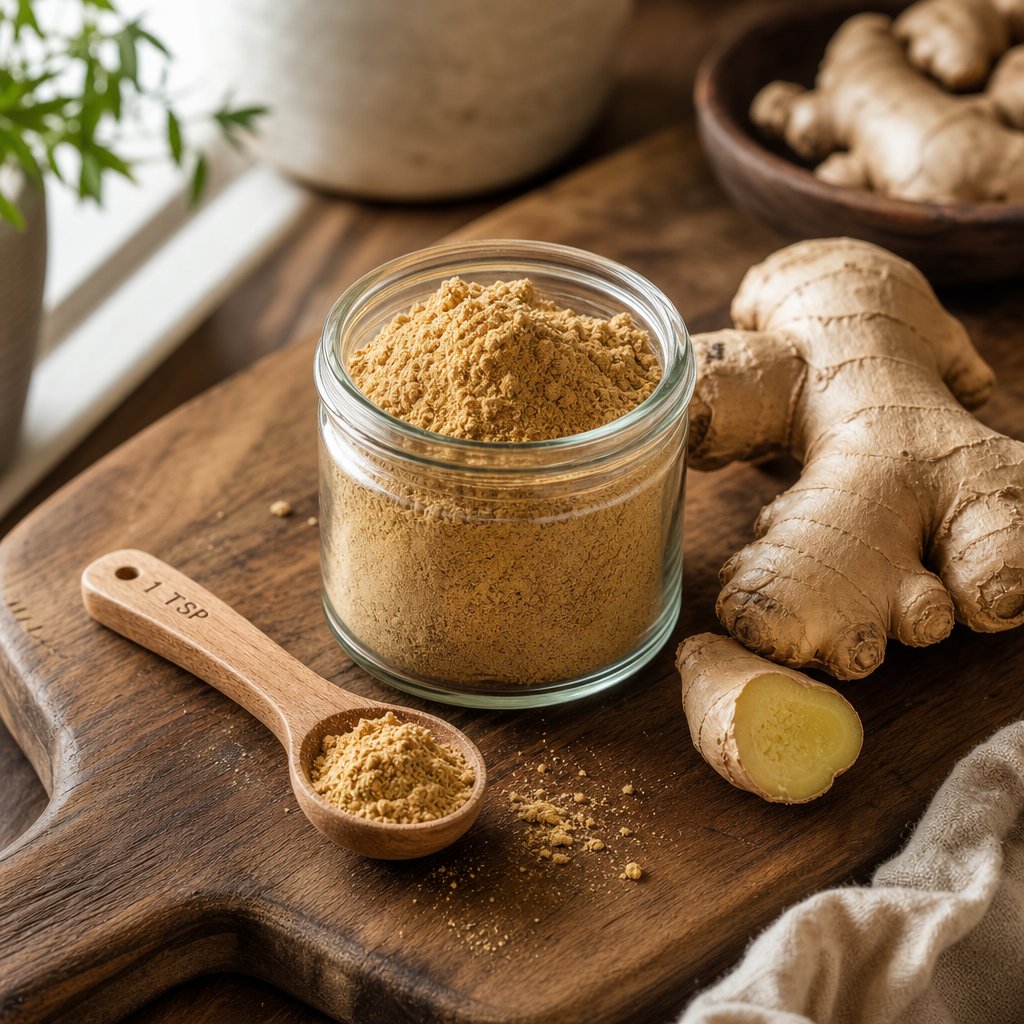
Ground Ginger and Ginger Powder Are the Same Thing
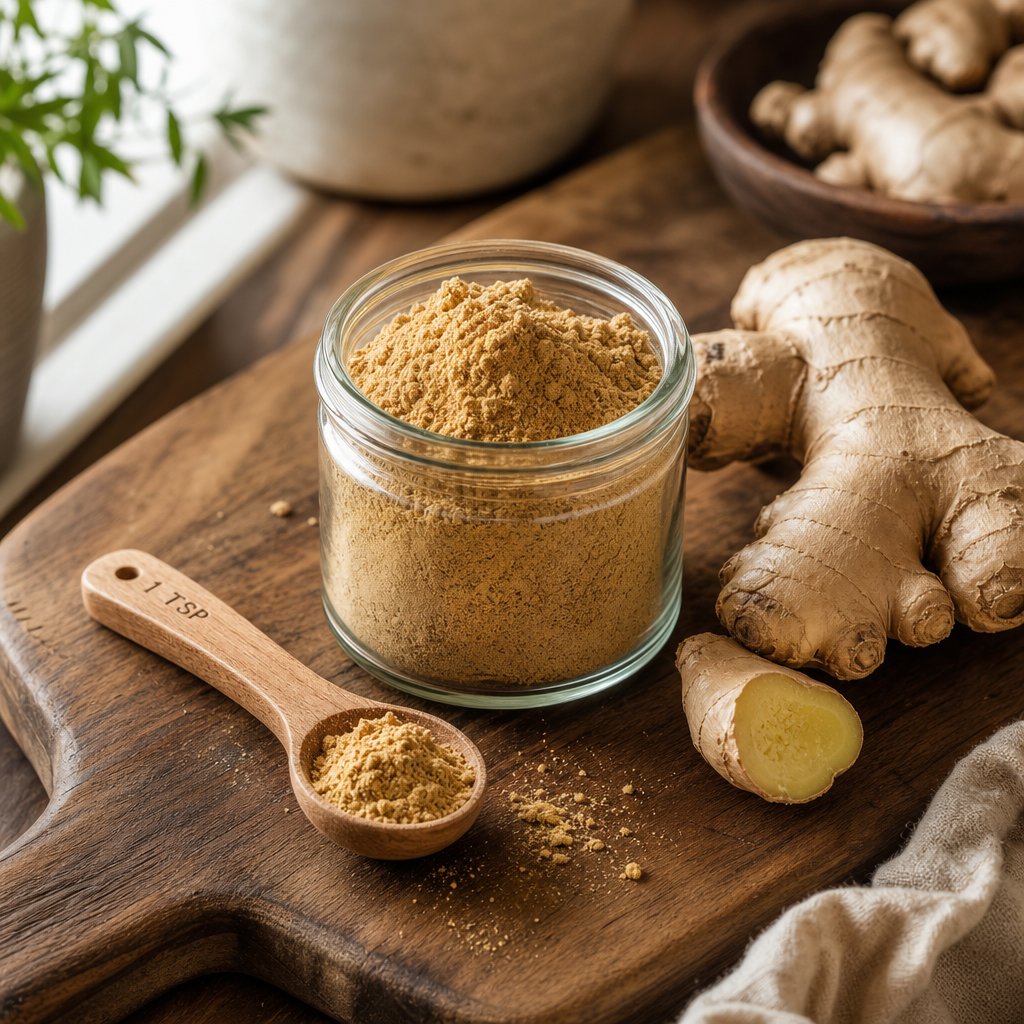
Is ground ginger the same as ginger powder? Yes. They are the exact same product. Both terms describe fresh ginger root that has been dried, peeled, and milled into a fine powder. Whether your jar says "ground ginger" or "ginger powder," you are looking at the same spice with the same flavor, the same uses, and the same shelf life.
The Definitive Answer
Ground ginger and ginger powder refer to the exact same dried, pulverized ginger root product. The two names exist because of inconsistent labeling across brands, regions, and recipe sources — not because of any difference in the spice itself.
So why does this question come up so often? Imagine you are following a recipe that calls for "ginger powder," but the jar in your spice rack reads "ground ginger." That small mismatch creates doubt. The confusion grows when you compare cookbooks, browse international recipe blogs, or shop across different brands. One source says ground ginger, another says powdered ginger, and a third lists "ginger root powder." They all mean the same thing. As The Spice House confirms, ginger powder and ground ginger are the same spice — simply fresh ginger that has been dried and ground into a fine powder.
The ground ginger vs ginger powder debate is really just a labeling issue, not a culinary one. You can use them interchangeably in any recipe without adjusting measurements or technique.
What This Guide Covers
This guide goes beyond the simple yes-or-no answer. You will learn why two names exist and how regional labeling conventions drive the confusion. We will walk through how the spice is produced from raw rhizome to finished powder, compare it side by side with fresh ginger, and provide conversion ratios for recipe substitutions. We also cover health benefits, storage tips, and practical cooking applications so you can use your jar of ground ginger — or ginger powder — with complete confidence. Whether you have been wondering is ground ginger the same as powdered ginger or simply want to sharpen your spice knowledge, every section ahead is built to give you a clear, practical answer.
Why the Same Spice Carries Two Different Labels
If is ginger powder and ground ginger the same product, why do two names exist in the first place? The answer has nothing to do with what is inside the jar and everything to do with how the spice industry labels, markets, and sells dried ginger across different regions.
Labeling Conventions in Different Markets
In the United States, spice companies follow a long-standing naming pattern: dried spices that have been milled are labeled "ground." You will find ground cinnamon, ground cumin, ground turmeric, and ground ginger sitting side by side on grocery store shelves. The FDA's compliance policy guide on spice definitions describes ginger simply as "the dried, or decorticated and dried, rhizome of Zingiber officinale" — without specifying whether the retail label should read "ground" or "powder." That regulatory flexibility is exactly why both names persist.
Cross the Atlantic, and the convention shifts. UK and Australian markets lean toward "ginger powder" on packaging, treating "powder" as the more intuitive descriptor for a finely milled product. Recipe books from these regions reflect the same preference. So when you encounter a British baking blog calling for ginger powder while your American jar says ground ginger, the disconnect is purely geographic — not chemical.
Why Brands Choose Different Names
Marketing plays a role too. Traditional spice rack brands stick with "ground ginger" because it matches the rest of their product line. Health food and wellness brands, on the other hand, often prefer "ginger powder" or even "ground ginger root powder" because it sounds fresher, more natural, and more aligned with supplement-style packaging.
You will also see labels reading "ginger root powder" or "organic ginger powder." When comparing ground ginger vs ginger root powder, the distinction is cosmetic. The product inside is still dried Zingiber officinale rhizome, milled to a fine consistency. Some shoppers wonder is ground ginger the same as ginger root — and the answer is yes, with the understanding that "root" simply emphasizes the botanical source rather than indicating a different ingredient.
Whether is powdered ginger the same as ground ginger or is ground ginger and ginger powder the same — the conclusion stays consistent. The naming difference is a branding choice, not a product difference. Knowing this frees you to shop confidently regardless of what the label says and focus instead on what actually matters: how the spice is made and how fresh it is when it reaches your kitchen.
How Ground Ginger Powder Is Produced
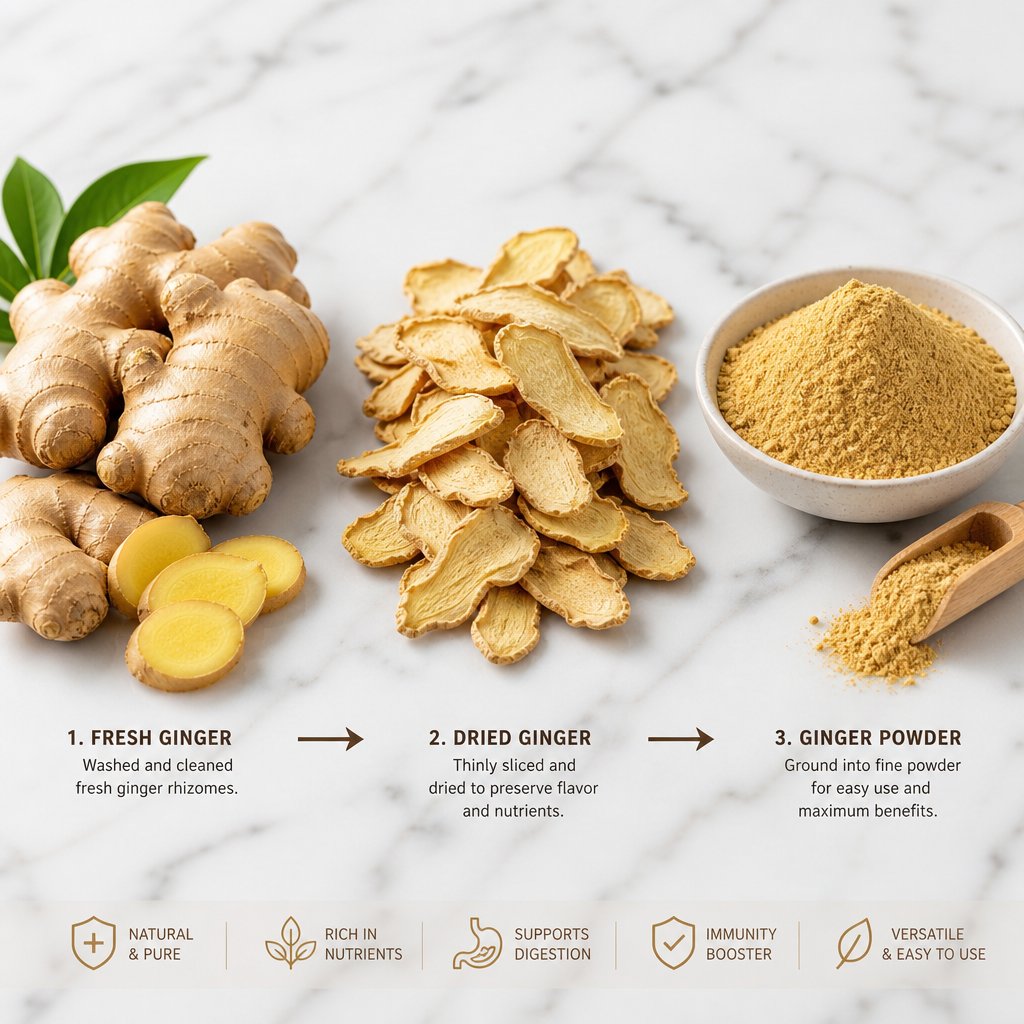
So what is ground ginger, exactly? It is simply the dried rhizome of the ginger plant (Zingiber officinale), processed down to a fine, free-flowing powder. The journey from a knobby, moisture-rich root to the tan-colored spice in your cabinet involves a handful of carefully controlled steps. Understanding this process helps explain why the end product earns both the "ground ginger" and "ginger powder" label — the manufacturing method is identical regardless of what a brand prints on the jar.
From Root to Powder in Five Steps
Whether produced in a large-scale spice facility or a home kitchen with a dehydrator and coffee grinder, the basic sequence stays the same. Here is how you ground ginger root into a shelf-stable powder:
- Harvesting — Mature ginger rhizomes are pulled from the soil after roughly 8 to 10 months of growth. Maturity matters because older rhizomes contain higher concentrations of gingerols and volatile oils, which translate directly into flavor intensity in the finished powder.
- Cleaning and preparation — Fresh ginger is thoroughly washed to remove soil and debris. A brush washer with high-pressure water is commonly used in commercial production to clean the rhizomes and remove the outer skin simultaneously. The ginger is then sliced into thin, uniform pieces — typically 2 to 5 mm thick — so that moisture evaporates evenly during drying. Some producers mince or shred the ginger instead, which speeds up dehydration time.
- Drying and dehydration — This is the step that transforms fresh ginger into dry ginger powder. The goal is to reduce moisture content to below 8%, making the product shelf-stable and grindable. Common methods include hot air drying (continuous belt dryers held between 50 and 70 degrees Celsius), home dehydrators set as low as 35 degrees Celsius for better flavor retention, and freeze drying for premium applications. Drying typically takes 4 to 12 hours depending on slice thickness and equipment type.
- Grinding and sieving — Once brittle and fully dried, the ginger pieces enter a grinding mill. The mill pulverizes them into powder, and the result is then passed through a sieving machine to remove any oversized particles and ensure a uniform consistency. Temperature control during grinding is critical — mechanical friction generates heat that can evaporate volatile oils and diminish aroma, so some manufacturers use low-temperature or cryogenic grinding techniques.
- Packaging — The finished dried ginger powder is sealed in airtight containers or bags to protect it from moisture, light, and oxygen. Proper packaging preserves the spice's potency for months or even years.
That is the complete picture of how to make ground ginger. Whether a factory processes tons per day or you dehydrate a single hand of ginger at home, the fundamental steps — clean, slice, dry, grind, store — remain the same.
Does Grind Size Matter
You might wonder: if two brands use different grinding equipment, could one jar of "ground ginger" be noticeably coarser than another jar labeled "ginger powder"? In theory, yes. Commercial ginger powder typically falls between 80 and 120 mesh in particle size, and manufacturers can adjust this based on the intended application. A finer grind dissolves more readily in liquids and integrates seamlessly into batter, while a slightly coarser grind might suit dry rubs or spice blends where texture is welcome.
In practice, though, retail products labeled "ground ginger" and those labeled "ginger powder" land in the same fineness range. Both are milled to a consistency suitable for everyday cooking and baking. The label choice reflects branding, not a specification sheet difference. Research confirms that particle size does influence how efficiently bioactive compounds like polyphenols are extracted from the spice, but for kitchen purposes, what is powdered ginger on one shelf is functionally identical to what is ground ginger on the next.
Drying method can introduce subtle variations in color and flavor intensity. Sun-dried ginger tends to be slightly darker with a more muted aroma, while mechanically dried ginger at controlled temperatures retains brighter color and sharper pungency. Freeze-dried ginger preserves the most volatile oils but comes at a higher price point. None of these differences change the product category — they all produce dried ginger powder ready for your recipes.
The real takeaway? How do you ground ginger into a quality powder? Start with mature, flavorful rhizomes, dry them gently to preserve volatile oils, and grind only what you plan to use in the near term. The fresher the grind, the more aromatic punch your spice delivers — a principle that matters far more than whatever name appears on the label.
Ground Ginger vs Fresh Ginger Explained
The drying process does more than remove water. It fundamentally changes ginger's chemistry, flavor, and culinary behavior. While ground ginger and ginger powder are the same product, neither one tastes or performs like fresh ginger root. Understanding the difference between fresh ginger vs ground ginger helps you choose the right form for every recipe and avoid disappointing results.
Flavor and Aroma Differences
Fresh ginger gets its sharp, bright bite from a compound called gingerol — the primary bioactive molecule in raw ginger rhizomes. When you slice into a fresh knob, that zesty, almost citrusy heat you smell? That is gingerol at work.
Here is where things shift. During the dehydration process, gingerols partially convert into shogaols through thermal dehydration of their beta-hydroxy ketone groups. Shogaols are more pungent and carry a deeper, warmer spiciness — less bright, more concentrated. Research shows that higher drying temperatures accelerate this conversion, meaning dried ginger vs fresh ginger are not just texturally different but chemically distinct.
You will notice this immediately in the kitchen. Fresh ginger delivers a sharp, aromatic punch with a slight sweetness. Ground ginger tastes warmer, drier, and more uniformly spicy without that juicy brightness. The volatile essential oils that give fresh ginger its complex aroma also diminish during drying, which is why powdered ginger vs fresh ginger smell noticeably different when you open the jar versus cutting into a raw rhizome.
Neither form is better — they simply serve different purposes. The gingerol-rich profile of fresh ginger suits dishes where you want that lively, aromatic kick. The shogaol-forward character of ground ginger blends seamlessly into baked goods and spice mixes where a steady warmth is the goal.
When to Use Each Form
Choosing between ginger powder vs fresh ginger comes down to the dish, the texture you need, and how much convenience matters. Here is a side-by-side comparison:
| Category | Fresh Ginger | Ground Ginger |
|---|---|---|
| Flavor Profile | Sharp, bright, citrusy, complex | Warm, concentrated, peppery, earthy |
| Best Uses | Stir-fries, marinades, fresh teas, soups, sushi | Baking, spice blends, dry rubs, curries, smoothies |
| Shelf Life | 2-3 weeks refrigerated; months frozen | 2-3 years in airtight container |
| Convenience | Requires peeling, grating, or slicing | Ready to measure and add directly |
| Nutritional Density | Higher in gingerols and essential oils | Higher in shogaols; more concentrated by weight |
Fresh ginger excels anywhere its fibrous texture and volatile aroma can shine — think a ginger-scallion sauce, a Thai curry paste, or a mug of brewed ginger tea. Ground ginger, on the other hand, disappears into batters and doughs without leaving stringy bits behind, making it the standard choice for gingerbread, pumpkin pie, and spice-rubbed meats.
When evaluating dry ginger vs fresh ginger for savory cooking, consider the cooking time. Long-simmered dishes like stews can handle either form since heat mellows fresh ginger's sharpness over time. Quick-cooking dishes like stir-fries benefit from fresh ginger added at the last moment for maximum aroma.
Can You Substitute One for the Other
Yes — with caveats. Because the flavor profiles differ and ground ginger is far more concentrated than fresh, a straight swap without adjusting quantities will throw off your recipe. The general rule is that a small amount of ground ginger replaces a much larger volume of fresh, roughly a 1:12 ratio by volume. Substitution works well in baked goods, sauces, and soups where ginger plays a supporting role. It falls short in dishes where fresh ginger's texture and bright aroma are the star.
Getting the ratio right matters more than most cooks realize, so the next section breaks down exact conversion measurements you can rely on.
Fresh Ginger to Ground Ginger Conversion Ratios
Knowing that ground ginger is more concentrated than fresh is one thing. Knowing exactly how much to use is what keeps a recipe from tasting flat or overwhelmingly spicy. The fresh ginger to ground ginger conversion trips up even experienced cooks because the ratio is not intuitive — you need far less dried powder than you might expect.
The Standard Fresh to Ground Conversion
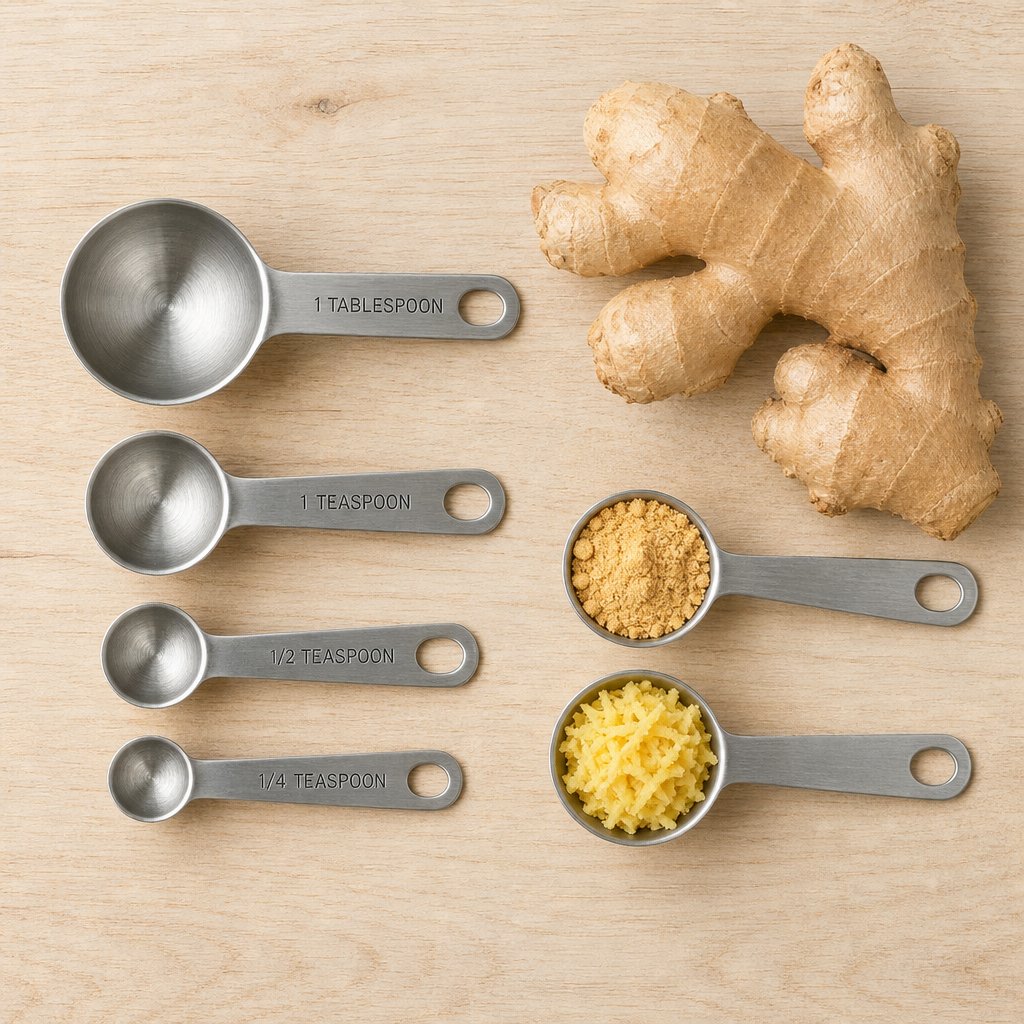
According to McCormick, 1/4 teaspoon of ground ginger is equivalent to 1 teaspoon of freshly grated ginger. That is a 4:1 ratio by volume — meaning ground ginger is roughly four times more potent, measure for measure, than the fresh root. Some sources like The Spruce Eats recommend an even more conservative approach: 1/4 teaspoon of ground ginger per tablespoon of fresh, which works out to a 12:1 ratio. The difference depends on how finely you grate the fresh ginger and how potent your ground ginger is.
Here is a quick-reference table for the most common measurements:
| Fresh Ginger Amount | Ground Ginger Equivalent |
|---|---|
| 1 teaspoon freshly grated | 1/4 teaspoon ground |
| 1 tablespoon freshly grated | 3/4 teaspoon ground |
| 1-inch piece of fresh ginger | 1/2 teaspoon ground |
For the reverse — when a recipe calls for ground ginger but you only have fresh — multiply the ground measurement by four. So 1/2 teaspoon of ground ginger becomes 2 teaspoons of freshly grated root. Keep in mind that adding fresh ginger also introduces moisture, which can matter in baking.
A practical tip: start with slightly less ground ginger than the conversion suggests and taste as you go. As Tasting Table notes, powdered ginger contains a higher concentration of shogaols, making it spicier and more pungent than fresh. If your jar has been open for a while and the aroma has faded, you may need to nudge the amount upward.
When Substitutions Work and When They Fail
Ground ginger performs well as a substitute for ground ginger's fresh counterpart in baked goods, simmered sauces, soups, and marinades — anywhere the spice has time to meld with other flavors and texture is not the focus. Gingerbread, pumpkin pie filling, and curry sauces all accept the swap gracefully.
Where it falls short: dishes that rely on fresh ginger's fibrous bite and volatile aroma. Sushi pickled ginger, a bright ginger-scallion relish, or a freshly brewed ginger tea will not taste right with powder alone. The texture is absent, and the sharp citrusy top notes simply do not exist in the dried form. In these cases, you are better off finding a different ginger substitute altogether rather than forcing the swap.
Crystallized ginger and ginger paste offer middle-ground alternatives worth knowing about. Crystallized (candied) ginger brings sweetness along with ginger flavor — use about 1 tablespoon of minced crystallized ginger for every 1/8 teaspoon of ground, adjusting sugar elsewhere in the recipe. Ginger paste, sold in tubes or jars, substitutes for fresh at roughly a 1:1 ratio and works well in curries and stir-fries where convenience matters.
If you have neither fresh nor dried ginger available, a replacement spice for ginger depends on the dish. Allspice, cardamom, cinnamon, or nutmeg can fill the warmth gap in baked goods, though none replicates ginger's exact profile. Use half the amount of allspice or mace compared to the ginger called for, and adjust by taste. These are not perfect stand-ins, but they keep a recipe moving when your spice cabinet comes up short.
The key takeaway: fresh ginger to ground ginger conversion works reliably when you respect the ratio and match the form to the dish. Ground ginger is a concentrated, shelf-stable powerhouse — but it is a different tool than fresh root, not a universal replacement.
Health Benefits of Ground Ginger Powder
Ground ginger is not just a kitchen staple — it is a concentrated source of bioactive compounds with a long history in traditional medicine. People often ask: is ginger powder as good as fresh ginger when it comes to health? The answer is more nuanced than a simple yes or no. Drying changes ginger's chemical makeup in ways that may actually enhance certain therapeutic properties, making ground ginger benefits distinct from — and in some cases stronger than — those of the fresh root.
Bioactive Compounds in Dried vs Fresh Ginger
Fresh ginger is rich in gingerols, particularly 6-gingerol, which is the most abundant pungent compound in raw rhizomes. These molecules are responsible for ginger's well-known anti-inflammatory, antioxidant, and anti-nausea effects. A study published in Food Science and Biotechnology found that fresh ginger contains approximately 6,200 mg/kg of 6-gingerol on a dry-weight basis, with only trace amounts of shogaols (around 29 mg/kg).
Here is where the chemistry gets interesting. When ginger undergoes heat treatment during drying, gingerols lose a water molecule and convert into shogaols through a dehydration reaction. The same research demonstrated that dry heat treatment on ginger powder at 130 degrees Celsius produced up to 1,611 mg/kg of 6-shogaol — a dramatic increase from the negligible levels found in fresh ginger. Moist heat processing pushed that number even higher, reaching 2,991 mg/kg under optimal conditions.
Why does this matter for your health? Research in the Journal of Agricultural and Food Chemistry reports that shogaols exhibit stronger anti-proliferative activity and greater anti-inflammatory potency than gingerols. They have also shown promise as antioxidant agents with neuroprotective properties. So when you compare ginger powder vs ginger root from a bioactive standpoint, the dried form trades some of fresh ginger's gingerol content for higher shogaol concentrations — compounds that current evidence suggests may be more pharmacologically potent.
Both forms retain beneficial compounds, just in different proportions. Fresh ginger delivers more gingerols and volatile essential oils. Ground ginger delivers more shogaols and a higher concentration of total bioactives per gram, simply because removing water (which makes up roughly 80% of fresh ginger's weight) leaves behind a denser package of active molecules.
Popular Health Applications of Ginger Powder
Is ground ginger good for you? Centuries of traditional use and a growing body of clinical research say yes. Here are the most well-supported applications:
- Digestive wellness — Ginger supports gastrointestinal health and helps relieve nausea. The American College of Obstetricians and Gynecologists recognizes ginger capsules as a remedy for pregnancy-related nausea. Ground ginger's concentrated form makes it practical for consistent daily dosing.
- Healthy inflammation response — Both gingerols and shogaols inhibit pro-inflammatory pathways. Studies suggest ginger supplementation can help soothe occasional muscle soreness after exercise and support joint comfort over time.
- Immune support — Ginger's antimicrobial and antioxidant properties contribute to overall immune resilience. Its warming nature has made it a go-to ingredient in traditional cold-weather remedies across Asian and Ayurvedic medicine systems.
- Blood sugar management — A 2022 review found that ginger supplementation (1,200 to 3,000 mg per day for 8 to 13 weeks) produced significant reductions in fasting blood sugar and HbA1c in people with type 2 diabetes.
- Heart health — Research indicates ginger consumption may help reduce triglycerides and LDL cholesterol while supporting healthy HDL levels, though more studies are needed to confirm optimal dosing.
So is ground ginger as good as fresh for health purposes? In many supplement and therapeutic contexts, it is actually preferred. Ground ginger's shelf stability, precise dosing, and elevated shogaol content make it the standard form for health products. When evaluating ginger root vs powder for wellness goals, the dried form offers practical advantages that fresh root cannot match — consistent potency batch to batch, easy incorporation into daily routines, and no refrigeration required.
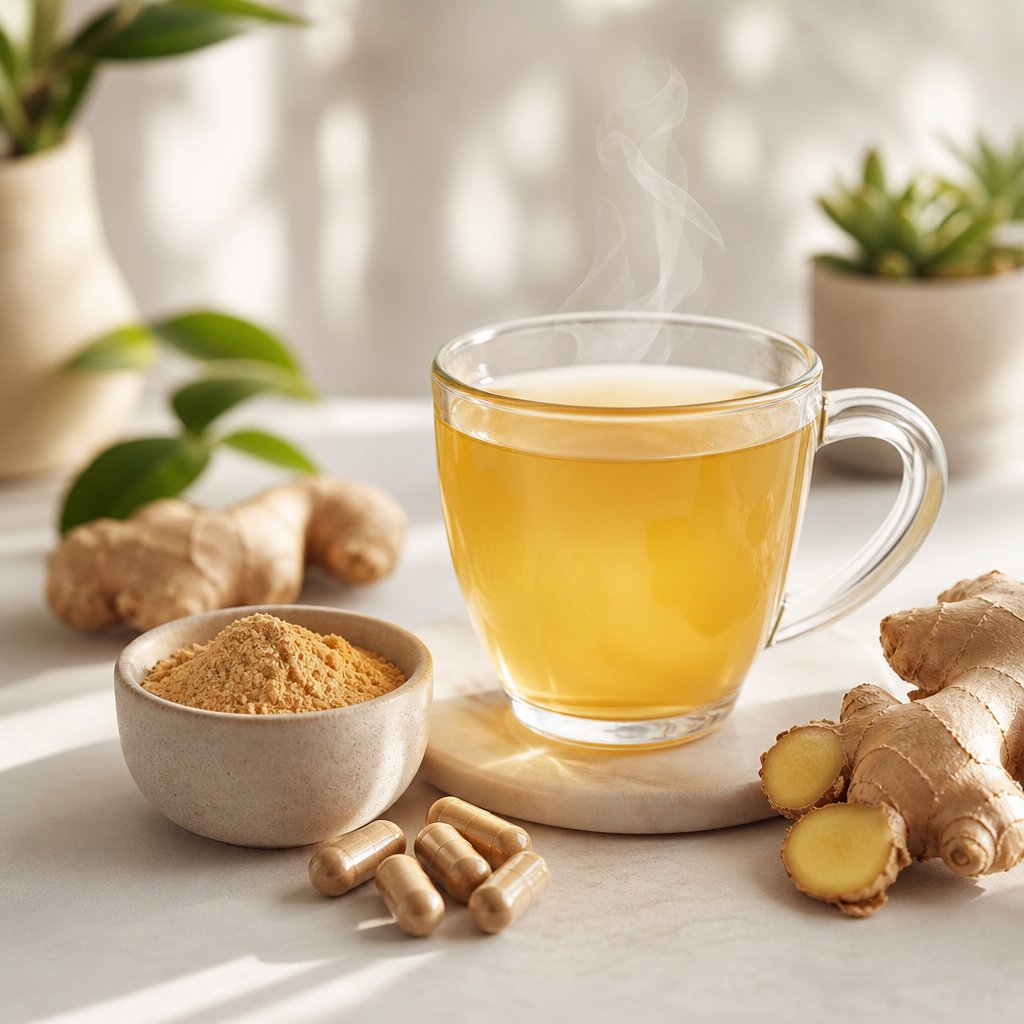
Ginger powder's concentrated, shelf-stable nature is exactly why it dominates the supplement industry. You will find it delivered in capsules, tablets, powder sachets, gummy supplements, and liquid extracts — each format designed for different consumer preferences and absorption profiles. For brands developing ginger-based health products, OEM/ODM manufacturers like ZhuFeng offer scalable production across these formats (hard capsules, tablets, powder/granules, soft capsules, gummies, oral liquids) with customized formulations, helping nutrition brands and private label sellers bring market-ready ginger supplements from concept to shelf efficiently.
Whether you stir a quarter teaspoon into your morning smoothie or take a standardized capsule, ground ginger delivers a meaningful dose of bioactive compounds. The key is consistency — the health benefits associated with ginger in clinical research typically emerge with regular use over weeks, not from a single serving. That concentrated potency also means quality matters. How the ginger was sourced, dried, and stored directly affects how much active compound remains in the powder by the time it reaches you.
How to Choose and Store Quality Ginger Powder
That concentrated potency only delivers results if the powder in your jar is actually fresh and well-sourced. A stale, poorly stored product will not give you the flavor or the bioactive compounds you are counting on — regardless of whether the label says ground ginger or ginger powder. Knowing what does ground ginger look like when it is at peak quality helps you shop smarter and avoid wasting money on a jar that has already lost its punch.
What to Look for When Buying
High-quality ground ginger announces itself through color, aroma, and texture. When you open a fresh jar, you should immediately notice a warm, spicy-sweet scent that fills the space around it. If you have to press your nose against the opening to detect anything, that product has already faded. Here are the key indicators to check:
- Vibrant color — Look for a warm golden-tan or sandy beige hue. Pale gray or dull brown powder signals age, poor drying methods, or low-quality source material.
- Strong aroma — A fresh jar should smell peppery, warm, and slightly sweet the moment you crack the seal. As Serious Eats notes, the aroma of a spice gives you the most reliable information about how fresh and flavorful it is.
- Fine, consistent texture — The powder should flow freely without clumps or hard chunks. Clumping usually means moisture has gotten in, which degrades both flavor and shelf life.
- Clear origin labeling — Single-origin ginger from India, Nigeria, or Indonesia each carries a distinct flavor profile. Indian ginger tends toward lemony brightness, while Nigerian varieties lean earthier and more pungent.
- Sealed packaging with an expiration date — Airtight containers protect volatile oils from oxidation. A printed date gives you a baseline for freshness.
Do price differences reflect actual quality? Often, yes. Organic ginger powder and single-origin options typically deliver more potent flavor because producers prioritize freshness and careful processing over volume. If you are buying ground ginger bulk for frequent cooking or product development, sourcing from a reputable spice supplier with transparent origin information makes a noticeable difference in the finished dish.
Where can you buy ginger powder that meets these standards? Specialty spice shops, international markets, and reputable online retailers tend to offer fresher stock with faster turnover than the back shelf of a big-box store. If you are wondering where to buy ground ginger with the best potency, look for vendors who list harvest dates or roast dates — a sign they take freshness seriously.
Storage and Shelf Life
Does ground ginger go bad? Technically, dried spices do not spoil in the way that fresh food does — they will not make you sick. But they absolutely lose potency over time. Eat By Date lists ground ginger's shelf life at 2 to 3 years past its printed date when stored properly. Tilda's ingredient guide extends that estimate to up to four years under ideal conditions, though peak flavor typically fades well before that mark.
Can ground ginger go bad in terms of usability? Yes — once the volatile oils evaporate, you are left with flavorless dust that adds nothing to your recipe. Does ground ginger expire in a meaningful way? The expiration date on the jar is a conservative guideline, but your senses are a better judge.
To maximize shelf life, store your ground ginger in an airtight container away from heat, light, and moisture. That means off the counter next to the stove (too much heat) and out of direct sunlight. A cool, dark pantry or a closed spice drawer is ideal. Here is how to tell when your powder has lost its edge:
- The color has faded from golden-tan to a washed-out beige or gray
- Rubbing a pinch between your fingers produces little to no aroma
- The flavor tastes flat and one-dimensional when you touch it to your tongue
The simplest freshness check? The sniff test. Pinch a small amount, rub it between your fingertips, and inhale. If the warm, peppery scent hits you immediately, your ginger is still in good shape. If you get nothing — or just a faint dustiness — it is time to replace the jar. A fresh container of quality ground ginger costs little compared to the flat, lifeless results you get from cooking with a spent one.

Cooking with Ground Ginger and Beyond
A fresh jar of quality ground ginger spice opens up a wide range of culinary possibilities — from holiday baking to weeknight curries to morning smoothies. And here is the reassurance worth repeating: any recipe calling for "ginger powder" works perfectly with your jar labeled "ground ginger." No conversion needed, no adjustment required. They are the same product, so you can cook with confidence regardless of how the recipe or your spice label phrases it.
So how to use ginger powder effectively across different cooking contexts? It comes down to understanding how this dry, concentrated spice behaves in heat, moisture, and combination with other ingredients.
Baking with Ground Ginger
Ground ginger for baking is the standard choice over fresh for one practical reason: it integrates seamlessly into dry ingredient mixtures without adding moisture that could throw off a recipe's chemistry. When you whisk it into flour alongside baking soda and salt, it distributes evenly throughout the batter or dough, delivering consistent warmth in every bite.
You will find ginger powder for baking called for in classics like gingerbread cookies, gingersnaps, spiced carrot cake, pumpkin pie, and molasses-based loaves. It pairs naturally with cinnamon, nutmeg, cloves, and allspice — the warming family of spices that defines autumn and holiday baking. A typical gingerbread recipe uses 1 to 2 teaspoons of ground ginger per batch, enough to provide that signature warmth without overpowering the molasses and brown sugar base.
A tip that elevates your results: add ground ginger to the dry ingredients rather than creaming it with butter and sugar. This prevents clumping and ensures the spice disperses evenly through the flour matrix before liquid is introduced.
Savory Dishes and Spice Blends
Ginger spice cooking extends far beyond the dessert table. In savory applications, ground ginger adds depth to curries, stir-fry sauces, marinades, soups, and dry rubs for grilled meats. Its warm, peppery character complements garlic, turmeric, cumin, and chili — making it a backbone ingredient in global cuisines from Indian to Moroccan to Caribbean.
What is ginger spice in the context of blended seasonings? It is a core component of several iconic spice mixes. Pumpkin spice relies on it alongside cinnamon and nutmeg. Garam masala uses it to balance cardamom and cloves. Chinese five-spice pairs it with star anise, Sichuan peppercorn, fennel, and cinnamon for a sweet-savory-aromatic profile. In each blend, ground ginger provides the warm undercurrent that ties sharper flavors together.
For beverages, stir a quarter teaspoon into golden milk (turmeric latte), blend it into fruit smoothies for a spicy kick, or simmer it into a quick ginger tea when fresh root is not on hand. The powder dissolves readily in warm liquids, making it a convenient ginger spice food ingredient for drinks as much as for solid dishes.
As Green Jeeva notes, ginger powder's concentrated flavor and shelf stability make it invaluable for ginger spice for cooking at scale — from home kitchens to commercial food manufacturing, where it enables consistent flavor profiles across large production batches without the logistical challenges of sourcing fresh root.
Sourcing Ginger Powder for Product Development
Beyond home kitchens, ginger powder is a high-demand ingredient in the functional food and supplement industry. Its versatility spans instant soups, low-sodium seasoning blends, wellness shots, and encapsulated supplements. For nutrition brands, supplement importers, and private label sellers looking to develop ginger-based products, partnering with an experienced manufacturer streamlines the path from formulation to market.
Businesses interested in launching ginger-based health products can explore ZhuFeng's OEM/ODM services for customized formulation and scalable production across multiple product formats — including hard capsules, tablets, powder/granules, soft capsules, gummy candy, and oral liquids. This flexibility allows brands to match their ginger product to their target consumer's preferred delivery method, whether that is a daily capsule, a flavored gummy, or a powder sachet designed for mixing into beverages.
Whether you are reaching for ground ginger to spice a batch of cookies or sourcing it at scale for a commercial product line, the fundamentals stay the same: start with quality powder, store it properly, and let its concentrated warmth do the work.
Frequently Asked Questions About Ground Ginger and Ginger Powder
1. Can I use ground ginger instead of ginger powder in a recipe?
Absolutely. Ground ginger and ginger powder are identical products — dried ginger root milled into a fine powder. The two names reflect regional labeling conventions and brand marketing choices, not any difference in the spice itself. Use them interchangeably at a 1:1 ratio without adjusting your recipe in any way.
2. What is the conversion ratio from fresh ginger to ground ginger?
The standard conversion is 1 teaspoon of freshly grated ginger equals 1/4 teaspoon of ground ginger. For a 1-inch piece of fresh ginger root, substitute approximately 1/2 teaspoon of ground ginger. Start with slightly less than the conversion suggests and taste as you go, since ground ginger contains concentrated shogaols that deliver more pungent heat than fresh gingerols.
3. Does ground ginger have the same health benefits as fresh ginger?
Ground ginger offers comparable and sometimes enhanced health benefits. During drying, gingerols convert into shogaols — compounds research suggests have stronger anti-inflammatory and antioxidant properties. Ground ginger is more concentrated by weight since water has been removed, making it the preferred form for supplements and consistent daily dosing. For brands developing ginger-based health products, OEM/ODM manufacturers like ZhuFeng provide scalable production in formats including capsules, tablets, powders, gummies, and oral liquids.
4. How long does ground ginger last before it loses its flavor?
Ground ginger maintains peak flavor for 2 to 3 years when stored in an airtight container away from heat, light, and moisture. It won't become unsafe to eat after that point, but the volatile oils that deliver aroma and taste will gradually evaporate. Use the sniff test: rub a pinch between your fingers and inhale. If the warm, peppery scent is immediate and strong, your powder is still potent. If you detect only faint dustiness, replace the jar.
5. Why is ground ginger preferred over fresh ginger in baking?
Ground ginger integrates seamlessly into dry ingredient mixtures without adding moisture that could alter a recipe's chemistry. Its fine texture distributes evenly through flour, delivering consistent warmth in every bite. Fresh ginger would introduce liquid and fibrous texture that disrupts the structure of cookies, cakes, and pie fillings. Ground ginger also pairs more harmoniously with other dry baking spices like cinnamon, nutmeg, and cloves because its warmer, earthier shogaol-based flavor profile blends rather than competes.