What Are Campden Tablets and Why Brewers Rely on Them
You just crushed your first batch of grapes or cracked open a fresh can of malt extract. Everything looks great, but one question keeps popping up in every forum and recipe guide: should you be using campden tablets? And what are campden tablets, exactly? Whether you are making wine, cider, mead, or beer, these tiny tablets play a surprisingly big role in protecting your final product.
The Simple Definition Every Brewer Needs
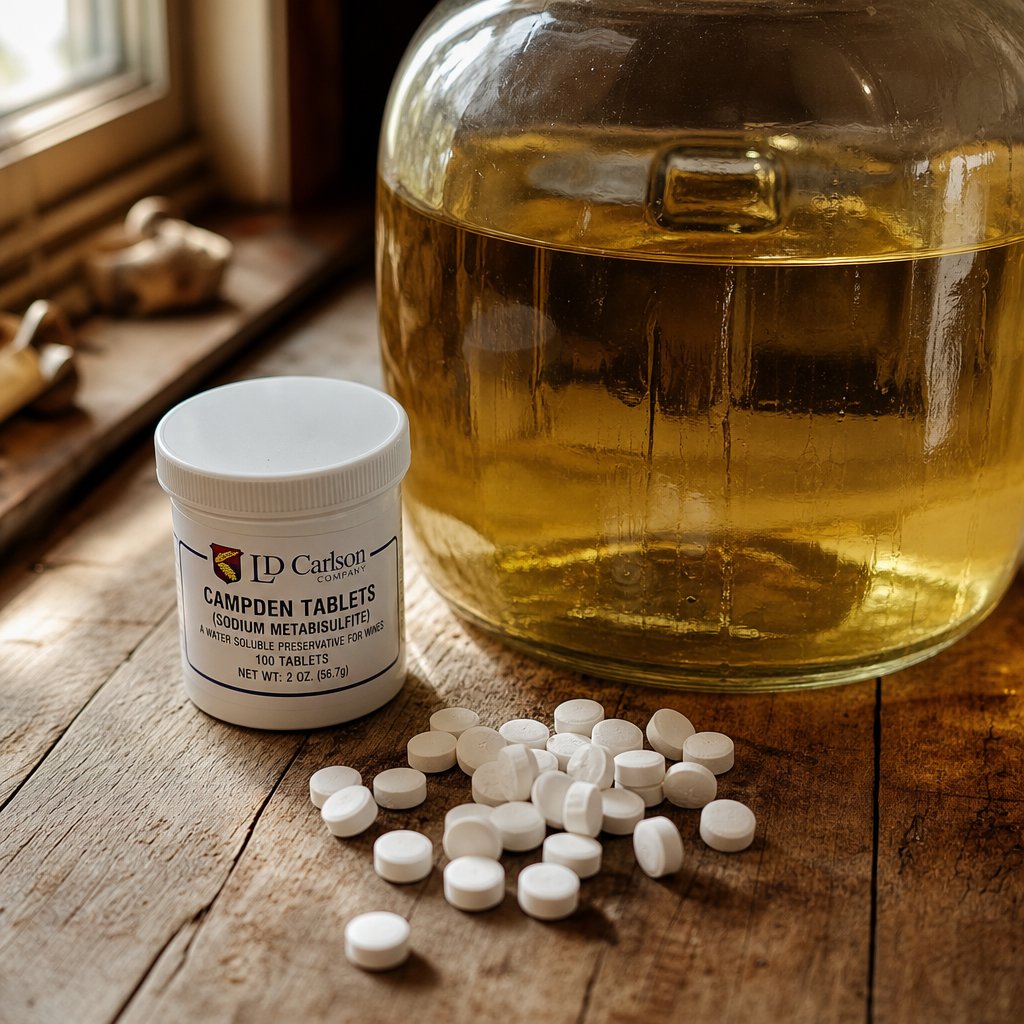
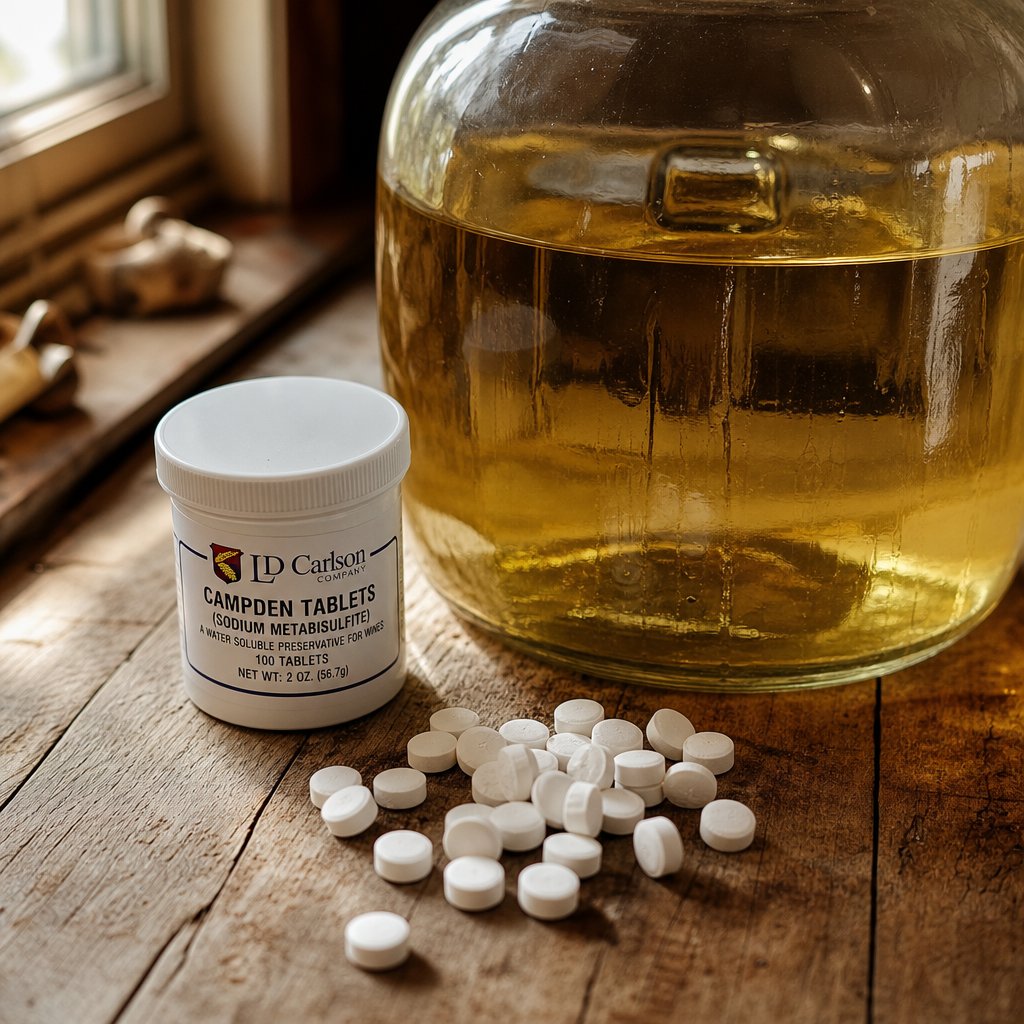
Campden tablets are small, pre-measured tablets of potassium metabisulfite or sodium metabisulfite that release sulfur dioxide (SO2) when dissolved in liquid. They are used in homebrewing, winemaking, cider-making, and water treatment to kill bacteria, inhibit wild yeast, prevent oxidation, and remove chlorine or chloramine from tap water.
A single campden tablet typically contains about 0.44 g of metabisulfite plus a small amount of filler. This pre-measured format makes it easy for home producers to add precise, consistent doses without needing a milligram scale. When you ask what is campden tablets in practical terms, think of them as a convenient, multi-purpose shield for your brew.
Where the Name Comes From
The name traces back to Chipping Campden, a small market town in Gloucestershire, England. In the 1920s, the Fruit and Vegetable Preserving Research Station located there developed a sulfite solution to help preserve fruit products. The Boots Company later refined the concept into a tablet form, giving amateur producers an easy way to measure small quantities of sulfite. The name stuck, and today "campden" is synonymous with sulfite treatment across the brewing world.
Who Uses Campden Tablets and Why
Winemakers, cider producers, mead makers, and homebrewers all reach for these tablets, though for slightly different reasons. What is a campden tablet doing in a beer brewer's toolkit? Mostly removing chlorine and chloramine from municipal tap water before brew day. For winemakers and cider makers, the applications run deeper. The tablets serve three distinct purposes:
- Sanitization - Suppressing wild yeast and harmful bacteria like acetobacter in fresh must before fermentation begins.
- Preservation - Acting as an antioxidant during racking and bottling to prevent oxidation and keep flavors stable over time.
- Chlorine and chloramine removal - Neutralizing water treatment chemicals that can produce off-flavors such as medicinal or plastic-like chlorophenols in finished beer and wine.
Each of these use cases calls for different dosages, different timing, and different expectations. A brewer treating tap water uses far less than a winemaker stabilizing must, and the waiting periods vary significantly. Understanding these distinctions is what separates a well-made batch from one plagued by off-flavors or spoilage.
The chemistry behind how sulfur dioxide actually protects your brew is more nuanced than most guides let on, and it starts with what happens the moment a tablet dissolves in liquid.
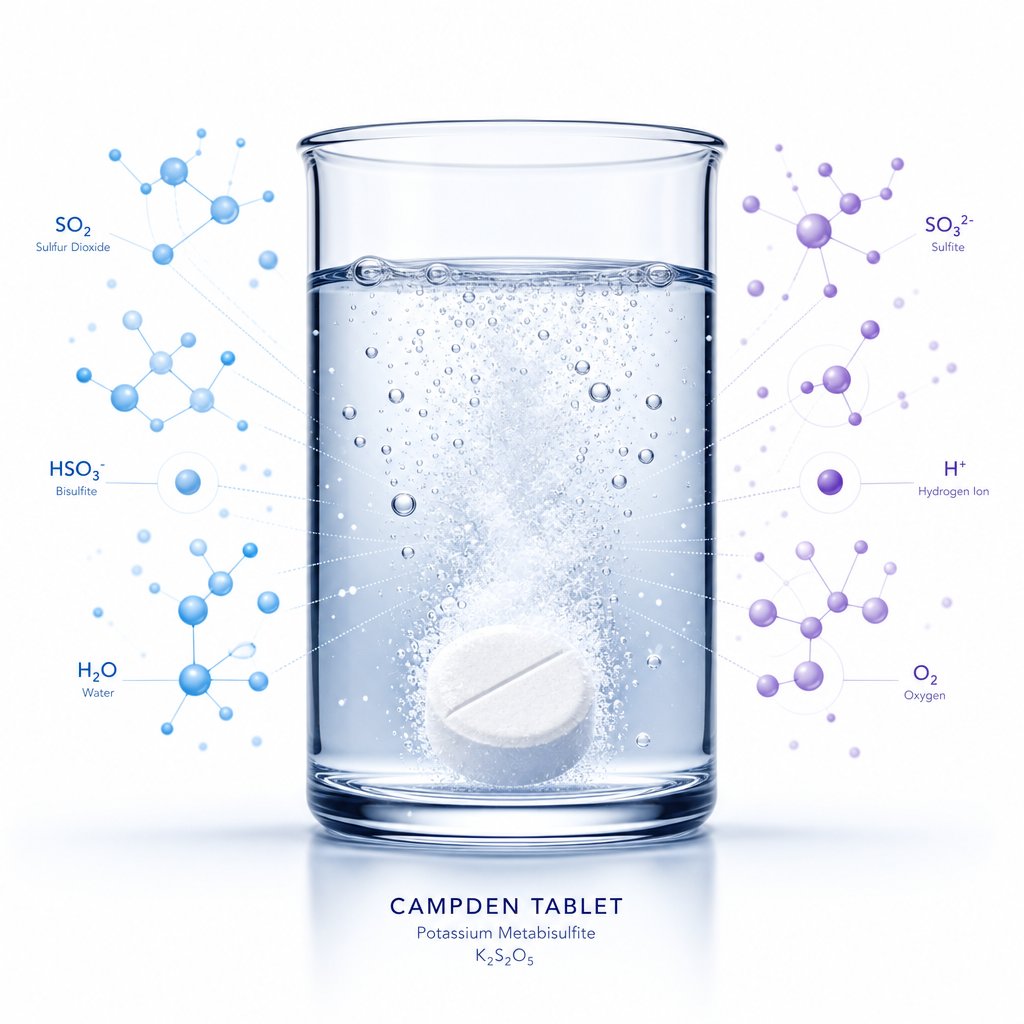
The Chemistry Behind Campden Tablets
Drop a campden tablet into a gallon of must and it starts dissolving almost immediately. But what actually happens at the molecular level? The metabisulfite potassium (or sodium) compound reacts with the liquid and releases sulfur dioxide gas into solution. That SO2 does not just float around passively. It transforms into different chemical species, each with a distinct role in protecting your brew. Understanding this chemistry helps you use these tablets far more effectively than simply following a recipe card.
How Sulfur Dioxide Protects Your Brew
Sulfur dioxide pulls double duty as both an antimicrobial agent and an antioxidant. On the antimicrobial side, SO2 in its molecular form can penetrate the cell walls of wild yeast and bacteria, disrupting their internal metabolism and effectively shutting them down. Unlike a simple oxygen tablet that might aerate a solution, campden tablets work by creating a hostile chemical environment for spoilage organisms while leaving your chosen yeast strain largely unaffected.
On the antioxidant side, sulfite ions compete with dissolved oxygen for reactive compounds in your wine or cider. They bind preferentially to compounds like acetaldehyde and keto acids that oxygen would otherwise oxidize, preventing the browning, stale flavors, and premature aging that come with uncontrolled oxidation. SO2 also deactivates polyphenoloxidase (PPO) enzymes responsible for oxidative browning in juice, which is why winemakers sulfite white grape must immediately at crushing.
Sounds complex? Here is the key takeaway: molecular SO2 handles microbial threats by entering cells directly, while bisulfite ions handle oxidation threats by outcompeting oxygen for reactive wine compounds. Two different protective mechanisms from the same tablet.
Free SO2 vs Bound SO2 Explained
When you dissolve a campden tablet, not all of the sulfur dioxide remains available to protect your brew. Some of it binds irreversibly to other compounds in the liquid, particularly acetaldehyde, anthocyanin pigments in red wine, and various phenolic compounds. Once bound, that SO2 is essentially spent. It no longer provides antimicrobial or antioxidant protection.
This gives us two critical measurements:
- Free SO2 - The unreacted portion still available to protect your wine. This includes molecular SO2 and bisulfite ions that have not yet bound to anything. This is the number that matters for preservation.
- Bound SO2 - The portion that has already reacted with wine compounds. It is locked up and no longer useful for protection.
Total SO2 is simply the sum of free and bound fractions. Research from the Australian Wine Research Institute (AWRI) notes that when a wine shows a very high proportion of bound SO2 compared to free SO2, it often signals that oxidation or microbial spoilage has already occurred. Monitoring this ratio over time gives you an early warning system for problems developing in your batch.
In practical terms, when you add a campden tablet to wine, roughly 35 to 40% of the SO2 ends up in the useful free form. The rest binds with existing compounds. This is why understanding what is a campden tablet at the chemical level matters: you are never getting 100% of the tablet's sulfite working in your favor.
Why pH Changes Everything About Sulfite Effectiveness
Here is where most brewing guides fall short. The effectiveness of your campden addition depends heavily on the pH of your liquid. When SO2 dissolves, it exists in equilibrium between three forms:
- Molecular SO2 - The most potent antimicrobial form. Penetrates cell walls of spoilage organisms. Dominant at very low pH (below 1.8).
- Bisulfite ion (HSO3-) - The most abundant form at wine pH (3.0 to 4.0). Responsible for antioxidant protection through competitive binding. Reacts with acetaldehyde and other carbonyl compounds.
- Sulfite ion (SO3 2-) - Dominant at high pH (above 7). Essentially absent at wine pH and largely irrelevant for brewers.
At typical wine pH of 3.0 to 4.0, the solution contains mostly bisulfite ions with a small but critical fraction of molecular SO2. Drop the pH lower and you get more molecular SO2, which means stronger antimicrobial action. Raise the pH and that molecular fraction shrinks. According to AWRI research, for the same level of free SO2, there is twice as much molecular SO2 at pH 3.5 compared to pH 3.8.
What does this mean for your brewing? A cider at pH 3.2 gets significantly more antimicrobial protection from a single campden tablet than a mead at pH 3.8. Higher pH beverages need higher free SO2 levels to achieve the same molecular SO2 concentration. Temperature and alcohol content also play a role. Higher alcohol and warmer temperatures both increase the molecular SO2 fraction slightly, but pH remains the dominant factor by far.
This pH relationship explains why winemakers obsess over acidity adjustments before adding sulfite. It is not just about taste. It directly determines how well your campden addition protects the batch. A wine at pH 3.5 might need 30 to 50 mg/L of free SO2 for adequate protection, while the same wine at pH 3.2 could get by with 20 mg/L or less.
The chemistry dictates the dosage, and the dosage varies depending on whether you are treating water, preparing must, or stabilizing a finished wine for bottling.
Potassium Metabisulfite vs Sodium Metabisulfite
Both forms of campden tablets release sulfur dioxide into your liquid, but the carrier salt makes a real difference in how, when, and why you use each one. Potassium metabisulfite and sodium metabisulfite share the same core function, yet they behave differently in your must, on your equipment, and even in your body. Choosing the right form is not just a matter of grabbing whatever is on the shelf.
Potassium Metabisulfite for Wine and Mead
Potassium metabisulfite wine applications dominate the homebrewing world for a straightforward reason: it adds zero sodium to your finished product. When you dissolve a potassium-based tablet in must, the potassium ions left behind can actually contribute to the mineral balance of the wine in a positive way. Some winemakers note that potassium metabisulfite for wine also has a higher oxidation potential, meaning it provides slightly better long-term antioxidant protection during aging.
Flavor impact matters here. Sodium metabisulfite can introduce a faint salty or mineral note at higher concentrations, something you would never want in a delicate Riesling or a floral mead. Potassium-based tablets avoid this entirely. If you plan to age your wine for months or years, potassium is the safer bet for preserving clean, true-to-varietal flavors over time.
There is also a practical safety consideration during use. Sodium meta bisulphite produces only SO2 gas when dissolved, while potassium metabisulfite can also release small amounts of sulfur trioxide (SO3). In a well-ventilated space this is negligible, but it is worth noting if you are working in a tight cellar or garage with limited airflow.
Sodium Metabisulfite for Water and Sanitization
Sodium metabisulfite shines in two areas: treating brewing water and sanitizing equipment. It is less expensive, more widely available at general homebrew shops, and releases a slightly higher concentration of SO2 per gram. For dechlorinating tap water before brew day, the sodium content is irrelevant because you are treating the water, not the finished beverage.
Equipment sanitization is another strong use case. WineMaker Magazine recommends making a sanitizing solution of 8 teaspoons of potassium metabisulfite per gallon of warm water for equipment, but sodium metabisulfite works equally well for this purpose and costs less. Since the solution never enters your wine directly, the sodium content is a non-issue. The absence of SO3 in sodium metabisulfite fumes also makes it slightly more comfortable to work with when sanitizing carboys, hoses, and fermenters in enclosed spaces.
Which Form Should You Choose
The decision comes down to what the sulfite will touch. If it goes into your must, juice, or finished wine, use potassium metabisulfite. If it touches only your water supply or equipment surfaces, sodium metabisulfite is perfectly fine and saves you a few dollars.
People on low-sodium diets sometimes worry about whether wine has sodium from sulfite additions. The answer is reassuring: potassium-based campden tablets eliminate this concern completely. Even with sodium metabisulfite, the actual sodium contribution per glass of wine is too small to meaningfully affect blood pressure or daily sodium intake. Still, using potassium tablets for anything that enters the bottle removes even that trace amount from the equation.
Here is a side-by-side comparison to make the choice clear:
| Category | Potassium Metabisulfite (K2S2O5) | Sodium Metabisulfite (Na2S2O5) |
|---|---|---|
| Chemical Formula | K2S2O5 | Na2S2O5 |
| Best Use Case | Must treatment, wine/mead preservation, bottling | Water dechlorination, equipment sanitization |
| Sodium Content | None | Trace amounts enter solution |
| SO2 Release per Gram | Slightly lower | Slightly higher |
| Flavor Impact in Wine | Neutral to positive (potassium contributes to mineral balance) | Possible faint salty note at high doses |
| Availability | Common at homebrew shops, sometimes harder to find in tablet form | Widely available, lower cost |
| Shelf Stability | Excellent when stored cool and sealed (2+ years) | Excellent when stored cool and sealed (2+ years) |
| Fumes During Use | SO2 + trace SO3 | SO2 only |
Many experienced winemakers keep both forms on hand: potassium metabisulfite for everything that contacts the wine, and sodium metabisulfite for water treatment and cleaning solutions. This dual approach gives you the best protection without compromising flavor or spending more than necessary.
Knowing which form to use is only half the equation. The real complexity lies in how much to add, when to add it, and how each application differs across wine, cider, mead, and beer.
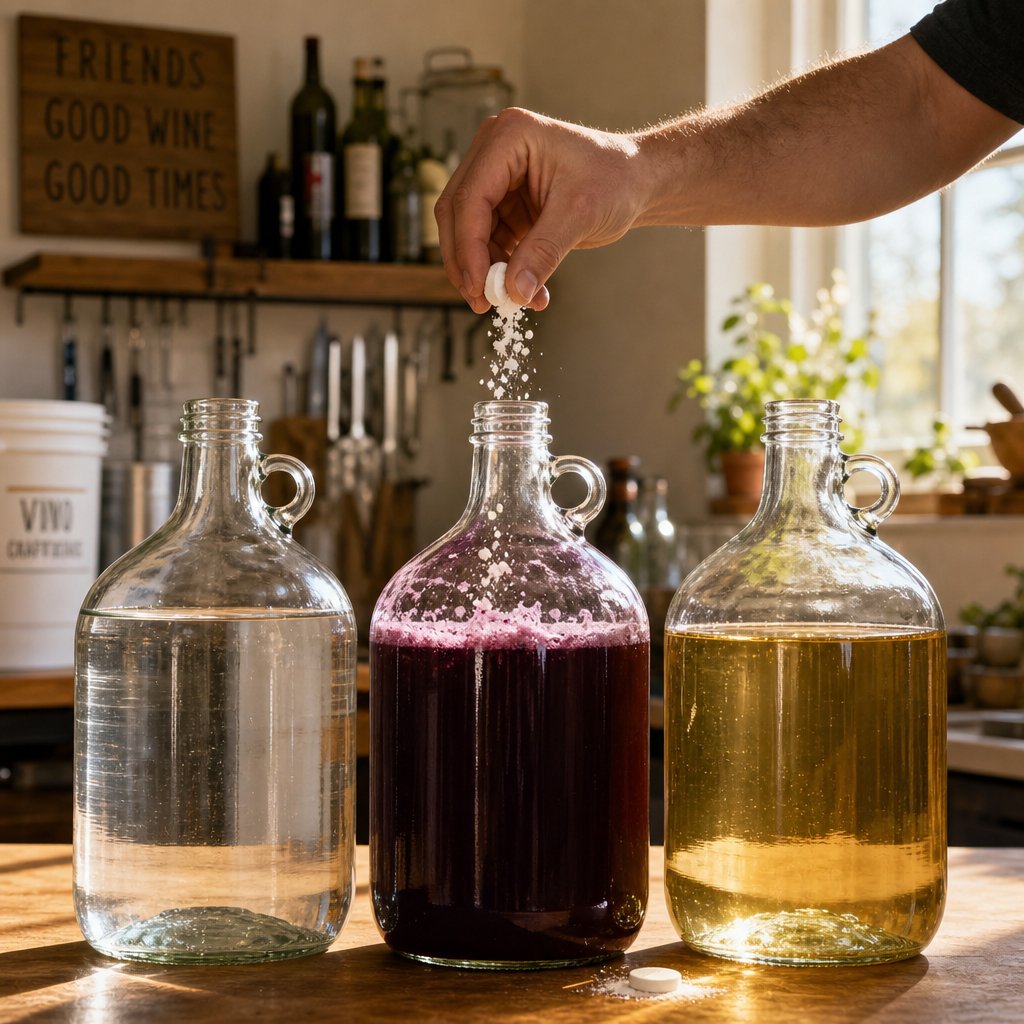
Three Distinct Uses with Different Dosages
Here is where most beginners trip up: they treat every campden addition the same way. In reality, the dosage and method change dramatically depending on your goal. A brewer dechlorinating tap water needs a fraction of what a winemaker uses to suppress wild yeast in fresh must. Mixing up these applications can leave you with under-protected wine or over-sulfited beer. Each use case has its own workflow, its own timing, and its own rules.
Removing Chlorine and Chloramine from Tap Water
Municipal water treatment chemicals produce chlorophenol off-flavors in beer and wine, often described as band-aid, plastic, or medicinal. If you want to know how to dechlorinate tap water for brewing, campden tablets are the fastest and cheapest solution available.
The dose here is remarkably small. According to Hazy and Hoppy, one tablet treats approximately 20 gallons of water. For a standard 5-gallon homebrew batch requiring 9 to 10 gallons of water, half a tablet is plenty.
- Crush half a campden tablet into powder using the flat side of a knife or a spoon.
- Add the powder directly to your brewing water in the kettle or vessel.
- Stir briefly and wait 2 to 5 minutes. The reaction with chlorine and chloramine is nearly instantaneous.
- Proceed with your brew day. No rinsing or additional waiting required.
This applies equally to beer, wine, cider, and mead. Any time you use treated municipal water as your base, this step prevents off-flavors before they start. The dose is so low that it has no measurable impact on yeast health or fermentation performance, so there is no need to wait before pitching.
Pre-Fermentation Must Treatment
When you crush fresh grapes, press apples for cider, or mix raw honey for mead, the juice carries wild yeast and bacteria from the fruit surface. Campden tablets wine applications at this stage knock back those organisms so your chosen yeast strain can dominate fermentation without competition.
The standard dose for must treatment is one tablet per gallon of juice or must. This is dramatically higher than the water treatment dose because you are fighting a living microbial population, not just neutralizing a chemical.
- Crush one campden tablet per gallon of must into a fine powder.
- Dissolve the powder in a small amount of the juice and stir it thoroughly into the full batch.
- Cover the vessel loosely with a cloth or lid left slightly ajar. The SO2 needs to dissipate over time.
- Wait 12 to 24 hours before pitching your yeast. This gives the sulfite time to suppress wild organisms and then off-gas enough that your cultured yeast can thrive.
For campden tablets cider applications, the process is identical. Press your apples, add one tablet per gallon, and wait overnight. The same applies to campden tablets for mead: dissolve honey in water, add the tablet, and give it a full day before introducing your yeast. Choosing what yeast for wine or mead matters here too. A strong, healthy pitch of cultured yeast after the waiting period easily overcomes any residual SO2 that the wild organisms could not tolerate.
One critical note: campden tablets mead applications sometimes require slightly higher free SO2 targets because mead typically has a higher pH than grape wine. As covered in the chemistry section, higher pH means less molecular SO2, so some mead makers add a second tablet per gallon for musts above pH 3.8.
Preservation and Antioxidant Protection at Bottling
The third use case protects your finished product from oxidation and microbial spoilage during aging and packaging. Every time you rack wine, cider, or mead from one vessel to another, you expose it to oxygen. Campden tablets scavenge that oxygen before it can damage delicate aromas and cause browning.
The dose drops significantly at this stage. Common practice calls for one tablet per 5 to 6 gallons of finished beverage.
- Crush one tablet per 5 to 6 gallons into powder.
- Dissolve in a small amount of the wine or cider and add to the receiving vessel before racking.
- Rack on top of the sulfite solution so it mixes as the liquid flows in.
- Repeat at each subsequent racking and again shortly before bottling for maximum protection.
For hard cider campden tablets use at bottling, this step is especially important if you plan to age bottles for several months. Cider's delicate fruit aromatics oxidize quickly without sulfite protection. White wines and fruit meads benefit equally from this treatment.
Beer is the exception here. Most homebrewers do not add campden at bottling because beer's hop compounds and lower pH already provide some oxidation resistance, and the carbonation process (whether bottle conditioning or force carbonating) limits oxygen exposure. Campden tablets in beer remain primarily a water treatment tool.
These three applications cover the full lifecycle of a batch, from water preparation through fermentation and into the bottle. But knowing the dose is only useful if you also understand the timing, especially how long to wait before adding yeast, enzymes, or stabilizers alongside your sulfite additions.
Dosage Guide and Timing for Every Stage
Getting the dose right is one thing. Getting the timing right is what separates a clean fermentation from a sluggish, stalled mess. The question of how many campden tablets per gallon comes up constantly in forums, and the answer depends entirely on what stage of the process you are in. Pair that with the wrong waiting period or a poorly timed additive, and you can undo all the protection those tablets were supposed to provide.
How Many Campden Tablets Per Gallon
The dosage varies by application, and mixing them up is one of the most common mistakes new brewers make. Here is a clear breakdown of how to use campden tablets at each stage:
| Application | Campden Tablets Per Gallon | SO2 Added (approx.) | Purpose |
|---|---|---|---|
| Water treatment (chlorine/chloramine removal) | 1 tablet per 20 gallons | ~3 ppm | Neutralize water treatment chemicals |
| Pre-fermentation must treatment (wine, cider, mead) | 1 tablet per gallon | ~50-75 ppm | Suppress wild yeast and bacteria |
| Post-fermentation racking | 1 tablet per 5-6 gallons | ~10-15 ppm | Antioxidant protection during transfer |
| Before bottling (long-term storage) | 1 tablet per gallon | ~50-75 ppm | Preservation and spoilage prevention |
Notice the dramatic difference between water treatment and must treatment. When you are asking how many campden tablets per gallon of wine, the answer for pre-fermentation and bottling is consistently one tablet per gallon. That single tablet delivers roughly 50 to 75 ppm of sulfite, which is enough to knock back wild organisms without making the wine taste sulfurous. For racking, you need far less because you are only scavenging the small amount of oxygen introduced during transfer, not fighting a microbial population.
A useful rule of thumb from SRAML's dosage guide: one standard campden tablet equals approximately 1/16 teaspoon of metabisulfite powder. If you scale up to a 5-gallon batch, that means 5 crushed tablets for must treatment or 1 tablet for a racking addition.
Critical Waiting Periods Before Pitching Yeast
Timing is where most fermentation failures originate. When to add campden tablets to wine is only half the question. The other half is how long to wait before introducing yeast.
The standard rule: wait a minimum of 24 hours after adding campden tablets before pitching yeast. During this window, the SO2 gas dissipates from the must into the air above it. This is why you must cover the fermenter loosely with a cloth or towel rather than sealing it with an airlock. Sealing the container traps the sulfite gas inside, which can inhibit or outright kill your cultured yeast even after the full 24-hour wait.
Here is what happens during that waiting period:
- 0 to 6 hours - SO2 levels are at their peak. Wild yeast and bacteria are being suppressed. Free SO2 is actively binding to compounds in the must.
- 6 to 12 hours - Molecular SO2 begins off-gassing through the loose cover. Free SO2 levels start declining as binding continues.
- 12 to 24 hours - Most of the volatile SO2 has dissipated. Residual free SO2 drops to levels that cultured yeast can tolerate (typically below 15 to 20 ppm of molecular SO2).
If you accidentally sealed your fermenter during this period, do not panic. Remove the lid, stir the must vigorously to help release trapped gas, and wait an additional 12 to 24 hours before pitching. Rushing this step is a recipe for a stuck fermentation.
For those wondering how much yeast per gallon of mead to pitch after sulfite treatment, the answer is one full packet (typically 5 grams of dried yeast) for a 1 to 5 gallon batch. A strong, healthy pitch overcomes any residual SO2 far more easily than an underpitched starter. Rehydrating your yeast according to the manufacturer's instructions before adding it to the sulfited must gives it the best chance of a vigorous start.
Interactions with Pectic Enzyme and Potassium Sorbate
Campden tablets do not exist in isolation. Most wine and cider recipes call for additional additives, and the order you add them matters enormously.
Pectic enzyme: This enzyme breaks down pectin in fruit musts, improving juice extraction and preventing haze in the finished wine. The catch? High SO2 levels can partially deactivate pectic enzyme. The best practice is to add pectic enzyme at the same time as your campden tablet, or within the first few hours. The enzyme works during the 24-hour waiting period while SO2 levels are still elevated but declining. Some winemakers prefer adding it 12 hours after the campden dose, once the initial SO2 spike has passed. Either approach works, but never add pectic enzyme after pitching yeast, as the rising alcohol and CO2 environment reduces its effectiveness.
Potassium sorbate: This additive prevents yeast from reproducing, making it essential for back-sweetening wine or cider before bottling. It does not kill existing yeast cells. It only stops them from budding new ones. For effective stabilization, always use potassium sorbate together with a campden tablet at bottling time. The campden tablet handles antimicrobial protection and oxygen scavenging, while the sorbate prevents re-fermentation of any added sugar. Without both working in tandem, you risk bottle bombs from renewed yeast activity.
Yeast nutrients: Diammonium phosphate (DAP) and other nutrient blends can be added at the same time you pitch yeast, which is after the 24-hour campden waiting period. There is no negative interaction between residual sulfite and yeast nutrients. In fact, well-nourished yeast handles residual SO2 more effectively than nutrient-starved yeast, making proper nutrition a form of insurance against sluggish starts.
The timeline looks like this for a typical wine or cider batch:
- Hour 0 - Add campden tablet (1 per gallon) and pectic enzyme. Cover loosely.
- Hour 24 - Pitch yeast and yeast nutrients. Attach airlock.
- Fermentation complete - Add 1 tablet per 5-6 gallons at each racking for antioxidant protection.
- Bottling day - Add 1 campden tablet per gallon plus potassium sorbate if back-sweetening.
Sulfite levels dissipate over time even in a sealed container. Free SO2 drops by roughly 10 to 20 ppm per month during bulk aging, which is why winemakers add a fresh dose at each racking and again before bottling. Skipping these maintenance doses leaves your wine increasingly vulnerable to oxidation and microbial spoilage the longer it sits.
Dosage precision and additive timing give you control over the process, but they do not address a different set of concerns: who should avoid sulfites entirely, and what these tablets cannot do despite popular belief.
Safety Considerations and Common Misconceptions
Sulfites protect your wine, but they are not without risk for certain individuals. And beyond health concerns, a surprising number of homebrewers hold beliefs about campden tablets that simply are not true. Misunderstanding what these tablets can and cannot do leads to spoiled batches, false confidence in sanitation, and occasionally unnecessary worry about safety.
Sulfite Sensitivity and Asthma Concerns
Can sulfites actually make you sick? For most people, no. But for a specific subset of the population, sulfite exposure triggers real and sometimes serious reactions. Cleveland Clinic reports that about 4% to 5% of people with asthma have some form of sulfite sensitivity. People without asthma very rarely experience serious reactions to sulfites.
Symptoms of sulfite sensitivity include:
- Wheezing and shortness of breath
- Chest tightness and coughing
- Sneezing, stuffy or runny nose
- Hives and skin reactions
- In rare cases, anaphylaxis (severe allergic reaction requiring emergency treatment)
The mechanism is not fully understood. One theory is that sulfites release sulfur dioxide gas, which you might inhale when swallowing sulfite-containing beverages. This can cause airways to swell and narrow, worsening asthma symptoms. Another possibility involves low levels of sulfite oxidase, an enzyme that breaks down SO2 in the body. Some asthmatics may not clear sulfites efficiently, leading to accumulation and reaction.
If you are making wine with yeast and plan to share bottles with friends or sell at a local market, labeling matters. The U.S. Alcohol and Tobacco Tax and Trade Bureau (TTB) requires a sulfite declaration on any wine label where sulfur dioxide or a sulfiting agent is detected at 10 or more parts per million (ppm). The statement "Contains Sulfites" must appear in legible type on the label. This regulation exists specifically to alert sensitive individuals. Even wines made without added sulfites often contain naturally occurring sulfites produced during fermentation, sometimes reaching 10 to 20 ppm on their own.
The Joint FAO/WHO Expert Committee on Food Additives (JECFA) sets the acceptable daily intake for sulfites at 0.7 mg per kilogram of body weight. For a 150-pound adult, that works out to roughly 48 mg per day. A single glass of wine typically contains 20 to 40 mg of total sulfites, so moderate consumption stays well within limits for non-sensitive individuals. Sodium metabisulfite in food products follows the same guidelines, as it releases the same SO2 compound regardless of the carrier salt.
The bottom line for asthmatics: if you have a known sulfite sensitivity, consult your healthcare provider before consuming homemade wines or ciders treated with campden tablets. For everyone else, the levels used in standard homebrewing practice fall well within established safety margins.
Common Misconceptions About Sterilization
This is where many beginners get into trouble. They add a campden tablet and assume their must is now sterile. It is not. Not even close. Here are the most persistent myths versus what actually happens:
- Myth: Campden tablets sterilize your must completely.
Reality: They suppress and inhibit wild yeast and bacteria. They reduce microbial populations significantly but do not achieve true sterilization. Some hardy organisms survive, which is why you pitch a strong cultured yeast to outcompete them. - Myth: Campden tablets replace proper sanitation of equipment.
Reality: Sulfite treatment of your must is separate from equipment sanitation. You still need to clean and sanitize every surface that contacts your wine, including fermenters, hoses, spoons, and airlocks. A dirty siphon introduces bacteria that one campden tablet cannot overcome. - Myth: Campden tablets stop fermentation permanently.
Reality: They can temporarily stun yeast, but fermentations often recover and restart after the sulfite dissipates. They are not designed to halt active fermentation. Relying on them for this purpose leads to bottle bombs and blown corks. - Myth: More tablets means better protection.
Reality: Overdosing creates a harsh sulfur smell, delays fermentation, and can leave a permanent off-flavor in your wine. Stick to the recommended one tablet per gallon for must treatment.
When NOT to Use Campden Tablets
There are specific situations where adding campden tablets does more harm than good:
- During active fermentation - Adding sulfite while yeast is actively working can stall or kill your fermentation. If you need to add sulfite, wait until fermentation is fully complete.
- Before malolactic fermentation (MLF) - If you plan to run a malolactic culture in your red wine, sulfite will kill the bacteria before they can convert malic acid to lactic acid. Complete MLF first, then sulfite.
- When serving sulfite-sensitive guests - If someone in your household or tasting group has confirmed sulfite sensitivity or asthma triggered by sulfites, consider whether the risk is worth it. You can make wine without added sulfites, though shelf life and spoilage resistance decrease significantly.
- As a substitute for cleanliness - No amount of sulfite compensates for dirty equipment, contaminated fruit, or poor handling practices. Sanitation comes first. Campden tablets are a second line of defense, not the first.
Does wine have sodium from campden additions? If you use potassium metabisulfite tablets, the answer is no. Even sodium-based tablets contribute negligible sodium per serving. The health concern with campden tablets is not sodium content but sulfite sensitivity, and that affects a relatively small percentage of the population.
Understanding what campden tablets cannot do naturally raises the question of what else is available. Other sanitizers and preservatives fill different niches, and knowing when to reach for an alternative versus when to combine products gives you a more complete toolkit.
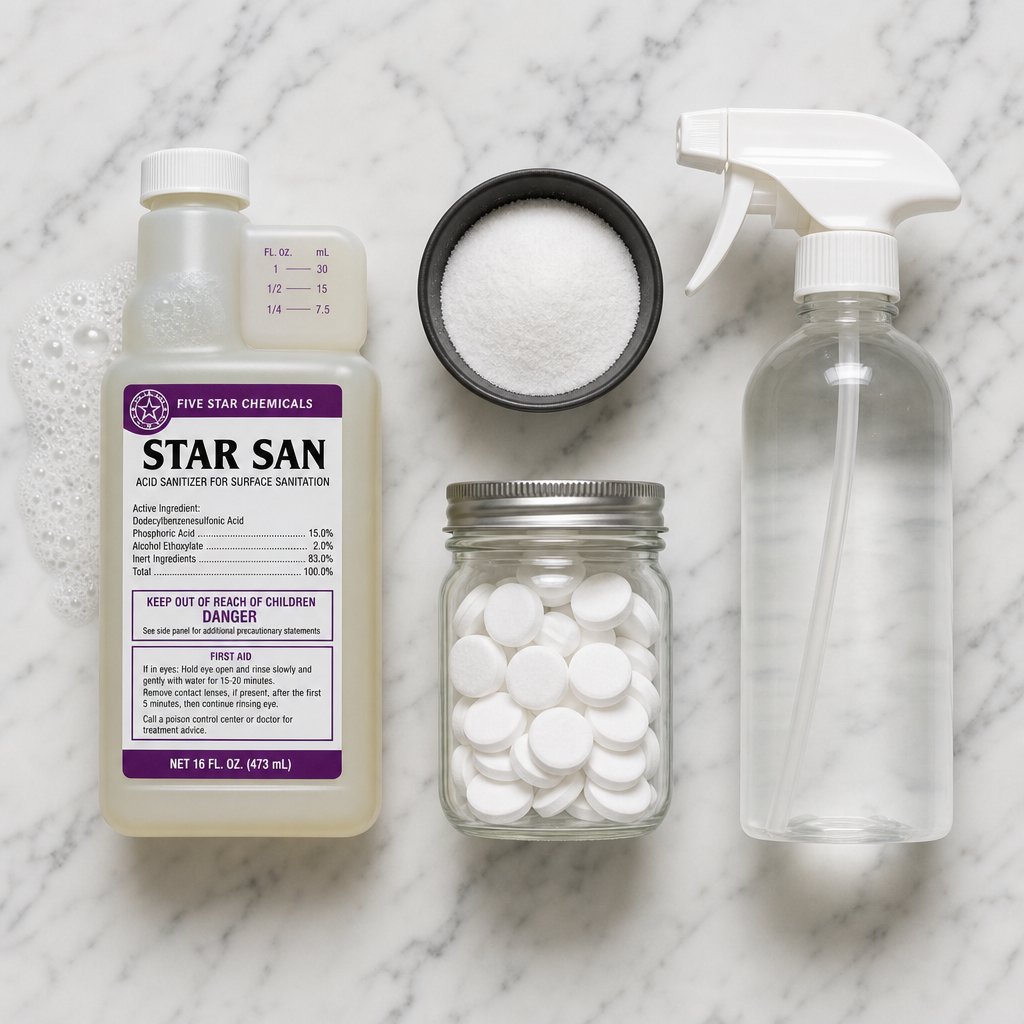
Campden Tablets vs Alternative Sanitizers and Preservatives
Every homebrew shop stocks a shelf full of sanitizers, stabilizers, and preservatives. Some kill microbes on contact. Others prevent oxidation. A few do both. Knowing which product belongs at which stage of your process keeps you from reaching for the wrong tool at the wrong time, or worse, assuming one product covers all your bases.
Campden Tablets vs Star San and Iodophor
Star San and iodophor are the two most popular equipment sanitizers in homebrewing. Both are highly effective at eliminating bacteria, wild yeast, and other microorganisms from fermenters, hoses, spoons, and airlocks. But here is the critical distinction: they are designed for surfaces, not for your must.
Star San is a no-rinse, acid-based sanitizer that works by dropping the pH on contact surfaces to levels microorganisms cannot survive. It requires only 1 minute of contact time and leaves no flavor or odor behind. Its foaming action helps it reach crevices and hard-to-sanitize areas inside carboys and kegs. However, Star San has zero antioxidant properties and cannot be added to wine or cider to protect against oxidation or spoilage during aging.
Iodophor takes a different approach. It uses iodine as its antimicrobial agent, denaturing proteins in microorganisms on contact. Iodophor requires about 2 minutes of contact time and remains effective for up to 24 hours after mixing, making it practical for longer brew sessions. The downside? It can stain plastic equipment a yellow-brown color and has a noticeable aroma that some brewers find off-putting. Like Star San, it belongs on equipment only and has no role inside your fermentation vessel.
Campden tablets fill a completely different niche. They go into the liquid itself, protecting must from wild organisms and shielding finished wine from oxygen. You would never sanitize a fermenter with a campden solution and expect the same microbial kill rate as Star San or iodophor. Conversely, you would never pour Star San into your grape must. These products complement each other rather than compete.
Campden Tablets vs Ascorbic Acid
Ascorbic acid (vitamin C) shows up in some winemaking guides as an antioxidant alternative. It does scavenge oxygen effectively, preventing browning and preserving fresh fruit aromas. Some winemakers add it alongside sulfite for extra oxidation protection, particularly in delicate white wines.
The problem? Ascorbic acid has no antimicrobial action whatsoever. It will not suppress wild yeast, inhibit acetobacter, or prevent bacterial spoilage. Worse, when ascorbic acid reacts with oxygen, it produces hydrogen peroxide as a byproduct. Without sulfite present to neutralize that peroxide, it can actually accelerate oxidative damage rather than prevent it. This is why ascorbic acid should only be used in combination with campden tablets, never as a standalone replacement.
Some brewers confuse campden tablets with chlorinated tablets or chlorine dioxide capsules used in water purification systems. These are entirely different products. Chlorine dioxide gas treatment is a water disinfection method used in municipal systems and portable water treatment tabs for camping. It kills pathogens through oxidation but would ruin a batch of wine if added directly to must. Campden tablets actually remove chlorine and chloramine from water rather than adding them, placing these products on opposite ends of the spectrum.
When to Combine Campden Tablets with Potassium Sorbate
Is potassium sorbate bad for your wine? Not at all. It is one of the most widely used preservatives in food and beverage production, classified as Generally Recognized As Safe (GRAS) by the FDA. Potassium sorbate works by preventing yeast cells from reproducing. It does not kill existing yeast. It simply stops them from budding new cells, which means any residual sugar you add for back-sweetening stays sweet rather than fermenting into CO2 and alcohol.
Here is why you need both products together: potassium sorbate prevents re-fermentation, but it does nothing to stop bacterial spoilage or oxidation. Campden tablets handle those threats. Without sulfite present, lactic acid bacteria can metabolize sorbate into a compound called geraniol, which produces an unpleasant geranium-like off-flavor. Adding a campden tablet alongside potassium sorbate prevents this reaction entirely.
The standard stabilization protocol before back-sweetening:
- Confirm fermentation is fully complete (stable specific gravity readings over 2 to 3 days).
- Add one campden tablet per gallon to the finished wine or cider.
- Add potassium sorbate at the manufacturer's recommended rate (typically 0.5 to 0.75 grams per gallon).
- Wait 24 to 48 hours, then add your sweetener of choice.
This combination is essential for anyone bottling sweet wines, off-dry ciders, or back-sweetened meads. Skipping either component invites either renewed fermentation (missing sorbate) or bacterial off-flavors (missing sulfite).
Here is how all these products compare across key functions:
| Product | Antimicrobial Action | Antioxidant Action | Use in Must/Wine | Use on Equipment | Convenience |
|---|---|---|---|---|---|
| Campden Tablets | Yes (suppresses wild yeast and bacteria via SO2) | Yes (scavenges oxygen, binds reactive compounds) | Yes (primary use) | Yes (as sanitizing rinse solution) | High (pre-measured tablets) |
| Star San | Yes (acid-based, 1-min contact time) | No | No | Yes (primary use) | High (no-rinse, foaming) |
| Iodophor | Yes (iodine-based, 2-min contact time) | No | No | Yes (primary use) | Moderate (can stain, has odor) |
| Ascorbic Acid | No | Yes (but produces peroxide without sulfite) | Yes (only with sulfite) | No | Moderate (requires weighing) |
| Potassium Sorbate | No (prevents reproduction only) | No | Yes (stabilization before sweetening) | No | High (dissolves easily) |
Campden tablets occupy a unique position in this lineup. They are the only product that delivers both antimicrobial and antioxidant protection directly in your must or wine, in a pre-measured format that requires no scale or measuring spoon. That dual action, combined with their role in water treatment, makes them the single most versatile additive in a homebrewer's toolkit.
Still, the tablet format itself raises practical questions. Is a pre-pressed tablet always the best choice, or does loose powder give you more control? And does the quality of the tablet itself affect how consistently it performs in your batch?
Tablet vs Powder Form and Manufacturing Quality
Walk into any homebrew shop and you will find metabisulfite sold in two formats: pre-pressed camden tablets and loose powder by the pound. Both deliver the same sulfur dioxide to your must, but the format you choose affects convenience, precision, cost, and even the consistency of your results. Your production scale and experience level determine which one makes more sense for your workflow.
Tablets for Small Batches and Beginners
If you are making 1 to 6 gallons of wine, cider, or mead at a time, camden tablets are hard to beat for sheer simplicity. Each tablet is pre-measured to treat one gallon of must, so dosing requires nothing more than counting and crushing. No milligram scale, no measuring spoons, no math. You crush one tablet per gallon, stir it in, and move on.
This pre-measured format eliminates the most common beginner mistake: overdosing. As the reference material from Adventures in Homebrewing explains, campden tablets are simply metabisulfite in tablet form, measured in a dose for one gallon of wine. You use one tablet per gallon. That built-in dosing removes guesswork entirely, which is why wine tablets remain the go-to recommendation for first-time winemakers.
The tradeoff? Tablets are slightly more expensive per gram of active ingredient compared to bulk powder. You also lose some flexibility when working with odd batch sizes. Treating 3.5 gallons means crushing three tablets and then trying to split a fourth in half, which is imprecise at best. For standard 1, 5, or 6 gallon batches, though, the convenience factor outweighs the cost difference.
Powder for Precision and Larger Volumes
Once you scale beyond 5 or 6 gallons, loose potassium or sodium metabisulfite powder becomes the more practical choice. A one-pound bag costs a fraction of the equivalent number of tablets and lets you measure exact doses with a precision scale or calibrated measuring spoon.
The standard powder dose is 1/16 teaspoon per gallon for must treatment, which equals approximately one campden tablet. For a 250-gallon commercial batch, you would need 250 tablets versus a few tablespoons of powder. The math alone makes the decision obvious at scale. Powder also dissolves faster than tablets in large volumes of liquid because there is no binder or filler to break down first.
Precision matters most when you are targeting specific free SO2 levels based on pH measurements. Advanced winemakers who test their wine with a sulfite titration kit and adjust additions accordingly need the ability to add, say, 0.3 grams rather than rounding to the nearest whole tablet. Powder gives you that granularity. Camden pills for wine work perfectly for standard one-tablet-per-gallon additions, but they cannot match the fine-tuning that powder allows.
Shelf Life, Storage, and Potency Testing
Both formats degrade over time as the metabisulfite slowly releases SO2 into the surrounding air. Proper storage extends useful life significantly:
- Keep containers sealed tightly - Every time you open the bag or bottle, moisture and air accelerate degradation.
- Store in a cool, dry location - Heat and humidity are the primary enemies. A basement shelf or refrigerator works well.
- Avoid temperature swings - Condensation from temperature cycling introduces moisture that weakens the product.
How do you know if your metabisulfite has lost potency? According to Ed Kraus of E.C. Kraus, the best predictor is simply age. If purchased within the past 12 months and stored properly, it should be fine. Between one and three years, it is likely still usable but worth being cautious about. Beyond three years, discard it without question. One physical indicator: if powder has hardened into clumps or tablets have become chalky and crumbly, moisture has likely compromised the sulfite content.
You can also try smelling the granules or a crushed tablet. Fresh metabisulfite has a sharp, pungent sulfur smell. If you detect little to no odor, the product has likely lost significant potency. The definitive test is an SO2 titration kit, which measures the actual sulfite concentration in your wine after addition. If your free SO2 readings come back lower than expected, your metabisulfite source is the likely culprit.
The general recommendation from experienced winemakers: replace your supply every two years regardless of storage conditions. The cost of fresh metabisulfite is negligible compared to losing a batch of wine to oxidation or spoilage because your sulfite additions were not delivering the protection you assumed.
How Tablet Quality Affects Your Results
Not all camden tablets are created equal. The manufacturing process behind a pressed tablet directly determines how consistently it performs in your must. A well-made tablet has uniform weight, consistent hardness, and predictable dissolution behavior. A poorly manufactured one may crumble unevenly, dissolve incompletely, or deliver inconsistent SO2 levels from tablet to tablet within the same bottle.
What makes a quality tablet? The same principles that govern pharmaceutical and supplement tablet production apply here. According to industry manufacturing standards, critical quality attributes include:
- Weight variation - Each tablet should contain the same amount of active ingredient within tight tolerances. Inconsistent weight means inconsistent dosing.
- Hardness (crushing strength) - Too soft and the tablet crumbles during shipping and handling. Too hard and it will not dissolve properly in your must, leaving undissolved chunks that release SO2 unevenly.
- Friability - A tablet's tendency to chip or shed powder. High friability means dust at the bottom of the bottle and reduced active ingredient in the tablets themselves.
- Disintegration time - How quickly the tablet breaks apart in liquid. Tablets that dissolve too slowly create localized pockets of high SO2 concentration rather than distributing evenly throughout your batch.
Professional OEM/ODM tablet manufacturers like ZhuFeng ensure consistent tablet weight, hardness, and dissolution rates through scalable production processes that include in-process testing at every stage, from granulation through compression and packaging. This level of quality control explains why some campden tablets dissolve cleanly in seconds while others leave gritty residue at the bottom of your fermenter. The compression force, tooling design, and excipient ratios all influence the end product's behavior in your must.
For homebrewers, the practical takeaway is straightforward: buy from reputable suppliers who source from quality manufacturers. If your tablets arrive as powder at the bottom of the bag, or if they resist dissolving even after vigorous stirring, switch brands. Consistent dissolution means consistent protection. Businesses looking to develop custom tablet-based products, whether food-grade brewing additives, water treatment tablets, or supplement tablets, can explore OEM/ODM services for customized formulation at https://ahzfsw.com/services.
Whether you choose tablets or powder, the format is just a delivery mechanism. What matters is that the sulfite reaches your wine at the right concentration, at the right time, and in a form that distributes evenly. With the chemistry, dosing, safety, and format decisions covered, the final step is pulling everything together into a practical workflow you can follow from brew day through bottling.
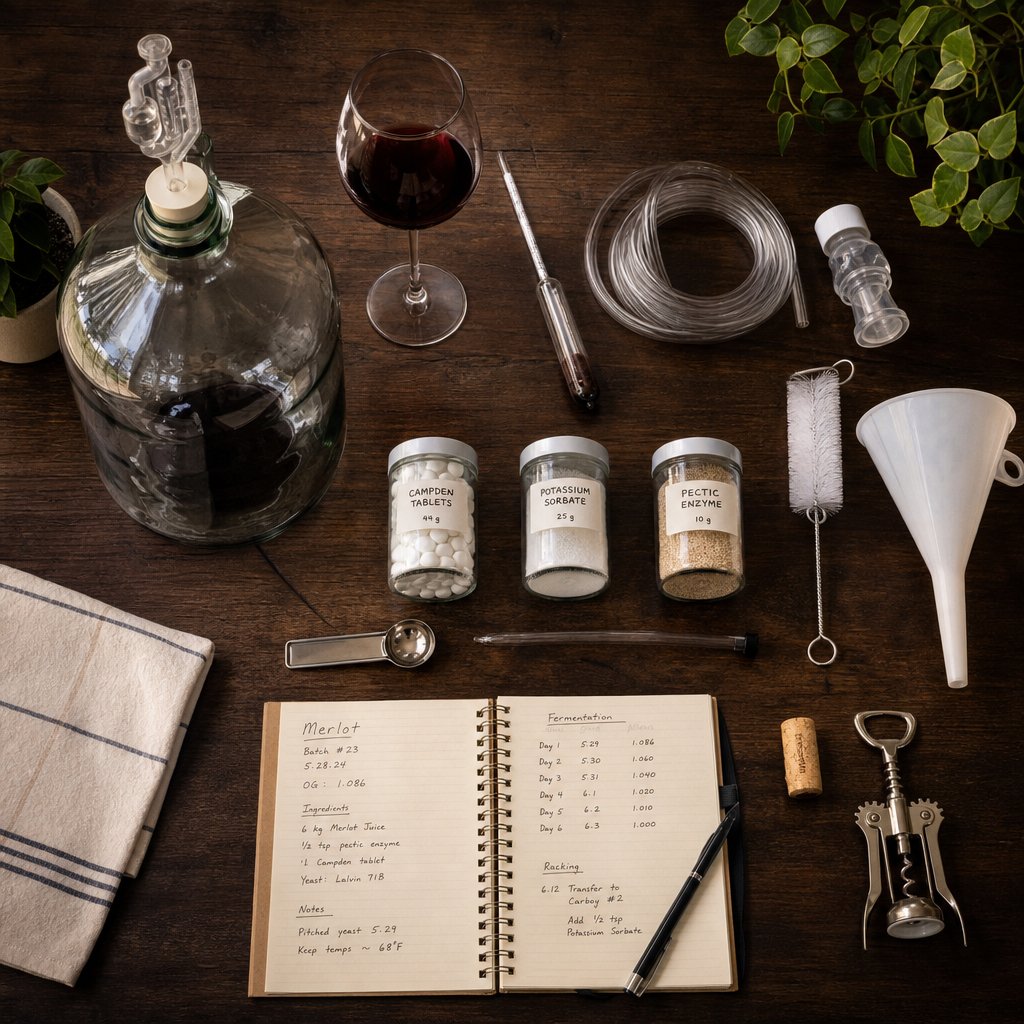
Putting It All Together for Better Brews
You have the chemistry, the dosages, the timing, and the safety knowledge. The only thing left is a clear, repeatable workflow you can follow every single batch. Whether you are making a 1-gallon test batch of mead or a 6-gallon carboy of Cabernet, using campden tablets follows the same logical sequence from start to finish.
Your Complete Campden Tablet Workflow
Here is the full process, condensed into a decision framework you can pin above your fermenter:
- Treat your water - Crush half a tablet and dissolve it in your brewing water (treats up to 20 gallons). Wait 2 to 5 minutes. Proceed immediately.
- Treat your must - Add one crushed tablet per gallon of fresh juice, must, or honey water. Cover loosely and wait 24 hours. Add pectic enzyme during this window if your recipe calls for it.
- Pitch your yeast - After the full 24-hour wait, add your cultured yeast and nutrients. Seal with an airlock.
- Protect during racking - Each time you transfer to a new vessel, dissolve one tablet per 5 to 6 gallons into the receiving container before racking on top of it.
- Stabilize before bottling - Add one tablet per gallon plus potassium sorbate if back-sweetening. Wait 24 to 48 hours before adding sugar or honey.
This sequence covers wine, cider, and mead. For beer, you typically only need step one (water treatment) unless you are making a fruit beer with unpasteurized additions.
The single most important rule when using campden tablets: never seal your fermenter during the 24-hour waiting period after must treatment. Leave the cover loose so SO2 can escape, or you risk killing the very yeast you plan to pitch.
If you search for campden tablets before bottling wine reddit threads, you will find this advice echoed repeatedly by experienced winemakers. The same wisdom appears in camden tablets before bottling reddit discussions for cider and mead. The consensus is consistent: sulfite at bottling extends shelf life and preserves flavor, but only when paired with sorbate for sweet or off-dry beverages.
Choosing Quality Tablets for Consistent Results
Where you buy matters less than what you look for. You can find campden tablets near me at most local homebrew shops, online brewing retailers, and even some pharmacies that stock water treatment supplies. When evaluating a product, check for:
- Clear labeling - The package should state whether it contains potassium or sodium metabisulfite and the weight per tablet.
- Intact tablets - If you open the container and find mostly powder and fragments, the tablets were either poorly manufactured or improperly stored. Switch suppliers.
- Recent production date - Metabisulfite degrades over time. Buy from shops with regular turnover and replace your supply every one to two years.
- Sealed packaging - Moisture is the enemy. Look for airtight containers or individually sealed packets rather than loose tablets in open bags.
Reputable brands source from manufacturers that test for consistent weight, hardness, and dissolution rate. These quality markers directly affect how evenly the sulfite distributes through your batch. A tablet that crumbles to dust in the bottle delivers less active ingredient than one that holds together until you intentionally crush it.
Building Your Brewing Toolkit
Campden tablets are one piece of a larger system. A well-stocked brewing toolkit for wine, cider, or mead includes:
- Campden tablets (potassium metabisulfite for must and wine contact)
- Sodium metabisulfite (for water treatment and equipment sanitizing solution)
- Potassium sorbate (for stabilization before back-sweetening)
- Star San or iodophor (for equipment sanitation)
- Pectic enzyme (for fruit wines and ciders)
- A precision scale or calibrated spoons (if using powder form)
- An SO2 testing kit (for advanced winemakers targeting specific free sulfite levels)
Each product fills a specific role that the others cannot. Campden tablets handle what goes into your liquid. Star San handles what touches your liquid. Potassium sorbate prevents re-fermentation. Together, they form a complete defense system from brew day through the last bottle you open years later.
For entrepreneurs or brands interested in developing their own line of brewing additives, water treatment tablets, or supplement tablets, OEM/ODM manufacturing partners like ZhuFeng offer customized formulation and scalable production across multiple product formats including tablets and powder/granules. This is a natural path for readers who see a gap in the market for better-quality brewing products and want to bring a product to shelf with professional manufacturing behind it.
The beauty of campden tablets is their simplicity. One small tablet, used at the right time and in the right amount, protects months of work from spoilage, oxidation, and off-flavors. Master the workflow above, invest in quality products, and you will taste the difference in every glass you pour.
Frequently Asked Questions About Campden Tablets
1. How many campden tablets per gallon of wine should I use?
The dosage depends on your goal. For pre-fermentation must treatment, use one tablet per gallon to suppress wild yeast and bacteria. For antioxidant protection during racking, use one tablet per 5 to 6 gallons. For water dechlorination, a single tablet treats approximately 20 gallons. At bottling, return to one tablet per gallon for long-term preservation, especially when combined with potassium sorbate for back-sweetened wines.
2. Can I pitch yeast immediately after adding campden tablets?
No. You must wait a minimum of 24 hours after adding campden tablets before pitching yeast. During this period, keep the fermenter covered loosely so sulfur dioxide gas can escape. Sealing the container traps SO2 inside and can inhibit or kill your cultured yeast. After 24 hours, the residual free SO2 drops to levels that a healthy yeast pitch can easily tolerate.
3. Are campden tablets safe for people with asthma?
Approximately 4 to 5 percent of people with asthma have sulfite sensitivity, which can trigger wheezing, chest tightness, and in rare cases anaphylaxis. If you have confirmed sulfite sensitivity or asthma triggered by sulfites, consult your healthcare provider before consuming wines or ciders treated with campden tablets. For non-sensitive individuals, standard homebrewing sulfite levels fall well within the acceptable daily intake established by international food safety authorities.
4. What is the difference between potassium metabisulfite and sodium metabisulfite tablets?
Both release sulfur dioxide, but potassium metabisulfite adds no sodium to your finished wine and is preferred for anything that contacts the beverage directly. Sodium metabisulfite is cheaper, releases slightly more SO2 per gram, and works well for water dechlorination and equipment sanitization where sodium content is irrelevant. Many experienced winemakers keep both on hand for their respective applications.
5. Do campden tablets sterilize wine must completely?
No. Campden tablets suppress and inhibit wild yeast and bacteria but do not achieve true sterilization. Some hardy organisms survive the treatment, which is why you pitch a strong cultured yeast strain afterward to outcompete any remaining microbes. Campden tablets also do not replace proper equipment sanitation with products like Star San or iodophor. They are a second line of defense, not a substitute for cleanliness.