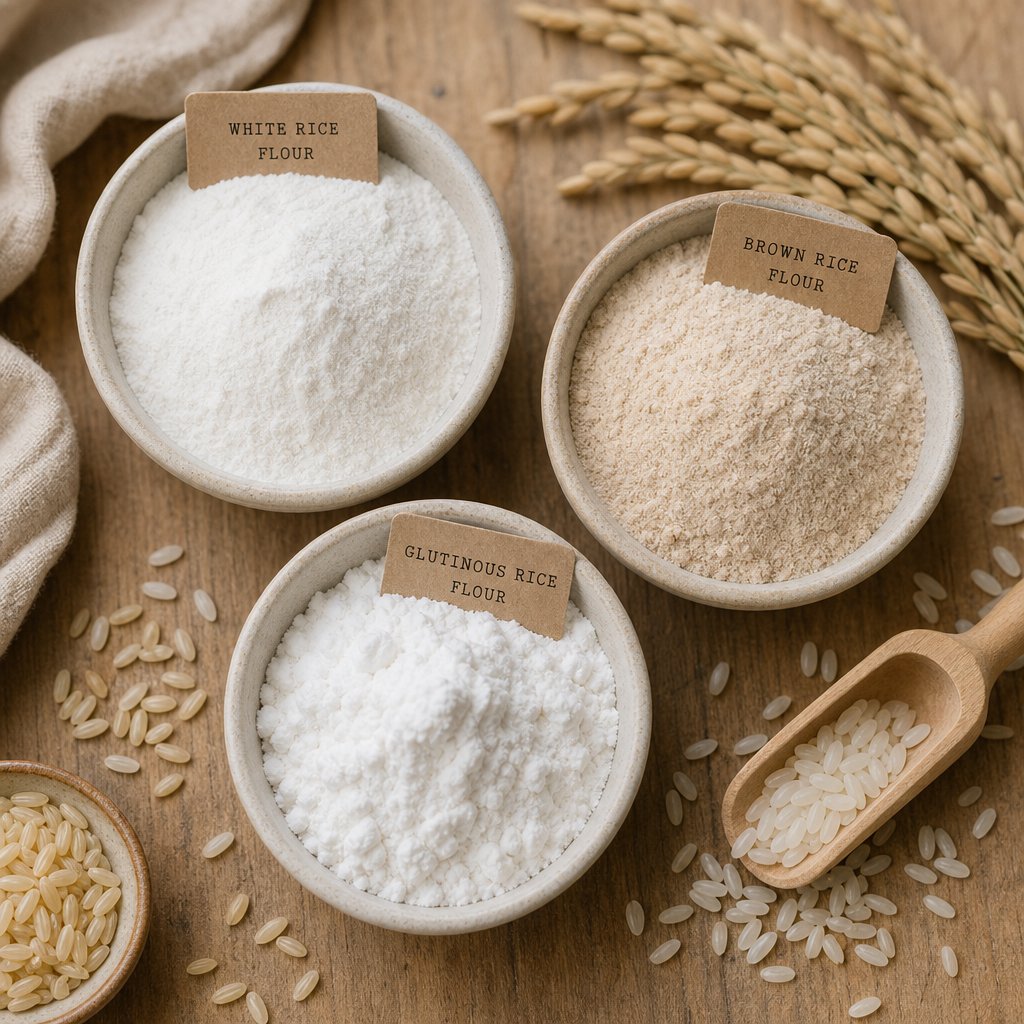
What Is Rice Powder and Why It Goes Beyond Simple Flour
You search for rice powder and get a dozen different answers. Some pages talk about baking. Others mention skincare. A few blur the line between rice powder and rice flour entirely. So what is rice powder, really?
Rice Powder Defined
Rice powder is finely milled rice ground into a soft, powdery consistency from raw or cooked rice grains. It is used across culinary, beauty, and cultural applications worldwide.
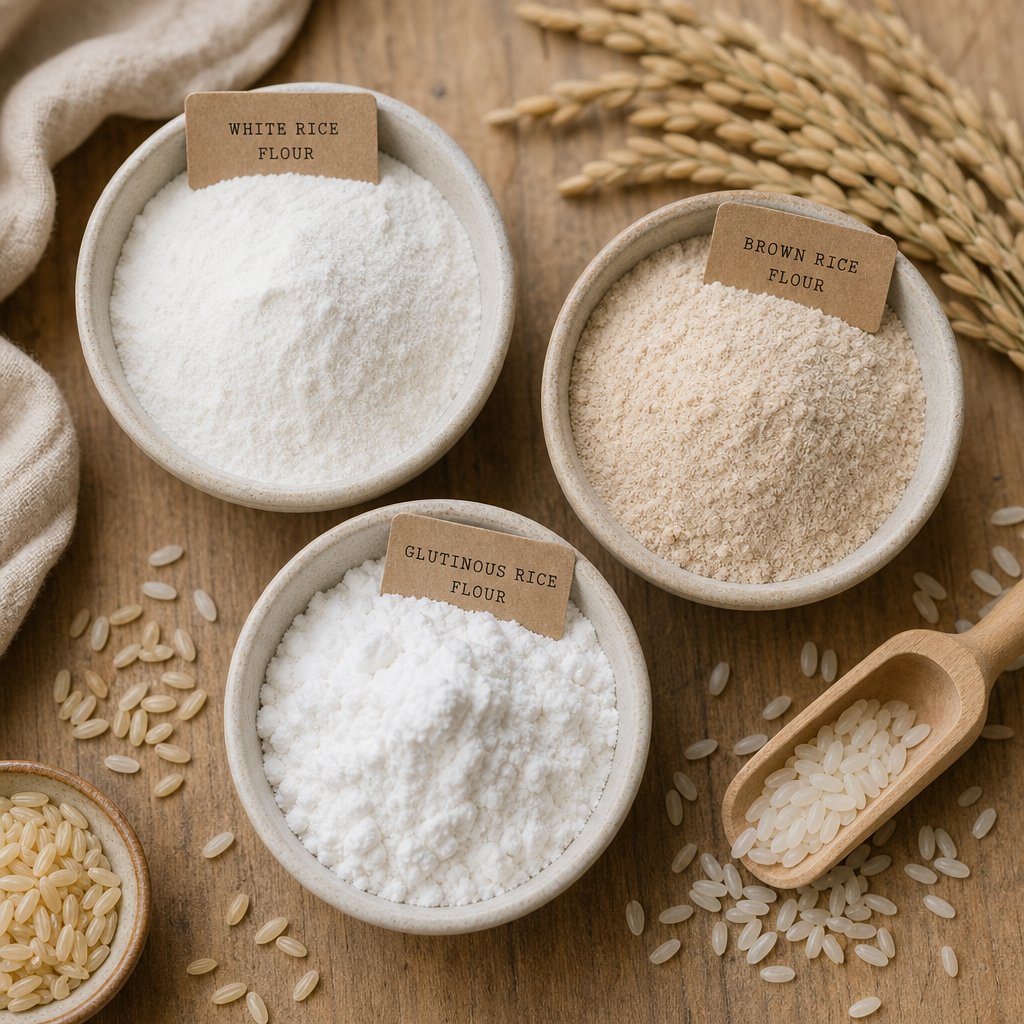
At its simplest, that is the answer. But the full picture is more interesting. What is rice powder made of? Just rice, whether white, brown, or glutinous varieties, processed through grinding until it reaches a fine particle size. No additives, no chemical processing. The same grain that sits in your pantry becomes a completely different ingredient once it is reduced to powdered rice.
This is similar to how rice flour is produced. What is rice flour made of? The same raw material. The difference often comes down to how fine the grind is and what you plan to do with it.
Why the Terminology Matters
Here is where things get interesting. The term "rice powder" shifts meaning depending on who is using it and why. A baker in California means something different from a skincare formulator in Seoul or a grandmother in Tamil Nadu preparing kolam art on her doorstep.
In cooking contexts, you will usually hear "rice flour." In beauty and cosmetics, the same substance becomes "rice powder." In traditional cultural practices across Asia, the terminology varies by region and ritual. These are not always different products, but the context changes everything about how they are sourced, processed, and applied.
This guide covers all of those worlds in one place, something most resources skip entirely. The distinction between rice powder and rice flour is the logical starting point.
Rice Powder vs Rice Flour vs Rice Starch Explained
Is rice flour the same as rice powder? This is the single most common question people ask, and the honest answer is: it depends on where you are and what you are doing with it. The two terms overlap in some contexts, diverge sharply in others, and get tangled up with a third product, rice starch, that operates on an entirely different level.
Granularity and Milling Differences
Imagine a spectrum. On one end, you have coarsely ground rice with a gritty, sand-like texture. On the other, an ultra-fine talc-like powder that feels silky between your fingers. Both come from the same grain, but their particle size changes everything about how they behave.
Research published in Foods demonstrates that rice flour particle size directly influences whiteness, water absorption, and pasting behavior. Finer particles (below 90 micrometers) show increased whiteness and higher damaged starch content compared to coarser fractions (above 150 micrometers). In practical terms, this means the finer you grind rice, the more it changes how it interacts with liquids, heat, and your skin.
When comparing rice flour vs rice powder, the distinction often comes down to this grind size:
- Standard rice flour typically falls in the 100-150 micrometer range, suitable for baking, noodles, and batters
- Fine rice powder sits below 90 micrometers, preferred for delicate desserts, cosmetics, and smooth pastes
- Rice starch powder is a different product entirely, produced not by grinding but by steeping rice in an alkaline solution to isolate the pure starch component
The milling method matters just as much as the final particle size. Wet-milled rice flour is made from grains soaked in water before grinding, producing a super-fine, silky result that rehydrates quickly. Dry-milled rice flour skips the soaking step, yielding a coarser texture that works well for frying coatings and certain baked goods. As food writer Andrea Nguyen explains in Bon Appetit, wet-milled flour weighs less by volume and behaves differently enough that you cannot freely swap one for the other in recipes.
When Each Term Applies
Regional naming conventions add another layer of complexity. In South and Southeast Asia, what Western markets label "rice flour" is often called rice powder in local languages. The Korean term ssal-garu, the Vietnamese bot gao, and the Thai paeng khao chao all translate loosely to "rice powder," yet they refer to the same culinary product sold as "rice flour" on English-language packaging.
Here is a useful rule of thumb: culinary contexts almost always use the term "rice flour." Beauty and cosmetic contexts use "rice powder." Traditional and cultural applications vary by region. Is rice flour and rice powder the same product physically? They can be. But the intended use shapes how the product is processed, how fine it is ground, and what you will find on the label.
| Feature | Rice Powder (Beauty/Ultra-Fine) | Rice Flour (Culinary) | Rice Starch |
|---|---|---|---|
| Grind Size | Below 90 micrometers | 90-186 micrometers | Extracted, not ground |
| Texture | Silky, talc-like | Fine to slightly gritty | Powdery, very smooth |
| Common Uses | Skincare, setting powder, face masks | Baking, noodles, batters, coatings | Thickening sauces, puddings, baby food |
| Best Applications | Oil absorption, gentle exfoliation, cosmetics | Gluten-free baking, Asian desserts, frying | Clear gels, light thickening, laundry starch |
| Typical Retail Format | Small jars or cosmetic packaging | Bags (400g-2kg) in baking or Asian food aisles | Small boxes or bags in specialty stores |
The takeaway is straightforward. These three products share a common origin but serve different purposes. Rice starch is chemically isolated, not simply ground. Rice flour is ground for cooking. And rice powder, in its finest form, is ground for skin or ultra-delicate culinary work. Knowing which one a recipe or routine calls for saves you from gluey batters, gritty face masks, or sauces that refuse to thicken.
The source rice variety adds yet another variable to this equation, one that determines whether your powder will produce chewy, crispy, or tender results.
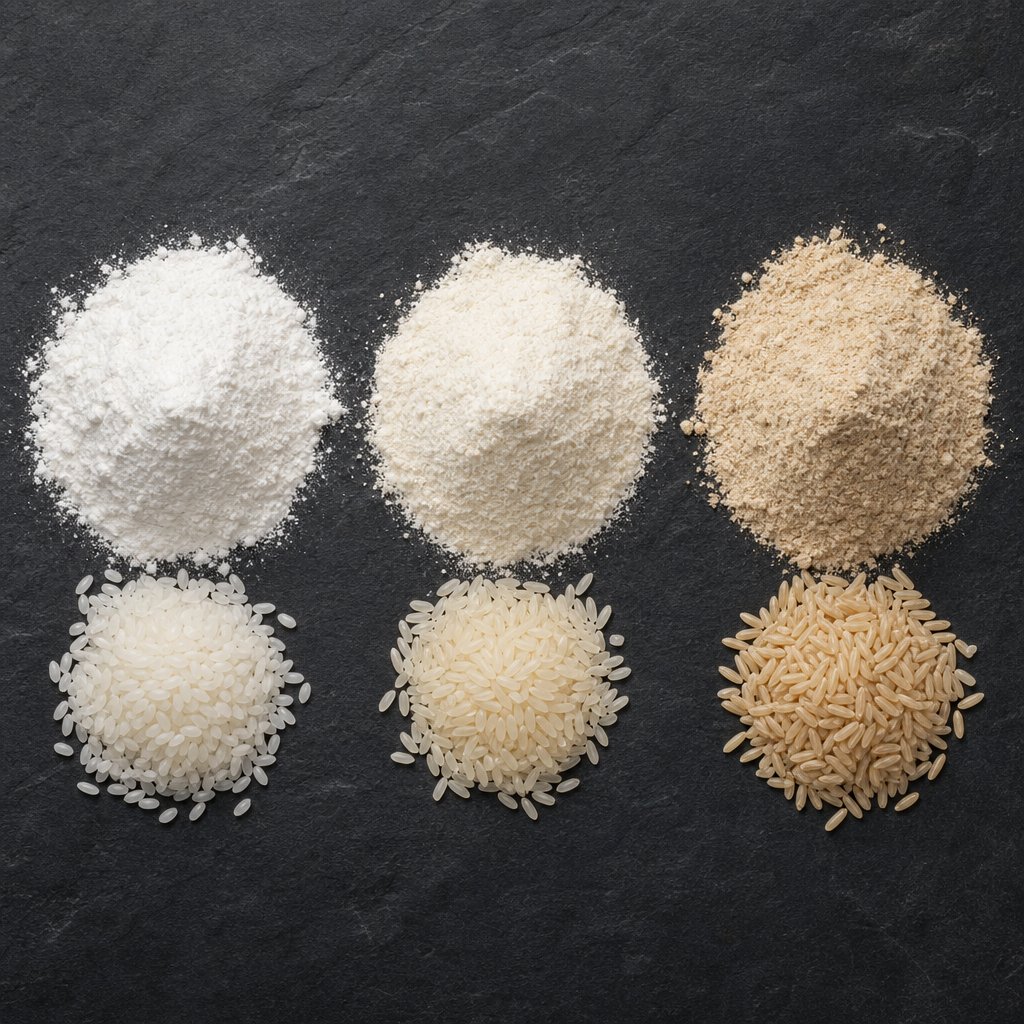
Types of Rice Powder by Variety and Starch Content
Every grain of rice contains two types of starch: amylose and amylopectin. The ratio between them is what separates a light, fluffy rice cake from a stretchy, chewy mochi ball. When you grind different rice varieties into powder, those starch ratios carry over directly into the final product. Choosing the wrong type means your recipe will not behave the way you expect.
Regular Rice Powder Varieties
Regular (non-glutinous) rice powder comes from standard white or brown rice varieties. These grains contain a relatively high proportion of amylose, the starch molecule responsible for firm, non-sticky textures. Research published in Foods measured amylose content in Indica rice at 26.14% and Japonica rice at 15.88%, confirming that these varieties produce gels with greater strength and elasticity compared to glutinous rice.
What does that mean in your kitchen? White rice flour made from long-grain Indica rice gives you light, tender results in steamed dishes like cheung fun and turnip cake. Short-grain Japonica rice powder produces a slightly softer, more cohesive texture. Jasmine and basmati rice powders fall within the long-grain category, offering subtle aromatic notes but behaving similarly in terms of starch performance.
Brown rice flour retains the bran, germ, and endosperm of the whole grain. This adds fiber, a slightly nutty flavor, and a tan color to baked goods. The tradeoff? A denser texture and shorter shelf life due to the higher fat content in the bran layer. Brown rice flour works well in gluten-free cookies and crusty breads where that density is an asset rather than a drawback.
Glutinous Rice Powder and Its Unique Properties
Here is where confusion runs deep. "Glutinous" does not mean this flour contains gluten. It does not. The name refers to the glue-like, sticky quality of the cooked rice. Glutinous rice contains almost no amylose, with measured levels as low as 1.57%, and is instead dominated by amylopectin. That amylopectin is what makes dough stretchy, chewy, and pliable once cooked.
You will encounter this ingredient under several names depending on the country of origin:
- Mochiko rice flour - A dry-milled Japanese sweet rice powder made from short-grain mochigome. Used for mochi, dango, and baked mochi desserts. Because it is dry-milled, it feels coarser than its Thai counterpart.
- Thai glutinous rice flour (sticky rice flour) - Wet-milled from long-grain sticky rice, producing a finer, softer texture. Sold in green-labeled packages from brands like Erawan. Ideal for tang yuan and Chinese sweet rice cakes.
- Chapssalgaru - Korean sweet rice powder used for tteok (rice cakes) and traditional desserts. Often freshly milled from soaked glutinous rice.
Can you swap mochiko for Thai glutinous rice flour? Not freely. As Healthy Nibbles and Bits explains, the milling method creates real differences in texture and hydration. Mochi flour (mochiko) produces a firmer, denser dough, while wet-milled glutinous rice flour yields something more supple and soft. One cup of wet-milled flour weighs around 105 grams, while the same volume of dry-milled sweet rice powder weighs roughly 150 grams. That gap makes direct substitution unreliable.
Specialty and Colored Rice Powders
Beyond the standard white and glutinous categories, a handful of specialty rice powders serve niche culinary and nutritional roles:
- Red rice flour - Milled from whole-grain red rice, retaining anthocyanin pigments and a slightly earthy flavor. Used in artisan breads and health-focused baking.
- Black glutinous rice flour - Ground from black sticky rice, offering a deep purple color and mild sweetness. Popular in Southeast Asian desserts like Thai black sticky rice pudding.
- Toasted rice powder (khao khua) - Dry-roasted sticky rice ground into a coarse powder. A staple condiment in Thai and Lao cuisine, adding nutty crunch to larb and nam tok salads.
Each variety brings a distinct starch profile, color, and flavor to the table. The practical question, then, is how to turn raw rice into usable powder at home and how that process compares to what happens at an industrial scale.
How to Make Rice Powder at Home and How It Is Produced Commercially
How do you make rice flour from a bag of plain rice sitting in your pantry? The process is surprisingly straightforward, but the method you choose determines whether you end up with a silky powder suitable for delicate desserts or a coarser grind better suited for frying coatings and rustic baking. Two primary approaches exist for home production: dry grinding and wet grinding. Each produces a different texture and serves different culinary goals.
Dry Grinding Method Step by Step
Dry grinding is the most accessible way to make rice powder at home. You start with uncooked, dry rice and reduce it to flour using mechanical force. This method works best for baking, frying coatings, and any application where you want a free-flowing powder that blends easily with other dry ingredients.
Here is how to prepare rice flour using the dry method:
- Select your rice. Long-grain white rice produces the most neutral, versatile flour. Short-grain or jasmine rice works too, but each brings slightly different starch behavior. To make white rice flour, standard long-grain varieties like Mahatma or similar inexpensive brands work perfectly.
- Optional: toast the rice. For a nuttier flavor profile (think Thai khao khua), spread the rice in a dry skillet over medium heat and stir for 3-5 minutes until lightly golden and fragrant. Skip this step if you want a neutral-tasting powder.
- Grind in batches. This is where equipment matters. A dedicated grain mill produces the finest, most consistent results. A high-speed blender can work in a pinch, but as Gluten Free on a Shoestring notes from extensive testing, blenders and food processors typically produce gritty rice flour regardless of how long you run them. The heat generated by blenders also limits how many passes you can make. A grain mill set to its finest setting avoids both problems.
- Double-grind for fineness. Pass the rice through your mill once, then feed the already-ground flour back through a second time. This double-grinding step is essential. A single pass leaves noticeable grit that ruins baked goods and creates uneven textures. Since grain mills do not generate the same heat as blenders, you can grind twice in quick succession without damaging the starch.
- Sift the result. Run your ground flour through a fine-mesh sieve or flour sifter. Any particles that refuse to pass through get returned for another grind. The powder that makes it through the sieve is your finished rice flour from rice, ready to use or store.
One cup of raw long-grain white rice yields approximately one cup of flour by volume, though the weight shifts slightly due to aeration during grinding. Store homemade rice flour in an airtight container, preferably refrigerated, since it lacks the preservatives of commercial products.
Wet Grinding Method for Silky Texture
Wet grinding takes a different path entirely. Instead of pulverizing dry grains, you hydrate the rice first, grind it into a smooth paste, and then dry the result. This method produces an exceptionally fine, silky powder that rehydrates quickly and creates smoother batters. It is the traditional approach behind South Indian dosa and idli batter, Vietnamese banh cuon, and many Chinese rice noodle preparations.
- Soak the rice. Submerge your chosen rice in cool water for 4-6 hours, or overnight. The grains should absorb enough moisture to become soft and slightly crumbly when pressed between your fingers. This hydration step is what allows the grains to break down into a paste rather than a gritty powder.
- Drain and grind with water. Drain the soaked rice, then add it to a blender or wet grinder with just enough fresh water to allow the blades to move freely. Grind until you achieve a smooth, pourable batter with no visible grain fragments. A wet grinder (common in South Indian kitchens) produces the best results here, but a high-powered blender works for smaller batches.
- Strain if needed. For the finest possible powder, pass the slurry through cheesecloth or a fine-mesh strainer to remove any remaining coarse particles. This step is optional for batters used immediately but important if you are drying the flour for storage.
- Dry the paste. Spread the strained slurry thinly on parchment-lined baking sheets. Dry in a low oven (150-170°F / 65-75°C) or a food dehydrator until completely moisture-free and brittle. In humid climates, a dehydrator gives more reliable results than air drying.
- Final grind and sift. Break the dried sheets into pieces and pulse briefly in a blender or spice grinder. Sift through a fine-mesh sieve. The result is an ultra-fine powder with a texture noticeably smoother than dry-ground flour.
Why go through the extra effort? Wet-ground rice flour absorbs liquid differently, producing lighter noodles, more tender steamed cakes, and smoother batters for crepes and wrappers. If your goal is traditional Asian sweets or fresh rice noodles, wet grinding delivers results that dry grinding simply cannot match.
Commercial Milling and Industrial Production
So how is rice flour made at an industrial scale? Commercial manufacturers use specialized equipment that achieves particle sizes and consistency far beyond what home methods can produce. According to Hosokawa Micron Corporation, a leading powder processing equipment manufacturer, three primary milling types dominate commercial rice powder production: roller mills, stamp mills, and impact mills.
Each serves a different product category:
- Roller mills - Suitable for mass production of standard rice flour. Rice is first soaked to absorb moisture, then dried before milling. Requires sieving for particle size control.
- Stamp mills - Operate at low temperatures to minimize starch damage. Used for traditional Japanese rice powders (joshinko and shiratamako). Particle size is harder to control precisely.
- Impact mills (ACM Pulverizers) - The modern standard for fine rice powder. These compact systems grind rice with minimal starch damage while simultaneously drying the product using hot air blown directly into the mill. They achieve particle sizes around 40 micrometers for wheat flour replacement applications, compared to the 100-micrometer range of conventional rice products.
One critical detail separates commercial production from home grinding: the pre-soaking step. Industrial processors soak rice before milling not for the same reasons as wet grinding at home, but to suppress temperature rise during high-speed milling. This moisture absorption protects the starch granules from mechanical damage, which would otherwise alter the flour's cooking properties and create off-textures in finished products.
The result? Commercial rice powder offers a level of uniformity in particle size, moisture content, and starch integrity that even the best home grain mill cannot replicate. That consistency is why professional bakers and food manufacturers rely on commercially milled products for applications where precision matters, like gluten-free bread formulation or delicate rice noodles that need to hold their shape.
Whether you make rice powder at home or buy it off the shelf, the nutritional profile remains largely the same. What changes is how that nutrition stacks up against wheat flour and other alternatives, and whether rice powder deserves its reputation as a healthy swap.
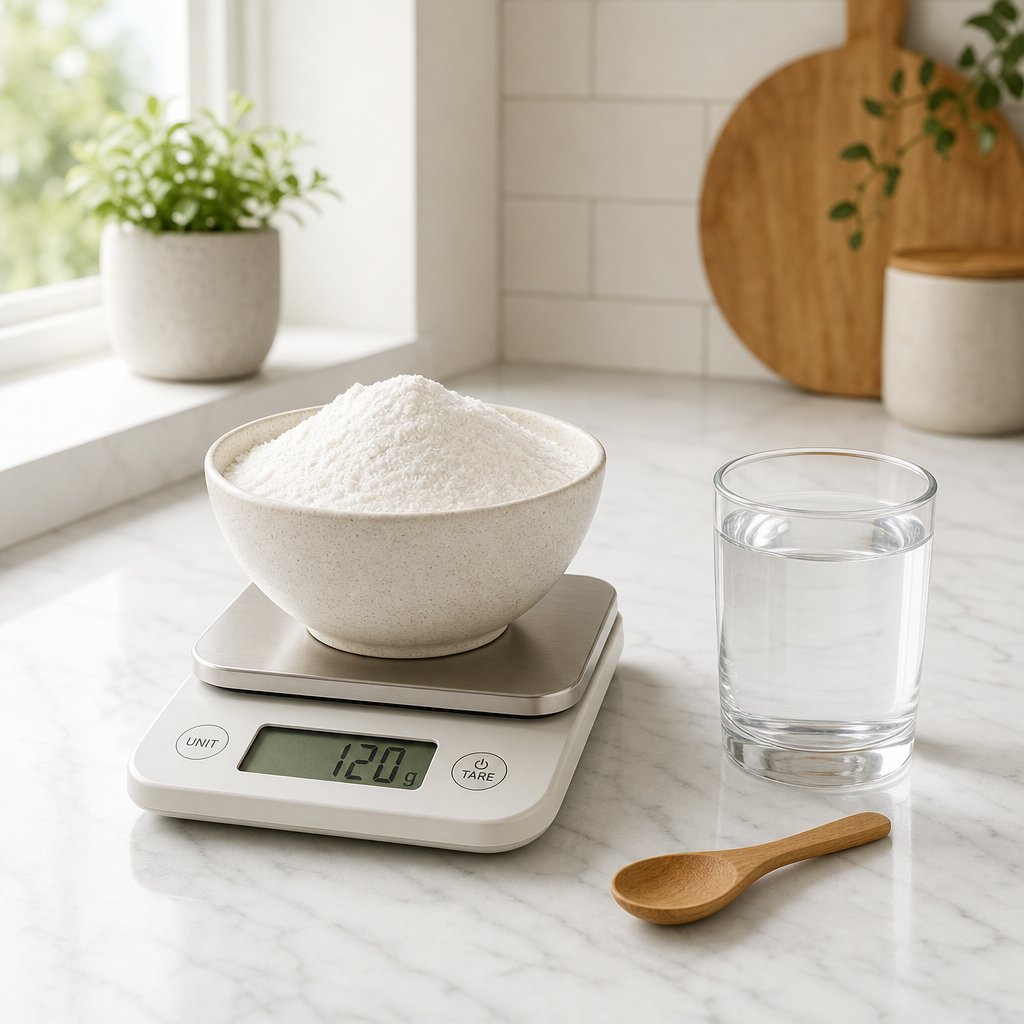
Nutritional Profile and Health Benefits of Rice Powder
Rice powder nutrition is straightforward but often misunderstood. People assume that because it is gluten-free and plant-based, it must be a superfood. Others dismiss it as empty carbs. The truth sits somewhere in between, and the details matter if you are building a diet around it.
Nutritional Breakdown and Macros
White rice powder is primarily a carbohydrate source. A quarter-cup serving (about 40 grams) delivers roughly 145 calories, 32 grams of carbohydrates, 2.4 grams of protein, and less than 1 gram of fat. Fiber content is minimal at around 0.9 grams per serving for white rice flour, though brown rice flour bumps that number up to approximately 1.8 grams.
How does that compare to the flours you might already have in your pantry? Here is a side-by-side look at rice flour nutritional information versus two common alternatives, based on equivalent quarter-cup (roughly 30-40g) servings:
| Nutrient (per ~40g serving) | White Rice Flour | All-Purpose Wheat Flour | Almond Flour |
|---|---|---|---|
| Calories | 145 | 145 | 160 |
| Carbohydrates | 32g | 30g | 6g |
| Protein | 2.4g | 4g | 6g |
| Fat | 0.6g | 0.4g | 14g |
| Fiber | 0.9g | 1.1g | 3g |
| Gluten-Free | Yes | No | Yes |
You will notice rice flour and wheat flour are nearly identical in calories and carbohydrate content. The key differences? Rice flour has less protein and no gluten. Almond flour flips the script entirely with high fat, high protein, and very low carbs, making it a better fit for keto-style diets but a poor thickener or noodle base.
So is rice flour good for you? It depends on what you need from it. The benefits of rice flour center on its role as a reliable, easily digestible, gluten-free carbohydrate source. It is not nutrient-dense in the way that whole-grain flours or nut flours are, but it fills a specific gap that few other ingredients can.
Gluten-Free Status and Digestibility
Is rice flour gluten free? Yes, inherently. Rice contains no gluten proteins whatsoever. This makes rice powder one of the safest staple flours for people with celiac disease or non-celiac gluten sensitivity. Its simple starch structure also makes it gentle on the digestive system, which is why rice-based foods are often recommended during gastrointestinal recovery.
There is a catch, though. "Naturally gluten-free" does not always mean "safe from gluten." A market-based study published in Frontiers in Nutrition analyzed 163 flour samples in Turkey and found that 28.6% of rice flour samples contained gluten above the 20 mg/kg safety threshold. The contamination was not from the rice itself but from cross-contact during harvesting, milling, storage, or retail handling. Commercially produced gluten-free rice flours performed significantly better, with zero contaminated samples among certified products in that study.
The practical takeaway: if you have celiac disease, look for rice flour that carries a certified gluten-free label rather than buying unpackaged or unlabeled products from bulk bins. The same study found that unpackaged naturally gluten-free flours had contamination rates as high as 69.2% for rice flour when sold without protective packaging or dedicated storage. Shared scoops and proximity to wheat products on store shelves significantly increased contamination risk.
Health Considerations and Limitations
Rice flour is it good for you as a daily staple? Two concerns deserve honest attention.
The first is arsenic. Rice absorbs arsenic from soil and water during cultivation, and this element concentrates in the grain. The National Celiac Association notes that brown rice contains on average 80% more inorganic arsenic than white rice of the same type, because arsenic concentrates in the bran and germ layers that are removed during polishing. For people on gluten-free diets who rely heavily on rice-based products, this cumulative exposure is worth monitoring. Steps to reduce risk include rinsing rice thoroughly before grinding, varying your grain sources, and choosing white rice flour over brown when consuming it daily.
The second limitation is nutritional depth. White rice powder is low in fiber, B vitamins, iron, and other micronutrients compared to whole-grain alternatives. Brown rice flour improves on this front with more fiber and minerals, but it introduces the arsenic tradeoff and a shorter shelf life due to the oils in the bran layer going rancid more quickly.
Rice flour benefits are real but specific. It excels as a gluten-free baking base, a light thickener, and a gentle food for sensitive stomachs. It is not a nutritional powerhouse on its own. Pairing it with protein sources, fiber-rich foods, and varied grains gives you the best of both worlds: safe, versatile cooking with a balanced nutritional profile.
Nutrition tells you what rice powder can do for your body. The next question is what it can do in your kitchen, where its culinary versatility spans continents and centuries of tradition.
Culinary Uses of Rice Powder Across World Cuisines
Rice flour uses span nearly every cooking technique you can think of: frying, steaming, thickening, baking, and boiling. What makes it so adaptable is its neutral flavor and its starch behavior, which shifts depending on the variety, the liquid ratio, and the heat applied. Rather than listing countries one by one, it helps to organize these applications by what you are actually trying to accomplish in the kitchen.
Thickening, Coating, and Binding Uses
What is rice flour used for most often in everyday cooking? Chances are, it is working behind the scenes as a thickener or coating rather than starring as the main ingredient.
As a rice flour thickening agent, it behaves gently. Whisk a tablespoon into cold water, stir that slurry into a hot soup or gravy, and it thickens without clumping or turning cloudy the way cornstarch sometimes does. It produces a lighter body than wheat-based roux, making it ideal for delicate sauces, pudding bases, and cream soups where you want silkiness rather than heaviness.
For frying, rice powder creates an ultra-crisp shell that stays crunchy longer than wheat-based coatings. Japanese tempura batter relies on this principle, producing that signature airy, shatteringly light crust. Korean fried chicken recipes often blend rice flour with cornstarch for a double-crunch effect that holds up even after saucing. Vietnamese banh xeo (sizzling crepes) use rice flour batter to achieve crisp, lacy edges while staying soft inside.
The binding role is subtler. In Indian cuisine, rice powder holds together steamed snacks like kozhukattai and modak, giving them structure without the chewiness that wheat gluten would introduce.
Asian Desserts and Traditional Sweets
This is where rice powder truly shines, and where choosing the correct variety becomes non-negotiable. Each traditional sweet demands a specific starch profile:
- Mochi and dango (Japan) — Require glutinous rice flour (mochiko or shiratamako) for their signature stretch and chew. Regular rice flour will not produce the same elastic texture.
- Tteok (Korea) — Korean rice cakes use chapssalgaru (sweet rice powder), often freshly milled from soaked glutinous rice. Songpyeon, gyeongdan, and injeolmi each rely on this flour's sticky cohesion.
- Puttu (South India/Sri Lanka) — Steamed cylinders of coarse rice flour layered with coconut. This dish specifically needs a coarser grind; fine powder would compact into a dense, gummy mass instead of staying fluffy.
- Kanom (Thailand) — Thai desserts like kanom krok (coconut pancakes) and kanom chan (layered jelly cake) use regular rice flour for structure and glutinous rice flour for chewiness, often in the same rice powder recipe.
- Dosa and idli (South India) — Fermented batters made from wet-ground rice and urad dal. The wet-milling process is essential here, producing the smooth pour and airy fermentation that dry-ground flour cannot replicate.
Notice the pattern: glutinous rice flour goes where you want chew and stretch, while regular rice flour goes where you want lightness, crispness, or a firm set.
Gluten-Free Baking and Modern Applications
Baking with rice flour in Western kitchens has exploded over the past decade, driven largely by the gluten-free movement. But rice flour behaves nothing like wheat. It lacks the elastic protein network that traps air and gives bread its rise and chew. That means you cannot simply swap it one-to-one into a wheat recipe and expect the same result.
The solution? Blending. Most successful gluten-free formulas combine rice flour with starches (tapioca, potato) and a binder (xanthan gum, psyllium husk, or eggs) to mimic what gluten does structurally. As Everyday Gluten Free Gourmet explains, white rice flour works best at 30-40% of a flour blend. Go higher and you risk a gritty mouthfeel and that telltale translucent-white color that screams "gluten-free."
Rice flour for baking performs especially well in shortbread-style cookies, where its lack of gluten is actually an advantage, producing a tender, melt-in-your-mouth crumb. It also excels in pancakes, crepes, and muffins when paired with the right supporting ingredients. Rice flour bread is trickier, requiring careful hydration and often a combination of brown and sweet rice flours to achieve acceptable structure and moisture retention.
Beyond baking, rice flour for noodles remains one of its most iconic modern applications. Vietnamese pho noodles, pad thai noodles, and Chinese ho fun (wide rice noodles) all depend on rice flour's ability to form smooth, slippery sheets when combined with water and steamed or boiled. Sweet rice flour's natural elasticity makes it particularly suited for wrappers and noodles that need to bend without cracking.
- Crispy coatings and frying — Best type: white rice flour (regular, fine grind)
- Sauce and soup thickening — Best type: white rice flour or sweet rice flour
- Stretchy mochi and rice cakes — Best type: glutinous rice flour (mochiko or wet-milled)
- Gluten-free bread and cakes — Best type: blend of white, brown, and sweet rice flour
- Rice noodles and wrappers — Best type: fine white rice flour or sweet rice flour
- Steamed traditional sweets — Best type: varies by dish (coarse for puttu, fine for kanom)
- Fermented batters (dosa, idli) — Best type: wet-ground rice flour
Rice powder's culinary reach is vast, but it represents only half the story. The same fine powder that crisps your tempura and thickens your gravy has an entirely separate life in skincare, beauty rituals, and cultural traditions that stretch back centuries.
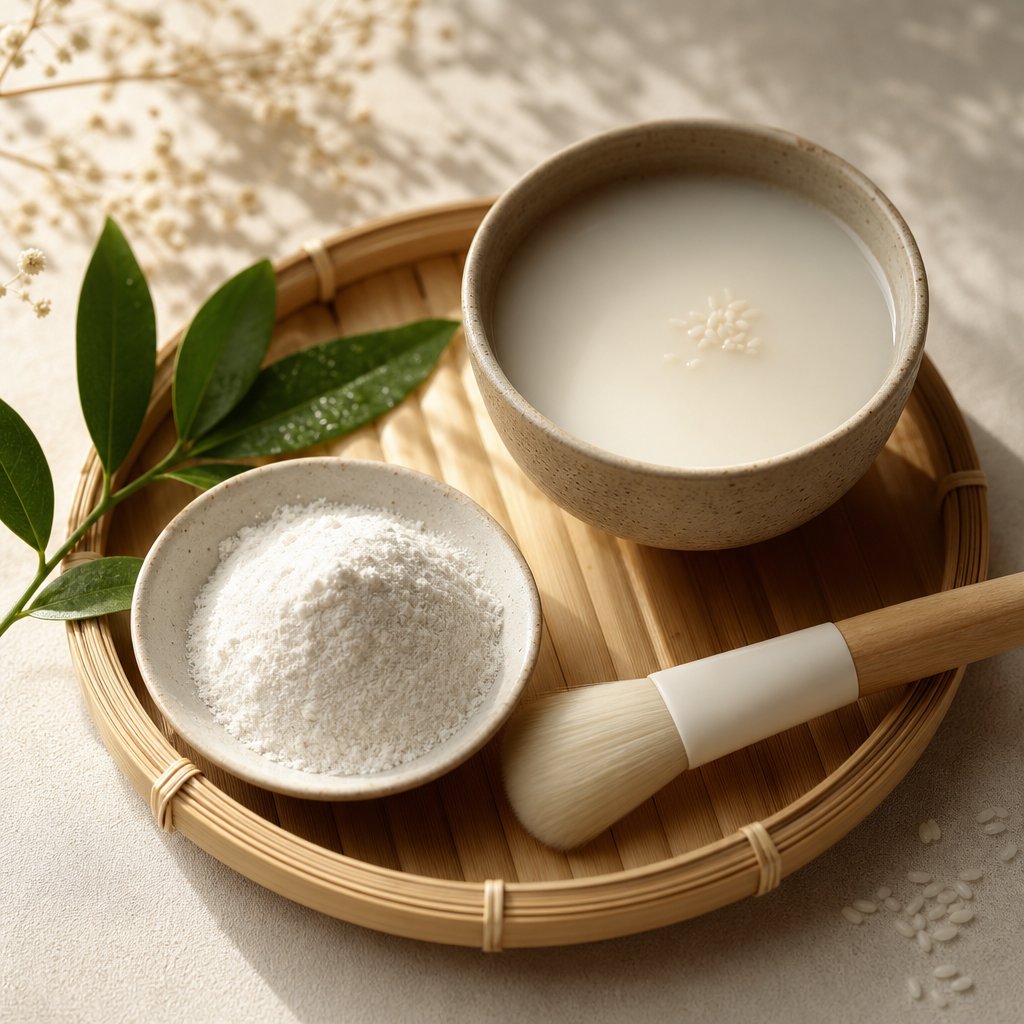
Rice Powder for Skincare and Traditional Beauty Rituals
The same white rice powder that crisps your tempura has been smoothed onto faces across Asia for centuries. This is not a modern wellness trend repackaged with influencer marketing. Rice powder uses in beauty predate commercial skincare by a thousand years, and the science behind why it works is more grounded than you might expect.
Skincare Benefits and How Rice Powder Works on Skin
Why does rice powder do anything useful on skin at all? Three mechanisms are at play, each tied to a different component of the grain.
First, oil absorption. Rice starch binds to water and stabilizes fat, which is why it pulls excess sebum from pores without stripping moisture. As Healthline notes, rice starch is used in commercial skincare and hair products specifically to absorb oil, control shine, and minimize pore appearance. When you apply fine rice powder to your face, the starch particles act like tiny sponges sitting on the skin's surface.
Second, gentle physical exfoliation. The fine particles create mild friction when massaged across skin, lifting dead cells without the micro-tears that coarser scrubs can cause. Board-certified dermatologist Dr. Bruce Robinson confirms that "gentle rubbing on the skin of just about any product can lead to some exfoliation," and rice powder's ultra-fine texture makes it one of the softer options available.
Third, bioactive compounds in the bran layer. Rice bran contains ferulic acid, a potent antioxidant that stabilizes vitamins C and E and offers photoprotective properties. It also contains phytic acid, an alpha hydroxy acid shown in a 2019 clinical study to be as effective as glycolic acid for treating acne and hyperpigmentation while being gentler on skin. Allantoin, another compound present in rice, has soothing and anti-inflammatory properties that may support wound healing.
One honest caveat: these compounds are more concentrated in rice extracts than in rice powder itself. Dermatologist Dr. Suzanne Friedler notes that "how much active ingredient is absorbed by the skin is a big unknown" when using plain rice flour topically. The oil-absorbing and exfoliating effects are the most reliable benefits you can expect from DIY application.
Traditional Beauty Practices from Asia
Long before clinical studies confirmed any of this, women across Asia built entire beauty systems around rice. Japanese rice flour has deep roots in geisha culture. During the Heian period (794-1185 AD), women known as Yakumi maintained floor-length hair using rice water, the starchy liquid left after washing rice. Geishas later adopted rice water soaks for their faces, believing it brightened skin, reduced pore visibility, and maintained the porcelain-smooth complexion their profession demanded.
In China, the Yao women of Huangluo village maintain hair averaging two meters in length that reportedly resists greying until near their 80s. Their method involves fermenting rice water with pomelo peels, ginger, and fleece flower root for up to two months before applying it to hair. The fermentation process lowers pH to match hair's natural acidity while concentrating gamma-oryzanol and amino acids.
Korean rice flour traditions take a different form. Rice powder korean beauty practices center on rice bran and rice water as brightening agents, a philosophy now embedded in the K-beauty industry's emphasis on "glass skin." Traditional Korean ubtan-style preparations blended finely ground rice with other botanicals for gentle cleansing masks, a practice that modern sheet masks and rice-based essences have commercialized but not fundamentally changed.
In South Asia, rice powder mixed with turmeric, sandalwood, and milk forms the base of ubtan, a pre-wedding skincare preparation applied to brides across India, Pakistan, and Bangladesh. The rice component provides the exfoliating base while other ingredients target brightening and fragrance.
Cultural and Household Applications
Rice powder uses extend well beyond the face. In South India, rice flour is the traditional medium for kolam, the geometric patterns drawn on thresholds each morning. These intricate designs serve multiple purposes: they signal auspiciousness, provide food for ants and small birds, and represent mathematical precision through counted dots, vertices, and arcs. The impermanence of rice powder kolam, swept away daily and redrawn fresh, mirrors Hindu beliefs about the transient nature of the physical world.
Rangoli art across broader India uses colored rice powder for festival decorations, wedding entrances, and temple floors. The powder holds pigment well and creates crisp lines that chalk or sand cannot match.
Beyond art and beauty, rice powder fills several practical household roles:
- Dry shampoo alternative — Sprinkle white rice powder at the roots, massage into the scalp, and brush out. The starch absorbs oil and adds volume without water or chemical propellants.
- Natural mattifying powder — Pat a thin layer onto the T-zone as a setting powder. Works especially well for oily skin types seeking a matte finish without synthetic ingredients.
- Gentle face mask base — Mix rice powder with rose water or honey into a paste, apply for 10-15 minutes, then rub gently while rinsing for mild exfoliation.
- Religious offerings and ceremonies — Used in Hindu puja rituals, Buddhist temple offerings, and Shinto ceremonies across Asia as a symbol of purity and sustenance.
- Fabric stiffening — A thin rice powder paste applied to cotton or linen provides natural starch for crisp collars and traditional garments, the same principle behind commercial laundry starch.
Whether you are drawing kolam at dawn, mixing a face mask before bed, or dusting rice powder through oily roots between washes, the applications share a common thread: rice powder's fine texture, absorbency, and gentle nature make it useful far beyond the kitchen. The real question becomes which type to buy, where to find it, and how to store it so it performs when you need it.
How to Choose, Store, and Source the Right Rice Powder
You know what rice powder is, how it is made, and what it can do. The practical challenge is standing in a store aisle, or scrolling through an online catalog, and picking the right product for your specific goal. The wrong choice means gritty face masks, gummy rice cakes, or bread that crumbles into sand. A use-case-first approach cuts through the confusion faster than memorizing product names ever will.
Choosing by Use Case
Where can i find rice powder that actually works for my project? Start with what you want to accomplish, then match backward to the product. This table maps common goals to the rice powder type that delivers the best results:
| Goal | Best Rice Powder Type | Key Properties to Look For | Substitutes |
|---|---|---|---|
| Gluten-free baking (bread, cakes) | White rice flour blend (regular + sweet) | Fine grind, neutral flavor, labeled "for baking" | Tapioca starch + potato starch blend |
| Crispy frying coatings | White rice flour (dry-milled, regular) | Medium-fine grind, free-flowing, no clumps | Cornstarch or tapioca starch |
| Mochi, tteok, and stretchy desserts | Glutinous rice flour (mochiko or wet-milled) | Labeled "sweet rice flour" or "glutinous," check milling method | No true substitute for stretch |
| Sauce and soup thickening | White rice flour or sweet rice flour | Fine grind, dissolves without lumps in cold water | Cornstarch or arrowroot |
| Skincare and face masks | Ultra-fine rice powder (cosmetic grade or finely sifted) | Below 90 micrometers, no additives, pure rice | Oat flour (for sensitive skin) |
| Rice noodles and wrappers | Fine white rice flour (wet-milled preferred) | Silky texture, quick rehydration, Thai or Vietnamese brands | Tapioca starch (partial, for elasticity) |
| Kolam/rangoli art | Coarse white rice powder | Flows easily through fingers, holds shape on ground | Chalk powder (less traditional) |
When shopping, read labels carefully. In Asian grocery stores, look for color-coded packaging: red-labeled Thai rice flour indicates regular (non-glutinous) rice, while green labels signal glutinous rice flour. Brands like Erawan, with the three-headed elephant logo, are widely distributed and consistent. For Japanese mochiko, Koda Farms remains the standard. Mainstream brands like Bob's Red Mill and Arrowhead Mills sell dry-milled white and brown rice flour at most Western supermarkets and health food stores.
Where can i find rice flour if your local grocery store does not carry specialty types? Asian supermarkets remain the most reliable source for Thai and Japanese varieties. Online retailers stock nearly every type, though shipping costs can add up for heavy bags. Health food stores typically carry mainstream white and brown rice flour but rarely stock glutinous varieties or wet-milled products.
Storage and Shelf Life Tips
Rice powder is shelf-stable, but not indestructible. How you store it determines whether it stays fresh for months or turns rancid and bug-infested within weeks. According to storage research from Komeko's Palette, shelf life varies significantly by method:
- Room temperature (unopened): 1-2 months. Store in a cool, dark place away from direct sunlight, high temperatures, and humidity. Once opened, use within one month.
- Refrigerated (unopened): 2-3 months. The low temperature slows oxidation and discourages insects. Store in an airtight container to prevent the flour from absorbing refrigerator odors. Let it return to room temperature before opening to avoid condensation.
- Frozen (unopened): 6 months to 1 year. Freezing is the best option for long-term storage. Place the flour in a freezer bag with as much air removed as possible. Thaw slowly in the refrigerator over half a day rather than using a microwave, which can damage starch quality.
Brown rice powder deserves extra caution. The bran layer contains oils that oxidize faster than the pure starch in white rice flour. Signs of rancidity include a stale, paint-like smell, a bitter taste, or a yellowish discoloration. If your brown rice flour smells off, discard it. White rice flour spoilage shows up differently: look for visible mold, insect activity, hardened clumps from moisture absorption, or a musty odor.
A few storage rules that apply across all types:
- Transfer opened packages to airtight containers immediately. Zippered bags or glass jars with tight lids both work.
- Add a food-safe desiccant packet during humid seasons to prevent moisture buildup.
- Never return used scoops or measuring cups to the container without wiping them dry first.
- Keep rice flour away from strong-smelling foods. It absorbs odors readily.
Sourcing Quality Rice Powder
For home cooks and DIY skincare enthusiasts, where to get rice flour is usually a matter of finding the right retail channel. Asian markets for specialty types, mainstream grocers for standard white and brown, and online for anything niche or hard to source locally. Where to buy rice powder for cosmetic use? Look for products explicitly labeled "cosmetic grade" or "food grade, ultra-fine" from skincare ingredient suppliers.
For brands and businesses developing rice-powder-based products at scale, the sourcing equation changes entirely. Consistency across batches, custom particle sizes, specific starch profiles, and regulatory compliance become non-negotiable. Working with an experienced OEM/ODM manufacturer streamlines this process significantly. ZhuFeng, for example, offers customized formulation and flexible product formats for rice based flours for food industry applications, from powder and granule supplements to functional food products. Their manufacturing services target nutrition brands, supplement importers, private label sellers, and functional food businesses looking to launch market-ready health products without building production infrastructure from scratch. This kind of partnership enables efficient market entry with consistent quality control that small-batch production cannot guarantee.
Whether you are buying a single bag for weekend baking or sourcing bulk quantities for a product line, the same principle applies: match the product to the purpose, verify the grind and variety, and store it properly once it arrives. Get those three things right, and rice powder performs exactly as expected every time.
Of course, there will be moments when you reach for the rice powder and the container is empty. Knowing which substitutes actually work, and which ones will ruin your recipe, saves you from last-minute disasters.
Rice Powder Substitutes and When Nothing Else Will Do
Your container is empty, the store is closed, and the recipe is halfway done. Finding a workable rice flour substitute depends entirely on what role the powder plays in your dish. Some substitutions are nearly seamless. Others will change the outcome so dramatically that you are better off waiting until you can source the real thing.
Best Culinary Substitutes
Not every alternative rice flour option works in every context. The following list ranks substitutes for rice flour by overall versatility, starting with the closest match across the widest range of applications:
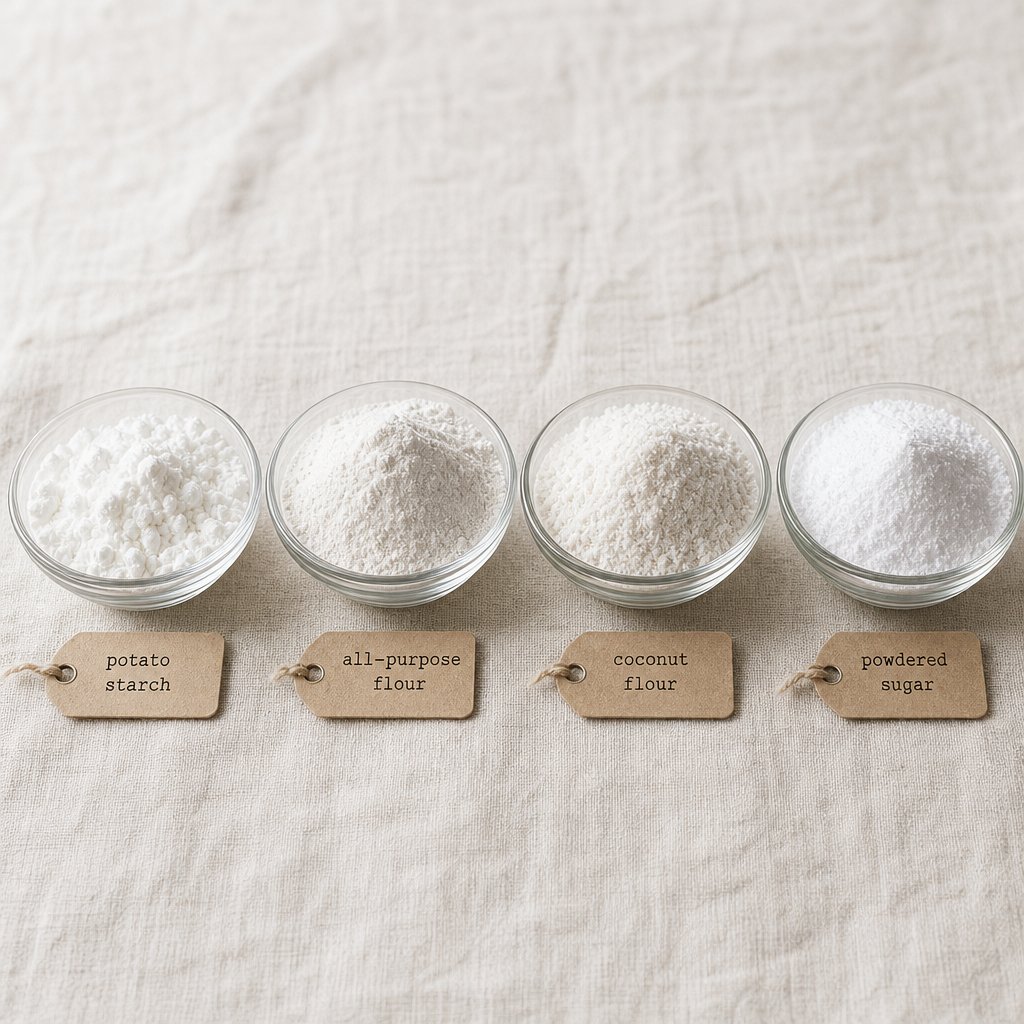
- Tapioca starch — The most reliable substitute flour for rice flour in thickening, frying, and even chewy desserts. It is gluten-free, neutral in flavor, and produces a similar light crispness when used as a coating. For thickening, use a 1:1 ratio. For baking, replace one cup of rice flour with two cups of tapioca starch to approximate the right texture in sticky desserts. It will not replicate mochi perfectly, but it gets closer than anything else on this list.
- Cornstarch — Excellent for thickening sauces, crisping fried foods, and light baking. Use half the amount called for in your recipe when substituting for rice flour. It dissolves cleanly, creates glossy sauces, and produces shatteringly crisp coatings. The limitation? It is a pure starch with zero protein, so it cannot provide structure in bread or cake recipes the way rice flour can.
- Potato starch — Another strong substitute of rice flour for thickening and frying. It creates a lighter, more delicate crunch than cornstarch and works well in gluten-free baking blends. Like cornstarch, it breaks down under prolonged heat, so add it toward the end of cooking.
- All-purpose wheat flour — Works as a direct 1:1 substitution for rice flour in frying coatings, roux-based sauces, and general baking. The obvious caveat: it contains gluten. If your reason for using rice powder is celiac disease or gluten sensitivity, this is not an option. If you simply ran out of rice flour and have no dietary restrictions, wheat flour handles most cooking tasks without issue.
For skincare, the best substitute for rice powder is finely ground oat flour. It offers similar oil-absorbing properties and gentle exfoliation without irritation. Cornstarch also works as a mattifying face powder in a pinch, though it lacks the bioactive compounds found in rice bran.
When No Substitute Will Work
Some applications depend on rice powder's specific starch composition so completely that no substitution for rice flour will produce acceptable results. Three scenarios stand out:
- Glutinous rice desserts. Mochi, tteok, tang yuan, and muah chee require the near-100% amylopectin content of sweet rice flour to achieve their signature stretch and chew. No glutinous rice flour substitute truly replicates this texture. Tapioca starch comes closest but produces a bouncier, less cohesive dough that tears rather than stretches. If your recipe demands that elastic pull, only glutinous rice flour will deliver it.
- Ultra-crisp tempura and rice-based coatings. The specific way rice starch interacts with hot oil creates a uniquely light, shatteringly crisp shell. Wheat flour produces a denser, breadier coating. Cornstarch gets close but lacks the subtle crunch that rice flour provides.
- Skincare absorption and brightening. Rice powder's combination of starch-based oil absorption, ferulic acid, and phytic acid is unique. Oat flour absorbs oil but does not brighten. Cornstarch mattifies but offers no antioxidant benefit. For the full range of traditional beauty effects, rice powder remains irreplaceable.
Rice powder is a versatile, naturally gluten-free ingredient that bridges culinary, beauty, and cultural worlds. Understanding which type you need is the key to getting the results you want.
Frequently Asked Questions About Rice Powder
1. Is rice powder the same as rice flour?
Rice powder and rice flour often come from the same grain but differ in grind size and intended use. Culinary rice flour typically has a particle size of 100-150 micrometers, while beauty-grade rice powder is milled below 90 micrometers for a silky, talc-like feel. In many South and Southeast Asian languages, both terms translate identically, adding to the confusion. The key distinction is context: if you are cooking, you likely need rice flour; if you are making skincare products, you need ultra-fine rice powder.
2. What is rice powder used for in skincare?
Rice powder serves three primary functions in skincare: oil absorption, gentle physical exfoliation, and mild skin brightening. The starch in rice powder binds to sebum and reduces shine without stripping moisture. Its fine particles lift dead skin cells when massaged gently across the face. Rice bran also contains ferulic acid and phytic acid, antioxidants linked to photoprotection and reduced hyperpigmentation. Traditional beauty practices in Japan, Korea, and South Asia have used rice powder in face masks, cleansing preparations, and mattifying powders for centuries.
3. Can you make rice powder at home?
Yes, you can make rice powder at home using two methods. Dry grinding involves milling uncooked rice in a grain mill or high-speed blender, then sifting for fineness. This works best for baking and frying coatings. Wet grinding requires soaking rice for 4-6 hours, blending it with water into a paste, then drying and re-grinding. Wet grinding produces a finer, silkier result ideal for noodles and traditional sweets. A dedicated grain mill yields more consistent results than a blender, and double-grinding is recommended for smoothness.
4. Is rice flour gluten free and safe for celiac disease?
Rice is naturally gluten-free, containing no gluten proteins whatsoever. However, cross-contamination during harvesting, milling, or retail storage can introduce gluten. A study in Frontiers in Nutrition found that 28.6% of unpackaged rice flour samples exceeded the 20 mg/kg gluten safety threshold, while certified gluten-free products showed zero contamination. For celiac safety, always choose rice flour with a certified gluten-free label rather than buying from bulk bins or unpackaged sources.
5. What can I use as a substitute for rice powder?
The best substitute depends on your application. Tapioca starch is the most versatile replacement, working well for thickening, frying, and some desserts at a 1:1 ratio. Cornstarch excels for sauces and crispy coatings at half the amount. Potato starch offers a delicate crunch for frying. For skincare, finely ground oat flour provides similar oil absorption. However, no substitute replicates glutinous rice flour's elastic stretch in mochi or tteok, and rice powder's unique combination of starch absorption and bioactive compounds remains irreplaceable for traditional beauty applications.