Yes You Can Bring Protein Powder on a Plane
Imagine you're packing for a trip and staring at your protein powder, wondering if it's going to cause a scene at airport security. You're not alone. Whether you're heading to a fitness competition, a work conference, or a week-long vacation where you want to stay on track, the question comes up constantly: can you bring protein powder on a plane?
The answer is yes. Protein powder is allowed in both carry-on and checked luggage on flights departing from U.S. airports. You won't be arrested, fined, or turned away for having it in your bag. The only real caveat involves how much you pack in your carry-on and what that means for screening speed.
The Short Answer for Travelers in a Hurry
You can bring protein powder on plane in your carry-on or checked bag without issue. The one rule to keep in mind: if the quantity in your carry-on exceeds 12 oz (350 mL) by volume, TSA requires it to go in a separate bin for X-ray screening. It may also need additional testing. Amounts under that threshold pass through standard screening just like any other solid food item. So if you can keep your supply compact, you'll breeze through the checkpoint.
Why Powder Rules Confuse So Many Flyers
The confusion traces back to 2018, when TSA rolled out enhanced screening procedures for powder-like substances. Many travelers heard "new powder restrictions" and assumed supplements were banned entirely. Others still operate on outdated advice from forums and social media posts that predate the policy update. The reality is far less dramatic than the rumors suggest.
Powder-like substances greater than 12 oz. / 350 mL must be placed in a separate bin for X-ray screening. They may require additional screening and containers may need to be opened. — TSA.gov
That's it. No ban. No confiscation. Just a slightly longer look if you're carrying a larger container. Can you fly with protein powder in a full-size tub? Technically yes, though TSA recommends placing non-essential powders greater than 12 oz in checked bags for convenience.
The fitness community has grown rapidly, and so has the number of people who travel with supplements. Protein powder on airplane trips is routine for millions of passengers every year. The gap between perception and policy is what creates anxiety, and this guide exists to close that gap. Below, you'll find scenario-based guidance covering domestic flights, international travel, carry-on strategies, checked luggage rules, and what actually happens if your powder gets flagged at the checkpoint.
TSA Powder Rules and the 12 Oz Screening Threshold
TSA's current powder screening policy didn't appear out of nowhere. It was a direct response to a 2017 terror plot in Australia, where suspects attempted to conceal an improvised explosive device disguised as a powder-based substance on a passenger aircraft. Following that intelligence, TSA implemented enhanced screening measures at U.S. airports and requested international airports with nonstop U.S. flights to adopt similar protocols. The changes took effect on June 30, 2018.
The core TSA powder rule is straightforward: powder-like substances in carry-on baggage exceeding 12 oz (350 mL) by volume must be placed in a separate bin for X-ray screening. They may require additional testing, and containers may need to be opened. Quantities under 12 oz pass through standard screening with no extra steps. This applies to all TSA powders equally, whether it's protein, baby formula, spices, cosmetics, or dry shampoo.
One detail that trips people up: the 12 oz threshold is measured by volume, not weight. A container that holds 350 mL of space triggers the rule regardless of how many grams of powder are inside. So can you bring powder on a plane in a half-full 2 lb tub? Technically the container itself exceeds the volume threshold, even if the actual powder inside weighs very little.
The 12 Oz Carry-On Threshold Explained
Think of 12 oz as roughly the size of a standard soda can. For TSA protein powder screening purposes, that volume holds approximately 10 to 12 scoops of whey protein, since a typical serving scoop measures around 30 to 35 grams. That's enough for about a week and a half of single daily shakes, which covers most short trips comfortably.
If your trip is longer and you need more, you have two clean options: pack the excess in checked luggage where no volume limit applies, or carry a container that holds 12 oz or less and check the rest. Either way, can you take powder on a plane in larger amounts? Absolutely. The TSA powder rules don't ban anything. They just add a screening step.
How to Use the TSA What Can I Bring Tool
Before any flight, you can verify current rules yourself using the What Can I Bring search tool on TSA.gov. Type in "protein powder" and you'll see a dedicated page confirming that protein or energy powders are allowed in both carry-on and checked bags. The page also notes that the final decision rests with the TSA officer at the checkpoint.
If your powder does exceed 12 oz and triggers additional screening, here's what can i take powder on a plane travelers should expect from the officer:
- Visual inspection of the container and its contents
- Explosive Trace Detection (ETD) swab testing on the exterior or interior of the container
- A request to open the container so the officer can examine the powder more closely
This process typically adds two to five minutes. It's routine, not adversarial. Knowing exactly what the rules say and where to verify them puts you in control of the experience, but the rules only tell half the story. How you pack your powder, and where you place it in your bag, determines whether screening is a quick formality or an extended hold-up.
Carry-On vs Checked Luggage Rules Compared
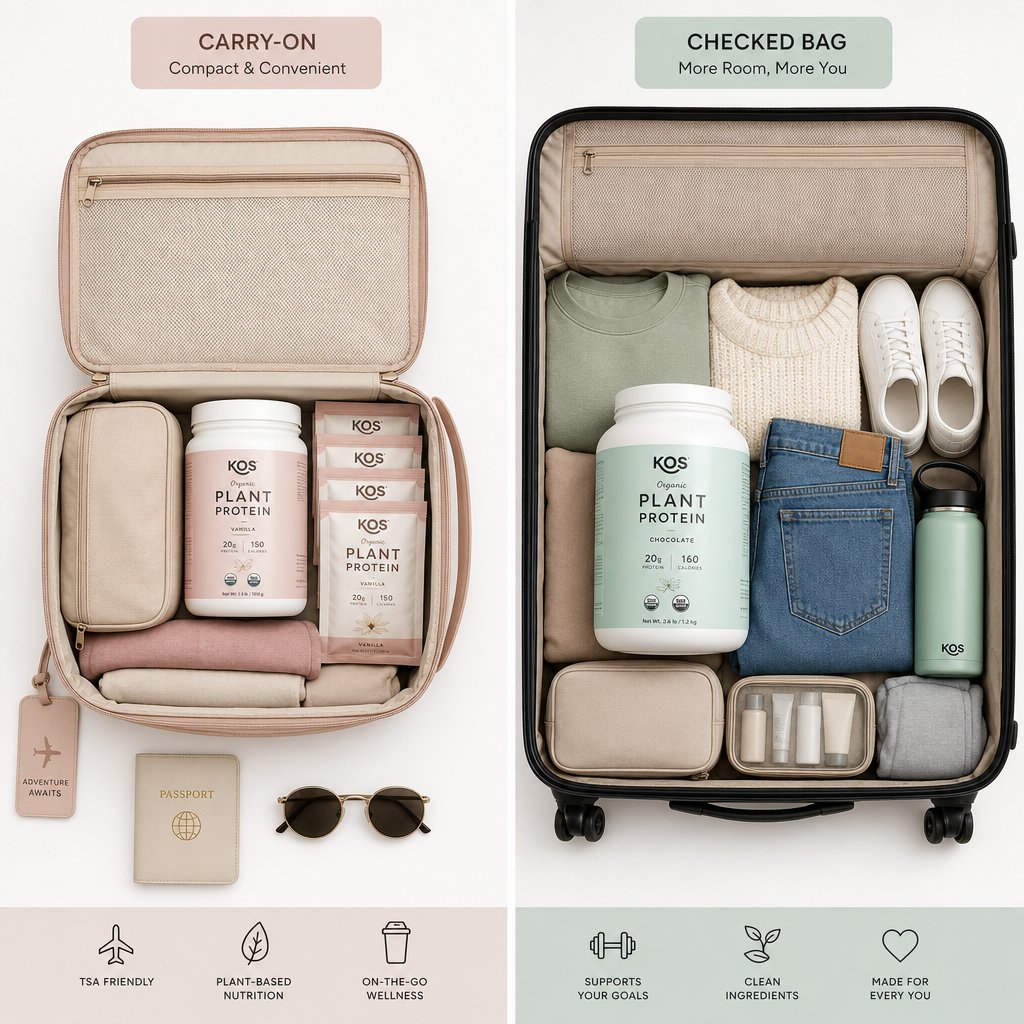
Packing strategy matters just as much as knowing the rules. You can carry protein powder on a plane in either your carry-on or checked bag, but each option comes with different trade-offs around convenience, screening speed, and weight management. Most travel guides focus almost exclusively on carry-on rules and leave checked luggage as an afterthought. That's a mistake, especially for longer trips where you need more than a week's worth of servings.
Carry-On Bag Rules for Protein Powder
If you can bring protein powder in carry on quantities under 12 oz (350 mL), it passes through the X-ray machine like any other solid food item. No separate bin, no additional testing, no questions. You'll barely notice it happened.
Quantities over 12 oz are still permitted, but they trigger the enhanced screening process. You'll need to pull the container out of your bag and place it in a separate bin, similar to how you handle a laptop. The officer may open it, visually inspect the contents, or run an ETD swab. This adds a few minutes but doesn't put your supplement at risk of confiscation.
For the fastest clearance, keep your carry on protein powder in its original labeled packaging. A clearly branded container with a visible nutrition label tells the officer exactly what they're looking at. Generic containers or unmarked bags create ambiguity, and ambiguity is what slows things down. If you've portioned powder into a smaller travel container, make sure the product name and ingredients are still identifiable at a glance.
Checked Luggage Rules and Weight Considerations
Here's where things open up considerably. Can you bring powder in checked luggage without worrying about volume limits? Yes. TSA imposes no quantity restriction on powders in checked bags. You could pack an entire 5 lb tub of whey protein and it would clear screening without issue.
The real constraint isn't security. It's your airline's baggage weight allowance. A standard 5 lb protein tub eats up 10% of a typical 50 lb checked bag limit before you've packed a single shirt. For a two-week trip, that trade-off might be worth it. For a long weekend, it's overkill.
Smarter strategies for checked bags include:
- Portioning out only the servings you need into a sealed, labeled container
- Using single-serve packets that let you pack the exact number of days
- Splitting your supply between carry-on (under 12 oz for quick access) and checked luggage (the rest)
This hybrid approach gives you immediate access to a few servings during travel while keeping the bulk of your supply safely stowed without eating into your carry-on space.
Quick Comparison: Where to Pack Your Protein Powder on Flights
| Location | Quantity Limit | Screening Process | Best For |
|---|---|---|---|
| Carry-on (under 12 oz) | Up to 12 oz / 350 mL | Standard X-ray, no extra steps | Short trips, quick access during layovers |
| Carry-on (over 12 oz) | No hard cap, but separate bin required | Separate bin, possible visual inspection or swab test | Travelers who want all supplements on hand |
| Checked luggage | No TSA limit (airline weight limits apply) | Standard baggage X-ray, no passenger interaction | Longer trips, full-size tubs, bulk quantities |
A Note on Ready-to-Drink Shakes and Pre-Mixed Liquids
Can protein powder be taken on a plane in liquid form? Not exactly the same way. If you've already mixed your shake or you're carrying a ready-to-drink (RTD) protein bottle, it falls under the 3-1-1 liquids rule in carry-on bags. That means each container must be 3.4 oz (100 mL) or less and fit inside a single quart-sized clear bag. Most RTD protein shakes come in 11 oz or larger bottles, which makes them a no-go for carry-on unless you purchase them after clearing security.
In checked luggage, pre-mixed shakes and RTD bottles face no liquid restrictions. If you prefer the convenience of grab-and-go protein drinks, packing them in your checked bag is the simplest path. Just wrap them securely to prevent leaks from pressure changes in the cargo hold.
The bottom line: dry powder gives you the most flexibility across both bag types, while liquids require more planning around where they're stored. Knowing these distinctions is half the battle. The other half is how you physically pack and label your supplements to minimize friction at the checkpoint.
How to Pack Protein Powder for Stress-Free Screening
Knowing the rules is one thing. Walking up to the X-ray belt with confidence is another. Many travelers report feeling genuinely anxious about pulling out a container of white powder in front of a line of strangers and uniformed officers. That anxiety is understandable, but it's almost entirely avoidable with the right packing approach. How you pack protein powder for air travel determines whether you breeze through or get pulled aside for a closer look.
Best Containers and Packing Methods
The container you choose sends a signal to the TSA officer before they even open your bag. A clearly branded, factory-sealed tub communicates "supplement" instantly on the X-ray screen. An unmarked zip-lock bag full of white powder? That's the single most common trigger for extended screening, according to travel security experts who note that any unidentified powder invites closer inspection.
Here are your best options for how to travel with protein powder without creating problems:
- Original sealed container: The gold standard. A branded tub or bag with intact seals and visible nutrition labels gets cleared fastest. If your container is under 12 oz, it likely won't even get a second glance.
- Dedicated travel containers with screw lids: Sturdy, airtight, and leak-proof. Look for travel size protein powder containers specifically designed for supplements, with compartments for individual servings.
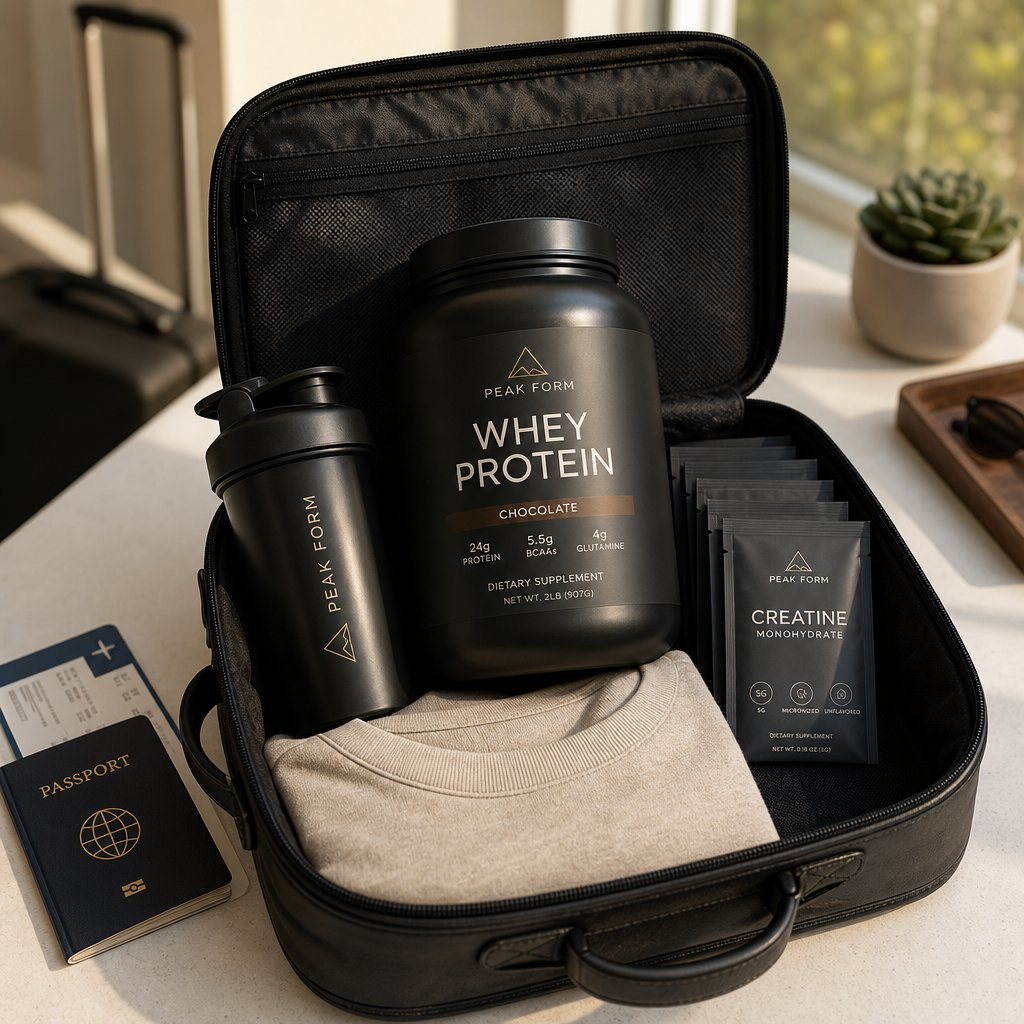
- Single-serve packets: Pre-portioned, commercially labeled, and compact. These are the best way to travel with powder supplements if you want zero friction at security. Each packet is clearly under 12 oz and identifiable at a glance.
- Zip-lock bags (with caveats): Functional for saving space, but they create ambiguity on the X-ray. If you go this route, attach a printed label or keep the original packaging nearby for reference.
Whichever container you pick, place it in an easily accessible spot near the top of your carry-on. Burying powder deep in your bag means the officer has to dig through everything else if they need to inspect it, which slows you down and holds up the line behind you.
Labeling and Documentation Tips
Labels do the talking for you. When a TSA officer can read "Whey Protein Isolate" and see a nutrition panel, there's rarely a reason to open the container at all. If you've portioned powder into a smaller travel container, tape or clip the nutrition label from the original packaging onto it. A handwritten "protein powder" note is better than nothing, but a printed ingredient list is better still.
For specialty supplements like creatine monohydrate or pre-workout blends that might look unfamiliar, keep a photo of the original container on your phone. This gives you a quick reference if an officer asks what's inside. It's not required, but it speeds up the conversation and reduces any awkwardness.
Here's a step-by-step packing checklist for anyone looking to travel with protein powder and avoid delays:
- Choose a leak-proof, airtight container that won't burst open from pressure changes or rough handling.
- Keep the quantity under 12 oz (350 mL) in your carry-on for the fastest possible screening.
- Ensure the product label or nutrition facts are clearly visible on the outside of the container.
- Place the container in an easily accessible spot, ideally the top or outer pocket of your bag.
- Be prepared to separate it at the X-ray belt, just as you would a laptop or liquids bag.
This five-step approach covers the best way to travel with protein powder domestically. But packing correctly for TSA is only part of the equation. International destinations add a layer of customs regulations, ingredient restrictions, and declaration requirements that can catch even experienced travelers off guard.
International Travel Regulations for Supplements
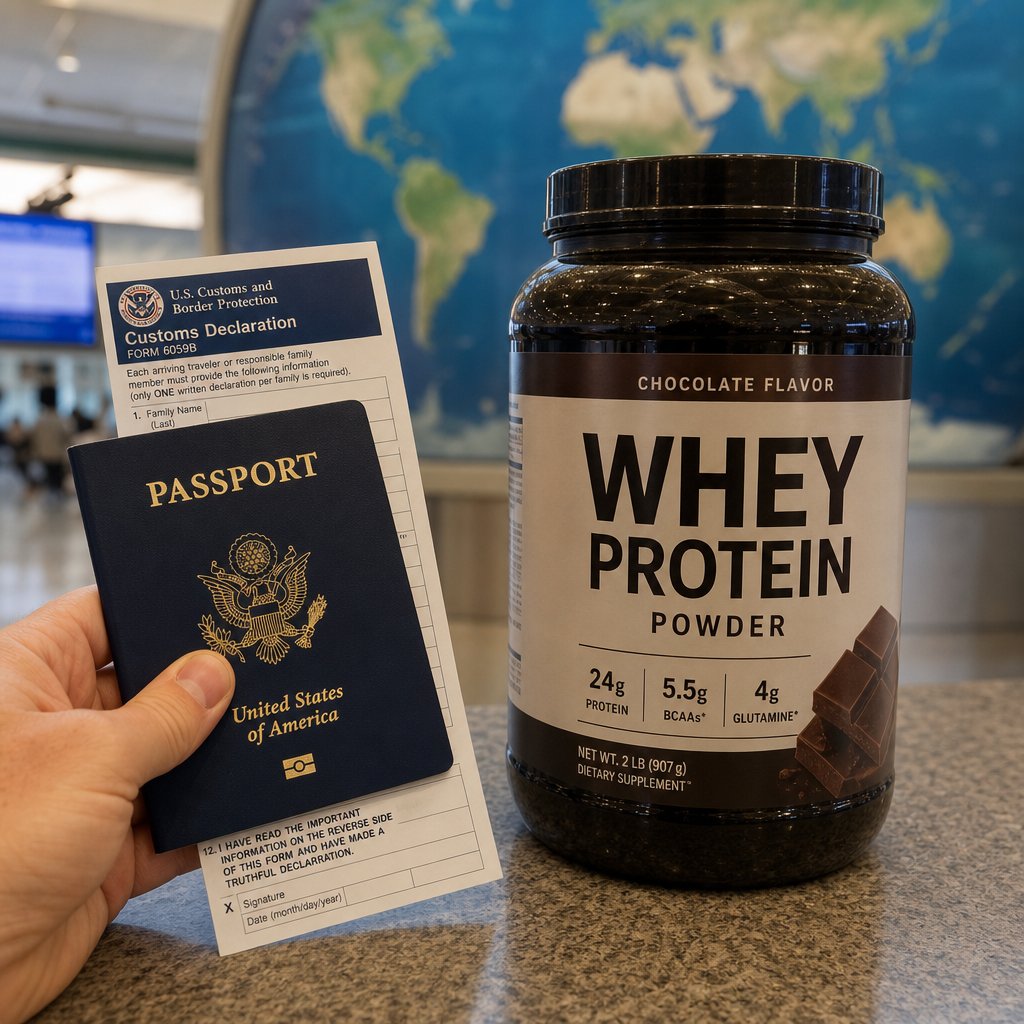
Clearing TSA is one checkpoint. Landing in another country introduces an entirely different set of rules. Can you bring supplements on a plane crossing international borders? Yes, but what happens after you land depends heavily on your destination. Customs agencies around the world treat supplements as food products, pharmaceutical items, or something in between, and the classification determines whether you walk through freely or face fines, confiscation, or mandatory declarations.
Most travelers assume that if TSA allowed it in their bag, the destination country will too. That's a dangerous assumption. Each country enforces its own biosecurity, food safety, and pharmaceutical import laws independently of U.S. screening rules. Here's what you need to know region by region.
Customs Declarations and Biosecurity Rules by Region
Australia and New Zealand operate some of the strictest biosecurity regimes in the world. Protein powder qualifies as a food product under Australian law, which means you must declare it on your Incoming Passenger Card (IPC) before clearing customs. Failure to declare can trigger an infringement notice starting at 2 penalty units ($660 AUD) and escalating to 12 penalty units ($3,960 AUD) for goods deemed high biosecurity risk. Declaring honestly and having your powder in original commercial packaging with a clear ingredient list is the simplest way to avoid problems. Biosecurity officers may inspect the product, but declared supplements for personal use are routinely cleared.
EU and UK countries generally permit supplements for personal use without special permits. The UK classifies most nutritional supplements, including protein powders, vitamins, and amino acids, as food preparations rather than medicines, making personal import relatively straightforward. The EU applies more scrutiny. Products containing ingredients with pharmacological effects or those marketed with medical claims may be reclassified as medicines, which carry heavy import restrictions. Certain stimulants found in U.S. pre-workout formulas, like DMAA or high-dose synephrine, are restricted or banned in several EU member states. If you can bring powdered supplements on a plane to Europe, stick to straightforward protein and amino acid formulas without stimulant blends.
Japan and South Korea regulate supplement imports under pharmaceutical affairs laws. Japan allows personal import of non-prescription health supplements, but quantities are limited. The Consulate-General of Japan notes that over-the-counter medications and health supplements are considered pharmaceutical products under Japan's Pharmaceutical Affairs Law, with external medications and body-care products limited to 24 items and other health products limited to a two-month supply. Protein powder for personal use in reasonable quantities typically clears without issue, but products containing stimulants like amphetamine-based compounds are strictly prohibited regardless of whether they're legally sold in the U.S.
Middle East countries vary widely. The UAE and Saudi Arabia permit protein supplements for personal use but may inspect products for banned substances. Pork-derived gelatin in capsules or non-halal ingredients can cause issues at customs in stricter jurisdictions. Keep ingredient lists accessible and avoid products with ambiguous labeling.
Canada is one of the easiest destinations for U.S. travelers carrying supplements. Health Canada treats protein powder as a natural health product, and personal-use quantities face minimal scrutiny at the border. No formal declaration is typically required for standard protein powder, though you should still answer truthfully if asked about food items.
How to Handle Supplement Declarations on Customs Forms
When a customs form asks whether you're carrying food products, protein powder qualifies. This catches many travelers off guard because they think of it as a "supplement" rather than "food," but customs agencies don't make that distinction. If the form asks about food, declare it. If it asks about medicines or health products, declare it there too. Honest declaration almost never results in confiscation. Failing to declare is what triggers penalties.
Can you take powder supplements on a plane internationally without any preparation? You can, but you're gambling on the officer's discretion. A few simple steps eliminate that gamble:
- Keep powder in original commercial packaging with the ingredient list clearly visible
- Ensure labels are in English (or the destination country's language if possible)
- Carry only personal-use quantities, generally a one to two month supply maximum
- Verify that no ingredients in your specific product are restricted at your destination
- Have a photo of the full product label on your phone as backup documentation
Can i bring powdered supplements on a plane to a country with strict food import laws? Yes, as long as you declare them and the ingredients are legal at your destination. The declaration itself is not a barrier. It's a formality that protects you from fines.
Regional Comparison for Traveling With Supplements on a Flight
| Region | Declaration Required | Key Restrictions | Tips |
|---|---|---|---|
| Australia / NZ | Yes, mandatory on Incoming Passenger Card | All food products must be declared; fines from $660 to $3,960 AUD for non-declaration | Use original packaging; declare even if unsure; biosecurity officers clear most supplements quickly |
| EU / UK | Not typically for personal-use food supplements; required if product could be classified as medicine | Stimulants like DMAA may be banned; products with medical claims can be reclassified as pharmaceuticals | Avoid pre-workouts with banned stimulants; keep quantities reasonable; UK is more lenient than EU member states |
| Japan / South Korea | Yes, for health products exceeding personal-use limits | Two-month supply limit for health supplements; stimulants strictly prohibited; some amino acid concentrations restricted | Carry only what you need for your trip; check ingredient lists against Japan's prohibited stimulants list |
| Middle East | Generally not required for standard protein powder | Non-halal ingredients (pork gelatin) may be flagged; some stimulants and hormonal supplements restricted | Choose plant-based or halal-certified products; keep labels clear and accessible |
| Canada | Not typically required for standard supplements | Minimal restrictions on personal-use protein powder; natural health products regulated but personal import is straightforward | Answer truthfully if asked about food items; no special packaging requirements beyond common sense |
Can i bring supplements on a plane for an international trip without running into trouble? In the vast majority of cases, yes. The travelers who encounter problems are almost always those who failed to declare, carried restricted stimulant ingredients, or packed quantities that exceeded personal-use thresholds. Stick to labeled, personal-use amounts of standard protein powder and you'll clear customs in virtually every country on this list.
International rules govern what happens after you land. But what about the screening process itself when something in your bag gets a second look? Understanding exactly what happens during secondary powder screening removes the last source of uncertainty from the experience.
What Happens During Secondary Powder Screening
You packed smart, labeled everything, and kept your container under 12 oz. But maybe your bag still got flagged. Or maybe you're carrying a larger supply and you know the separate-bin rule applies. Either way, the moment a TSA officer pulls your bag aside can feel like the start of something serious. It's not. Secondary screening for protein powder TSA encounters is one of the most routine procedures at any checkpoint, and knowing exactly what happens step by step takes the mystery out of it entirely.
What Happens If Your Powder Gets Flagged
Picture this: your carry-on goes through the X-ray machine, and the officer monitoring the screen spots a dense, uniform substance. Powders show up as a distinct mass on X-ray imagery, and anything over the 12 oz threshold, or anything that creates an unclear image, gets a closer look. Here's the sequence that follows:
- Bag pull: The officer stops the conveyor belt and sets your bag aside. They'll call you over or ask you to wait near the end of the belt.
- Identification request: The officer asks you to point out or remove the powder container from your bag. If you packed it near the top, this takes seconds.
- Separate bin placement: Your container goes into its own bin and passes through the X-ray again for a clearer, unobstructed image.
- Physical inspection: The officer may open the container to visually examine the contents. They're looking at color, texture, and consistency to confirm it matches what the label says.
- Explosive Trace Detection (ETD) swab: A small fabric swab is wiped across the outside or inside of the container, then inserted into a detection machine that analyzes for trace explosive compounds. This is the same technology used on laptops, shoes, and hands during random checks.
- Bottle Liquid Scanner (BLS): At some checkpoints, officers use a scanner that can analyze the composition of substances without opening the container. If your checkpoint has this technology, the process is even faster.
From start to finish, this entire sequence typically adds two to five minutes. You'll stand nearby the whole time, and the officer will explain what they're doing as they go. It's procedural, not confrontational. Can you bring protein powder through TSA without any of this happening? Yes, if your container is under 12 oz and produces a clear X-ray image. But even when secondary screening does occur, it's a brief pause rather than an ordeal.
Possible Outcomes and How to Respond
Once the officer completes their inspection, one of three outcomes follows. Understanding these ahead of time helps you stay calm and cooperative, which in turn speeds up the process.
Outcome 1: Cleared and repacked. This is what happens in the overwhelming majority of cases. The swab comes back clean, the visual inspection matches the label, and the officer hands your container back. You repack your bag and move on. If you can take protein powder through TSA in labeled, recognizable packaging, this outcome is almost guaranteed.
Outcome 2: Asked to surrender the item. This is rare and typically only happens under specific circumstances. If the powder cannot be identified, you have no documentation or labeling, and the substance cannot be resolved through available testing, the officer may ask you to voluntarily surrender it. You won't be detained or penalized. You simply lose the product. This outcome is almost entirely preventable by keeping your powder in original or clearly labeled containers.
Outcome 3: Referred to law enforcement. This is extremely rare and only occurs if the substance tests positive for prohibited materials during ETD analysis. Protein powder, creatine, pre-workout, and other fitness supplements do not trigger positive results on explosive trace detection equipment. This outcome is essentially irrelevant for anyone carrying legitimate supplements.
The vast majority of flagged powders are cleared within minutes with no issues. Secondary screening for supplements is routine checkpoint procedure, not an indication of suspicion or wrongdoing.
Your best response during the process is simple: stay calm, answer questions directly, and let the officer do their job. Avoid reaching into your bag without being asked, and don't volunteer lengthy explanations. A brief "it's protein powder" when asked is all you need. The officer has likely screened dozens of similar containers that same shift.
One question that comes up often: is there such a thing as tsa approved protein powder? There's no official approval list or certification for specific brands. TSA doesn't endorse or pre-clear individual products. Any commercially available protein powder or supplement sold legally in the United States is permitted through security. The term "tsa approved protein powder" is a misnomer. What actually matters is how the product is packaged, labeled, and presented at the checkpoint, not which brand it is.
Different powder types, whether whey, casein, plant-based blends, creatine monohydrate, or stimulant-containing pre-workout, may appear slightly different on X-ray due to variations in density and particle size. A dense casein powder looks different from a fluffy plant-based blend on the screen. But procedurally, all powders are treated identically. The officer follows the same inspection steps regardless of what type of protein powder on plane you're carrying. No formula gets extra scrutiny simply because of its composition.
Can i bring protein powder through TSA if it's a brand-new sealed container versus an opened one? Both are permitted. Sealed containers may clear visual inspection faster since the tamper seal provides additional confidence, but opened containers with visible labels still pass without issue after a standard swab test.
The screening process is designed to identify threats, not to inconvenience travelers carrying legitimate products. Once you've experienced it once, you'll realize how unremarkable it actually is. The real friction points for most travelers aren't at the TSA checkpoint at all. They come from packing mistakes that could have been avoided entirely, or from carrying formats that create unnecessary complications at security.
Travel-Friendly Protein Alternatives That Skip Screening Hassles
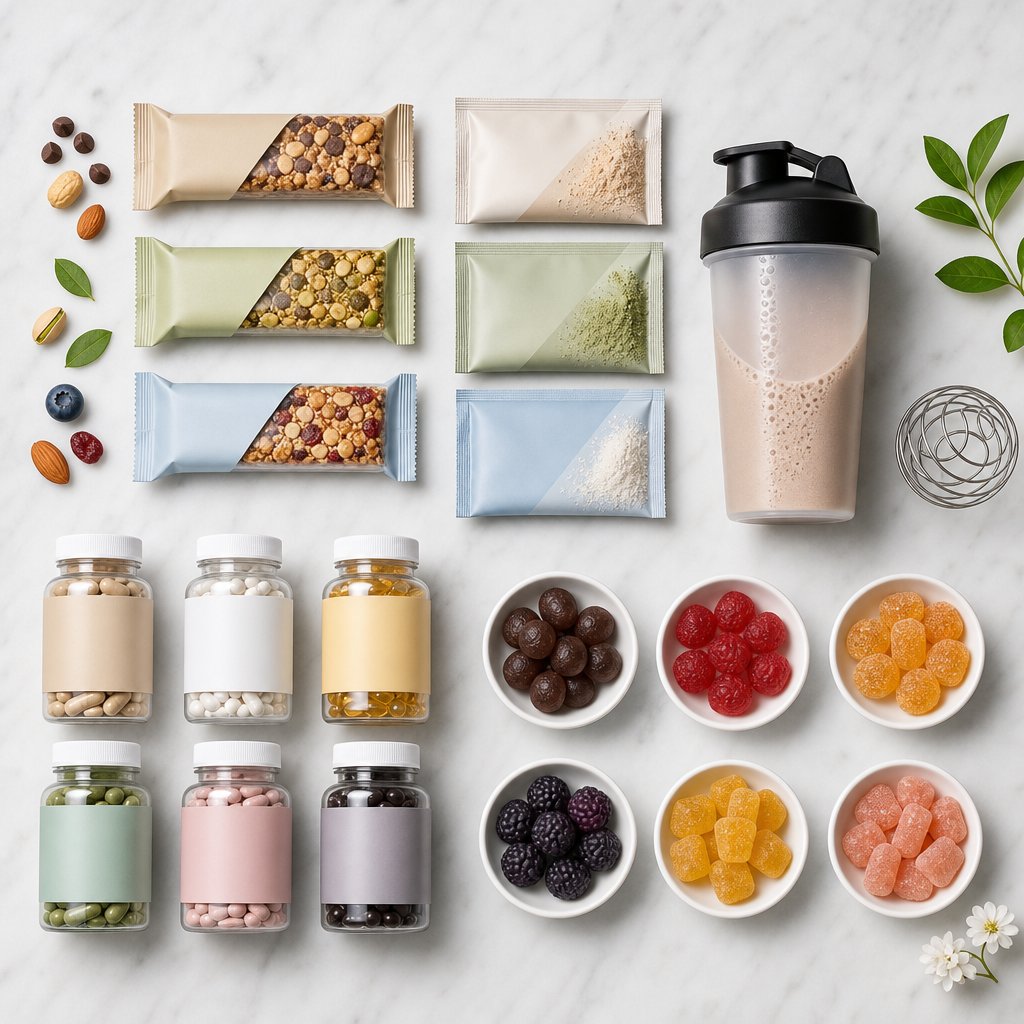
Not everyone wants to deal with powder screening at all, even if it only adds a few minutes. Maybe you're a frequent flyer who values speed above everything else, or maybe you're tired of worrying about spills, labels, and separate bins. The good news: powder isn't your only option. Several supplement formats let you travel with protein powder alternatives that bypass the 12 oz threshold entirely and sail through security without a second glance.
The question shifts from "can you travel with protein powder" to "what format makes the most sense for how I travel?" Each option comes with trade-offs around protein content, convenience, and TSA interaction. Here's how they compare.
Protein Bars and Ready-to-Drink Shakes
Protein bars are the simplest travel-friendly option available. They're classified as solid food by TSA, which means zero additional screening, no volume thresholds, and no need to separate anything at the X-ray belt. Toss them in your carry-on, your personal item, or even your jacket pocket. A bar delivering 20 to 30 grams of protein takes up less space than a shaker bottle and creates absolutely no friction at the checkpoint.
For travelers who prefer liquid protein, ready-to-drink (RTD) shakes require a bit more planning. In carry-on bags, they fall under the 3-1-1 liquids rule: each container must be 3.4 oz (100 mL) or less and fit inside your quart-sized clear bag. Since most RTD protein shakes come in 11 oz or larger bottles, they won't make it through carry-on screening. You have two practical workarounds:
- Pack RTD shakes in checked luggage where no liquid volume restrictions apply
- Purchase them after clearing security at airport shops or vending machines
A related question travelers often ask: can you bring Liquid IV on a plane? The same 3-1-1 rule applies to any liquid or gel-based product in carry-on. However, Liquid IV and similar hydration products sold as dry powder packets are treated like any other powder and fall under the standard 12 oz screening threshold. Dry single-serve stick packs are far easier to carry through security than pre-mixed liquids.
Capsules, Tablets, and Single-Serve Packets
Capsules and tablets sidestep the powder screening threshold completely. TSA treats pills and capsules as standard personal items, not as powder-like substances. They pass through X-ray without triggering the separate-bin requirement regardless of quantity. If your primary goal is amino acids, BCAAs, or concentrated protein in a compact form, capsules are the most screening-friendly format available.
Single-serve powder packets offer a middle ground. Each packet is clearly labeled, commercially sealed, and well under 12 oz individually. Even carrying a week's worth of single-serve sachets keeps your total volume manageable and gives TSA officers instant visual confirmation of what's inside. No guessing, no opening containers, no swab tests. They're also the answer to "what can you put protein powder in" when you don't want to deal with bulky containers or messy transfers. The manufacturer pre-portions and seals everything for you.
Gummy supplements are another format gaining popularity among travelers. They're classified as solid food, produce no ambiguity on X-ray, and require zero additional screening. Protein content per serving is typically lower than powder (around 5 to 10 grams versus 20 to 30 grams), but for travelers who just want to supplement a balanced diet rather than replace meals, gummies work well.
The best protein powder travel container depends on your format choice. For loose powder, look for a protein powder container for travel with airtight screw lids and stackable compartments. A protein powder travel container set with multiple pre-measured sections lets you portion out individual servings without carrying the full tub. For capsules and packets, a simple zip pouch or pill organizer keeps everything compact and accessible. A protein powder portable container with a built-in funnel makes mixing easier at your destination without creating mess during transit.
Format Comparison for Travelers
| Format | TSA Screening | Convenience | Protein Per Serving | Best For |
|---|---|---|---|---|
| Powder tub | Over 12 oz requires separate bin and possible inspection | Moderate; requires container, scoop, and shaker at destination | 20-30g | Extended trips where high daily intake is needed |
| Single-serve packets | Standard screening; each packet clearly under threshold | High; pre-portioned, labeled, no measuring needed | 20-25g | Frequent flyers who want zero hassle at security |
| Capsules / tablets | No powder threshold applies; passes like any personal item | Very high; compact, no mixing required | 3-10g (amino acids) or concentrated protein peptides | Travelers prioritizing speed and minimal baggage |
| Gummy supplements | Solid food; no additional screening | Very high; eat directly, no water needed | 5-10g | Casual supplementation alongside regular meals |
| RTD shakes | 3-1-1 liquids rule in carry-on; unrestricted in checked bags | High after security; limited in carry-on | 20-42g | Post-security consumption or checked bag packing |
| Protein bars | Solid food; no additional screening whatsoever | Very high; no preparation, no container needed | 15-30g | On-the-go nutrition during flights and layovers |
Why Brands Are Expanding Into Travel-Ready Formats
The demand for travel-optimized supplements has pushed the industry toward multi-format product lines. Brands increasingly recognize that their customers don't just use protein at home. They need formats that work in hotel rooms, airport lounges, and gym bags across time zones. This shift is why you'll notice more companies offering the same formula in powder tubs for home use alongside single-serve sachets, capsules, and gummies designed specifically for portability.
Behind the scenes, this flexibility comes from OEM/ODM manufacturers who produce across multiple delivery formats under one roof. Companies like ZhuFeng manufacture hard capsules, tablets, powder sachets, soft capsules, gummy candy, and oral liquids, allowing nutrition brands and private label sellers to launch travel-friendly product lines without building separate supply chains for each format. For supplement businesses looking to serve customers who fly frequently, this kind of scalable, multi-format production turns the travel compliance challenge into a product development opportunity.
From a consumer perspective, the takeaway is simple: you're no longer locked into a single format. If screening concerns or packing constraints make loose powder impractical for a particular trip, you have legitimate high-protein alternatives that eliminate the issue entirely. The right choice depends on your trip length, protein needs, and how much you value speed at the checkpoint.
Choosing the wrong format is one thing. But even travelers who pick the right format can still run into problems through avoidable packing and planning mistakes that turn a smooth experience into an unnecessary delay.
Common Mistakes That Get Your Supplements Flagged or Confiscated
Every screening delay and confiscation story you've heard likely traces back to one of a handful of preventable errors. The rules themselves are straightforward. It's the execution that trips people up. Whether you're bringing protein powder on plane domestically or crossing international borders, these are the mistakes that create real problems, ranked by how frequently they cause issues.
Packing Mistakes That Trigger Extra Screening
The most common domestic errors all share a theme: they make it harder for the TSA officer to quickly identify what's in your bag.
- Transferring powder into unlabeled zip-lock bags. Protein powder in a bag with no label is the number one trigger for extended inspection. On an X-ray screen, an unmarked bag of protein looks identical to any other unidentified substance. The officer has no choice but to open it, swab it, and verify manually. This single mistake adds five or more minutes to your screening.
- Exceeding 12 oz without realizing the volume threshold. Many travelers think the limit refers to weight. It doesn't. A half-empty protein powder tub that holds 32 oz of volume still exceeds the threshold, even if only a few scoops remain inside. How much powder can you bring on a plane in carry-on without extra screening? The answer is based on container volume, not powder weight.
- Mixing powder with liquid before security. The moment you add water or milk to your shaker bottle, your protein powder becomes a liquid subject to the 3-1-1 rule. A 16 oz shaker full of pre-mixed shake will be confiscated at the checkpoint. Wait until after security to mix.
- Burying powder deep inside a packed bag. If the officer needs to inspect your container and it's wedged beneath clothes, toiletries, and electronics, they'll have to unpack everything to reach it. Keep supplements near the top or in an outer compartment for quick access.
- Carrying multiple large containers in carry-on. One protein powder tub plus a separate bag of creatine plus a pre-workout container creates a cluster of dense masses on the X-ray image. Each one may need individual inspection. Consolidate where possible or move extras to checked luggage.
International Mistakes That Can Cost You
Domestic packing errors cost you time. International mistakes can cost you money or your entire supply.
- Failing to declare supplements on customs forms. In Australia and New Zealand, not declaring protein powder on your incoming passenger card can result in fines starting at $660 AUD. The declaration itself doesn't get your product confiscated. Skipping it does.
- Carrying pre-workout with banned ingredients. Can you take pre workout on a plane to Europe or Asia? You can board with it, but customs at your destination may confiscate products containing DMAA, DMHA, or other stimulants that are legal in the U.S. but restricted abroad. Can you bring preworkout on a plane internationally? Yes, but verify every ingredient against your destination's restricted substances list before packing.
- Packing quantities that exceed personal-use thresholds. Japan limits health supplement imports to a two-month supply. Showing up with six months of product invites questions about whether you're importing for resale, which carries different legal requirements entirely.
- Not checking airline-specific policies. Some carriers impose their own powder restrictions on certain routes independent of TSA rules. Delta Air Lines, for example, advises passengers on international flights to the U.S. to place powder-like substances of 12 oz or more in checked bags, noting that powder that cannot be cleared by security officials will be prohibited from the cabin. Always check your specific carrier's advisory page before flying.
Protein powder in bag form, whether a zip-lock or an unmarked pouch, accounts for the majority of avoidable screening delays. The fix is almost always the same: use labeled containers, respect volume thresholds, and research your destination's import rules before you pack. Every mistake on this list is preventable with five minutes of preparation, which is less time than you'd spend standing at the checkpoint waiting for a swab test to clear.
With these pitfalls mapped out, the final step is pulling everything together into a single pre-flight action plan you can reference every time you travel with supplements.
Your Complete Pre-Flight Supplement Action Plan
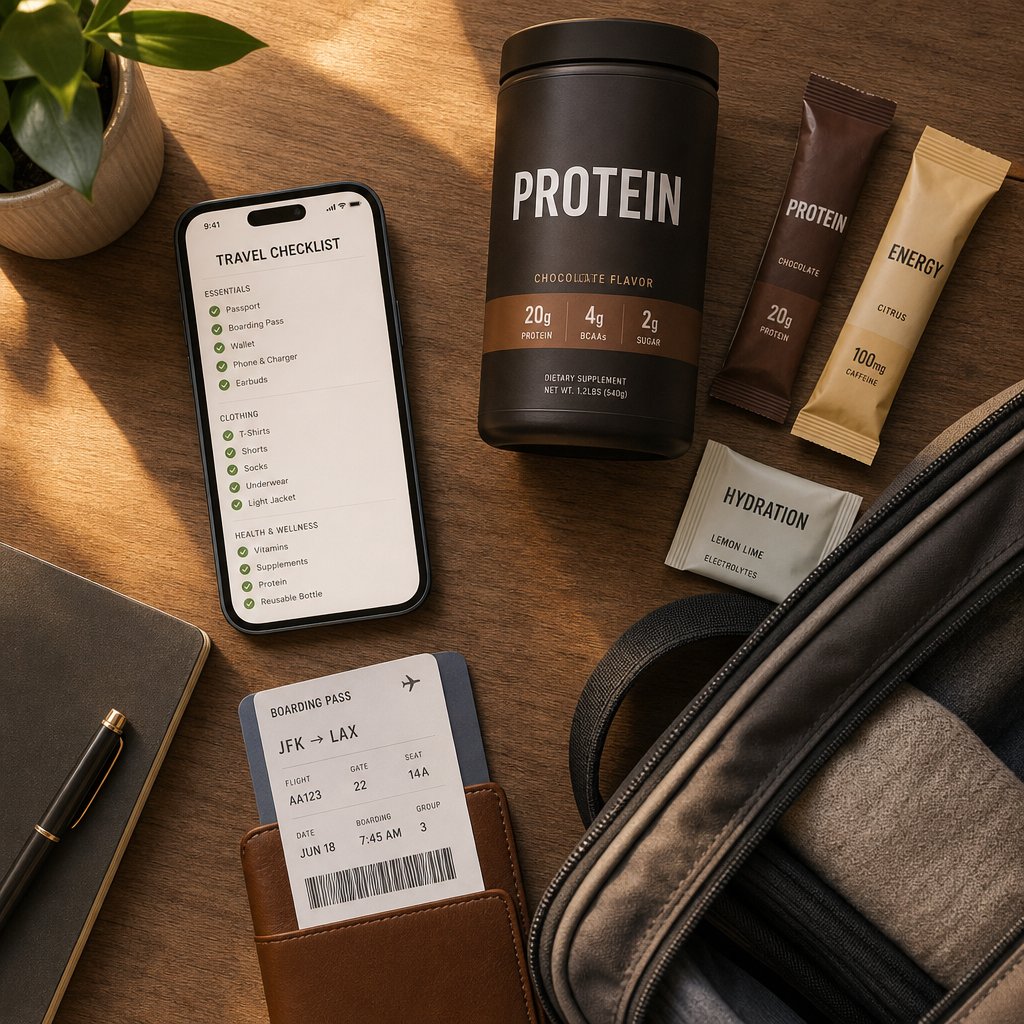
You've got the rules, the packing strategies, the international regulations, and the screening walkthrough. All that's left is a single reference you can pull up on your phone every time you fly. Whether you're asking "can i take protein powder on a plane for a weekend trip?" or planning a month-long international itinerary, this checklist covers every scenario in one place.
Your Pre-Flight Supplement Checklist
Run through these steps before every trip and you'll eliminate virtually every source of screening friction or customs trouble:
- Verify current rules on TSA.gov's What Can I Bring tool. Policies can update without fanfare. A 30-second search confirms that nothing has changed since your last flight.
- Keep powder under 12 oz (350 mL) in your carry-on, or pack excess in your checked bag. This single step determines whether you get standard screening or the separate-bin process. If you need more than 12 oz for your trip, split the supply between bags.
- Use original labeled containers or clearly marked travel containers. Visible branding and nutrition labels let TSA officers identify your product instantly. No label means manual inspection every time.
- For international trips, declare supplements on customs forms and verify destination restrictions. Check whether your destination requires food product declarations (Australia, Japan) and confirm that no ingredients in your specific formula are banned or restricted at your arrival country.
- Consider travel-optimized formats like single-serve packets, capsules, or bars for maximum convenience. These formats skip the 12 oz threshold entirely and create zero ambiguity at the checkpoint. Can you take protein powder on plane in sachet form? Absolutely, and it's the fastest path through security.
That's it. Five steps, five minutes of preparation, and you can confidently answer anyone who asks "can i take protein powder on the plane?" with a definitive yes and a clear plan for how to do it without delays.
Choosing the Right Format for Your Travel Style
Frequent travelers quickly learn that one format doesn't fit every trip. A bulk powder tub makes sense at home where you have a blender, a kitchen scale, and no TSA officer watching. But on the road, flexibility wins. The smartest approach is maintaining your supplements in multiple formats: powder for daily home use, single-serve sachets or capsules for carry-on travel, and protein bars for days when you want zero preparation.
Can i travel with protein powder in bulk on a two-week international trip? Sure. Pack the tub in checked luggage, carry a few single-serve packets in your carry-on for transit days, and you're covered from departure to return. Can you bring supplements on plane without any screening interaction at all? Choose capsules or bars and the answer is yes, every single time.
This multi-format strategy isn't just a consumer hack. It reflects where the supplement industry is heading. Brands that serve travel-conscious customers are expanding their product lines to include sachets, capsules, gummies, and stick packs alongside traditional tubs. For nutrition brands, supplement importers, or private label sellers looking to add travel-friendly formats to their lineup, OEM/ODM manufacturing partners like ZhuFeng offer scalable production across powder sachets, capsules, gummies, and oral liquids with customized formulation, making it straightforward to serve customers who need their protein to travel as easily as they do.
From a traveler's perspective, the bottom line is simple: you can bring protein powder on the plane, through customs, and into virtually any country on earth. The rules aren't complicated. They just require a few minutes of intentional packing. Follow the checklist above, match your format to your trip, and you'll never second-guess your supplement bag again.
Frequently Asked Questions About Flying With Protein Powder
1. How much protein powder can you bring on a plane in carry-on?
There is no hard limit on protein powder in carry-on bags. However, containers exceeding 12 oz (350 mL) by volume must be placed in a separate bin for X-ray screening and may undergo additional inspection such as a visual check or explosive trace detection swab. Keeping your supply under 12 oz allows it to pass through standard screening with no extra steps, similar to any solid food item.
2. Does protein powder need to be in original packaging for TSA?
TSA does not require original packaging, but it is strongly recommended. Labeled, branded containers allow officers to identify the substance immediately on the X-ray screen, which speeds up clearance significantly. Unlabeled bags of white powder are the most common trigger for extended inspection. If you transfer powder to a travel container, attach the nutrition label or keep a photo of the original packaging on your phone.
3. Can you bring pre-workout powder on international flights?
You can board with pre-workout powder, but your destination country may restrict certain ingredients. Stimulants like DMAA and DMHA are banned in several EU member states and Asian countries. Australia requires all food products, including supplements, to be declared on the incoming passenger card. Always check your specific formula's ingredient list against your destination's restricted substances regulations before packing.
4. What happens if TSA flags your protein powder at security?
The officer will ask you to remove the container, place it in a separate bin for a clearer X-ray image, and may open it for visual inspection or run an Explosive Trace Detection swab. The process typically adds two to five minutes. In the vast majority of cases, the powder is cleared and returned to you immediately. Confiscation only occurs in rare situations where the substance cannot be identified and no documentation is available.
5. What are the best travel-friendly alternatives to protein powder tubs?
Single-serve powder packets, protein bars, capsules, and gummy supplements all bypass the 12 oz screening threshold entirely. Bars and gummies are classified as solid food with zero additional screening. Capsules pass through like any personal item. Single-serve sachets are pre-portioned and clearly labeled, making them ideal for frequent flyers. Many supplement brands now offer these travel-ready formats through OEM/ODM manufacturers like ZhuFeng who produce across multiple delivery formats including sachets, capsules, and gummies.