Yes, Vitamin Tablets Expire and Here Is What That Really Means
You find a bottle of multivitamins tucked behind the cough syrup, flip it over, and notice the date printed on the bottom passed six months ago. The immediate question: do vitamins expire, and should you toss the whole bottle? The short answer is yes, vitamin tablets do expire. But that expiration carries a very different meaning than the one stamped on a carton of milk or a bottle of prescription medication.
The Short Answer to Whether Vitamin Tablets Expire
When people ask "do vitamins actually expire," they usually picture something going bad the way food spoils. In reality, vitamin supplements do not suddenly become unsafe the moment a printed date passes. Instead, the active ingredients inside the tablet gradually lose strength over time. A vitamin C tablet that once delivered its full labeled dose may only provide a fraction of that amount months or years down the road. The tablet still exists, it still looks the same, but the nutrient payload has quietly diminished.
This is true across the board. Whether you are wondering do vitamin pills expire, do vitamin supplements expire, or can vitamins expire at all, the answer stays consistent: potency fades. The rate at which it fades, however, depends on the specific nutrient, the supplement form, and how the product has been stored. Tablets, as a category, tend to be among the most shelf-stable supplement formats available. Their compressed structure and low moisture content give them a natural advantage over gummies, liquids, and powders, which degrade more quickly under the same conditions.
Why Expiration Matters Differently for Supplements
Here is where most advice on this topic falls short. Articles tend to lump two very different concerns into one vague warning: safety and efficacy. These are not the same thing, and treating them as interchangeable leads to either unnecessary panic or misplaced confidence.
An expiration date on a supplement label signals projected potency loss, not a safety cliff. It marks the point after which the manufacturer can no longer guarantee the product meets its labeled nutrient claims.
Can vitamins really expire in a way that makes them dangerous? For the vast majority of vitamin tablets and mineral supplements, the honest answer is no. The concern is effectiveness, not toxicity. Do vitamins really expire into something harmful? Only in a narrow set of cases involving specific supplement types, which this article will break down in detail.
That distinction between "less effective" and "potentially harmful" is the framework worth keeping in mind as you evaluate every bottle in your cabinet. Rather than defaulting to fear or blind trust, you can ask two separate questions: will this still work, and could this hurt me? The answers are often quite different, and understanding both puts you in control of smarter supplement decisions.
Of course, knowing that potency fades raises a natural follow-up: how fast does it fade, and does every vitamin lose strength at the same rate? The chemistry behind that process is more nuanced than most people expect.
Safety Versus Potency
Every expired supplement bottle invites the same internal debate: is it safe to take expired vitamins, or should I throw them out? The confusion usually stems from treating safety and potency as a single issue. They are not. Separating them changes how you evaluate what happens if you take expired vitamins and whether the risk is worth it.
When Expired Means Less Effective
For the vast majority of vitamin tablets and mineral supplements, expiration is a potency story, not a safety story. The active ingredients break down gradually, delivering less of the nutrient than the label promises. A calcium tablet past its date still contains calcium. A B-complex capsule still holds B vitamins. But the amounts may fall short of what your body needs to see a real benefit.
This matters most when you rely on a supplement to fill a genuine nutritional gap. Imagine taking expired vitamins to manage a diagnosed deficiency, say vitamin B12 on a plant-based diet or folic acid during pregnancy. If the tablet has lost significant potency, you could develop a shortfall without realizing it. Medical News Today highlights that a vitamin B12 deficiency can lead to complications like shortness of breath, depression, and neurological symptoms, making potency loss far from trivial even when the tablet itself is harmless.
So can you take expired vitamins in this category without physical danger? Generally, yes. Is it ok to take expired vitamins if you are counting on them for a specific health outcome? That is where the answer gets more complicated. The tablet will not hurt you, but it may quietly stop helping you.
When Expired Could Mean Potentially Harmful
A smaller group of supplements carries a different risk profile after expiration. Bioactive oils, particularly fish oil and omega-3 softgels, undergo a chemical process called oxidation as they age. When the fats inside these capsules break down, they turn rancid. Rancid oils do not just taste and smell unpleasant. According to BodyBio, consuming rancid bioactive oils can trigger an inflammatory response in the body and increase oxidative stress, essentially producing the opposite effect of what the supplement was designed to do.
Liquid probiotics present a related but distinct concern. Because they contain live organisms, potency drops sharply past expiration, and the liquid medium can become a breeding ground for unwanted microbial activity. Degraded vitamin A in very high supplemental doses could also theoretically raise concerns, though for standard multivitamins and single-nutrient tablets this scenario is unlikely.
Can i take expired vitamins from the potency-loss-only group without worry? In most cases, the worst outcome is a weaker dose. Is it bad to take expired vitamins from the safety-concern group? The stakes are meaningfully higher, and discarding those products is the smarter call.
To make this distinction practical, here is how common supplement categories break down by risk profile:
- Potency loss only (generally safe past expiration): most vitamin tablets, hard capsules, mineral supplements, standard multivitamins, B-complex tablets, vitamin C tablets, vitamin D tablets, iron tablets, and melatonin capsules
- Potential safety concern (discard after expiration): fish oil and omega-3 softgels, liquid probiotics, evening primrose oil capsules, and any supplement containing bioactive oil fills prone to oxidation and rancidity
Knowing which category your supplement falls into is the single most useful filter for deciding what stays and what goes. And the chemistry behind why certain vitamins land in one group rather than the other has everything to do with how their molecular structure responds to time, heat, moisture, and light.

Why Some Vitamins Break Down Faster Than Others
Molecular structure is the hidden variable behind every expiration date on your supplement shelf. Two tablets sitting side by side in the same medicine cabinet can lose potency at wildly different rates, and the reason comes down to a fundamental chemistry distinction: whether the vitamin dissolves in water or in fat. That single property shapes how each nutrient reacts to its environment and how quickly it degrades once the clock starts ticking.
How Water-Soluble Vitamins Break Down
Water-soluble vitamins include vitamin C (ascorbic acid) and the entire B-complex family: B1 (thiamine), B2 (riboflavin), B3 (niacin), B5 (pantothenic acid), B6 (pyridoxine), B7 (biotin), B9 (folate), and B12 (cobalamin). Their molecular structures are loaded with polar, hydrophilic groups like hydroxyl (-OH), amine (-NH2), and carboxylic acid (-COOH) functional groups. These polar structures make them highly sensitive to heat, light, and oxidation, which is exactly why they tend to degrade faster in supplement form.
Does vitamin C expire faster than other nutrients? It does. Ascorbic acid is one of the most reactive vitamins in the supplement world. Its multiple hydroxyl groups readily interact with moisture in the air, triggering oxidation that converts the active compound into dehydroascorbic acid and eventually into biologically inactive byproducts. Humidity is especially damaging. When a packaging seal is compromised or a bottle is stored in a bathroom cabinet, ambient moisture accelerates this breakdown significantly. Does vitamin C go bad in a way you would notice? Not always visually, but the potency loss can be substantial well before the tablet changes appearance.
B vitamins follow a similar vulnerability pattern, though each member of the family has its own weak point. Research published in Advanced Pharmaceutical Bulletin found that B vitamins are sensitive to light, heat, moisture, and both oxidizing and reducing agents. Vitamin B2 (riboflavin) is particularly prone to photodegradation, breaking down when exposed to light. Vitamin B12 (cyanocobalamin) degrades through multiple chemical pathways, including hydroxylation and oxidation, and its instability increases when combined with other B vitamins in solution. The study demonstrated that in multi-ingredient B-vitamin formulations, cyanocobalamin degraded by 28 to 37 percent under accelerated conditions, a rate far exceeding what most consumers would expect from a sealed bottle.
Why Fat-Soluble Vitamins Degrade Differently
Fat-soluble vitamins, vitamins A, D, E, and K, have a fundamentally different molecular architecture. Their structures feature long hydrophobic hydrocarbon chains or ring systems that make them more stable under similar conditions compared to their water-soluble counterparts. Because they do not dissolve in water, moisture alone is far less threatening to their chemical integrity.
Can vitamin D expire? It can, but vitamin D in dry tablet form is one of the more resilient supplement ingredients. Does vitamin D go bad quickly? Not under normal storage conditions. Its molecular stability means potency loss tends to be gradual and slow, making it one of the longer-lasting vitamins on your shelf.
The catch with fat-soluble vitamins is not moisture but oxidation of their oil-based carriers. When these vitamins are delivered in softgel or liquid form, the oil fill surrounding the active ingredient becomes the weak link. Vitamin E (tocopherol), despite being a powerful antioxidant itself, is sensitive to oxidative degradation when exposed to air. Does vitamin E oil expire differently than a vitamin E tablet? It does, precisely because the oil medium provides a larger target for oxygen to attack. Similarly, vitamin K can degrade under prolonged UV light exposure, though this is less of a concern in opaque tablet packaging.
This is why can vitamin C expire and can vitamin D expire have such different practical answers. Vitamin C in a chewable tablet stored in a humid bathroom might lose meaningful potency within months of its printed date. Vitamin D in a sealed, dry tablet kept in a cool drawer could remain effective well beyond its labeled expiration.
The Four Environmental Enemies of Supplement Stability
Regardless of whether a vitamin is water-soluble or fat-soluble, four environmental factors drive virtually all supplement degradation. Understanding them helps explain why identical products stored differently can have very different real-world shelf lives.
- Humidity and moisture: Water molecules initiate hydrolysis, breaking chemical bonds in active ingredients. This is the primary threat to water-soluble vitamins and the reason desiccant packets are included in supplement bottles. Moisture can also cause tablets to soften, dissolve, or promote microbial growth, compromising both stability and safety.
- Oxygen exposure: Oxidation reactions damage drug molecules and reduce their effectiveness. Many vitamins are sensitive to this process, but fat-soluble vitamins in oil-based carriers and bioactive oils like fish oil are especially vulnerable. Once a bottle is opened and the seal is broken, oxygen exposure increases with every use.
- UV light: Photodegradation occurs when vitamin molecules absorb photons and undergo structural changes. Riboflavin (B2) and vitamin K are particularly light-sensitive. Amber glass bottles and opaque packaging exist specifically to counter this threat, but supplements stored near windows or under fluorescent lighting lose that protection.
- Temperature fluctuations: Heat accelerates nearly every chemical degradation reaction. Most supplements are formulated to remain stable within a room temperature range of 15 to 25 degrees Celsius (59 to 77 degrees Fahrenheit). Storing them near stoves, in cars, or in rooms with poor climate control pushes degradation rates higher. Freezing temperatures can also cause physical changes like crystal formation in certain formulations.
These four factors rarely act alone. A supplement stored in a hot, humid bathroom with the cap left loose faces a triple assault of moisture, heat, and oxygen simultaneously, compounding the degradation rate far beyond what any single factor would cause.
The table below summarizes how water-soluble and fat-soluble vitamins compare across the key stability dimensions:
| Characteristic | Water-Soluble Vitamins (C, B-Complex) | Fat-Soluble Vitamins (A, D, E, K) |
|---|---|---|
| Primary Degradation Trigger | Moisture, heat, and light | Oxygen exposure and UV light |
| Relative Stability | Lower — more prone to rapid potency loss | Higher — inherently more chemically stable |
| Common Forms Affected | Chewables, effervescents, powders, and liquids degrade fastest; tablets are more resilient | Oil-based softgels and liquids degrade faster than dry tablets |
| Typical Shelf-Life Range | 1 to 2 years (varies by form and storage) | 2 to 3 years in dry tablet form (shorter for oil-based formats) |
These differences in degradation chemistry set the stage for a practical question: if each vitamin breaks down at its own pace, how do specific supplements like vitamin C, vitamin D, fish oil, probiotics, and melatonin actually compare when you line them up side by side?
A Vitamin-by-Vitamin Guide to Degradation Timelines
Knowing that water-soluble vitamins degrade faster than fat-soluble ones is useful as a general rule. But when you are standing in front of your medicine cabinet holding a bottle of expired multivitamins, you need specifics. Which supplements hold up well past their date, and which ones should go straight into the trash? The answer varies dramatically depending on what is inside the bottle.
Below is a supplement-by-supplement breakdown covering the most common products people find lingering on their shelves. For each, you will see how quickly potency fades, whether the concern is effectiveness, safety, or both, and how the supplement form changes the equation.
Vitamins That Stay Potent Longest
Vitamin D is one of the most shelf-stable nutrients in supplement form. In dry tablet or hard capsule formats, it resists degradation remarkably well under normal storage conditions. A large-scale stability study published in Current Research in Food Science analyzing over 1,400 product recipes found that vitamin D remained stable in powder-based products over a two-year shelf life, with significant losses occurring primarily in liquid formulations or products containing hydrolyzed proteins. In practical terms, a vitamin D tablet stored in a cool, dry drawer is among the last supplements you need to worry about. Potency loss is gradual and slow, and there is no meaningful safety concern tied to degradation.
Iron tablets are another durable option. Mineral supplements in general show exceptional stability. The same research confirmed that all minerals tested, including iron, zinc, calcium, magnesium, and selenium, displayed no significant degradation under any of the tested conditions, whether in powder or liquid form. Iron tablets that have passed their expiration date are unlikely to have lost meaningful potency. One caveat worth noting: iron can cause stomach discomfort, nausea, or constipation regardless of whether the tablet is fresh or expired. That side-effect profile is tied to the mineral itself, not to degradation.
Vitamin E in dry tablet form also holds up well. The stability study classified vitamin E alongside riboflavin (B2), niacin (B3), pyridoxine (B6), biotin (B7), vitamin K, and beta carotene as nutrients showing no or minimal losses across all tested conditions. The important distinction is form: natural tocopherol in oil-based softgels is more temperature-sensitive than tocopheryl acetate esters used in dry tablets. If your vitamin E comes in a compressed tablet, it is in the stable camp. If it is an oil-filled softgel, oxidation of the carrier oil becomes a factor over time.
Expired melatonin is another supplement people commonly find past its date. Melatonin loses potency gradually, but it does not produce harmful breakdown products. The primary concern is that an expired melatonin capsule may simply deliver a weaker dose than expected, which could mean less effective sleep support. There is no documented safety risk from taking degraded melatonin, making it a potency-loss-only supplement.
Supplements That Degrade Fastest After Expiration
Vitamin C sits at the opposite end of the stability spectrum. It is one of the fastest-degrading vitamins in supplement form, and the delivery format makes a significant difference. Chewable and effervescent vitamin C tablets contain higher moisture levels and more surface area exposed to air, accelerating the oxidation of ascorbic acid. The stability research found that vitamin C losses in liquid products reached 20 to 65 percent within a single year depending on storage temperature and packaging conditions. Dry compressed tablets fare better, but vitamin C still degrades faster than most other nutrients. If you have vitamins expired 1 year ago and they are vitamin C chewables or effervescent tablets, the potency loss is likely substantial. The good news: degraded vitamin C does not become toxic. It simply stops delivering the antioxidant benefit you are paying for.
B-complex vitamins fall into a moderate stability range, but individual members of the family vary. Thiamine (B1) is notably fragile, with the same study documenting losses of 20 percent at room temperature and up to 50 percent at slightly elevated temperatures in liquid form over 12 months. Folic acid (B9) and pantothenic acid (B5) also showed meaningful degradation, especially in acidic environments. Riboflavin (B2), niacin (B3), pyridoxine (B6), and biotin (B7), on the other hand, remained stable across all conditions tested. The practical takeaway: a B-complex tablet past its date may still deliver adequate amounts of some B vitamins while falling short on others, particularly B1 and B9.
Expired probiotics represent a unique category because they are not vitamins at all. They are live microorganisms, and their "potency" is measured in viable colony-forming units (CFU), not milligrams of a chemical compound. Once those organisms die, the product cannot deliver its intended benefit. A study published in FEMS Microbes examined 33 expired probiotic products, some up to 22 years past their labeled date. While 22 of the 33 products still contained viable organisms, only 5 met or exceeded their original labeled cell count. The study found a clear negative relationship between time since expiration and viability, with packaging type and storage conditions playing a major role. Products in metal packaging retained significantly higher viability than those in plastic bottles. Expired probiotics are not dangerous to consume, but they are far less likely to deliver the therapeutic dose needed for a meaningful health effect.
Fish oil and omega-3 softgels are the supplement category where expiration carries the most genuine safety weight. Does fish oil expire in a way that matters? Absolutely. The n-3 polyunsaturated fatty acids (PUFA) in fish oil are, as a review in the Journal of Nutritional Science described, "one of the most labile supplements sold to consumers." Oxidation produces hydroperoxides that decompose into volatile ketones, aldehydes, and alcohols, the compounds responsible for that unmistakable rancid smell. Multiple independent analyses have found that 39 to over 80 percent of retail fish oil products already exceed recommended oxidation limits before they even reach their expiration date. Expired fish oil compounds this problem further. Unlike expired vitamins where the concern is simply a weaker dose, rancid fish oil introduces oxidation byproducts that may trigger inflammatory responses, essentially doing the opposite of what omega-3 supplementation is designed to achieve. If you have vitamins expired 2 years ago and they include fish oil softgels, discarding them is the safest choice.
Expired multivitamins are a mixed bag because they contain multiple nutrients degrading at different rates simultaneously. The most stable ingredients, minerals and certain B vitamins like riboflavin and niacin, will likely retain their potency long after the printed date. The least stable components, particularly vitamin C and thiamine, will be the first to fall below label claims. An expired multivitamin is not dangerous, but it becomes an increasingly uneven nutritional package over time, delivering full doses of some nutrients and diminished doses of others.
The table below puts these degradation profiles side by side for quick reference:
| Supplement Type | Relative Degradation Speed | Primary Concern | Notes on Form Sensitivity |
|---|---|---|---|
| Vitamin D (tablet) | Slow | Potency loss | Very stable in dry form; degrades faster in liquid or with hydrolyzed proteins |
| Iron (tablet) | Slow | Potency loss | All minerals show exceptional stability; stomach side effects are unrelated to age |
| Vitamin E (tablet) | Slow | Potency loss | Dry ester forms are stable; natural tocopherol in oil softgels oxidizes faster |
| Melatonin (capsule) | Slow to moderate | Potency loss | No harmful degradation products; weaker dose is the only downside |
| B-Complex (tablet) | Moderate (varies by vitamin) | Potency loss | B1 and B9 degrade fastest; B2, B3, B6, and B7 remain stable |
| Multivitamin (tablet) | Moderate (uneven across ingredients) | Potency loss | Minerals and some B vitamins hold; vitamin C and B1 decline first |
| Vitamin C (tablet/chewable) | Fast | Potency loss | Chewables and effervescents degrade fastest; compressed tablets are more resilient |
| Probiotics (capsule/powder) | Fast | Potency loss (efficacy) | Live organisms die off rapidly; metal packaging and refrigeration slow the decline |
| Fish Oil / Omega-3 (softgel) | Fast | Potency loss and safety risk | Oxidation produces rancid byproducts; many products already exceed limits before expiration |
Exact degradation percentages vary by manufacturer, formulation, and storage history, so checking the stability data provided by your specific brand is always the most reliable approach. What this breakdown does reveal is a clear pattern: the supplement format, not just the nutrient inside, plays a decisive role in how long a product remains useful after its printed date.
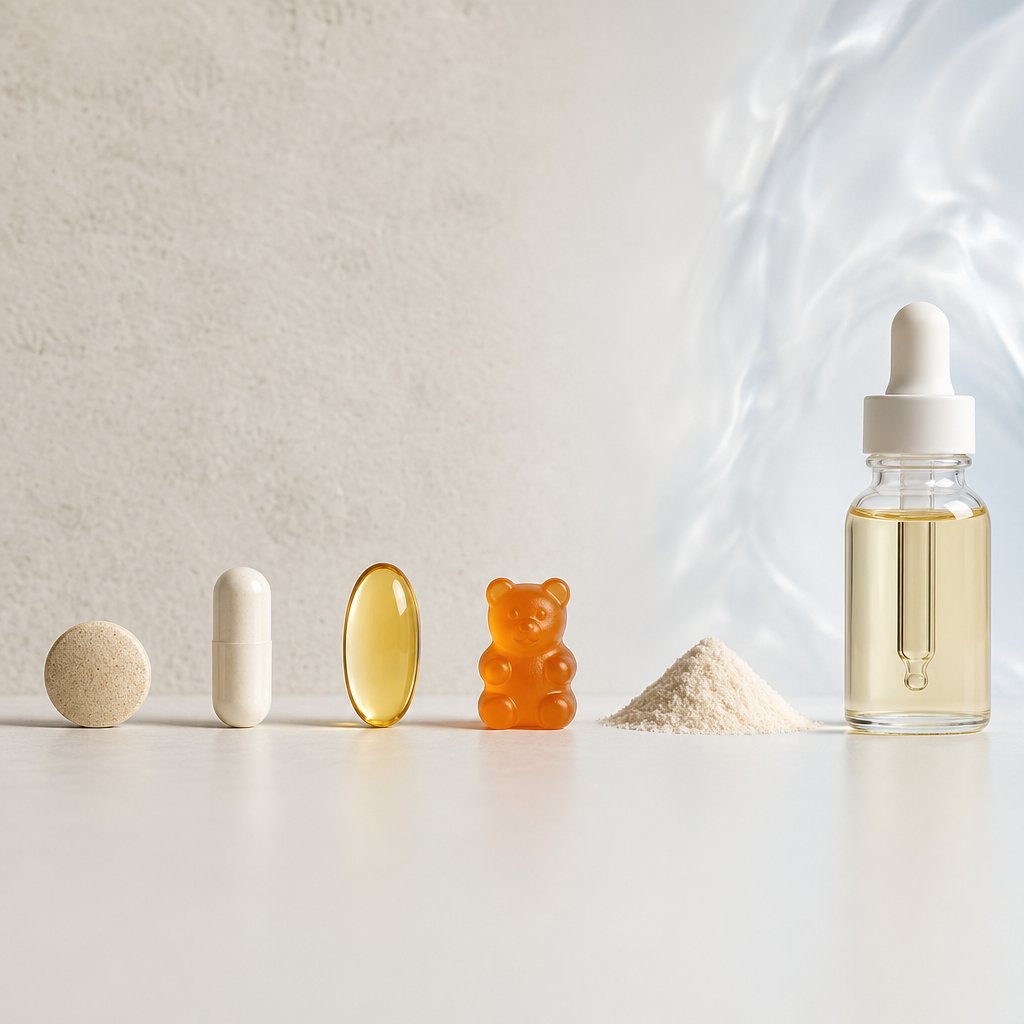
How Tablet, Capsule, Gummy and Liquid Forms Compare
The previous breakdown made something clear: the nutrient inside the bottle is only half the shelf-life equation. The other half is the physical format that nutrient is delivered in. A vitamin C compressed tablet and a vitamin C gummy contain the same active ingredient, yet they degrade at very different rates under identical storage conditions. So do vitamin c pills expire at the same pace as vitamin C gummies? Not even close. Format is the variable most consumers overlook, and it has a direct impact on how long any supplement stays effective.
Why Tablets and Hard Capsules Lead in Shelf Stability
Tablets earn their reputation as the most shelf-stable common supplement form for three structural reasons. First, the compression process used during manufacturing squeezes out nearly all moisture from the finished product. Low internal moisture content means fewer water molecules available to trigger hydrolysis, the chemical reaction that breaks down active ingredients. Second, that same compression creates a dense, tightly packed structure with minimal surface area exposed to air. Less exposed surface means less opportunity for oxygen to initiate oxidation reactions. Third, the binder systems holding a tablet together, typically cellulose derivatives, stearic acid, or silicon dioxide, form a stable matrix that resists environmental degradation.
The result is a format that, as Lyfe Group's oral dosage comparison notes, retains potency for a longer period of time than liquids, powders, and most capsules. Do multivitamins expire more slowly in tablet form than in other formats? They do, and this is the primary reason.
Hard capsules, whether made from gelatin or HPMC (hydroxypropyl methylcellulose), offer comparable stability. The two-piece shell acts as an additional physical barrier against moisture and oxygen, enclosing the powdered or granulated fill inside a sealed environment. HPMC capsules have particularly low moisture content, typically between 3 and 7 percent, which gives them an edge in humid climates. Do supplements expire at different rates depending on capsule material? The shell composition does matter, and plant-based HPMC shells tend to offer slightly better moisture resistance than traditional gelatin in high-humidity conditions.
Where Gummies, Liquids, and Powders Fall Short
Gummies sit at the opposite end of the stability spectrum among solid supplement forms. Can gummy vitamins go bad faster than tablets? They can, and the reasons are baked into their formulation. Gummies require sugar or sugar substitutes, gelatin or pectin, water, and flavoring agents to achieve their candy-like texture. That recipe means higher moisture content, typically 10 to 15 percent or more, compared to the near-zero moisture in a compressed tablet. Do vitamin gummies expire faster because of this moisture? Yes. Water activity inside the gummy provides a hospitable environment for both chemical degradation and microbial growth. Heat compounds the problem: gummies stored in warm environments can melt, fuse together, and undergo accelerated nutrient breakdown. Do gummy vitamins expire in a way that is noticeable? Often, yes. Texture changes, stickiness, crystallized sugar on the surface, and off-flavors are common signs that a gummy has degraded beyond its useful life.
Softgels present a more nuanced picture. For dry compounds, the sealed one-piece gelatin shell provides excellent protection, and softgels can actually have a longer shelf life than two-piece hard capsules because they are completely air-tight. The vulnerability appears when the fill is an oil, as it is with fish oil, omega-3, and vitamin E softgels. Do fish oil pills expire differently than dry-fill softgels? They do. The polyunsaturated fatty acids inside oil-filled softgels are highly susceptible to oxidation, and once that process starts, it produces the rancid byproducts discussed earlier. Do fish oil capsules expire faster than a vitamin D tablet? Significantly, and the concern shifts from potency loss to potential safety risk.
Powders and granules have a large surface-area-to-volume ratio, which means more of the active ingredient is directly exposed to air, moisture, and light. Every time you open the container and scoop out a serving, you introduce fresh oxygen and ambient humidity. This makes powdered supplements more vulnerable to degradation than their compressed tablet equivalents, even when the active ingredient is identical.
Liquid supplements, including oral solutions and syrups, are the most susceptible format of all. The active ingredients are already dissolved, which increases their chemical reactivity. Water activity in liquid formulations is high, accelerating hydrolysis and providing conditions for microbial growth. As Texas Health Resources points out, liquid supplements often have a shorter shelf life and may require refrigeration, a tradeoff for their potentially higher absorption rates. The convenience of a liquid format comes at the cost of a tighter expiration window.
The table below lines up the major supplement formats by shelf stability so you can see the tradeoffs at a glance:
| Supplement Form | Relative Shelf Life | Key Stability Advantage | Primary Degradation Risk |
|---|---|---|---|
| Tablets | Longest (2-3+ years) | Low moisture, compressed density, stable binder matrix | Minimal — moisture ingress if packaging is compromised |
| Hard Capsules (gelatin/HPMC) | Long (2-3 years) | Sealed two-piece shell provides moisture and oxygen barrier | Shell can become brittle or sticky in extreme humidity |
| Softgels (dry fill) | Long (2-3 years) | Air-tight one-piece seal; excellent for non-oil compounds | Gelatin shell sensitive to high heat and humidity |
| Softgels (oil fill) | Moderate (1-2 years) | Sealed format slows but does not prevent oil oxidation | Oxidation and rancidity of polyunsaturated oil fills |
| Gummies | Shorter (1-2 years) | Consumer-friendly taste and format drive compliance | High moisture content, sugar matrix, heat sensitivity, microbial risk |
| Powders / Granules | Moderate (1-2 years) | Flexible dosing; no shell or binder limitations | Large surface area exposed to humidity and oxygen |
| Oral Liquids | Shortest (6-18 months) | High bioavailability; easy to swallow | High water activity, hydrolysis, microbial growth, requires refrigeration |
These differences are not accidental. They are engineered. Supplement manufacturers who produce across multiple formats, including hard capsules, tablets, powder and granules, soft capsules, gummy candy, and oral liquids, must design distinct stability profiles for each one. The formulation decisions made during product development, such as selecting the right binder system for a tablet or choosing between gelatin and HPMC for a capsule shell, directly determine the expiration timeline that ends up printed on the bottle. Stability testing performed under controlled temperature, humidity, and light conditions is what validates those decisions, and the rigor of that testing varies considerably across the industry.
This is where the choice of manufacturing partner becomes a practical factor for supplement brands. OEM/ODM manufacturers like ZhuFeng, which offer customized formulation across all major product formats, help brands select the optimal delivery form based on both target market preferences and shelf-life requirements. When a contract manufacturer has hands-on experience engineering stability across tablets, capsules, gummies, powders, softgels, and oral liquids, the formulation accounts for how each active ingredient behaves in each specific format. That upstream expertise is what separates a product that holds its potency through the printed date from one that falls short months early.
Format selection, then, is not just a consumer preference decision. It is a stability decision that gets locked in at the manufacturing stage. And once you understand how format shapes shelf life, the next logical question is what the dates printed on those bottles actually mean, because not all date labels communicate the same thing.
Reading Date Labels on Your Vitamin Bottles
Flip over any supplement bottle and you will find a date stamped somewhere on the label, the bottom, or the lid. Most people glance at it, do a quick mental comparison to today's date, and make a snap judgment: keep or toss. The problem is that not every date on a vitamin bottle means the same thing. Different labels carry different implications, and confusing them leads to either throwing away perfectly usable supplements or placing too much trust in a product that has quietly lost its edge.
Understanding what each date type actually communicates is one of the simplest ways to make smarter decisions about the vitamins and expiration dates on your shelf. Here is what each label means and, just as importantly, what it does not.
Expiration Date vs Best-By Date vs Use-By Date
You will encounter up to four different date formats on supplement packaging. They look similar, but each one tells you something distinct:
- Expiration date (EXP): The manufacturer's guarantee that the product meets its full labeled potency through this date. After this point, the active ingredients may fall below the amounts stated on the Supplement Facts panel. This is the strongest date claim a supplement can carry.
- Best-by or best-before date: An indication of when the manufacturer expects the product to maintain optimal quality and effectiveness. As Brickhouse Nutrition explains, best-by dates are more conservative than actual expiration dates and primarily relate to product effectiveness rather than safety. A supplement past its best-by date has not crossed a danger line. It has crossed a quality line.
- Use-by date: A stronger recommendation to consume the product before this point. Use-by dates are less common on dietary supplements and more typical of food products and infant formula. When they do appear on supplements, they suggest a tighter window for optimal results.
- Manufacturing date (MFG) or lot code: The date the product was produced, sometimes embedded within a lot number rather than printed as a standalone date. This is useful for calculating how old a product actually is, especially when no expiration or best-by date is present. Lot numbers also serve a practical purpose: they allow you to report issues to the manufacturer or identify your product during a recall.
These four labels are not interchangeable. A best-by date is not an expiration date with a different name. A manufacturing date tells you when the clock started, not when it runs out. Treating them as identical leads to two opposite mistakes: discarding supplements that still have months of useful life, or assuming a product is fine simply because a vaguely worded date has not passed yet.
How long can you use vitamins after the expiration date? There is no universal answer, because it depends on the nutrient, the format, and how the product was stored. A vitamin D tablet in a sealed bottle kept in a cool drawer may retain meaningful potency for months past its printed date. A vitamin C chewable stored in a humid bathroom may have already lost significant strength before the date arrives. The printed date is a starting point for your decision, not the final word.
Even specific branded products illustrate this variability. If you check a Berocca expiry date, for example, you are looking at a date set by that manufacturer based on their own stability testing of a particular B-vitamin and vitamin C effervescent formulation. That date reflects the unique degradation profile of that specific product in that specific format, not a universal rule for all B-vitamin supplements everywhere.
What the FDA Does and Does Not Require
Here is the regulatory detail that surprises most consumers: the dates on your supplement bottles are voluntary.
The FDA does not require dietary supplement manufacturers to include expiration dates on their labels. Unlike pharmaceutical drugs, which must carry expiration dating backed by mandatory stability testing, supplements operate under a different regulatory framework where date labeling is the manufacturer's choice.
This distinction comes directly from how supplements are classified under federal law. The Dietary Supplement Health and Education Act (DSHEA) amended the Federal Food, Drug, and Cosmetic Act to define dietary supplements as a category of "food" for most regulatory purposes. Because they are food, not drugs, the rigorous expiration dating requirements that apply to prescription and over-the-counter medications do not extend to them.
That said, the FDA's Current Good Manufacturing Practice (CGMP) regulations do impose one important condition: if a manufacturer chooses to print a vitamin expiration date or vitamin expiry date on the label, they must have stability data to back it up. The product must maintain its stated strength, quality, and purity through that date. In other words, you cannot slap an arbitrary date on a bottle. But you also are not required to put a date on it at all.
What does this regulatory gap mean for you as a consumer? A few practical things:
- Some bottles may have no date at all. The absence of a date does not mean the product lasts forever. It means the manufacturer chose not to include one, which could reflect a lack of stability testing rather than exceptional shelf life.
- The rigor behind printed dates varies. A large manufacturer with in-house analytical labs running accelerated and real-time stability studies will produce a more reliable date than a smaller operation relying on minimal testing. The date on the bottle is only as trustworthy as the science behind it.
- Voluntary does not mean meaningless. Reputable manufacturers include expiration dates precisely because they have invested in the stability testing to support them. A printed date from a quality-focused brand is a genuine signal of how long the product will deliver what it promises.
This regulatory landscape also explains why the supplement industry has been moving toward greater transparency on its own. Both the FDA and USDA have recommended that food industry members, including supplement manufacturers, adopt clearer date labeling practices to reduce consumer confusion and unnecessary waste. The push toward standardized "Best if Used By" language on food products reflects a broader recognition that inconsistent date labels lead people to discard safe, effective products prematurely.
The bottom line: a vitamin expiration date is a potency guarantee backed by stability data, a best-by date is a quality recommendation, and the absence of any date is itself a piece of information worth weighing. Knowing which type of date you are reading, and understanding the regulatory context behind it, puts you in a much stronger position to judge whether a supplement still deserves a place in your routine.
Of course, dates only tell part of the story. A printed label cannot account for how a product was actually stored after it left the warehouse. Sometimes the most reliable way to evaluate a supplement is not the date on the bottle but the physical condition of what is inside it.
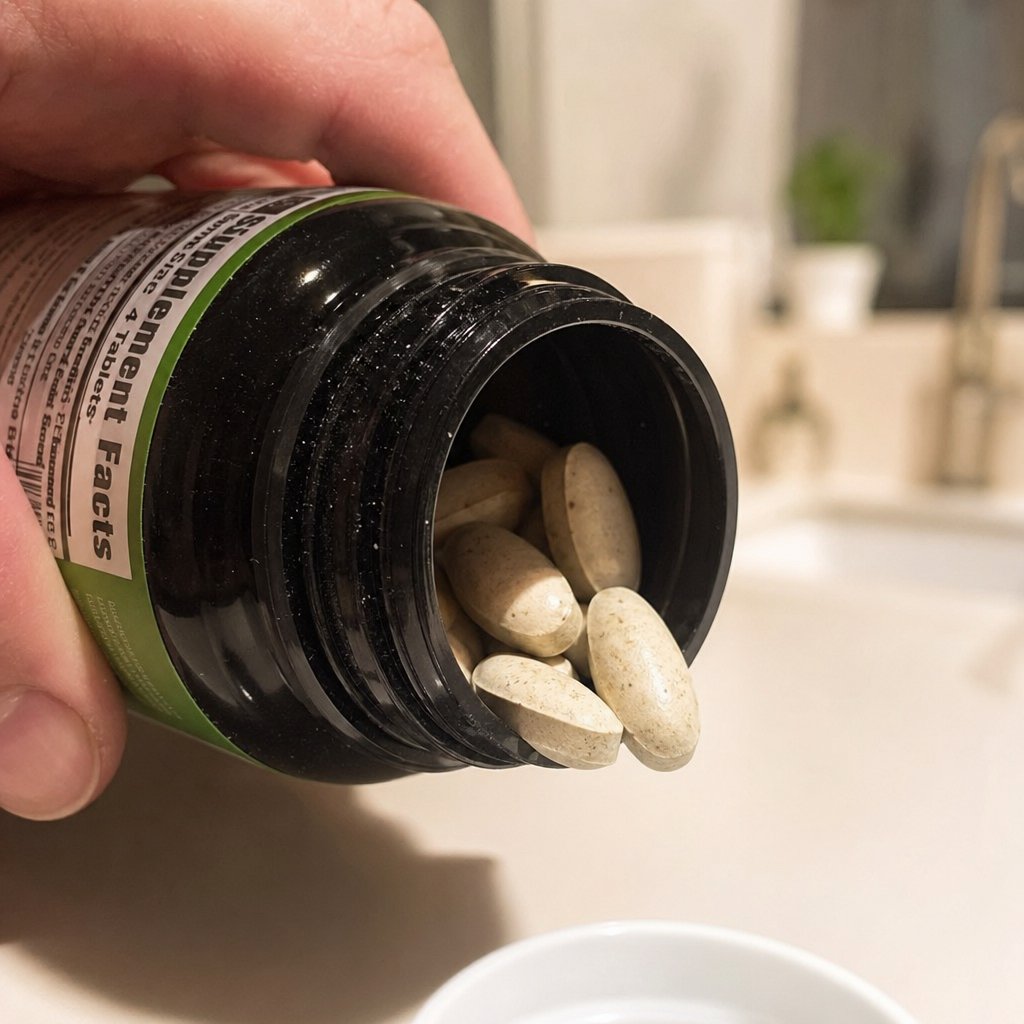
Visible Signs That Your Vitamins Have Gone Bad
A printed date gives you a timeline, but your own senses can give you a verdict. Do vitamins go bad in ways you can actually detect without a lab? In many cases, yes. Physical changes in a supplement's appearance, texture, and smell are reliable indicators that degradation has progressed past the point of usefulness. Learning to spot these cues turns every bottle in your cabinet into its own quality check.
What Degraded Tablets and Capsules Look Like
Visual and tactile inspection is the fastest way to evaluate whether out of date vitamins are still worth taking. Each supplement form shows degradation differently, and knowing what to look for saves you from guessing.
Can supplements go bad in ways that are obvious to the naked eye? Often, yes. A tablet that crumbles when you press it lightly or chips apart when you pour it from the bottle has experienced binder breakdown, usually from prolonged moisture exposure. Discoloration is another clear signal. Dark spots, yellowing, or an uneven color across the tablet surface point to oxidation or chemical degradation of the active ingredients. Capsule shells that have become brittle, cracked, sticky, or visibly swollen have lost their protective barrier, meaning the fill inside has likely been exposed to air and humidity for an extended period.
Softgels deserve their own scrutiny. Does fish oil go bad in a way you can see? Sometimes. Oil-filled softgels that have turned cloudy, leaked, or stuck together in clumps are showing signs of shell degradation and potential oxidation of the oil inside. As OmegaQuant notes, a mild fishy smell from fish oil is normal, but a strong odor of fish gone bad is a clear tell that the product has turned rancid.
Gummies show degradation most dramatically. They may melt together into a single mass, harden into something closer to a rock than a chewable, or develop a grainy, crystallized sugar coating on the surface. Any of these changes signals that the moisture balance and sugar matrix have broken down, and the active ingredients inside have almost certainly followed.
Smell and Texture Cues You Should Not Ignore
Your nose is a surprisingly effective quality control tool. An unusual or strong chemical smell from any supplement, especially B-vitamin complexes, which naturally have a mild yeasty odor, suggests chemical breakdown has accelerated. Fish oil softgels that produce a sharp, rancid stench when you break one open should be discarded immediately, along with the rest of the bottle.
Powders that have clumped into hard, solid masses rather than flowing freely have absorbed significant moisture. That moisture does not just make the powder inconvenient to use. It actively drives hydrolysis of the active ingredients, meaning potency has likely dropped well below label claims. Liquids that have changed color, separated into visible layers, or developed sediment at the bottom are showing signs of chemical instability or microbial activity.
Are expired vitamins still good if none of these signs are present? Possibly, but the absence of visible degradation does not guarantee full potency. A tablet can look and smell perfectly normal while its active ingredients have quietly declined below therapeutic levels. Sensory inspection catches the obvious failures. It cannot catch the subtle ones.
Use this checklist as a quick-reference discard guide organized by supplement form:
- Tablets: crumbling, chipping, powdery residue in the bottle, dark spots, discoloration, or unusual chemical odor
- Hard capsules: brittle or cracked shells, sticky or swollen shells, powder leaking from seams, off-putting smell when opened
- Softgels: cloudy or leaking fill, capsules stuck together, strong rancid odor (especially fish oil and omega-3 products)
- Gummies: melted together, hardened or rock-like texture, grainy or crystallized surface, off-flavors, or mold
- Powders: hard clumps that do not break apart easily, color changes, or strong unusual smell
- Liquids: color change, visible separation or layering, sediment at the bottom, cloudiness, or sour and off odors
Does vitamin water expire in the same detectable way? Vitamin-fortified beverages follow similar principles to liquid supplements. Color shifts, off-tastes, and cloudiness all suggest the added nutrients and flavoring compounds have degraded. The high water activity in these products makes them more perishable than dry supplement forms, so sensory changes tend to appear earlier and more obviously.
When do vitamins go out of date in a way that truly matters? The moment any of the signs above appear, the product has crossed from "possibly diminished" into "reliably degraded." Discard it. The cost of a replacement bottle is always less than the cost of taking something that no longer delivers what your body needs.
Catching degradation after it happens is useful, but preventing it in the first place is better. The way you store your supplements, down to which room you keep them in and whether you leave the cap loose, has a measurable impact on how long they stay effective.
Storage Tips That Actually Extend Shelf Life
"Store in a cool, dry place." You have read that line on every supplement bottle you have ever owned. It is technically correct, but it is also vague enough to be almost useless. What counts as cool? How dry is dry enough? And does the same advice apply to a compressed iron tablet and a liquid probiotic? It does not. How long do vitamins last depends less on the nutrient inside and more on the specific storage decisions you make every day, many of which seem harmless but quietly accelerate degradation.
The guidance below goes beyond the generic label instruction. It is organized by supplement form, because each format has its own environmental weak points, and paired with the most common storage mistakes that shorten shelf life faster than most people realize.
Storage Rules by Supplement Form
Tablets and hard capsules are the easiest to store correctly because they are the most forgiving format. Keep them at room temperature, ideally between 15 and 25 degrees Celsius (59 to 77 degrees Fahrenheit), in their original container with the lid tightly secured. That small desiccant packet tucked inside the bottle? Leave it there. It absorbs ambient moisture every time you open the cap, and removing it eliminates a layer of protection the manufacturer included for a reason. Natural Factors emphasizes that supplement manufacturers use specific packaging to protect their products, and discarding the original container or its desiccant can increase exposure to light, air, and moisture. How long do multivitamins last under these conditions? In tablet form, typically two to three years or more from the manufacturing date, making them one of the lowest-maintenance supplements to store.
Softgels and fish oil capsules need a bit more attention. Unopened bottles stored in a cool, dark cabinet are fine at room temperature. Once opened, however, consider moving fish oil and omega-3 softgels to the refrigerator. The cooler temperature slows oxidation of the polyunsaturated fatty acids inside the oil fill. As registered dietitian Melissa Groves Azzaro explains, a cooler temperature protects delicate oils from becoming rancid, lengthens the life of the supplement's potency, and slows potential microbial growth. The same logic applies to flaxseed oil and evening primrose oil softgels. Does magnesium expire faster in softgel form than in tablet form? Magnesium itself is a mineral with excellent stability, but if it is delivered in an oil-based softgel, the carrier oil becomes the weak link. A dry magnesium tablet stored at room temperature will outlast an oil-filled softgel under the same conditions.
Gummies demand the tightest environmental control among solid supplement forms. Their high sugar and gelatin content actively attracts moisture from the surrounding air, and heat causes them to melt, fuse, and degrade rapidly. Keep gummy bottles sealed as tightly as possible and store them in the coolest room available, never near a window, radiator, or kitchen appliance. Refrigeration is not typically recommended for gummies because the excess moisture inside a refrigerator can actually accelerate their breakdown, a point Natural Factors highlights as a common misconception. The goal is cool and dry, not cold and damp.
Probiotics are the supplement category where storage instructions matter most, because you are keeping living organisms alive, not just preserving a chemical compound. How long do probiotics last after expiration date? That depends almost entirely on how they were stored. Many traditional strains, particularly Lactobacillus and Bifidobacterium, are highly sensitive to heat and need refrigeration to survive. However, not all probiotics require cold storage. Shelf-stable probiotics use freeze-dried organisms that can remain viable at room temperature, sometimes for up to two years. The label is your definitive guide here. If it says refrigerate, refrigerate. If it says shelf-stable, a cool, dry cabinet is sufficient. One red flag worth watching for: if a probiotic label says it requires refrigeration but you find it sitting on an unrefrigerated store shelf, or it arrives shipped without ice, assume the potency has already declined significantly.
Powders and granules have a large surface area exposed to whatever is in the air around them. Every time you open the container, you introduce fresh oxygen and ambient humidity. Use the included scoop, reseal the container immediately after each use, and avoid reaching in with wet hands or a damp utensil. Does Emergen-C expire faster than a standard vitamin C tablet? It does, and the powdered format is a major reason why. Effervescent powder formulations like Emergen-C have more surface area and often contain moisture-sensitive ingredients like citric acid and sodium bicarbonate that react with humidity. Expired Emergen-C packets that have been stored in a humid environment, such as a bathroom cabinet or a gym bag, are likely to have lost substantial potency well before their printed date, let alone after it.
Liquid supplements are the most perishable format. Refrigerate them after opening and use them within the timeframe specified on the label, which is often 30 to 90 days. Does liquid IV expire faster than a dry tablet equivalent? The high water activity in liquid formulations accelerates hydrolysis and creates conditions for microbial growth, so yes, the shelf life is considerably shorter. Liquid iron, liquid B-complex, and liquid multivitamins all benefit from refrigeration to slow oxidative processes and preserve taste.
The table below consolidates the ideal storage approach for each format:
| Supplement Form | Ideal Storage Conditions | Biggest Storage Threat | Pro Tip |
|---|---|---|---|
| Tablets | Room temp (15-25°C / 59-77°F), original container, lid tight | Moisture ingress from humid rooms | Keep the desiccant packet inside the bottle |
| Hard Capsules | Room temp, original container, away from direct light | Humidity causing shell brittleness or stickiness | HPMC shells handle humidity better than gelatin |
| Softgels (oil fill) | Room temp unopened; refrigerate after opening | Oxidation of polyunsaturated oil fills | Move fish oil and flaxseed oil to the fridge once opened |
| Gummies | Cool room temp, tightly sealed, away from heat sources | Heat and moisture causing melting and microbial growth | Do not refrigerate — fridge moisture can accelerate breakdown |
| Probiotics | Refrigerate if label says so; shelf-stable strains at room temp | Heat killing live organisms | Check that the store and shipper kept it cold if refrigeration is required |
| Powders / Granules | Room temp, tightly resealed after each use | Humidity causing clumping and hydrolysis | Never use a wet scoop or reach in with damp hands |
| Oral Liquids | Refrigerate after opening; use within 30-90 days | Hydrolysis and microbial growth from high water activity | Mark the opening date on the bottle with a permanent marker |
Common Storage Mistakes That Shorten Shelf Life
Even people who know the basics often undermine their supplements through habits that seem harmless. Here are the most common ones:
- Storing supplements in the bathroom. It feels logical since that is where the medicine cabinet lives. But bathrooms experience dramatic humidity and temperature swings every time someone showers. Research has shown that warm, humid environments cause water-soluble nutrients like vitamin C and B vitamins to degrade, even when container lids are kept on properly. A bedroom drawer or a hallway closet is a far better choice.
- Keeping bottles near the stove or on kitchen counters. Kitchens rival bathrooms for temperature and moisture fluctuations. Microwaves, dishwashers, stovetops, and ovens all generate heat that radiates to nearby surfaces. A supplement bottle sitting on the counter above a dishwasher is absorbing steam with every cycle.
- Transferring pills to weekly organizers too far in advance. Pill organizers are convenient, but they strip away the original packaging, desiccant, and airtight seal that protect the supplement. Loading a month's worth of vitamins into a plastic organizer exposes every dose to air and light for weeks before you take it. If you use an organizer, fill it no more than a week at a time.
- Leaving bottles in cars or gym bags. A car parked in the sun can reach interior temperatures well above 40 degrees Celsius (104 degrees Fahrenheit). Even a gym bag left in a locker room exposes supplements to heat and humidity cycles that accelerate degradation. Carry only what you need for the day and return the bottle to proper storage.
- Throwing away the desiccant packet. That small silica gel sachet is not packing material. It is an active moisture absorber designed to protect the contents for the life of the bottle. Removing it is one of the most common and most easily avoidable storage mistakes.
Good storage habits will not make a supplement last forever, but they can meaningfully extend how long it delivers its full labeled potency. And that potency guarantee itself is not arbitrary. Behind every printed expiration date is a manufacturing practice called overage, an industry technique that most consumers have never heard of but that directly determines whether the vitamins in your bottle are still working months or even years down the road.

What Overage Means and How Manufacturers Protect Potency
Ever wonder why a vitamin tablet can still seem effective a few months past its printed date? The answer is not luck or conservative labeling. It is a deliberate manufacturing practice called overage, and it is one of the most important yet least understood factors behind how long are vitamins good after expiration date.
Overage is exactly what it sounds like: manufacturers intentionally add more of an active ingredient than the label states at the time of production. If a tablet claims 1,000 mg of vitamin C on the Supplement Facts panel, the actual amount loaded into that tablet at the factory might be 1,200 mg or even 1,300 mg. That surplus is not an accident or a bonus. It is a calculated buffer designed to offset the inevitable potency loss that occurs between the day the product is made and the day the expiration date arrives.
How Overage Keeps Vitamins Potent Through Their Shelf Life
The logic is straightforward. FDA regulations require dietary supplements to contain 100 percent of the ingredients listed on the label throughout the entire shelf life. Since every active ingredient degrades to some degree over time, the only way to meet that requirement at month 24 or month 36 is to start above 100 percent on day one. The gap between the starting amount and the label claim is the overage.
How much overage a product needs depends on several interconnected factors. Aaron Secrist, vice president of quality and regulatory affairs at NOW Foods, explained that vitamin C is a prime example: "Vitamin C is something that's going to have a tendency to break down relatively quickly, especially in a liquid environment — very, very quickly. You have to put in overages, sometimes really high overages in a liquid environment, to make sure you hit that 100% at the end of shelf life." A stable mineral like iron or calcium might need only a modest surplus, while a fast-degrading nutrient like ascorbic acid or thiamine could require 20 to 30 percent extra to survive the full shelf-life window.
Dosage form matters too. Secrist noted that active ingredients degrade at different rates depending on surface area and oxygen exposure, so overages are different across tablets, capsules, softgels, powders, and liquids. A compressed tablet with minimal moisture and low surface area needs less overage than a liquid formulation where the same ingredient is dissolved and fully exposed to water activity and oxygen.
Manufacturing variability adds another layer. Every encapsulation or tableting machine operates within a tolerance range. If a capsule is supposed to contain 300 mg of an ingredient but the equipment fluctuates plus or minus 10 percent, the target fill weight needs to be set at 330 mg to ensure no individual unit falls below the label claim. Analytical testing methods introduce their own margin of uncertainty on top of that. A test result might read 295 mg when the actual content is 330 mg, simply because of inherent method variability. Overage accounts for all of these compounding tolerances.
The printed expiration date is the end of a guaranteed potency window, not the moment a supplement becomes worthless. Because of overage, the actual nutrient content on the day of manufacture is intentionally higher than what the label states, which is why are vitamins good after expiration date in many cases — the surplus has not fully depleted yet.
This is the direct answer to a question millions of people search for: are vitamins still good after expiration date? For products made with properly calculated overages, the answer is often yes in the short term. The tablet did not suddenly lose all its potency at midnight on the printed date. It crossed below the threshold where the manufacturer can guarantee it still meets the full label claim. Some residual overage may remain for weeks or months beyond that point, depending on the nutrient, the format, and storage conditions.
Why Manufacturing Quality Determines Real-World Expiration
Here is where the picture gets more complicated. Overage only works if it is calculated correctly, and the quality of those calculations varies enormously across the supplement industry.
Reputable manufacturers determine overage levels through rigorous stability testing that subjects finished products to controlled temperature, humidity, and light conditions over extended periods. The gold standard involves both accelerated studies, which expose products to harsh conditions to predict degradation trends, and real-time studies that monitor potency under normal storage conditions for 12 months or longer. Andrew Shao, Ph.D., of the Council for Responsible Nutrition, cautioned that accelerated studies alone are not sufficient: "What manufacturers should do is start out with accelerated, but ultimately rely on what they call 'real time stability,' which is just monitoring the stability of the ingredients under ambient conditions."
The difference between a well-tested overage and a guess has real consequences for consumers. Secrist offered a telling example: a product claiming 1,000 mg of vitamin C that needs 30 percent overage to survive its two-year shelf life should have a release specification of 1,300 mg. "If your stability shows you have to have 1,300 mg, 1,000 mg is not going to cut it. You're not going to make it to the end of the shelf life." Manufacturers that set their release specification at the label claim rather than the overage-adjusted target are essentially guaranteeing their product will fall short before the printed date arrives.
Can vitamin supplements expire before their labeled date? They absolutely can, and this is the most common way it happens. A manufacturer without robust stability data may underestimate the overage needed, or skip real-time testing entirely and rely on rough estimates. The result is expired vitamin supplements that were already below label claims months before the consumer ever checked the date.
Formulation expertise also plays a role in reducing the amount of overage needed in the first place. Smart ingredient combinations, protective coatings, and packaging choices can slow degradation and lower the surplus required. Shao pointed out that certain metals can accelerate oxidation of other ingredients, so keeping them physically separated within a formulation extends shelf life and reduces overage demands. Packaging that limits light and oxygen exposure achieves the same effect. These are not afterthoughts. They are engineering decisions made during product development that directly shape how long vitamins good after expiration date remain meaningful.
This is where the choice of manufacturing partner becomes a tangible quality differentiator for supplement brands. OEM/ODM manufacturers like ZhuFeng build overage calculations into their customized formulations during product development, running stability testing across their full range of product formats — tablets, hard capsules, soft capsules, powders, gummies, and oral liquids — to determine appropriate overage levels for each active ingredient in each specific delivery form. Brands working with experienced contract manufacturers benefit from this depth of formulation expertise, because the overage decisions made at the factory directly impact how long the finished product remains effective for the person opening the bottle at home. For consumers, this connection between upstream manufacturing quality and downstream supplement performance is worth understanding: the brand name on the front of the bottle matters, but the manufacturer behind it often matters more.
So are vitamins good after expiration date how long, exactly? There is no single number that applies across the board. A well-formulated vitamin D tablet from a manufacturer with thorough stability testing and appropriate overage might retain meaningful potency for several months past its date. A poorly formulated vitamin C gummy from a manufacturer that skimped on testing might fall below its label claim before the date even arrives. The expiration date is only as reliable as the science and manufacturing discipline behind it.
What you can take away as a practical rule: supplements from brands that work with quality-focused manufacturers, invest in real stability data, and use appropriate overages are more likely to deliver how long are vitamins good past expiration date in a way that still benefits you. Products from less rigorous sources carry more uncertainty, and the printed date on those bottles deserves less trust, not more.
Frequently Asked Questions About Vitamin Tablet Expiration
1. Is it safe to take vitamins after the expiration date?
For most vitamin tablets and mineral supplements, taking them shortly after expiration poses no safety risk. The primary concern is reduced potency rather than toxicity. Your expired multivitamin or vitamin D tablet will not harm you, but it may deliver less of the nutrient than the label promises. The exception is fish oil and omega-3 softgels, which can turn rancid through oxidation and potentially trigger inflammatory responses. As a general rule, potency-loss-only supplements like tablets and hard capsules are safe past their date, while oil-based softgels and liquid probiotics should be discarded once expired.
2. How long are vitamins good after the expiration date?
There is no universal timeframe because it depends on the nutrient, the supplement form, and storage conditions. Vitamin D and mineral tablets stored in cool, dry environments may retain meaningful potency for several months beyond their printed date due to a manufacturing practice called overage, where extra active ingredient is added at production to offset natural degradation. Vitamin C and B1 degrade faster and may lose significant strength within weeks to months past expiration. Products from manufacturers with rigorous stability testing and appropriate overage calculations, such as OEM/ODM partners like ZhuFeng who engineer formulations across multiple formats, tend to hold potency longer past their printed dates.
3. What happens if you take expired vitamins?
In most cases, nothing harmful happens. Expired vitamin tablets simply deliver a reduced dose of the active ingredient. You will not feel sick or experience adverse effects from a standard expired multivitamin, vitamin D tablet, or B-complex capsule. The real risk is a hidden one: if you rely on that supplement to address a nutritional deficiency, the diminished potency could allow the deficiency to worsen without obvious symptoms. For fish oil softgels specifically, consuming rancid oxidized oils may increase oxidative stress in the body, which is the opposite of the intended anti-inflammatory benefit.
4. Do gummy vitamins expire faster than tablets?
Yes, gummy vitamins degrade noticeably faster than compressed tablets. Gummies contain 10 to 15 percent moisture or more, along with sugar and gelatin that attract additional humidity from the air. This high water activity accelerates chemical breakdown of active ingredients and creates conditions for microbial growth. Tablets, by contrast, have near-zero moisture content and a dense compressed structure that minimizes surface area exposed to air. Under identical storage conditions, a vitamin C tablet will retain its potency significantly longer than a vitamin C gummy. This is why supplement format selection at the manufacturing stage directly impacts the expiration timeline consumers see on the bottle.
5. How should I store vitamins to make them last longer?
Keep tablets and hard capsules in their original container with the lid tightly closed, at room temperature between 15 and 25 degrees Celsius, and retain the desiccant packet inside the bottle. Avoid bathrooms, kitchens near stoves, cars, and windowsills where heat and humidity fluctuate. For fish oil softgels, refrigerate after opening to slow oxidation. Probiotics requiring refrigeration must stay cold from purchase through use. Never transfer supplements into weekly pill organizers more than seven days in advance, as this removes the protective packaging. These habits can meaningfully extend how long your supplements deliver their full labeled potency.