Garlic Powder for 3 Cloves at a Glance
Three cloves of garlic equals 3/8 teaspoon of garlic powder, which is just under half a teaspoon. That is the number you need, and here is exactly how it works.
The Short Answer for 3 Cloves
3 cloves of garlic = 3/8 teaspoon garlic powder (just under 1/2 teaspoon)
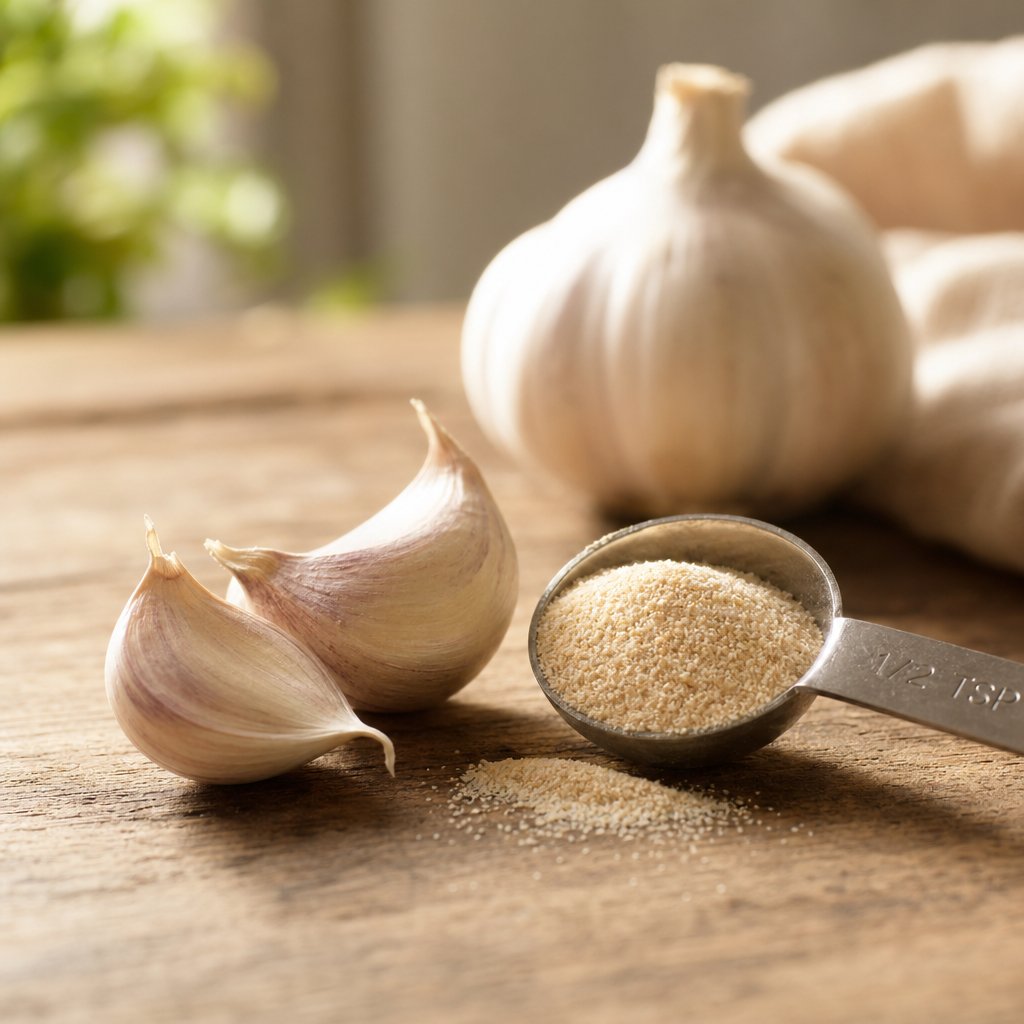
The math behind this is straightforward. The standard kitchen conversion is 1/8 teaspoon of garlic powder per clove of fresh garlic. Multiply that by three and you land on 3/8 teaspoon. If you do not have a 1/8 teaspoon measure handy, just scoop a half teaspoon and remove a small pinch. That gets you close enough for any home recipe.
So how much garlic powder equals one clove of garlic? Exactly 1/8 teaspoon. And how much garlic powder equals 1 clove garlic when the clove is on the larger side? You might nudge that closer to a flat 1/4 teaspoon. The single-clove ratio is the building block for every multi-clove conversion, which is why getting it right matters.
Why This Ratio Is Your Starting Point
This 3/8 teaspoon figure assumes two things: medium-sized cloves (roughly 4 to 5 grams each) and a standard-grind garlic powder with a flour-like texture. Change either variable and the amount shifts. Smaller cloves carry less flavor, so you would use a bit less powder. Larger cloves pack more punch, pushing you toward a full 1/2 teaspoon. The grind of the powder matters too. An ultra-fine industrial grind concentrates flavor even further, meaning you could overshoot with the same measured amount.
Knowing how much garlic powder equals 1 clove of garlic gives you a reliable anchor, but real-world cooking rarely follows a single rule. Clove size varies from bulb to bulb, garlic powder loses potency over time, and different recipes respond to the substitution in different ways. The ratio is your starting point, not the final word.
Speaking of variables, one of the most common mix-ups happens before you even reach for a measuring spoon. It starts with a simple question: what exactly counts as a clove?
What Exactly Is a Clove of Garlic
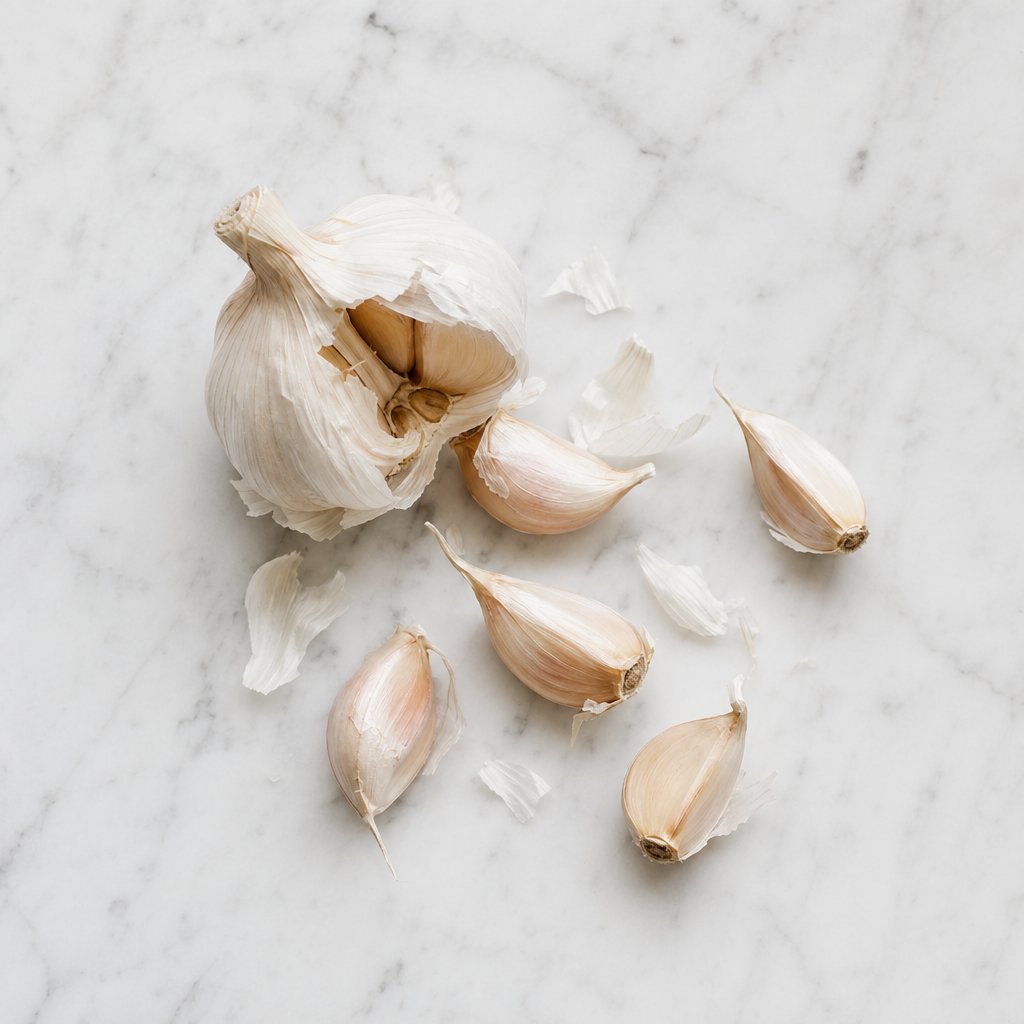
Imagine you are reading a recipe that calls for "3 cloves of garlic." You grab a whole garlic bulb from the counter and wonder: is this the clove, or is something smaller hiding inside? Getting this wrong does not just throw off your garlic powder conversion. It can wreck an entire dish.
Clove vs Head of Garlic
So what is a garlic clove? A clove of garlic is a single wedge-shaped segment wrapped in its own thin, papery skin. Several of these segments cluster together to form the full bulb, which is commonly called the head. Peel back the outer layers of a head and you will find the individual cloves nestled inside, each one ready to be snapped off and used on its own.
How many cloves are in a head of garlic? A typical head holds about 10 to 12 cloves, though that number shifts depending on the variety and size of the bulb. Some smaller heads may contain as few as 6, while larger ones can pack 15 or more.
Here is a quick visual breakdown:
- 1 clove = one small, wedge-shaped segment with its own skin
- 1 head = the entire bulb containing all the cloves
Why does this distinction matter so much for powder conversions? If a recipe calls for 3 cloves of garlic and you accidentally substitute powder for an entire head, you are looking at roughly 10 times the intended amount. That is the difference between a well-seasoned stir-fry and something that burns your tongue. When you are working with garlic powder, this mix-up magnifies fast because the powder is already a concentrated form of the fresh ingredient.
How Clove Size Affects Your Measurement
Even when you correctly identify individual cloves of garlic, there is another variable most conversion guides skip over: size. Not all cloves are created equal. The outer cloves on a bulb tend to be larger and heavier, while the inner ones near the center are often noticeably smaller.
Here is a general weight range to keep in mind:
| Clove Size | Approximate Weight | Garlic Powder for 3 Cloves |
|---|---|---|
| Small | ~3 grams each | ~1/4 teaspoon |
| Medium | ~4 to 5 grams each | ~3/8 teaspoon |
| Large | ~6 to 7 grams each | ~1/2 teaspoon |
Data from Hannaone's weight equivalents lists an average clove at around 3 grams, which leans toward the smaller end. If your cloves look closer to that size, dial back to about 1/4 teaspoon of powder for three. On the other hand, if you are working with plump, thick cloves from a large bulb, rounding up to 1/2 teaspoon keeps the garlic flavor where it should be.
The practical takeaway? Glance at your cloves before reaching for the measuring spoon. Three small inner cloves from a modest bulb carry far less flavor than three hefty outer segments from a jumbo head. Adjusting by even a small pinch makes a real difference in the finished dish.
This size variation also hints at something deeper about why the conversion ratio works the way it does. Fresh garlic is mostly water, and when that moisture disappears during processing, the flavor left behind becomes remarkably concentrated.
Why a Tiny Amount of Powder Replaces a Whole Clove
Think about it: a single fresh garlic clove fills the space between your thumb and forefinger, yet only 1/8 teaspoon of powder does the same job. That seems like a dramatic shrink. The reason comes down to one thing: water.
How Dehydration Concentrates Garlic Flavor
Garlic powder starts its life as regular fresh garlic. Producers peel the cloves, slice them thin, and then dehydrate the slices at low temperatures until nearly all the moisture is gone. Once dry, the slices are ground into the fine, flour-like powder you scoop from the jar.
Fresh garlic contains roughly 60 to 68% moisture. Removing that water strips away more than half the clove's total volume and weight, but the flavor compounds, the sugars, and the sulfur-based molecules that give garlic its punch stay behind. The result is a concentrated form where a tiny measured amount carries the flavor impact of a much larger piece of fresh garlic.
This is exactly why how much garlic powder equals a clove lands at such a small number. When you measure 1/8 teaspoon of powder, you are essentially getting the flavor payload of one whole clove minus all the water that used to surround it. Multiply by three and the 3/8 teaspoon figure from the previous section makes perfect sense. The conversion is not arbitrary. It is a direct consequence of dehydration math.
Fresh Garlic vs Powder Flavor Profile
The concentration factor handles intensity, but flavor character is a different story. If you have ever tasted a raw clove side by side with a pinch of powder, you already know they do not taste identical.
Fresh garlic delivers a sharp, pungent bite. That sharpness comes from allicin, a sulfur compound that forms the moment you cut, crush, or mince a clove. Allicin is produced by an enzymatic reaction: an enzyme called alliinase meets a precursor compound called alliin when cell walls break open. The reaction happens fast, which is why freshly crushed garlic hits your nose immediately.
Garlic powder largely skips this reaction. The dehydration and grinding process inactivates much of the alliinase enzyme, so the sharp allicin burst you get from a fresh clove is muted in powder form. What you get instead is a rounder, more evenly distributed garlic flavor without the raw bite. Powder blends smoothly into dishes and seasons more uniformly, but it will not replicate that bright, almost spicy edge of freshly minced garlic.
So when you convert 1 clove of garlic in powder form, you are making a practical substitution, not creating a perfect flavor clone. The garlic clove to garlic powder swap matches overall intensity reasonably well, but the taste profile shifts. Powder leans warmer and more mellow. Fresh leans sharper and more complex.
Understanding how much garlic powder equals 1 garlic clove is only half the picture. Knowing that the flavor lands differently helps you decide when the swap works seamlessly and when you might want to adjust. A dry rub or a slow-simmered stew? Powder fits right in. A fresh salsa where raw garlic punch is the whole point? The substitution will change the character of the dish.
That flavor gap also varies depending on which form of dried garlic you reach for. Garlic powder, granulated garlic, garlic flakes, and garlic salt each behave differently in a recipe, and the conversion ratio shifts with every one of them.
Complete Garlic Clove to Powder Conversion Table
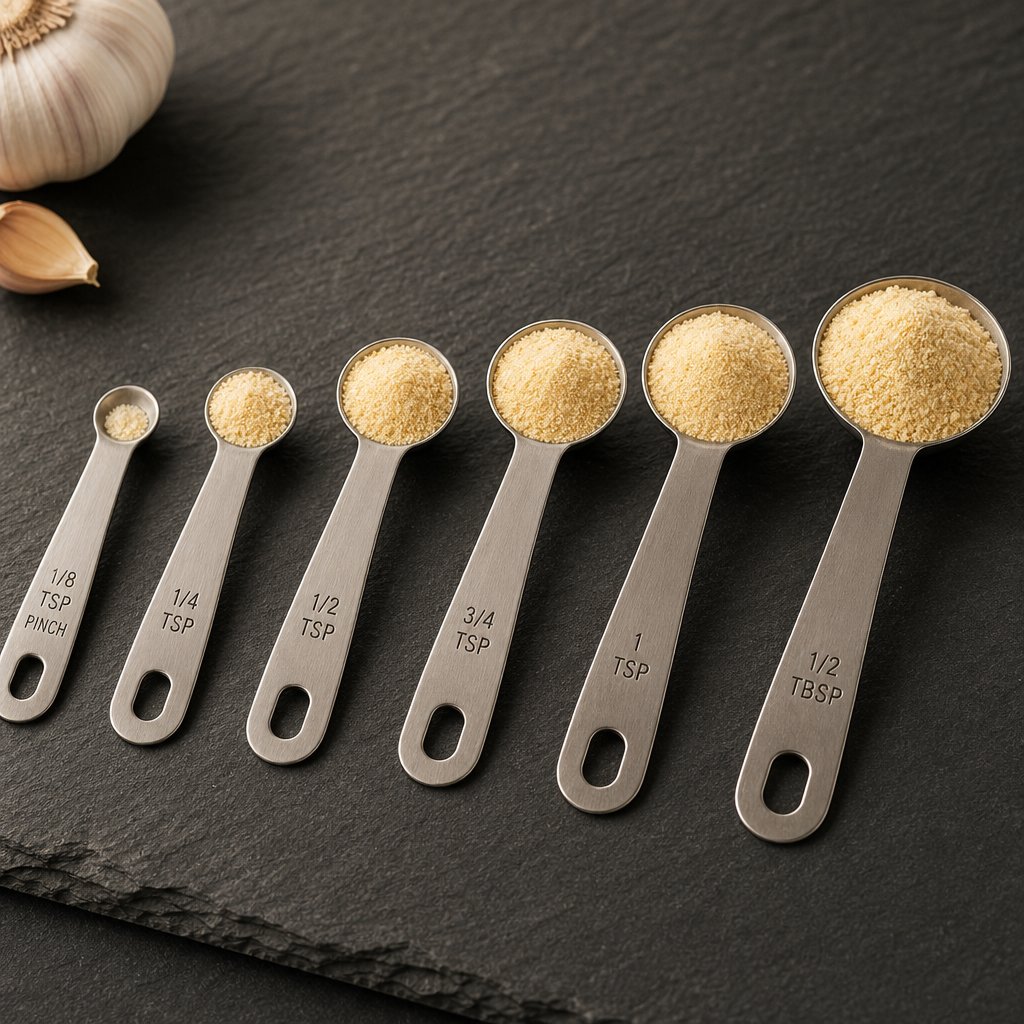
Knowing the ratio for three cloves is useful, but recipes rarely stay that predictable. One dish calls for a single clove, the next asks for six, and that slow-roasted chicken recipe your grandmother swears by might demand an entire head. Rather than doing the math every time, a single reference table covering garlic cloves to powder, minced garlic, and granulated garlic keeps things simple.
Garlic Cloves to Powder Conversion Table
The table below scales from a single clove all the way up to 12 cloves, which is roughly one full head of garlic. Every row includes the garlic powder amount in both teaspoons and tablespoons, plus the equivalent measurements for minced garlic and granulated garlic so you can convert no matter what your pantry holds.
| Number of Cloves | Garlic Powder (tsp) | Garlic Powder (tbsp) | Minced Garlic (tsp) | Granulated Garlic (tsp) |
|---|---|---|---|---|
| 1 | 1/8 | — | 1 | 1/4 |
| 2 | 1/4 | — | 2 | 1/2 |
| 3 | 3/8 | — | 3 | 3/4 |
| 4 | 1/2 | — | 4 | 1 |
| 5 | 5/8 | — | 5 | 1 1/4 |
| 6 | 3/4 | 1/4 | 6 | 1 1/2 |
| 8 | 1 | 1/3 | 8 | 2 |
| 10 | 1 1/4 | ~2/5 | 10 | 2 1/2 |
| 12 (1 head) | 1 1/2 | 1/2 | 12 | 3 |
The 3-clove row is bolded because that is the conversion most people land on this page looking for: 3/8 teaspoon of garlic powder. If you are wondering about the minced garlic column, 3 garlic cloves is how many teaspoons? Exactly 3 teaspoons, since each medium clove yields roughly 1 teaspoon of minced garlic. That also means 6 minced cloves fill one tablespoon, a handy shortcut when a recipe lists garlic by the clove garlic tablespoon amount instead of individual cloves.
For the garlic clove to tsp conversion in powder form, the pattern is clean: multiply the number of cloves by 1/8 teaspoon. Two cloves give you 1/4 teaspoon, four cloves give you 1/2 teaspoon, and a full 12-clove head works out to 1 1/2 teaspoons, which equals half a tablespoon. The granulated garlic column runs at double the powder amount because its coarser grind is less concentrated by volume.
How to Read and Use This Table
A few things to keep in mind before you start measuring:
- Clove size assumption: Every row is based on medium-sized cloves weighing about 4 to 5 grams each. If your cloves are noticeably small or large, adjust up or down by a pinch as covered in the clove-size section above.
- Powder grind assumption: The garlic powder column assumes a standard, flour-fine grind. Ultra-fine or industrial-ground powder is more concentrated, so start with slightly less and taste as you go.
- Odd clove counts: Need a conversion for 7 or 9 cloves? Interpolate between the nearest rows. Seven cloves falls between the 6-clove row (3/4 tsp) and the 8-clove row (1 tsp), so 7/8 teaspoon is your target.
- Bookmark it: Save or screenshot this table for quick access the next time you are mid-recipe and need to convert garlic cloves to garlic powder on the fly.
This table covers the math, but the real question is whether every form of dried garlic behaves the same way in a recipe. Garlic powder, granulated garlic, garlic flakes, and garlic salt each have a different texture, concentration, and even sodium profile, and swapping one for another without adjusting can throw off more than just flavor.
Garlic Powder vs Granulated Garlic and Other Forms
You reach into the spice cabinet for garlic powder and spot three other jars sitting right next to it: granulated garlic, garlic flakes, and garlic salt. They all say "garlic" on the label, so they should all work the same way, right? Not quite. Each form has a different grind, a different concentration, and a different impact on your recipe. Grabbing the wrong jar without adjusting the amount is one of the fastest ways to end up with a dish that tastes flat or overwhelmingly salty.
Garlic Powder vs Granulated Garlic
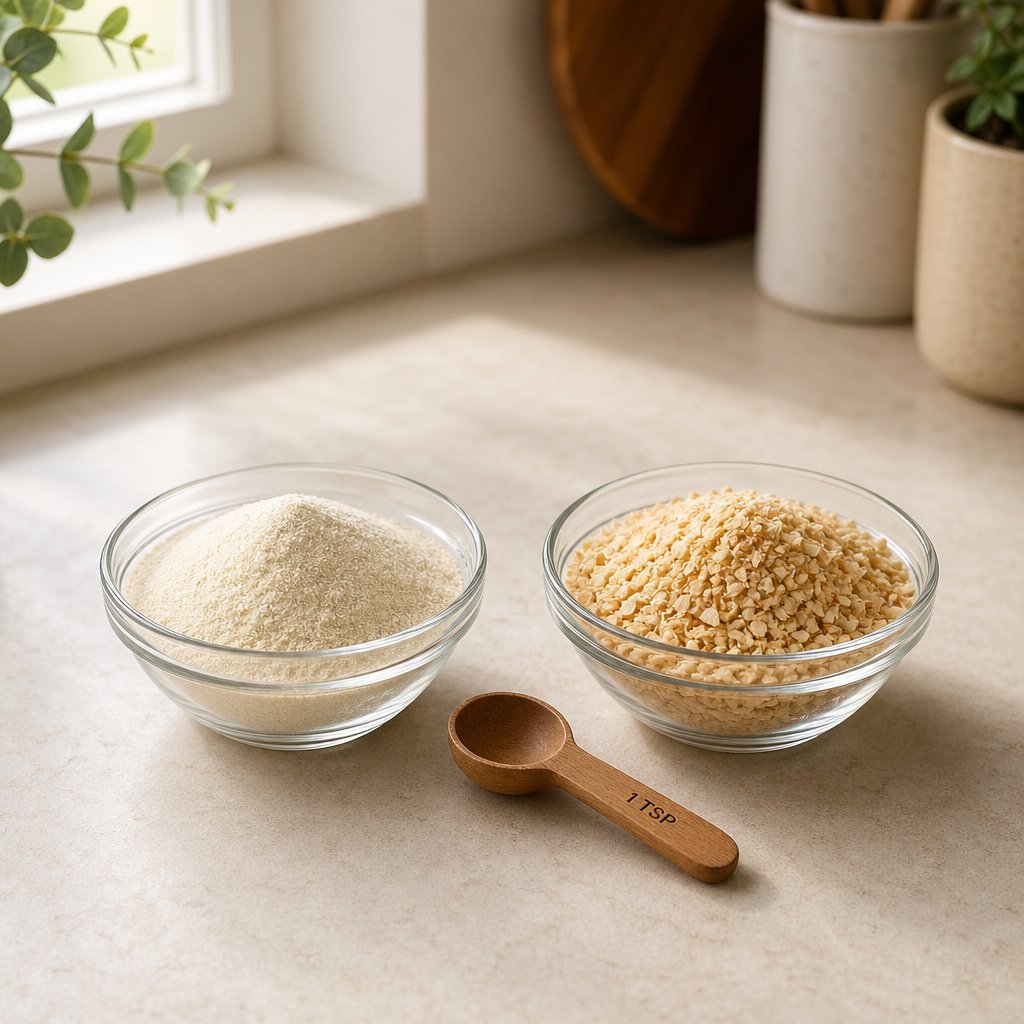
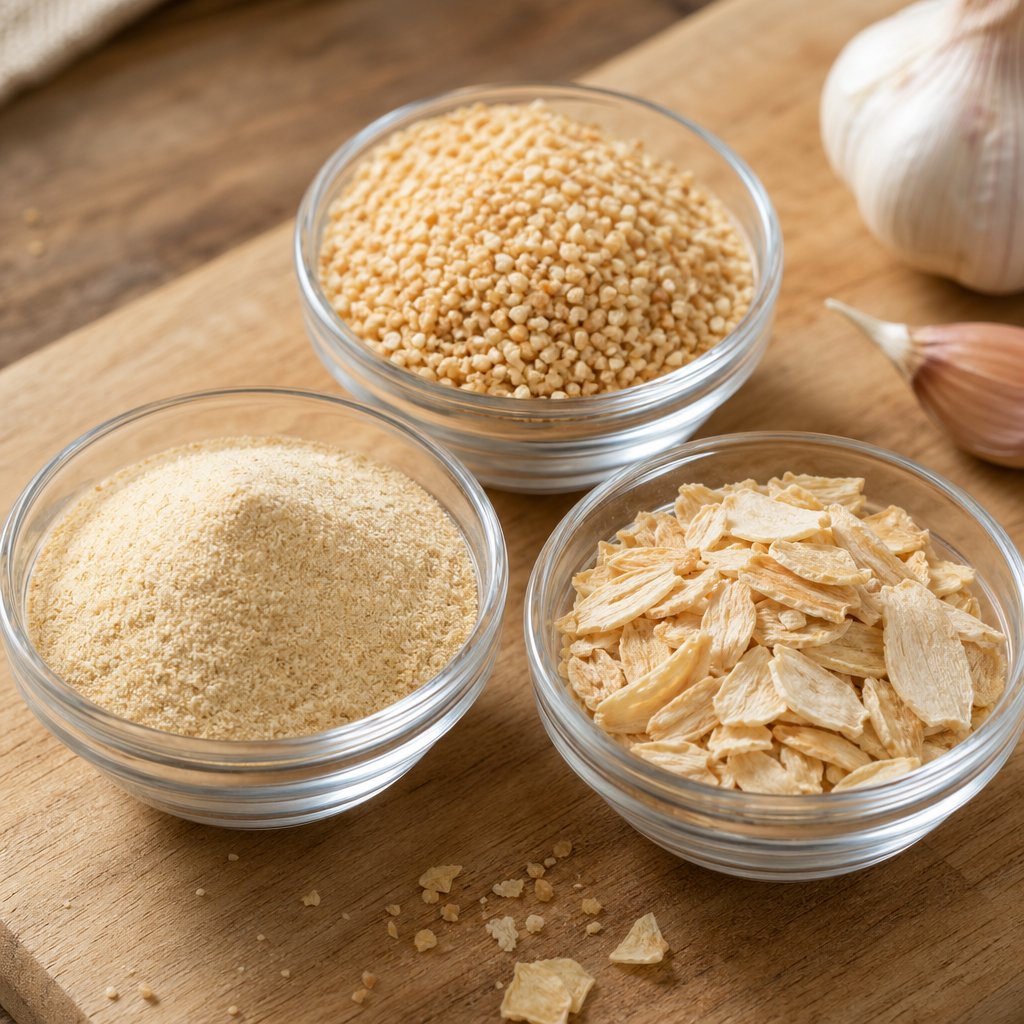
The difference between granulated garlic vs garlic powder comes down to texture. Garlic powder is ground to a flour-like consistency that dissolves almost instantly into liquids and coats surfaces evenly. Granulated garlic, on the other hand, has a coarser grind closer to cornmeal or fine sand. You can feel the individual garlic granules between your fingers, and they take longer to break down in a recipe.
That texture gap directly affects concentration. Because the finer grind of garlic powder packs more garlic into each measured spoonful, it delivers roughly twice the flavor punch of the same volume of granulated garlic. The practical conversion looks like this:
- Garlic powder: 1/8 teaspoon per clove
- Granulated garlic: 1/4 teaspoon per clove
So how much granulated garlic equals one clove? A quarter teaspoon. For three cloves, you would need 3/4 teaspoon of granulated garlic instead of the 3/8 teaspoon you would use with powder. Miss that distinction and your dish ends up with half the garlic flavor you intended.
There is one more wrinkle worth knowing. Some brands sell ultra-fine or industrial-ground garlic powder that is even more concentrated than the standard grocery store version. With these products, as little as 1/16 teaspoon may equal one clove. If your powder feels exceptionally silky and almost weightless on the spoon, start with less than the standard ratio and taste before adding more. You can always add garlic, but you cannot take it back out.
When should you choose one over the other? Garlic powder is the better garlic powder substitute for fresh cloves in sauces, dressings, and soups where you want the garlic to vanish into the liquid. Granulated garlic works well in dry rubs, spice blends, and breadcrumb coatings where a slight texture is welcome and clumping is less of a concern.
Garlic Salt and Garlic Flakes
Garlic salt is where most substitution mistakes turn costly. It looks similar to garlic powder, sits in the same section of the spice aisle, and even smells like garlic when you open the lid. The critical difference? Garlic salt is roughly 3 parts salt to 1 part garlic powder, with an anti-caking agent mixed in. If you substitute for garlic cloves using garlic salt at the same measurement as pure powder, you will flood the dish with sodium long before you reach the garlic flavor you want.
The adjusted ratio for garlic salt is approximately 1/2 teaspoon per clove. For three cloves, that means 1 1/2 teaspoons of garlic salt. Here is the catch: each half teaspoon of garlic salt also delivers about 3/8 teaspoon of salt. You need to reduce the other salt in your recipe by that amount, or the finished dish will taste over-seasoned.
Does garlic powder have sodium on its own? Pure garlic powder contains negligible sodium, typically less than 1 milligram per serving. Garlic salt, however, can pack 300 milligrams or more per half teaspoon depending on the brand. If you are watching sodium intake, garlic salt is not a safe one-for-one swap.
Dried garlic flakes, sometimes labeled dehydrated minced garlic, sit somewhere between granulated garlic and fresh minced in terms of texture. They are flat, visible pieces of dried garlic that rehydrate when added to liquids. The conversion is roughly 1/2 teaspoon of flakes per clove, so three cloves would call for about 1 1/2 teaspoons of flakes.
Here is a quick per-clove reference for every common form:
- Garlic powder: 1/8 teaspoon per clove
- Granulated garlic: 1/4 teaspoon per clove
- Dried garlic flakes: 1/2 teaspoon per clove
- Garlic salt: 1/2 teaspoon per clove (reduce other salt accordingly)
- Jarred minced garlic: 1/2 teaspoon per clove
Whichever form you use as a substitute of garlic powder or fresh cloves, the key is matching the concentration to the measurement. A teaspoon of garlic flakes and a teaspoon of garlic powder are not interchangeable amounts, even though they come from the same ingredient. Check the label, check the grind, and adjust.
Picking the right form and the right amount gets you most of the way there. The remaining variable is the recipe itself, because a dry rub, a simmering stew, and a cold vinaigrette each handle garlic powder in very different ways.
How to Adjust the Ratio for Different Recipes
The 3/8 teaspoon conversion is solid math, but recipes are not math problems. A dry spice rub coats the surface of a pork shoulder differently than garlic powder dissolving into a pot of chicken soup. A cold salad dressing never heats the powder at all. Each cooking context changes how garlic powder behaves, how quickly its flavor releases, and how much of that flavor actually reaches your palate. Treating every recipe the same way is where the ratio starts to mislead you.
Dry Rubs and Spice Blends
Dry applications are where garlic powder truly earns its place. When you are building a rub for ribs, brisket, or roasted chicken, the standard 3/8 teaspoon for three cloves works without any adjustment. Powder distributes evenly across the meat's surface, blending seamlessly with salt, paprika, black pepper, and whatever else goes into the mix.
Garlic powder is actually preferable to fresh garlic in rubs. Fresh minced garlic introduces moisture, which causes clumping and uneven coverage on dry surfaces. It can also burn quickly under high direct heat on a grill. Powder stays dry, sticks to the meat, and delivers consistent garlic flavor across every bite. If a rub recipe lists "3 cloves of garlic," converting to 3/8 teaspoon of powder is a straightforward swap that often improves the result.
For context on the fresh equivalent, how much minced garlic equals 3 cloves? About 3 teaspoons, or one full tablespoon. That volume of wet, sticky minced garlic would turn a dry rub into a paste, which is fine if you want a paste but not if you want an even, bark-forming crust on smoked meat.
Soups, Stews, and Sauces
Liquid-heavy dishes change the equation. Garlic powder dissolves and disperses quickly in broth, stock, or tomato sauce, which sounds like an advantage. The catch is that this rapid dispersion can make the garlic flavor feel thinner and less punchy compared to fresh cloves sauteed in oil at the start of cooking. When you brown fresh garlic in fat, the Maillard reaction creates deeper, more complex flavor compounds that carry through a long simmer. Powder skips that step entirely.
To compensate, consider bumping the amount up slightly. Instead of a strict 3/8 teaspoon for three cloves, try a rounded 3/8 or even a full 1/2 teaspoon in soups and stews. Another effective move is adding the powder later in the cooking process rather than at the beginning. Garlic powder that simmers for 45 minutes loses more of its aromatic punch than powder stirred in during the last 10 to 15 minutes. A late addition keeps the garlic flavor brighter and more present in the finished dish.
For thick, reduction-style sauces like a bolognese or a pan gravy, the standard ratio holds up better because the concentrated liquid intensifies every flavor in the pot. Start with 3/8 teaspoon, taste after a few minutes of simmering, and add a pinch more if the garlic feels buried under other ingredients.
Marinades and Dressings
Cold or uncooked applications are the trickiest territory for garlic powder. In a vinaigrette, a yogurt-based dressing, or a cold marinade, the powder never gets heated, so it delivers a milder, more uniform garlic flavor than raw fresh cloves would. That mildness is sometimes exactly what you want. A Caesar dressing made with powder instead of raw garlic tastes smoother and less aggressive, which can be a plus if you are serving it to people who find raw garlic too sharp.
The standard ratio works here, but you should know what it will not do. If the recipe depends on that bright, almost spicy bite of raw garlic, powder alone will not replicate it. For those dishes, try a hybrid approach: use 1/4 teaspoon of garlic powder for background warmth and add a small amount of garlic paste or one finely grated fresh clove for the sharp top note. This combination gives you the even distribution of powder plus the enzymatic punch of fresh garlic.
When converting 3 cloves of garlic to minced for a marinade, you get about 1 tablespoon of minced garlic, which carries a strong raw bite. The garlic powder to minced garlic swap softens that intensity considerably, so adjust your expectations for the finished flavor.
Here is a quick reference for adjusting by recipe type:
- Dry rubs and spice blends: Use the standard 3/8 teaspoon for 3 cloves. No adjustment needed.
- Soups, stews, and brothy sauces: Increase to 1/2 teaspoon for 3 cloves, or add the powder in the last 10 to 15 minutes of cooking.
- Thick, reduced sauces: Start with 3/8 teaspoon, taste, and adjust upward if needed.
- Cold marinades and dressings: Use 3/8 teaspoon for mellow garlic flavor. Combine with a small amount of fresh garlic paste if you want more bite.
- Baked goods and bread doughs: Use the standard 3/8 teaspoon. Powder disperses more evenly through dough than minced garlic would.
Knowing 3 cloves of garlic equals how much minced (about 3 teaspoons) and how that compares to the powder equivalent helps you gauge the flavor shift in any recipe. The conversion table gives you the numbers. These recipe-specific tweaks give you the judgment to use them well.
Even with the right amount dialed in for your recipe type, a few common missteps can still throw things off. Some of them have nothing to do with measurement at all.
Common Mistakes When Substituting Garlic Powder
You have the right ratio, you have picked the right form of dried garlic, and you have even adjusted for your recipe type. The dish still comes out wrong. What happened? In most cases, the problem is not the measurement itself but something around it: a mix-up in garlic anatomy, bad timing at the stove, or a jar of powder that lost its punch months ago. These mistakes are easy to make and even easier to prevent once you know what to watch for.
Confusing a Clove with a Whole Head
This one was covered earlier, but it is worth reinforcing here because it is the single most damaging substitution error you can make. A recipe says "3 cloves of garlic." You grab a whole head, assume that is three cloves, and measure garlic powder accordingly. The result? You have just added powder equivalent to 10 or 12 cloves instead of 3, roughly four times the intended amount.
At the powder level, that mistake turns 3/8 teaspoon into nearly 1 1/2 teaspoons. In a single serving of soup or a small batch of dressing, that much garlic powder overwhelms everything else in the bowl. The fix is simple: remember that one clove is one small wedge-shaped segment, not the whole bulb. If you are ever unsure, break the head apart first and count the individual pieces. How many teaspoons is a clove of garlic in minced form? About one teaspoon. If your recipe calls for 3 teaspoons of minced garlic, that is 3 cloves, not 3 heads.
Adding Garlic Powder at the Wrong Time
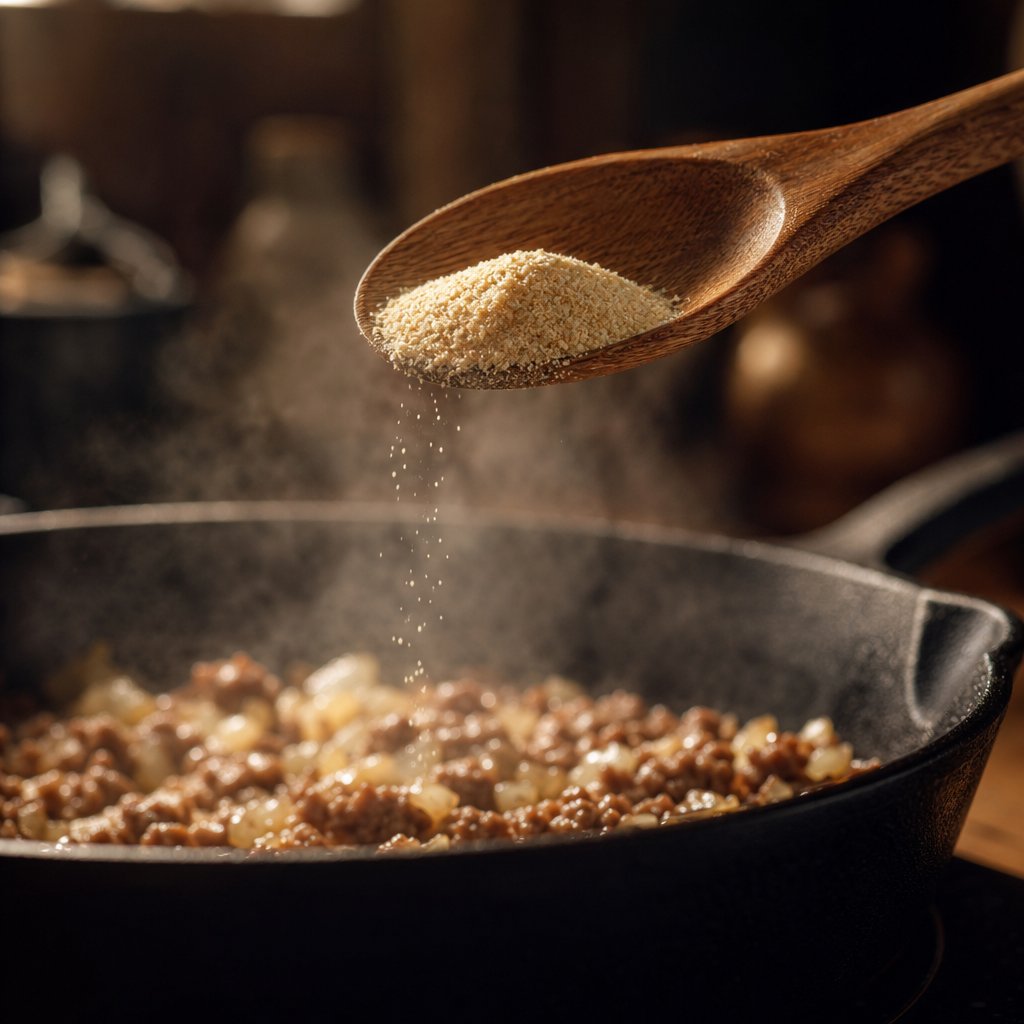
Fresh garlic can handle a minute or two in hot oil before it starts to color. Garlic powder cannot. The difference is moisture. A fresh clove contains 60 to 65% water, which acts as a buffer against direct heat. Powder has virtually none. Drop it into a screaming hot pan or sprinkle it over smoking oil and it scorches in seconds, turning sharp and bitter in a way that spreads through the entire dish.
The tiny particle size makes things worse. All that surface area means the Maillard reaction happens almost instantly. Instead of a gentle toast that deepens flavor, you get a fast burn that creates harsh, acrid compounds. Once those bitter notes are in the pan, you cannot cook them out.
The solution is to treat garlic powder as a late-stage ingredient in high-heat cooking:
- Searing meat or vegetables? Get your color first, then lower the heat and stir the powder into pan juices, butter, or sauce.
- Building a soup or stew? Add the powder after your liquid is already in the pot, not while you are sweating aromatics in dry fat.
- Making a stir-fry? Mix the powder into your sauce before pouring it into the wok, so it disperses into liquid rather than hitting bare metal.
- Roasting on a sheet pan? Toss the powder with oil and vegetables during the last 5 to 10 minutes, not at the start of a 400-degree roast.
How much minced garlic equals 1 clove? About one teaspoon, and that teaspoon of wet minced garlic has a built-in heat buffer that powder lacks. When you swap to powder, you lose that moisture protection, so adjusting your timing is just as important as adjusting your measurement. How much minced garlic equals one clove in terms of burn risk? The same teaspoon, but it buys you significantly more time before scorching starts.
Not Accounting for Stale or Old Powder
Garlic powder does not spoil in a way that makes you sick, but it absolutely loses flavor over time. The essential oils and volatile sulfur compounds that give garlic its punch break down gradually with exposure to air, light, and moisture. A jar that has been open on the shelf for many months, or one stored next to the stove where it absorbs heat and steam, will taste noticeably weaker than a fresh bottle.
How do you know if your powder has faded? GoodRx reports that ground spices can retain flavor for one to three years, but some chefs recommend replacing them within six months for peak quality. The best test is sensory: open the jar and take a sniff. Fresh garlic powder hits your nose immediately with a clean, pungent garlic aroma. If you have to hold the jar right up to your face to detect anything, or if the smell reads more dusty than garlicky, the potency has dropped. Taste a small pinch to confirm. If the flavor is faint or flat, increase your measurement by 25 to 50% to compensate.
A few storage habits help your powder stay potent longer:
- Keep the jar in a cool, dark cabinet away from the stove and dishwasher.
- Close the lid tightly after every use to limit air exposure.
- Never shake the jar directly over a steaming pot, as the moisture will clump the powder and accelerate flavor loss.
- Use a dry spoon every time you measure.
Always taste and adjust. The conversion ratio is a starting point, not an absolute rule. A pinch of fresh powder and a pinch of year-old powder are not the same measurement in terms of flavor.
Between clove-versus-head confusion, heat timing, and powder freshness, these three mistakes account for the vast majority of garlic powder substitution failures. None of them are about using the wrong ratio. They are about the variables that surround the ratio, the ones no conversion chart can capture for you. Build the habit of checking your garlic anatomy, adding powder away from peak heat, and sniffing before you measure, and the 3/8 teaspoon figure will deliver exactly the flavor you expect.
These kitchen-level details matter most when cooking for yourself or your family. But the same concentration principles behind garlic powder conversions play a role far beyond the home kitchen, especially in the world of health supplements and functional foods where garlic is a star ingredient.
From Kitchen Ratios to Garlic in Health Products
The same logic that makes 1 clove garlic to garlic powder equal just 1/8 teaspoon does not stop at your dinner plate. That concentration principle, stripping away water to pack maximum potency into minimum volume, is exactly what drives the formulation of garlic-based health supplements, functional foods, and nutraceuticals sold worldwide.
Garlic Beyond the Kitchen
Garlic has been used for medicinal purposes for thousands of years, and modern research continues to back up many of those traditional claims. A comprehensive review published in Antioxidants examined 83 human interventional trials and found that garlic consumption modulated multiple biomarkers related to cardiovascular health, blood pressure, blood sugar regulation, and inflammation. The bioactive compounds responsible, particularly organosulfur molecules like allicin, S-allylcysteine, and diallyl disulfide, are the same flavor compounds you interact with every time you crush a fresh clove or measure a pinch of powder.
This overlap between culinary use and health benefit is why garlic powder shows up in far more than spice jars. You will find it in capsule supplements, tablet formulations, functional food blends, and concentrated extracts designed to deliver specific doses of garlic's active compounds. The garlic clove to powder ratio that matters in your kitchen, where 1 clove of garlic equals how much powder depends on dehydration concentration, matters just as much in product development. Getting the potency wrong in a supplement is no different from over-seasoning a stew, except the stakes involve efficacy and consumer trust rather than dinner.
Research into garlic bioavailability adds another layer of complexity. A study published in the Journal of Agricultural and Food Chemistry found that allicin release from garlic powder supplements varied dramatically, from as low as 3% to over 95%, depending on tablet formulation and coating. That kind of variability means the difference between a supplement that delivers real garlic benefits and one that barely registers in the body. Precise ratios and consistent manufacturing processes are not optional in this space. They are the foundation.
Turning a Garlic Formulation into a Market-Ready Product
If you are a nutrition brand, supplement importer, or private label seller exploring garlic-based products, the jump from kitchen experiment to production line involves challenges that go well beyond scaling up a recipe. Consistent potency across thousands of units, stable shelf life, proper encapsulation or tableting, and regulatory compliance all require specialized manufacturing infrastructure.
This is where OEM/ODM health food manufacturers come in. Companies like ZhuFeng offer end-to-end manufacturing services for businesses looking to develop garlic supplements or functional foods without building their own production facility. Their flexible product formats span hard capsules, tablets, powder and granule blends, soft capsules, gummy candy, and oral liquids, which means a garlic formulation can be adapted to whichever delivery format fits the target market. Customized formulation support and scalable production help customers move from concept to market-ready product without the overhead of in-house R&D and manufacturing equipment.
For anyone who started this article wondering how much garlic powder for 1 clove and ended up here, the throughline is the same: garlic's value, whether in a weeknight stir-fry or a commercial health product, depends on getting the concentration right. In the kitchen, that means trusting the 3/8 teaspoon ratio and adjusting for your specific cloves, powder, and recipe. In the supplement world, it means partnering with manufacturers who understand how to preserve garlic's bioactive compounds at scale. Either way, the principle holds. Measure carefully, know your ingredients, and the results take care of themselves.
Garlic Powder Conversion FAQs
1. Can I use garlic powder instead of fresh garlic cloves in any recipe?
Yes, garlic powder works as a substitute in virtually any recipe, but the flavor profile shifts. Powder delivers a rounder, more evenly distributed garlic taste without the sharp bite of fresh cloves. It performs best in dry rubs, soups, and baked goods. For cold dishes like dressings where raw garlic punch is essential, consider combining a small amount of powder with fresh garlic paste to get both even distribution and that bright top note.
2. How much garlic powder equals 1 clove of garlic?
One clove of garlic equals 1/8 teaspoon of standard-grind garlic powder. This assumes a medium-sized clove weighing about 4 to 5 grams. For smaller cloves around 3 grams, a scant 1/8 teaspoon is sufficient. For larger cloves weighing 6 to 7 grams, you can round up closer to 1/4 teaspoon. Always check your powder's freshness, as older jars may require 25 to 50% more to match the same flavor intensity.
3. What is the difference between garlic powder and granulated garlic for substitution?
Garlic powder has a flour-like texture and is twice as concentrated by volume as granulated garlic, which has a coarser cornmeal-like grind. For 3 cloves, use 3/8 teaspoon of garlic powder or 3/4 teaspoon of granulated garlic. Powder dissolves instantly into liquids and works best in sauces and dressings. Granulated garlic suits dry rubs and breadcrumb coatings where slight texture is welcome. Using them interchangeably without adjusting the amount will leave your dish either under-seasoned or overpowering.
4. Does garlic powder expire or lose its flavor over time?
Garlic powder does not spoil in a way that causes illness, but it steadily loses potency as volatile sulfur compounds break down with air, light, and moisture exposure. Most ground spices retain peak flavor for six months to one year after opening. To test freshness, open the jar and sniff. If the aroma is faint or dusty rather than sharp and pungent, increase your measurement by 25 to 50%. Store powder in a cool, dark cabinet with the lid tightly sealed, and never shake it directly over a steaming pot.
5. How many teaspoons of minced garlic equal 3 cloves?
Three medium cloves of garlic yield approximately 3 teaspoons (1 tablespoon) of minced garlic. Each clove produces roughly 1 teaspoon when finely minced. This minced equivalent is useful when converting between fresh garlic forms. Compared to the 3/8 teaspoon of garlic powder that replaces the same 3 cloves, the volume difference highlights how much water content fresh garlic contains and why dehydrated powder is so much more concentrated by measure.