


Why Magnesium Timing Matters More Than You Think
You can pop a vitamin C tablet at any hour and expect roughly the same outcome. Magnesium is different. Its interaction with sleep hormones, digestive processes, and neural pathways means that when you take it can shape how well it works for you. If you have ever searched for what is the best time to take magnesium tablets, you have probably noticed conflicting advice. That is because there is no single universal answer. The best time of day to take magnesium depends on the form you choose, the health goal you are chasing, and how your body responds.
Why Timing Matters for Magnesium Absorption
Magnesium participates in over 300 biochemical reactions, from energy production to neurotransmitter regulation. What makes magnesium supplement timing uniquely important is the mineral's direct relationship with three time-sensitive systems in your body:
- GABA receptors: Magnesium ions interact with GABA receptors, potentiating inhibitory neurotransmission and dampening neural excitability. This calming effect is more useful at certain hours than others, depending on whether you want relaxation or alertness.
- Cortisol regulation: Magnesium helps regulate the HPA axis, the brain-body communication system that manages stress. It supports lower cortisol levels, which naturally decline in the evening as your body prepares for sleep. Aligning your dose with this rhythm can amplify the benefit.
- Muscle relaxation: By blocking excessive calcium influx into nerve cells, magnesium prevents overstimulation and promotes physical relaxation. For people dealing with cramps or restless legs, timing this effect around bedtime or post-exercise makes a measurable difference.
These mechanisms explain why when is the best time to take magnesium varies so much from person to person. A form designed to cross the blood-brain barrier behaves differently than one that primarily supports bowel motility.
The Four Factors That Determine Your Ideal Timing
Rather than offering a one-size-fits-all clock, this article walks you through a personalized decision framework built on four variables:
- Your health goal — sleep support, anxiety relief, muscle recovery, or digestive regularity each call for different timing windows.
- The magnesium form — glycinate and threonate behave differently than malate or oxide in terms of absorption speed and target effects.
- Medication and supplement interactions — spacing magnesium around other pills protects absorption on both sides.
- GI tolerance — some forms cause digestive discomfort on an empty stomach, making meal pairing a practical timing decision.
Consistency matters more than perfection. Taking magnesium at the same time daily builds steady serum levels over one to four weeks. But optimizing your timing around these four factors can accelerate results and reduce side effects.
When's the best time to take magnesium? The honest answer is: it depends on you. When is it the best time to take magnesium for someone chasing better sleep versus someone managing morning muscle stiffness? Those are two very different schedules. The sections ahead break down exactly how to match your timing to your situation, starting with the most common question people ask: morning or night?

Morning or Night and How to Decide
Should i take magnesium in the morning or at night? This is the question that drives most people to search for timing advice in the first place. The short answer: your primary health goal and the form of magnesium you are using determine which half of the day gives you the best return. Relaxation-focused forms pair naturally with evening hours, while forms that support energy metabolism fit better alongside your morning routine.
When Morning Dosing Makes Sense
Morning dosing works well when your goal is sustained energy, muscle function, or simply building a consistent habit. Magnesium malate, for example, supports cellular energy production through its role in the Krebs cycle, making it a logical companion to breakfast. If you are managing a deficiency or using magnesium for migraine prevention, research on habit adherence suggests that linking your dose to a morning cue like your first meal improves long-term consistency.
A practical morning window looks like this: take your dose with breakfast, ideally between 7:00 and 9:00 AM. The food slows gastric transit, giving your small intestine more contact time with the mineral and reducing the chance of loose stools.
When Evening Dosing Works Better
Should magnesium be taken at night or morning if sleep quality is your priority? Evening wins. Forms like glycinate and threonate have calming properties that complement your body's natural wind-down. Magnesium glycinate combines the mineral with the amino acid glycine, which independently promotes relaxation. Taking it 30 to 60 minutes before bed gives the supplement roughly an hour to reach peak absorption in the bloodstream, aligning its calming effect with the time you want to fall asleep.
Evening dosing also suits people using magnesium citrate for constipation relief. Because citrate can produce a bowel movement within 30 minutes to 6 hours, a bedtime dose often means results arrive by morning without disrupting your day.
The Role of Meals in Timing Decisions
Regardless of whether you take magnesium at night or morning, pairing your dose with food is a smart default. Studies show that magnesium absorption from mineral water increased from 45.7% to 52.3% when consumed with a meal. Food slows transit through the gut, giving the mineral more time to be absorbed in the small intestine and colon. This matters most for forms with higher GI risk, like oxide and citrate, but it applies broadly.
If you take magnesium on an empty stomach, you raise the odds of nausea, cramping, or diarrhea. A small snack with some healthy fat is enough to buffer these effects when a full meal is not available.
The table below summarizes what time of day should you take magnesium based on common scenarios, so you can match your form and goal to a specific window.
| Timing | Recommended Forms | Best Health Goals | Meal Pairing | Specific Time Window |
|---|---|---|---|---|
| Morning | Malate, Oxide, Citrate | Energy, muscle function, migraine prevention, deficiency correction | With breakfast | 7:00 - 9:00 AM |
| Evening | Glycinate, Threonate, Taurate | Sleep support, anxiety relief, nighttime muscle cramps, cognitive recovery | With dinner or a light snack | 30 - 60 minutes before bed |
Should magnesium be taken in the morning or at night? Use the table as a starting point, then refine based on how your body responds over the first week. And if you are wondering whether should magnesium be taken morning or night when you use a form not listed above, the next section dives deeper into timing recommendations for every major magnesium type.
Timing by Magnesium Form
Each magnesium form carries a different organic compound bonded to the mineral, and that compound changes how quickly the body absorbs it, where it concentrates, and what effects it produces. Knowing when to take magnesium glycinate versus when to take magnesium citrate is not a matter of preference. It is a matter of biochemistry. Below is a form-by-form breakdown with specific timing windows grounded in absorption science.
Glycinate and Threonate for Evening Use
The best time to take magnesium glycinate is 30 to 60 minutes before bed. Glycinate pairs elemental magnesium with the amino acid glycine, which independently activates inhibitory GABA receptors in the brain. This dual mechanism, mineral relaxation plus amino acid calming, makes it one of the most bioavailable forms for sleep and anxiety support. Because glycine starts influencing neurotransmission roughly 30 to 45 minutes after ingestion, taking it too close to lights-out shortchanges absorption time.
The best time of day to take magnesium L-threonate follows a similar evening logic, though for a different reason. Threonate is the only form shown in randomized controlled trials to significantly increase brain magnesium concentrations by crossing the blood-brain barrier via glucose transporters. A 2025 double-blind trial found that 2 g daily of magnesium L-threonate improved overall cognition and reduced estimated cognitive age by 7.5 years compared to placebo. Magnesium threonate benefits extend to working memory, reaction time, and heart rate variability during sleep. The study protocol used a split dose: one capsule in the morning and one two hours before bedtime. If you take only a single dose, evening is ideal for leveraging its calming autonomic effects overnight.
Malate and Oxide for Morning Use
Magnesium malate binds the mineral to malic acid, a key intermediate in the Krebs cycle responsible for ATP synthesis. This energizing profile makes morning the natural fit. Taking it with breakfast between 7:00 and 9:00 AM supports mitochondrial energy production during your most active hours without interfering with sleep. Athletes often dose 30 to 60 minutes before a workout for the same reason.
The best time to take magnesium oxide is also morning, paired with food. Oxide delivers a high percentage of elemental magnesium per tablet, making it a budget-friendly option, but its bioavailability is lower than chelated forms. Food slows gastric transit and gives the intestinal lining more contact time, improving uptake and reducing the GI discomfort oxide is known for. If you use oxide for heartburn or constipation, a morning dose on an empty stomach can accelerate its laxative effect, but expect more cramping.
Citrate and Taurate Flexible Timing
When comparing magnesium citrate vs glycinate, the biggest practical difference is timing flexibility. Citrate is highly bioavailable regardless of food intake, so it adapts to either morning or evening schedules depending on your goal. For general replenishment, take it with any meal. For constipation relief, an evening dose often produces a comfortable morning bowel movement. For sleep support, dose one to two hours before bed, though be aware it may cause overnight bathroom trips in sensitive individuals.
Magnesium taurate combines the mineral with taurine, an amino acid that supports cardiovascular function and has calming properties. Evening dosing suits people targeting heart rhythm regulation and sleep quality. For all-day cardiovascular support, a split schedule of 200 mg in the morning and 200 mg before bed maintains steadier levels.
The table below consolidates timing, absorption, and use-case data for every major form in one place.
| Form | Ideal Time Window | Take With Food? | Absorption Rate | Primary Benefits | Notes |
|---|---|---|---|---|---|
| Glycinate | 30 - 60 min before bed | Small snack recommended | High | Sleep, anxiety, muscle recovery | Glycine adds independent calming effect; may cause mild drowsiness if taken in the morning |
| L-Threonate | Split: morning + 2 hrs before bed | Optional | High (crosses blood-brain barrier) | Cognition, memory, brain health | Only form proven to raise brain magnesium; may cause vivid dreams at high evening doses |
| Malate | Morning or pre-workout | With breakfast | High | Energy production, muscle recovery, fatigue | Avoid evening dosing; malic acid supports ATP synthesis and may feel stimulating |
| Oxide | Morning with food | Yes, strongly recommended | Low (4 - 5%) | Budget replenishment, constipation, heartburn | High elemental content per tablet; GI side effects common without food |
| Citrate | Flexible (morning or evening) | Reduces laxative effect | Moderate-High | General deficiency, constipation, calming | Mild laxative within 6 - 12 hrs; evening dose yields morning relief |
| Taurate | Evening or split AM/PM | With meal preferred | Moderate-High | Cardiovascular health, blood sugar, sleep | Taurine adds calming and heart-protective effects; good for split dosing |
Matching your form to the right time window is the foundation. The next layer of precision comes from aligning that window with a specific health outcome, whether that is falling asleep faster, calming daytime anxiety, or stopping a leg cramp before it starts.

Optimal Timing Based on Your Health Goal
Knowing your magnesium form is half the equation. The other half is understanding what you want the mineral to do for you right now. Some benefits are acutely timing-dependent, meaning the hour you swallow the tablet directly shapes the outcome. Others are cumulative, building over weeks regardless of whether you dose at dawn or dusk. The breakdown below maps each common health goal to a specific timing strategy so you can stop guessing.
Timing for Sleep and Relaxation
Does magnesium help with sleep? Research says yes. A 2021 systematic review found that oral magnesium supplementation improved sleep quality in older adults with insomnia, likely through its effect on GABA receptor activity and melatonin production. Sleep is the most timing-sensitive goal on this list because you need the calming effect to peak as you are winding down, not hours later.
- When to take magnesium for sleep: 30 to 60 minutes before your target bedtime.
- Best type of magnesium for sleep: Glycinate or L-threonate. Glycinate delivers dual relaxation via magnesium and glycine. Threonate crosses the blood-brain barrier and supports overnight neural recovery.
- Magnesium glycinate dosage for sleep: 200 to 400 mg of elemental magnesium. Start at the lower end and increase after one week if needed.
- Meal pairing: A small snack with healthy fat (a handful of almonds, a spoonful of nut butter) buffers GI effects without slowing absorption enough to miss your sleep window.
Is magnesium good for sleep even if you take it earlier in the day? Cumulative serum levels do contribute over time, but the best time to take magnesium for sleep is close to bedtime so the acute relaxation effect aligns with your circadian wind-down.
Timing for Anxiety and Stress
Anxiety does not follow a single clock. Some people feel it most during work hours; others experience racing thoughts only after the lights go off. Your timing should mirror when symptoms peak.
- For daytime anxiety: Take 200 to 300 mg of glycinate or taurate with breakfast. The calming effect builds within 60 to 90 minutes and supports lower cortisol through the afternoon.
- For nighttime racing thoughts: Dose 30 to 60 minutes before bed, same as the sleep protocol above.
- Best time to take magnesium for anxiety with split dosing: 150 mg in the morning and 150 mg in the evening maintains steadier GABA support across the full day.
- Form recommendation: Glycinate for general calm; taurate if cardiovascular symptoms like a pounding heart accompany your anxiety.
Unlike sleep, anxiety relief from magnesium is partly cumulative. A 2024 systematic review noted that consistent supplementation over several weeks produced more reliable reductions in self-reported anxiety than sporadic use. Timing sharpens the effect, but daily consistency builds the foundation.
Timing for Muscle Recovery and Cramps
Magnesium for restless legs and nighttime cramps follows a straightforward rule: get the mineral into your system before the symptom window opens.
- Nighttime cramps or restless legs: Take 200 to 400 mg of glycinate or malate with dinner or 60 minutes before bed. This gives the mineral time to reach skeletal muscle tissue before involuntary contractions typically begin.
- Post-exercise recovery: Take magnesium malate within 30 to 60 minutes after training. Malic acid supports ATP regeneration while magnesium reduces exercise-induced muscle soreness.
- Pre-workout support: 200 mg of malate 30 minutes before exercise can improve muscular endurance and reduce perceived fatigue during the session.
For chronic conditions like restless leg syndrome, daily consistency matters more than hitting an exact minute. But dosing in the evening rather than the morning ensures peak tissue levels coincide with the hours when symptoms are most disruptive.
Timing for Digestive Health
Constipation and migraine prevention round out the goal-based timing picture, and they sit on opposite ends of the timing-sensitivity spectrum.
- Constipation: Take 200 to 400 mg of citrate or oxide in the morning on an empty stomach for maximum osmotic effect. Water follows magnesium into the intestinal lumen, softening stool and stimulating peristalsis. Expect results within 30 minutes to 6 hours. If morning urgency is inconvenient, an evening dose produces a comfortable bowel movement by the next morning.
- Migraine prevention: Consistent daily timing matters more than the specific hour. Split your total dose (often 400 to 600 mg of oxide or citrate) into two servings, morning and evening, to maintain steady serum levels. Migraines respond to cumulative magnesium status, not acute spikes.
- Energy and exercise performance: Take magnesium malate with breakfast or 30 minutes pre-workout. Malic acid feeds directly into mitochondrial energy pathways, making morning the logical window.
Goals like bone health and blood pressure regulation are fully cumulative. For these, any consistent daily time works. The mineral builds intracellular stores over weeks, and shifting your dose by an hour or two has no measurable impact on outcomes.
Timing your magnesium around a health goal is powerful, but it introduces a practical complication: what happens when your ideal magnesium window collides with another medication or supplement you already take? Spacing matters, and getting it wrong can neutralize both the magnesium and the drug it interacts with.
Medication Interactions and Safe Timing Gaps
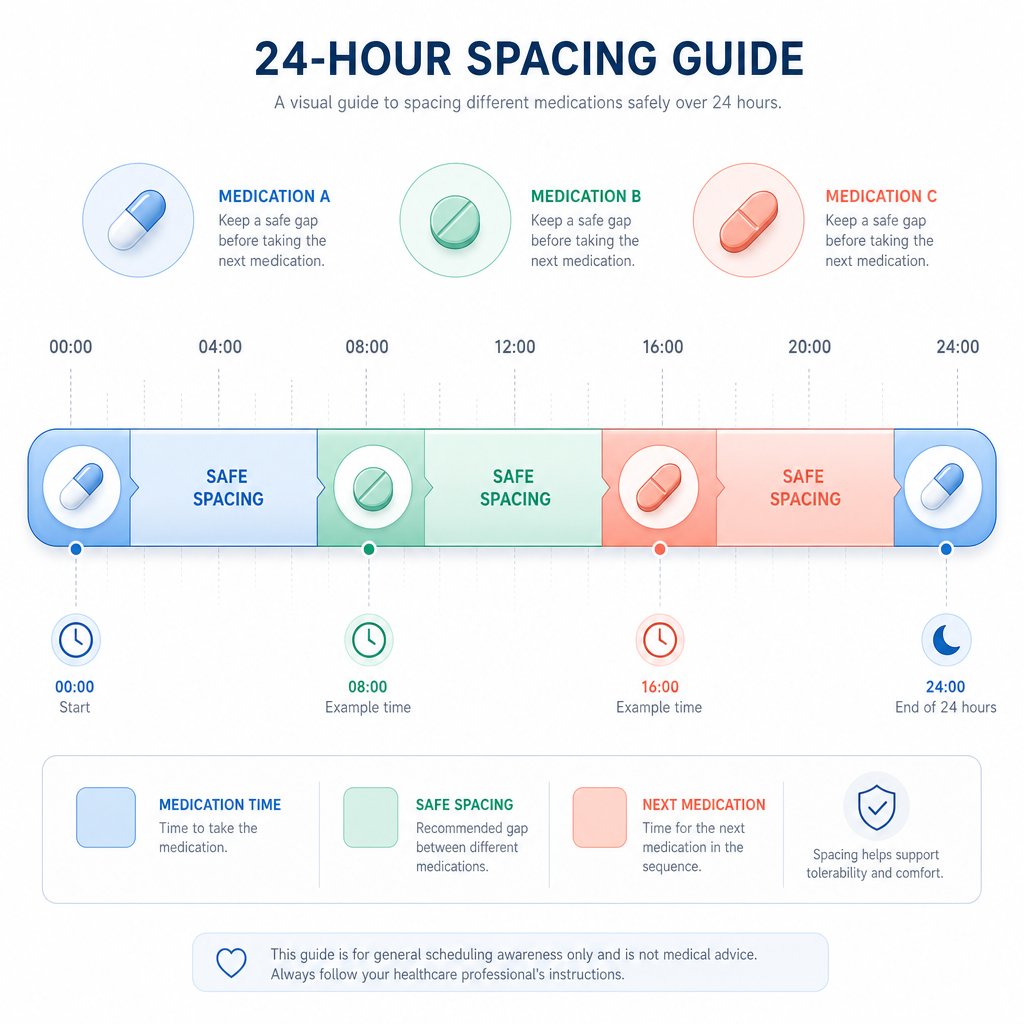
Choosing the right hour for your magnesium tablet gets more complicated when other pills share your daily routine. Magnesium is a divalent cation, meaning it readily binds to other compounds in the stomach. When it latches onto an antibiotic or thyroid hormone before either reaches the bloodstream, both substances lose effectiveness. The fix is simple: strategic spacing. But the specific gap depends on what you are pairing it with.
Spacing Magnesium Around Prescription Medications
Don't take magnesium with certain medications at the same time. The mineral can form insoluble complexes in your GI tract, blocking absorption of the drug, the magnesium, or both. Here are the most common conflicts and how to handle them:
- Tetracycline and fluoroquinolone antibiotics (doxycycline, ciprofloxacin, levofloxacin): Magnesium binds directly to these drugs in the stomach, reducing antibiotic absorption enough to compromise treatment. Take these antibiotics two hours before or four to six hours after any magnesium supplement. If you are wondering whether you can take magnesium with amoxicillin, the good news is that penicillin-class antibiotics like amoxicillin do not share this binding interaction, so simultaneous dosing is generally safe.
- Thyroid medications (levothyroxine, Armour Thyroid): These drugs require an acidic stomach environment for proper absorption. Magnesium can reduce stomach acid and form complexes that impair uptake. Space them at least four hours apart, and always take your thyroid medication first thing in the morning on an empty stomach as directed.
- Bisphosphonates (alendronate, risedronate, ibandronate): Used for osteoporosis, these medications are notoriously sensitive to mineral interference. Take magnesium at least two hours before or after your bisphosphonate. Some prescribing guidelines recommend waiting 30 to 60 minutes after the bisphosphonate before consuming any supplement or food.
- Proton pump inhibitors (omeprazole, pantoprazole, esomeprazole): This interaction works differently. PPIs do not bind to magnesium. Instead, long-term PPI use can impair your body's ability to absorb magnesium through the intestinal wall. A review in the World Journal of Gastroenterology documented cases of severe hypomagnesemia in patients on PPIs for more than one year, with symptoms including seizures, arrhythmias, and muscle spasms. If you take a PPI daily, ask your provider about monitoring magnesium levels rather than simply adjusting timing.
- Diuretics: Loop diuretics like furosemide and thiazides like hydrochlorothiazide can flush magnesium out through urine, potentially creating a deficiency over time. Potassium-sparing diuretics (spironolactone, amiloride) do the opposite, causing the body to retain magnesium and raising the risk of levels climbing too high. Coordinate with your prescriber to determine whether supplementation is appropriate and at what dose.
- Blood pressure medications (calcium channel blockers like amlodipine, verapamil, diltiazem): Magnesium acts as a natural calcium channel blocker. Combining it with prescription calcium channel blockers could theoretically cause blood pressure to drop too low. Your provider may recommend closer blood pressure monitoring rather than a strict timing gap.
Supplement Interactions and Co-factor Timing
Prescription drugs are not the only things competing for absorption. Other minerals in your supplement stack can interfere with magnesium uptake if you swallow them at the same moment.
The best time to take zinc is at least two hours apart from your magnesium dose. Zinc and magnesium compete for the same intestinal transport pathways, and high doses of zinc taken long-term can actually deplete magnesium stores. If you take a combined calcium magnesium and zinc formula, the doses are typically balanced to minimize competition, but standalone high-dose supplements of each mineral absorb better when separated.
Calcium and magnesium supplements follow the same logic. While it is safe to take them on the same day, spacing them by two hours gives each mineral uncontested access to shared absorption channels. A practical approach: calcium with breakfast, magnesium with dinner, or vice versa.
Vitamin D is the exception. It actually enhances magnesium absorption rather than competing with it. The best time to take magnesium and vitamin D is together, at the same meal. Magnesium is required to convert vitamin D into its active form, and vitamin D supports intestinal magnesium uptake in return. Pairing them is one of the few supplement combinations where simultaneous dosing is genuinely synergistic.
Iron supplements should be separated from magnesium by at least two hours. Large amounts of magnesium can reduce iron absorption, which matters if you are treating iron-deficiency anemia.
The table below consolidates these spacing rules into a quick-reference format you can check against your daily schedule.
| Medication / Supplement | Minimum Gap | Direction | Reason |
|---|---|---|---|
| Tetracyclines (doxycycline, minocycline) | 2 hrs before or 4-6 hrs after magnesium | Take antibiotic first | Magnesium binds antibiotic, reducing drug absorption |
| Fluoroquinolones (ciprofloxacin, levofloxacin) | 2 hrs before or 4-6 hrs after magnesium | Take antibiotic first | Same chelation mechanism as tetracyclines |
| Levothyroxine (thyroid) | 4 hours | Take thyroid med first (AM, empty stomach) | Magnesium reduces stomach acid needed for thyroid drug absorption |
| Bisphosphonates (alendronate, risedronate) | 2 hours | Take bisphosphonate first | Mineral interference reduces bone drug effectiveness |
| PPIs (omeprazole, pantoprazole) | No strict gap needed | N/A | Long-term PPI use impairs magnesium absorption systemically; monitor levels |
| Calcium channel blockers | Monitor BP; no fixed gap | N/A | Additive blood pressure lowering effect |
| Zinc (standalone high-dose) | 2 hours | Either direction | Competes for shared intestinal transporters |
| Calcium (standalone high-dose) | 2 hours | Either direction | Competes for absorption pathways |
| Vitamin D | 0 (take together) | Same time as magnesium | Synergistic: each enhances the other's absorption and activation |
| Iron | 2 hours | Either direction | Magnesium may reduce iron uptake |
A useful rule of thumb: if you take thyroid medication at 6:00 AM and a bisphosphonate or antibiotic at another fixed time, slot your magnesium into the widest open gap in your schedule, ideally with a meal. For most people juggling multiple medications, an evening magnesium dose with dinner creates the cleanest separation from morning prescriptions.
Spacing solves the interaction problem, but it raises a new question: what if your ideal timing window is too narrow to fit a full dose without GI discomfort? Splitting your daily magnesium into two smaller servings can solve both the interaction puzzle and the absorption ceiling issue at once.
Split Dosing and Missed Dose Strategies
Your body has an absorption ceiling for magnesium. The intestinal transporters responsible for pulling the mineral into your bloodstream become saturated at a certain threshold per dose, meaning a large single serving passes through partially unused. Smaller, divided doses keep those transporters working efficiently throughout the day. This is why magnesium supplements timing matters beyond just choosing morning or evening.
When and How to Split Your Daily Dose
Splitting makes practical sense in three situations:
- Your daily target exceeds 350 mg: If you take magnesium glycinate 400mg or magnesium glycinate 500mg per day, your gut absorbs a higher percentage when you divide that into two servings rather than swallowing it all at once. A dose above approximately 300 mg at a single time point increases the risk of a laxative effect because unabsorbed magnesium draws water into the intestinal lumen.
- You experience GI sensitivity: Cramping, bloating, or loose stools from a full dose often disappear when you split the same total amount across two meals.
- You need both morning and evening benefits: Someone managing daytime muscle fatigue and nighttime cramps can take 200 mg of malate with breakfast and 200 mg of glycinate before bed, covering both goals without overloading a single absorption window.
How much magnesium glycinate per day you actually need depends on your deficiency level, diet, and health goals, but most adults land between 300 and 400 mg of elemental magnesium. A clean split schedule looks like 200 mg with breakfast and 200 mg with dinner. This approach also creates natural spacing from morning medications, solving the interaction problem discussed earlier.
What to Do If You Miss a Dose
Life happens. You forget your evening tablet, or your morning routine gets disrupted. Here is how to handle it without overthinking:
- Taking it at a different time than usual: Perfectly fine. Magnesium builds steady intracellular levels over days and weeks. Shifting your dose by a few hours has no meaningful impact on long-term results.
- Doubling up the next day: Not recommended. A double dose increases the chance of diarrhea and does not accelerate replenishment. Your intestinal transporters can only process so much per sitting. Simply resume your normal schedule.
- Missing an entire day: One skipped day will not undo weeks of consistent intake. Your intracellular magnesium stores do not deplete overnight. Pick up where you left off without compensating.
The key principle: consistency over weeks matters far more than perfection on any single day.
How Long Until You Notice Results
How long does it take for magnesium to work? That depends on what you are measuring. Acute effects like muscle relaxation or mild drowsiness from glycinate can appear within 30 to 60 minutes of your first dose. But systemic benefits, like reduced anxiety, fewer cramps, or better sleep architecture, require one to four weeks of daily intake to stabilize intracellular levels.
If you are wondering how long for magnesium citrate to work for constipation, the answer is much faster: typically 30 minutes to 6 hours after a single dose. How fast does citrate of magnesium work depends on whether you take it with food (slower, gentler) or on an empty stomach (faster, stronger osmotic pull). When is the best time to take magnesium citrate for bowel regularity? Morning on an empty stomach delivers the quickest results, while an evening dose with a light snack produces a comfortable morning movement.
For new users, here is a week-one starter schedule that minimizes side effects while building toward your full dose:
- Days 1 - 3: Take half your target dose (e.g., 150 mg) with your largest meal. Note any GI effects like loose stools or cramping.
- Days 4 - 5: If tolerated, increase to three-quarters of your target dose. Keep pairing with food.
- Days 6 - 7: Move to your full daily dose. If GI discomfort returns, split into two servings (morning and evening) rather than reducing the total amount.
- Week 2 onward: Maintain your full dose at consistent times. Expect cumulative benefits like improved sleep quality and reduced muscle tension to emerge between weeks two and four.
Patience matters here. Magnesium replenishes intracellular stores gradually, and people with deeper deficiencies may need the full four weeks before noticing a clear shift. The temptation to increase the dose prematurely usually just produces GI symptoms without speeding up results.
Split dosing and a forgiving approach to missed days keep your magnesium routine sustainable. But sustainability also requires knowing which common beliefs about timing are actually wrong, because following a myth can quietly undermine an otherwise solid schedule.
Common Magnesium Timing Myths Debunked
Misinformation about magnesium timing circulates widely, and following the wrong advice can lead you to avoid a perfectly good schedule or create unnecessary GI problems. Below are five persistent myths, each followed by what the evidence actually shows.
Myths About Magnesium and Sleepiness
Myth 1: Magnesium always makes you sleepy, so you should take it at night.
Does magnesium make you sleepy regardless of form? No. The sedating reputation belongs primarily to glycinate and threonate, which influence GABA receptors and melatonin production. Forms like malate and oxide have no meaningful sedating effect. Magnesium malate actually supports ATP production, making it energizing rather than calming. A sleep medicine specialist at Rise Science notes that magnesium does not function like a traditional sleep aid that causes drowsiness. Instead, it promotes relaxation through neurotransmitter regulation, and only certain forms do this strongly enough to notice at bedtime. So does magnesium glycinate make you sleepy? It can promote readiness for sleep, but oxide or malate taken in the morning will not leave you fighting to stay awake at your desk.
Myth 4: You cannot take magnesium in the morning if you want sleep benefits.
Can you take magnesium in the morning and still sleep better at night? Yes. Many of magnesium's sleep benefits are cumulative, not acute. A meta-analysis of 48 randomized controlled trials found that serum magnesium concentrations respond gradually to supplementation, reaching steady state after approximately 20 weeks of consistent intake. This means your intracellular magnesium stores build over time regardless of the hour you dose. Can i take magnesium glycinate in the morning and still get calming benefits? Absolutely, though you will miss the acute pre-bed relaxation window. For people whose schedules make evening dosing unreliable, a consistent morning dose still improves long-term sleep architecture through steady-state replenishment.
Myths About Empty Stomach Absorption
Myth 2: You must take magnesium on an empty stomach for best absorption.
Should magnesium be taken on an empty stomach? For most forms, no. Taking magnesium with food slows gastric transit, giving the small intestine more contact time with the mineral. Food also buffers the osmotic effect that causes loose stools. Can magnesium cause diarrhea? It certainly can, especially oxide and citrate on an empty stomach, because unabsorbed magnesium draws water into the intestinal lumen. Registered dietitians recommend pairing magnesium oxide, chloride, and citrate with meals specifically to reduce digestive side effects. Some forms like glycinate and threonate are gentler and tolerate an empty stomach, but even these absorb well with food. The myth likely originated from confusion with other supplements like iron, which genuinely absorbs better without food competition.
Why Consistency Beats Perfect Timing
Myth 3: The exact time you take magnesium matters more than taking it consistently.
Should you take magnesium at night at exactly 9:00 PM every single evening? The precision is unnecessary. Whether you take magnesium in the morning or at night, what matters most is that you take it daily. Steady-state serum levels depend on weeks of consistent intake, not whether your dose lands at 8:00 PM versus 10:30 PM. Shifting your timing by an hour or two based on your evening schedule has no measurable impact on long-term outcomes like bone density, blood pressure, or deficiency correction.
Myth 5: All magnesium tablets work the same way, so timing does not matter by product.
A standard compressed tablet dissolves more slowly than a capsule or powder, which means its active magnesium reaches your intestinal lining on a different timeline. Two people taking the same dose of magnesium at the same hour can experience different absorption curves simply because one swallowed a tablet and the other mixed a powder into water. Delivery format shapes dissolution speed, and dissolution speed shapes how quickly you feel the effect. This distinction matters most for acute goals like pre-bed relaxation, where a slow-dissolving tablet taken 20 minutes before sleep may not release its contents in time.
These myths share a common thread: they treat magnesium as a single, uniform substance when it is actually a family of compounds delivered in different formats. Understanding how those formats dissolve and absorb brings the final piece of the timing puzzle into focus.

How Tablet Format Affects Your Timing Strategy
You have picked your magnesium form, matched it to a health goal, and identified the right time window. But there is one more variable that quietly shapes whether your timing strategy actually delivers: the physical format of the product you swallow. A compressed tablet, a hard capsule, a scoop of powder, and a liquid magnesium shot all contain the same mineral, yet they reach your intestinal lining on very different schedules. That gap between ingestion and absorption is where timing plans succeed or fail.
How Delivery Format Affects Absorption Speed
When you take a magnesium tablet, the compressed matrix must first disintegrate in stomach acid, then dissolve into free ions before absorption can begin. Research using the USP paddle dissolution method found that release rates among 15 commercial magnesium products ranged from immediate (over 80% released within 10 minutes) to slow-release (more than 120 minutes to reach 80% dissolution). That is a two-hour difference in how quickly the mineral becomes available, driven entirely by the physical format and excipients used in manufacturing.
Here is how each format stacks up in terms of dissolution speed:
- Tablets: Compressed powder bound with excipients. Dissolution depends heavily on formulation. Some tablets release magnesium within 10 minutes in acid medium, while others take over 60 minutes. Slow-dissolving tablets pair well with meals because food extends gastric residence time, giving the tablet more opportunity to break down.
- Hard capsules: The gelatin or HPMC shell dissolves within 5 to 10 minutes in stomach acid, exposing the powder fill directly to digestive fluids. This gives hard capsules a slight speed advantage over many compressed tablets.
- Soft capsules (softgels): Typically used for oil-based or liquid-fill magnesium formulations. The soft shell ruptures quickly, and the liquid interior disperses faster than dry powder, making absorption onset relatively rapid.
- Powder and granules: No shell or compression matrix to break down. Once mixed with water, the magnesium is already in a dissolved or semi-dissolved state before it even reaches your stomach. This makes magnesium malate powder or citrate powder among the fastest-absorbing options available.
- Gummy candy: Palatable and easy to chew, but the sugar matrix and gelling agents slow dissolution slightly. Gummies also tend to contain less elemental magnesium per serving because the gummy base takes up volume, meaning you may need two to three pieces to match a single tablet dose.
- Oral liquid: The fastest route to absorption. Liquid magnesium citrate and other liquid formulations skip the dissolution step entirely. The mineral is already in ionic or chelated solution, ready for intestinal uptake the moment it leaves the stomach.
The nutraceutical industry increasingly recognizes that how nutrients are delivered may be just as important as what is being delivered. Delivery format is no longer a secondary consideration. It directly shapes whether your timing strategy produces the effect you planned for.
Matching Your Format to Your Timing Strategy
Think about what your timing goal actually requires. If you want rapid pre-bed relaxation, you need the magnesium to reach your bloodstream within 30 to 45 minutes. A slow-dissolving tablet taken 20 minutes before sleep may still be sitting in your stomach when you want to be drifting off. A magnesium drink mixed from powder or a liquid formulation, on the other hand, can begin absorption almost immediately.
Conversely, if you want sustained overnight support for muscle cramps or restless legs, a slower-dissolving tablet taken with dinner provides a more gradual release that extends into the early hours of sleep. The best time to take magnesium tablets in this scenario is 60 to 90 minutes before bed, with food, giving the tablet enough lead time to dissolve and begin working.
When to take magnesium pills also depends on your GI tolerance. Powders and liquids hit the intestinal wall faster and in higher local concentrations, which can trigger loose stools in sensitive individuals. Tablets and capsules spread that exposure over a longer window, reducing osmotic stress. If you have tried liquid magnesium citrate and found it too aggressive, switching to a tablet form of the same compound and taking it with a meal often solves the problem without changing your timing.
The table below maps each delivery format to its ideal timing use case.
| Format | Dissolution Speed | Best Timing Strategy | Ideal For | Considerations |
|---|---|---|---|---|
| Tablets | Moderate to slow (10 - 120 min) | 60 - 90 min before target effect; pair with meals | Sustained overnight release, general daily supplementation | Dissolution varies widely by manufacturer; check for immediate-release vs. slow-release labeling |
| Hard capsules | Fast (5 - 15 min shell dissolution) | 30 - 60 min before target effect | Pre-bed relaxation, flexible scheduling | Slightly faster than tablets; easy to split dose across AM/PM |
| Soft capsules (softgels) | Fast (liquid fill disperses quickly) | 30 - 45 min before target effect | Rapid absorption goals, fat-soluble co-factors | Good for oil-based formulations; may contain fewer format options for magnesium salts |
| Powder / Granules | Very fast (pre-dissolved in water) | 20 - 30 min before target effect; flexible split dosing | Quick pre-bed calm, precise dose adjustments, split schedules | Magnesium malate powder and citrate powder offer fastest onset; taste may require flavoring |
| Gummy | Moderate (sugar matrix slows release) | 45 - 60 min before target effect | Compliance-focused users, mild daily supplementation | Lower elemental magnesium per piece; may need 2-3 gummies to match one tablet dose |
| Oral liquid | Immediate (already in solution) | 15 - 30 min before target effect | Fastest absorption, acute needs, people who cannot swallow pills | Liquid magnesium citrate is widely available; refrigeration may be required; stronger laxative effect at high doses |
The best time to take magnesium pills is not just about the clock. It is about giving your chosen format enough lead time to dissolve, absorb, and produce the effect you are after. A powder user and a tablet user aiming for the same 10:30 PM sleep onset should set different alarms: the powder user can mix a magnesium drink at 10:00 PM, while the tablet user should take theirs closer to 9:00 PM with a snack.
For supplement brand owners and private label sellers, this format-timing connection creates a product development opportunity. Offering multiple delivery formats, each positioned around a specific timing use case, lets customers self-select based on their routine. Manufacturers like ZhuFeng provide OEM/ODM services across hard capsules, tablets, powder/granules, soft capsules, gummy candy, and oral liquids, enabling brands to build timing-optimized product lines from a single manufacturing partner. A "PM Relaxation" powder and an "AM Energy" tablet can come from the same production facility with customized formulations tailored to each window.
Format determines how quickly your magnesium reaches the finish line. But choosing the right format still requires knowing your starting point: your goal, your form, your medications, and your tolerance. The next section ties all of these threads into a single decision framework you can walk through in under two minutes.
Building Your Personalized Magnesium Schedule
You have the science. You know which forms suit which goals, how to space around medications, and why format matters. What time of the day should you take magnesium given your specific situation? The answer lives at the intersection of four personal variables. Walk through the decision framework below, and you will land on a concrete timing recommendation in under two minutes.
Your Personal Timing Decision Framework
Answer these questions in order. Each answer narrows your options until a single timing window emerges.
- What is your primary health goal? Sleep and relaxation point toward evening. Energy, exercise performance, and constipation relief point toward morning. Anxiety management depends on when symptoms peak. Cumulative goals like bone health or blood pressure allow any consistent time.
- What form of magnesium are you taking? Glycinate and threonate align with evening. Malate fits morning. Citrate and taurate flex either direction based on your answer to question one. Oxide pairs best with a morning meal.
- Do you take other medications or supplements? If you take thyroid medication, antibiotics, or bisphosphonates in the morning, shift magnesium to evening to create a four-to-six-hour gap. If you take calcium or zinc, space them two hours from your magnesium dose. Vitamin D can go with magnesium at the same meal.
- Do you experience GI sensitivity? If yes, always pair with food and consider splitting into two smaller doses. If a single evening dose causes overnight bathroom trips, move half to morning.
When is the best time to take magnesium supplements for most people? The table below maps common answer combinations to specific timing recommendations so you can find your match quickly.
| Primary Goal | Form | Medications to Space? | GI Sensitive? | Recommended Timing |
|---|---|---|---|---|
| Sleep | Glycinate or Threonate | No | No | 30 - 60 min before bed, light snack |
| Sleep | Glycinate | Yes (morning meds) | Yes | With dinner + small second dose 30 min before bed |
| Energy / Exercise | Malate | No | No | With breakfast or 30 min pre-workout |
| Energy / Exercise | Malate | Yes (morning meds) | Yes | Mid-morning snack, 2+ hrs after medication |
| Anxiety (daytime) | Glycinate or Taurate | No | No | With breakfast |
| Anxiety (all-day) | Glycinate or Taurate | Yes | Yes | Split: lunch + dinner, 2+ hrs from meds |
| Constipation | Citrate or Oxide | No | No | Morning, empty stomach with full glass of water |
| Constipation | Citrate | Yes | Yes | Evening with light snack; results by morning |
| General deficiency | Any bioavailable form | No | No | Any consistent time with a meal |
| General deficiency | Citrate or Glycinate | Yes | Yes | Split AM/PM with meals, spaced from meds |
What time of day is best to take magnesium if none of these combinations match your exact situation? Default to the simplest rule: take it with your largest meal at whatever hour you are most likely to remember daily. Consistency builds steady intracellular levels over weeks, and that foundation matters more than landing on a theoretically perfect minute.
Week-One Starter Schedule for New Users
If you are just beginning magnesium supplementation, jumping straight to a full dose invites unnecessary GI discomfort. This graduated protocol lets your gut adapt while you fine-tune your timing preference:
- Day 1: Take half your target dose with your largest meal. Note the time and any digestive response over the next 6 hours.
- Days 2 - 3: Continue at half dose, same meal. If no cramping or loose stools appear, your GI tract is tolerating the form well.
- Days 4 - 5: Increase to three-quarters of your target dose. If you notice mild GI effects, split the dose across two meals rather than reducing the total.
- Days 6 - 7: Move to your full daily dose at your chosen time. Evaluate how you feel: are you sleeping better, waking more refreshed, or noticing fewer cramps? If the timing feels off, shift by 30 to 60 minutes and observe for another three days.
- Week 2 onward: Lock in your schedule. Expect cumulative benefits like improved sleep architecture, reduced muscle tension, and steadier mood to emerge between weeks two and four.
What is the best time to take magnesium is ultimately a question only your body can answer with certainty. The framework above gets you 90% of the way there. The final 10% comes from paying attention during that first week and making small adjustments based on real feedback rather than rigid rules.
What is the best time of day to take magnesium for you will likely differ from what works for someone else, even if you share the same health goal. That is normal. Treat the first week as a short personal experiment, not a prescription carved in stone. The best time to take magnesium supplement is the time you will actually take it, day after day, without fail.
For supplement brands looking to translate this timing science into product strategy, the opportunity is clear. Positioning magnesium products around specific use-case windows, a "PM Magnesium Glycinate" for sleep or a "Morning Energy Magnesium Malate" for daytime vitality, helps consumers self-select the right product without guesswork. Partnering with a full-service OEM/ODM manufacturer like ZhuFeng enables customized formulations across multiple delivery formats with scalable production, so brands can offer an entire timing-optimized line from a single manufacturing partner. Whether the end product is a fast-dissolving powder sachet for bedtime or a sustained-release tablet for morning routines, flexible manufacturing turns timing research into market-ready differentiation.
Frequently Asked Questions About Magnesium Timing
1. Should I take magnesium in the morning or at night?
It depends on your form and goal. Magnesium glycinate and threonate work best 30-60 minutes before bed for sleep and relaxation support. Magnesium malate suits morning dosing because malic acid supports ATP energy production. Citrate is flexible and can be taken at either time depending on whether you want constipation relief in the morning or calming effects at night. Pairing any form with a meal reduces GI side effects regardless of timing.
2. Can I take magnesium on an empty stomach?
You can, but it is not ideal for most forms. Taking magnesium without food increases the risk of cramping, nausea, and diarrhea, especially with oxide and citrate. Food slows gastric transit and gives your small intestine more contact time with the mineral, improving absorption. The exception is when you intentionally want a faster laxative effect from citrate or oxide for constipation relief. Gentler forms like glycinate tolerate an empty stomach better but still absorb well with food.
3. How long does it take for magnesium supplements to work?
Acute effects like muscle relaxation or mild drowsiness from glycinate can appear within 30-60 minutes of a single dose. For constipation, magnesium citrate typically works within 30 minutes to 6 hours. However, systemic benefits such as reduced anxiety, fewer muscle cramps, and improved sleep architecture require 1-4 weeks of consistent daily intake to build stable intracellular magnesium levels. People with deeper deficiencies may need the full four weeks before noticing meaningful changes.
4. Can I take magnesium with other vitamins and medications?
Magnesium pairs well with vitamin D since they enhance each other's absorption and activation. However, space magnesium at least 2 hours from calcium, zinc, and iron supplements because they compete for the same intestinal transporters. For medications, keep a 4-hour gap from thyroid drugs like levothyroxine, a 2-6 hour gap from tetracycline and fluoroquinolone antibiotics, and a 2-hour gap from bisphosphonates. Always take prescription medications as directed and consult your provider about specific interactions.
5. Is it better to split my magnesium dose or take it all at once?
Splitting is better when your daily target exceeds 350 mg, when you experience GI discomfort from a single dose, or when you need benefits at different times of day. Your intestinal transporters absorb magnesium more efficiently in smaller amounts, so two 200 mg doses typically deliver more usable mineral than one 400 mg dose. A practical split schedule pairs 200 mg with breakfast and 200 mg with dinner, which also creates natural spacing from morning medications.